- Phonics
How to Teach a Phonics Lesson
A Step-by-Step Video Guide for Daily Routines
Welcome!
Hi, I'm Carla Stanford, a veteran teacher and trainer here to help you deliver YOUR best research-based phonics instruction. You know the skills your students need. I'll show you how to deliver the strategies for each step of the lesson.

Hide Video Transcript
Show Video Transcript
Carla Stanford: Hi, I am Carla Stanford, and I work for Reading Universe. I'm the director of instructional design. I'm here to talk about a phonics lesson. When I was teaching and I was learning how to teach kids how to read, I learned the what to teach, and I learned the why to teach it, but I did not know the how and how is the missing piece that I needed in order to take that knowledge and make sure that my kids, my first graders learned how to read. So I'm going to walk you through a phonics lesson and share the what and the why and the how of each part of the phonics lesson so you can understand how they build on each other to ensure at the end of the lesson that your students are becoming proficient readers.
Narrator: Reading Universe is made possible by generous support from Jim and Donna Barksdale; the Hastings/Quillin Fund, an advised fund of the Silicon Valley Community Foundation; the AFT; the Emily Hall Tremaine Foundation; and anonymous donors.
Let's get started!

At Reading Universe we use an evidence-based approach popularly known as structured literacy. Structured literacy is a way of organizing and delivering reading instruction to ensure students get all the skills they need in an efficient timeframe — and without any gaps. We recommend a daily checklist for phonics lesson routines.

Hide Video Transcript
Show Video Transcript
Carla Stanford: We are going to start with a listening game. A listening game is where you ask kids to pull out their listening ears and put them on, and you are going to help them hone in on the ability to hear sounds that they're going to need in order to do the work in the lesson. In a listening game, you can use tools. The tools help kids connect what they're hearing to the position that they're hearing it in a word that you're giving them. So you can use a roller coaster, you can use Elkonin boxes or sound boxes, or you can use tapping. So the roller coaster is really great when you want kids to hear beginning, middle, and ending sounds. So a roller coaster works like this. Kids move their hand like a roller coaster, and they can say a word. So my word is cat, and they can think about the /k/ and the /ă/ and the /t/, so they can say cat, and then they can isolate different sounds.
This rollercoaster motion is really great for them to make. It helps them be actively engaged and it helps give a position. So if I say the word is cat, and the kids repeat cat, and they take their hand and make the rollercoaster, they say /k/, /ă/, /t/, and then you could say, give me the beginning sound. And you could point to that space on the rollercoaster, and they could say /k/. So it's really great to give them this physical reminder of where the sound would be.
You can also use Elkonin boxes, and those are just sound boxes. Basically, it's just boxes and you have kids push the sound and you can model on the board, and they can just use their fingers and push in the air. They could use an Elkonin box, and it helps them represent the sounds with a physical action. So if my word is stop. Repeat, stop. They could push /s/, /t/, /ŏ/, /p/. Stop.
Also tapping. Tapping is the easiest because they also can use it in dictation and tapping is just where they use their fingers to represent sounds. As a teacher, I'm always going to go left to right. It does not matter how the kids do the work, but these are all tools that you can use in the listening game to ensure that when you are asking kids to listen for a sound, that they have a way to connect it.
So I'm going to give some examples. So if I were going to teach the digraph 'sh', which says /sh/, then I could use my rollercoaster and I could say, "All right, boys and girls, we're going to use our rollercoaster. I'm going to say the word. You are going to repeat the word, we're going to use our rollercoaster, and I'm going to ask you to give me this first sound that's going to be right here. Get ready. My word is shop. Repeat. Shop. /sh/, /ŏ/, /p/. This sound." And they'd say, /sh/. And I'd say, "good job. Next word. My word is shell. Repeat. Shell. /sh/, /ĕ/, /l/. Shell. This sound. /sh/."
So the rollercoaster gives you an opportunity, a space. The rollercoaster gives you a space and a way to quickly show kids the sound they're looking for and listening for. In the listening game, you're always going to plan your work based on where you're going. So I'm going to use the '-ck' rule as an example for that. In the '-ck' rule, it is so important that kids are able to hear short vowels because in the '-ck' rule. The rule goes like this: "Immediately after a short vowel at the end of a one syllable word, when you hear /k/ you spell it, '-ck', hooray!" And so in order for kids to spell using the '-ck' rule, they have to be able to hear short vowels.
So I back that up and I go, "Oh my goodness. In my listening game, I need my kids to be able to hear short vowels." So my directions would go like this. "Hey, boys and girls, pull out your listening ears. Put 'em on. Here's what I want you to listen for today. I want you to listen for the vowel sound in the word. We're going to use our rollercoaster, and when we get here, that is going to be our vowel sound. I'll say the word, you repeat the word, we'll do the rollercoaster and we'll give the sound. Here we go. Our first word is rock. Repeat. Rock. /r/, /ŏ/, k/. Sound /ŏ/. Good. Our next word is luck. Repeat. Luck. /l/, /ŭ/, /k/. /ŭ/."
And what happens is, if you are using a tool, you can just give the motion for this middle sound. You're taking your voice out of it, and the kids can think quickly and they're not having to parse apart the sound they heard from weird directions. They can just say the vowel sound and you can move on. And you can get through a large amount of words for practice in a very short amount of time. Because remember, the listening game is all about setting kids up to be able to hear what they have to be able to hear in order to do the work in the phonics lesson.
Narrator: Reading Universe is made possible by generous support from Jim and Donna Barksdale; the Hastings/Quillin Fund, an advised fund of the Silicon Valley Community Foundation; the AFT; the Emily Hall Tremaine Foundation; and anonymous donors.
Hide Video Transcript
Show Video Transcript
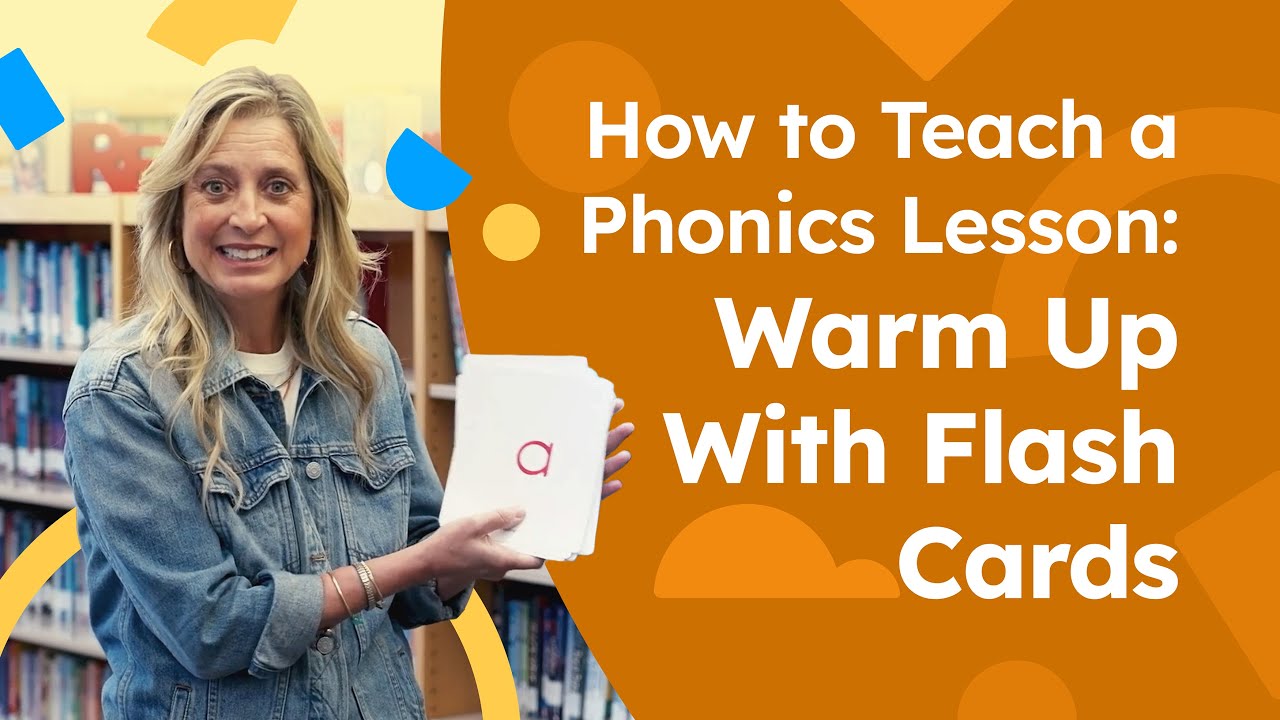
Carla Stanford: So now we're going to talk about warm up with flashcards. The warm up with flashcards is a really important part of the lesson plan. However, it's really short. It doesn't last very long, and everything that happens in it is super intentional. And as the teacher, I'm making all the decisions about what's going to go in this warm up with flashcards. So let's start with talking about the purpose of a flashcard. The purpose of a flashcard is to teach kids that when they see a letter, the letter has a name and the letter has a sound. And in order to get to spelling and reading, kids need to be able to have this sound-letter correspondence is what we call it. And it needs to be accurate and it needs to be quick. And this accuracy and this quickness, we pull it together and we call it automaticity. So the purpose of this work is to develop this ability.
When kids see this letter, they can automatically with automaticity, recall the sound. Now, in order to get from seeing the letter and automatically giving the sound, there has to be teaching involved. And there is direct explicit instruction that happens with that. But the deck is a place to practice that. It's all about practice. So when I'm planning my deck, I have two decisions to make. I need to decide what I'm going to put in my deck, and then I need to decide how the card is going to be read with the kids. And that sounds like a lot, but eventually it becomes like this automatic thing that happens. You flip through your cards, you make your decisions, and then you know exactly how you're going to have your kids read the cards. So remember, the deck is short. It's very intentional. You're driving the bus.
Everything that goes in your deck is chosen based on what kids need because you have assessed them informatively. You know what they need and based on what they need to do the job at hand in the lesson today. Now I'm going to talk you through the choices that I made to teach the '-ck' spelling rule. So I would have my short vowels because kids have to have a really great grasp of short vowel sounds. I would also put 'c' and 'k' because those are two ways that they know how to spell the /k/ sound already. And today we're going to add a third with the '-ck' rule. And I would also have my digraphs in there as a review because that is what has just been covered. So it's nice practice to ensure that they're holding onto that new concept. So let's talk about how you move through a deck.
First of all, when you have a keyword picture card, you can go through the card like this. You say the name of the letter, you give the keyword picture, you give the sound, and you can make a motion if the motion is helpful. The motion is really nice because you can hold onto that motion during dictation and you can make the motion and kids will get the sound quickly. So it ends up being a nice reminder of sounds as you're moving through the lesson. So this would sound like 'a', apple, and you would pretend like you're biting an apple. And kids love that. It gets their kinesthetic part of their learning involved and they get to participate. So we go 'a', apple, /ă/. And what happens is once kids know this, you can have them just say 'a', /ă/, and then eventually you can just have them say the sound, /ă/.
If I were going to do this deck, I would go through it like this, 'a', apple, /ă/. 'O', octopus, /ŏ/. 'E', edge, /ĕ/. And I would be listening to my kids and making sure that they were articulating the sound correctly. And if I hear anything that feels like maybe it's a little off, I would say, wait a minute, listen to me. I'm going to model. And I would say, 'e, "edge," /ĕ/. Your turn. And they would echo me because in this moment I'm listening and I'm teaching quickly to clear up any issues with the way sounds are pronounced. 'I', "igloo," /ĭ/. 'U', "umbrella," /ŭ/.
'Th', "thumb," /th/. Now this 'th' is a digraph that we would be reviewing. And it has two sounds. It has a motor off sound, which is /th/ like in "thumb," and it has a motor on sound like in mother. So I would say 'th', thumb, /th/. and /TH/. This is also a tricky sound. It sounds just like 'w'. 'Wh', whistle, /wh/. 'Ch', chair, /ch/. 'Sh', shoe, /sh/. And then I would say, that was amazing. Now friends, I think that you are ready to do the rest of this deck with no pictures. I'm going to hold up the card and I just want the sound. And I would have them go through these.
/ĕ/. /ŭ/. /ŏ/. And then I would probably say, because I can't let this moment go, Hey friends, look at these. And I would spread these guys apart. And I would say, tell me what kinds of letters are these. And they would say, vowels. And I'd say, you are so amazing. And just did the short vowel sounds. Last part of our deck. Sound /k/. Sound /k/. Oh my goodness, you guys are so brilliant. You know two ways to spell the /k/ sound. Guess what? Today you might learn another way and I would give them a little hint into what was to come. And so the deck just serves as a nice way to practice, to listen, and set the stage for what is coming next — building automaticity with sound-ltter correspondence.
Narrator: Reading Universe is made possible by generous support from Jim and Donna Barksdale, the Hastings/Quillen Fund, an advised fund of the Silicon Valley Community Foundation, the AFT, the Emily Hall Tremaine Foundation, and anonymous donors.

Hide Video Transcript
Show Video Transcript
Carla Stanford: So in this part of the lesson, which is like the new or review part, this is where you directly teach your children the phonics pattern or the phonics rule. So here we're going to talk about the direct instruction that happens in the lesson. And this is really important because one feature or characteristic of structured literacy is that instruction is direct and that it is systematic. It is cumulative, meaning it's scoops up everything that has been taught before, interacts with what's been taught before, so kids can take it and use it. And that it's diagnostic. This part of the lesson needs to be really tight. Any participation that I have kids doing, I've thought through that we can accordingly respond, that we can move through it. So we can actually get to the part of the lesson where they are doing the work. Where they have pencil to paper.
So I'm going to use the '-ck' rule as an example of how you could do this direct instruction with children while letting them participate using the information they already know about the way words work. When teaching kids directly about a new phonics pattern, we have to be really intentional about how we teach. In this rule, with '-ck', they have to know short vowels, they need to know closed syllables. And then all of the examples that were chosen for our work on the board really are easy for kids to look through and tap and read. So I would look at the board and I would say to my children, Hey guys, I want you to take a look right here. Reach into your pocket. Pull out your word detective goggles, and take a look. And I want you to look at these words and tell me what you notice.
They will say things like, oh my goodness, I notice that all the words end with a 'k'. And I would say, oh my goodness, you're so smart. Look, I'm going to underline all the 'k's. Looking all the way through. And at the end, they all would end with a 'k', and then someone else would go, oh my goodness, they also have a 'c'. And I'll say, oh, look. And we'll underline. We're acknowledging all their good, noticing, their word detective skills that they have. And then we'll talk about, oh my goodness, together, this is the '-ck'. And they are very excited. They've used their good noticing. And I say, look at these words. What else do you notice? I've done this enough times. And I'll tell you, they always say, oh my goodness, they all have a vowel. So we look here, and we can even call it 'v' for vowel if we wanted to.
Look, you are so right! All of our words have vowels. You are such good word detectives. And if they didn't get this part, I could give them a little hint. I could say, I want you to look at your vowel. Do you notice that it is closed in? And immediately they're going to say, oh my goodness, it is a closed syllable. If the syllable is closed, then the vowel will be short. So we can mark all our vowel short. So this would say, /ĕ/. This would say, /ĭ/. This would say, /ŭ/. This would say, /ă/. This would say, /ŏ/. This would say, /ĭ/. And I would say, you guys have been the most amazing word detectives, and you have figured out this rule that we can use for spelling and reading. And then at this point, I would teach them the rule, but they did all the detective work that got them here where they can see, I know what I need to have to move forward with this rule.
So immediately after a short vowel, at the end of a one syllable word, when you hear /k/ you spell it '-ck', hooray! And that's the rule. Of course, with the kids, I would take more time. We would practice it. They would love it. They would stand up and they would do the cheer. And the cheer is really just this opportunity to connect what they just verbalized and what we just talked about to the rule. So they're making this connection. So I want this chant to help them as they're spelling. And then as soon as they don't need it anymore, we'll take the chant away so that they're just automatically doing the work of spelling words. So from there, I would quickly say, all right, friends, now that you have learned that we have got to add this to our deck. So I could say, alright, here is our '-ck' flashcard that we're going to learn.
And if you look right here, it has a dash. And the dash reminds you that '-ck' can only go after a short vowel at the end of a one syllable word. So we could read it like the '-ck', duck, /k/. And then I would have them read it. And that is going to now be our flashcard that we'll have in our deck. And when we do our flashcard, for days to come, we can say '-ck', duck, /k/. And then the kids can quickly practice the chant. And then the chant can get shortened to immediately '-ck', hurray! Or eventually it just says '-ck' hurray. And they will say it as they're spelling, and it's a nice reminder. So the chant kind of starts really big and has all the words in it, and we go all the way through it. But eventually it's a scaffold that we take away the pieces of until the kids no longer need it. That is how we would teach the '-ck' rule directly and explicitly to our children to get them ready to do the work of reading and spelling the words.
Narrator: Reading Universe is made possible by generous support from Jim and Donna Barksdale; the Hastings/Quillen Fund, an advised fund of the Silicon Valley Community Foundation, the AFT; the Emily Hall Tremaine Foundation; and anonymous donors.

Hide Video Transcript
Show Video Transcript
Carla Stanford: This is the most magical part of the lesson is the dictation. We are going to start with sound dictation. In sound dictation it's very intentional that kids are being given the opportunity to hear a sound, think about the sound, think about how that sound is spelled, and then write the sound. And it's done in isolation. And thinking about if we give kids the opportunity to do the work in isolation, then when they move to the next part of dictation, they are really ready to go because they've had that practice. So I like to say, "Dictation every day!" That is how I was taught. The dictation every day. Kids are taking their pencil and they are putting it to the paper and they are really doing the work. In this part of the work, there's a lot of interaction back and forth, back and forth, and it's all about the work. It is not about how correct work is. So there's going to be this class community of, "We're all in this together. We are learning something new together. We're going to do the hard work. But guess what? When we learn something new, we make mistakes. And mistakes are good food. Mistakes are how we get better." So as we're doing this work, you can actually model a mistake on the board — I'll talk through that — and give your kids the grace to lean into their mistakes and say, "Okay, I messed up, but that's okay. Next time I am going to be able to get that sound-letter correspondence."
So sound dictation is the part of the lesson that leads into word dictation. I'm going to use '-ck' as an example. And when you're thinking about '-ck', you go back to what is it that kids have to have in order to do the work. First of all, they need to be able to hear short vowels. So one of the things we could do is we could have kids listen for short vowels and write the short vowels. That is an option. Another thing we could do is have kids listen for the /k/ sound at the end of words, and then actually spell the sound /k/ after a short vowel at the end of a one syllable word with a '-ck' because that is going to be the first time for some of them, that they've ever actually put the two letters together representing one sound. Dictation is very magical. And one of the parts that makes it so magical is when we use the same paper every day with kids. So the kids know how to enter the work because every day you have given them a piece of paper where they're like, oh my goodness, I know where to write the sounds. So if I know where to write the sounds, then all my cognitive energy can be spent on doing the job at hand. And for this job today, it's going to be spelling the /k/ sound after short vowel at the end of a one syllable word.
So this is what it could look like. Everyone would have their paper, everyone would have their pencils. I would have the board set up. We know that every day we're going to do sound dictation and it's going to lead us into our words. So I'd say, "All right, friends, now I'm going to say a word. You are going to repeat the word. We're going to tap it. And when we get to that end, we're going to repeat it, and then we're going to spell just that last sound. Get ready. Here we go. My word is sock. Repeat. Sock. Tappers up. /s/, /ŏ/, /k/, sock. The sound /k/. Oh, goodness. Wait. /s/, /ŏ/ ... Short vowel. /s/, /ŏ/, /k/. One syllable. How are we going to spell the /k/? We're going to spell it with a 'ck', hooray! So everyone on your paper right now, let's write it." And so all together, we are writing. They are writing. I am writing. I am modeling. C-K, /k/. And as they're writing, I can walk around and look and check in and give them the "good job. You guys got it." If someone flipped it, and it will happen, then we can model. "Oh my goodness. It's your first time that you've ever written this as 'ck' hooray. That comes after a short vowel at the end of a one syllable word. It's okay. Let's give it a hug." So we're going to give it a hug. That means we're going to put a parentheses around it and we're just going to correct it right above it because mistakes are good food. And when we're learning something new, we're going to make mistakes and it helps us get better. So then above it, they could write C-K, /k/. Next one. And we would do it again. "All right, next word. My word is lick. Repeat. Lick. Tappers up. /l/, /ĭ/, /k/, lick. Okay, let's go through it. /l/, /ĭ/ ... /ĭ/ ... Is that a short vowel? Yes. /l/, /ĭ/, /k/. Is that one syllable? One talking vowel? Yes. So how are we going to spell that /k/ sound? 'ck, hooray! And we could write C-K. Hooray! Everyone check your work." And you walk around and you look and you encourage, and you have them check their work up here. And then you can do it one more time. Another word. You walk through the process, you spell together 'ck'. This is not a test or a trick. We're all in this together. We get it on the board. Now, we always read back what we wrote because we really want to always partner the spelling with the reading. The encoding with the decoding. So we would come here and we're going to read it back together. And I would say, "Okay, friends, you can read your paper or you can read with me on the board, but we're going to read together. One, two, ready, go. /k/, /k/, /k/. And that is what sound dictation looks like on day one of something.
Now let's talk about the words that I chose for the sound dictation. Here I chose only words that model the '-ck' rule because that's what we're practicing and we're keeping the super tight. We need kids to listen for short vowels. We need for them to have practice reading short vowels in their deck. We need for them to have learned the rule together, combining the knowledge they already knew to learn this new way to spell /k/. And now they're getting to just spell that last part. And so every word we're going to choose is going to give them an opportunity to practice so that the word choice is very intentional and it's not random. And it's all to support the new learning of the '-ck' rule. If this were day two, day three, I could maybe include the vowel in the '-ck' for what they are writing in sound dictation. Maybe again, I just give them the /k/ sound and they write 'ck'. Here's another fun thing to do. I could say, "Friends ..." I love this. This is really great metacognitive work and say, "Friends, today, you guys are so brilliant and I know you're ready for this. I'm going to give you a sound and I want you to give me all three ways that you know how to spell it. So get ready. My sound is /k/. Repeat. /k/." And here I would walk around and check in with them and they would say, "Oh my goodness, I know this for /k/. I know this for /k/. And now I know this for /k/." And sometimes kids will put the dash here to represent. They know that a short vowel comes before. And we could talk about, "Oh my goodness guys, this sound /k/ has three spellings. And now when you are spelling and you hear /k/, you have to think through how to make the decisions." And we could talk through all their decision making. That's another way you can use the sound dictation later in the week to support the work of the '-ck' rule.
Sound dictation is so essential for success and more dictation because what we've done is we've taken this new pattern so they can hear it, they can spell it. So we know that they can represent the sound after a short vowel at the end of a one syllable word in isolation. So now they are ready to go into word dictation, where they're going to spell words that have the '-ck' rule in them, and they can look right at their very own paper as a reference. So the sound dictation serves as this appetizer of what's coming next with words. You have set this stage for your children to be successful as they spell this new pattern.
Narrator: Reading Universe is made possible by generous support from Jim and Donna Barksdale; the Hastings/Quillen Fund, an advised fund of the Silicon Valley Community Foundation; the AFT; the Emily Hall Tremaine Foundation; and anonymous donors.
Hide Video Transcript
Show Video Transcript
[Music]
Carla Stanford: Today we're going to talk about dictation. And dictation every day is what we like to say because dictation is so important. It is the place where kids get to really do the work of incorporating the new content that they've learned.
We start with sound dictation which really isolates the sound so kids can use all their cognitive resources in order to spell a particular sound. Then we move to word dictation. And in word dictation we give kids the opportunity to use that pattern within words and then we scoop up all the other content they've learned so that we know that everything is coming together and things are not living in isolation.
So in dictation, the teacher gives the word, the kids repeat the word, we tap the word together, and then we do the work of spelling the word. The kids are writing on their paper, the teacher's writing on the board, and we do all of the work together. And we really in move back and forth in a dance of learning. And the whole process is to give kids the cognitive space to really think through the new rule that they've learned. So dictation is different than spelling, or spelling tests, in the fact that it's all about doing the work together. We get to practice over and over and over as we move through words in dictation. So I'm going to go through some routines for dictation. First, the teacher says the word. So, if my word is luck, I would say luck. My kids repeat luck. We tap together — /l/, /ŭ/, /k/, luck. — and then we're going to write. And so, we're practicing using the '-ck' rule. So here I would take my pen and I'd say, "Okay, friends, let's do this one together. Let's do our thinking together." Our word was luck. Repeat. Luck. Let's tap it. /l/, /ŭ/, /k/, luck. /l/, /ŭ/ ... Right here, we have to get this /k/ sound. Immediately after a short vowel, at the end of a one-syllable word, we spell the /k/, '-ck'. Hooray. And here, because I'm working on the short vowel rule, we do all of this cognitive work together. We make sure that we get it accurate on the board together. I'm walking around. I'm looking at kids papers. We're checking. We're talking. If we make a mistake, we can give it a hug and we can fix it. And then we move on and we do another word. And this is all about practice. It's many, many opportunities to really interact with this new skill.
So my next word, my word is sick. Repeat. Sick. Tappers up. /s/, /ĭ/, /k/, sick. Okay, let's write it everyone. This time, let's try to write it on our own and we can check together. You ready? And then they could try to write it with me. /s/, /ĭ/, /k/. How are we going to spell the /k/ sound? With a '-ck'. Good job. Everyone check your work. The work on the board is really about we're all in this together and we're learning together. So, I want them to look up and I want them to check their work. I want them to correct mistakes. If I walk around and I see mistakes, I would say, "Oh my goodness, mistakes are good food. Let's talk about what you did. Let's talk about what happened and try another one. So in dictation, we're really going to push for our stamina. So we end up getting ... we would love to get through our goal, right? Would be words. But in the beginning as you're building stamina, you're just each day you add on more words. So you could say, okay, we have luck and we have sick.
Now our next word, here we go. Our word is chick. Repeat. Chick. Tappers up. /ch/, /ĭ/, /k/, chick.. Let's write it. And we would write ... I'm walking around maybe on the third one, they have it. So, I give them a moment and I don't write immediately and then I write. We spell it together. Everyone, we're spelling c-h-i-c-k. Hooray. So, we have our '-ck'. If you notice with the word chick, we have a diagraph. My kids were successful. They did great with a very simple word with a beginning consonant and now I'm going to scoop up the work I've already taught them. We have already learned diagraphs. So here I'm going to make sure that this work is cumulative. It is not going to live in isolation. All of the words I do today will not all be '-ck' words because I'm always going to scoop up all the work that we've done before. So I can say okay excellent. We have our diagraph here and we got our word chick.
Next word. My word is slick. Repeat. Slick. Tappers up. /s/, /l/, /ĭ/, /k/, slick. Okay, let's write. And here we would write our word slick. They would spell it out loud with me. We could talk about if there's any tricky part, which this is a beginning blend. So there again, I'm scooping up content that we already know. So, as we move through dictation, I'm being very intentional about my word choice. Here, I kept my vowels the same. I changed my beginning sounds to give them some repetition. I can purposefully choose words that have multiple meanings or can be used in different ways so that we can have a conversation about vocabulary. And dictation is this like magical part of the day where everything that we have talked about about words comes together and we're all in this together. I'm walking around. We're checking. We're going back and forth and doing the work together.
So I'm going to do the next word is duck. So I would say my word is duck. Tappers up. /d/, /ŭ/, /k/, duck. I'm going to walk around this time and look around. And here I may see that kids are struggling with that 'b'/'d' reversal. And so I know what is going to happen with my kids. I know the things that are going to be hard for them. So I'm ready to give a little cue. Hey, remember that /d/ sound is a "see the d." Check your work. Look up here if you want to match yours to mine. "See the d" for our beginning sound. Excellent. So let's finish our word. Spell it with me. D-U-C-K. Duck. Excellent.
So, let's do one more word. Our last word. Let's do the word with. Repeat. With. Tappers up. /w/, /ĭ/, /th/, with. Good. Let's write it. And then they would write. We would check W-I-T-H, with. Make sure you got that last sound as /th/. I know it's been tricky for us. And maybe I intentionally am pulling in words that have sounds that we've been working on. And once I got through all of my words is really important.
The whole goal of this work is that we can be strong readers and we can be strong spellers. So we just did all the work of spelling and now we're going to go back and read. So we're going to do what we call read what you wrote. Boom. Boom. Boom. Read what you wrote. So we would go back and we would read all of our words. And I'm just going to, here, say if your kids need to tap, tap. But you are driving the bus here. If your kids do not need to tap, you can say, Look at this word. Get your ... work your way all the way through it. Hold it in your head. Let's read it. Luck. But if they need to tap, you could say, Tappers up. Let's tap. Sick /s/, /ĭ/, /k/, sick. Excellent. And you would move through each word reading together. And you can give kids the choice. They can read from the board. They can read from their paper. And then when you're done, this is where you're going to layer in grammar and vocabulary work. So I could say, "Okay, we're detectives. I'm thinking of a word." And this word can be a noun like an a who or what. Or it can be an action, something you do. And we could talk through each of these words. Can luck be a noun? A name, a person, or a place, or a thing? Luck. I guess it can be an idea, a thing. Yes. And so you could talk through each one and talk about, okay, which one can be a noun or a verb. And they actually would get this really quickly. Duck can be an animal that quacks, right? And you can duck when the ball is coming your way. It can also be an action. So, you would read all the way through your words and layer in your vocabulary. So, some things I would like to point out. On Monday when you're ... or on day one when you're teaching something new, you're really holding tight and you're scaffolding. You're giving a lot of instruction on the board. You're walking around. You're checking. You're helping kids. You're doing a lot of metacognitive work where you do the thinking on the board together. But by Wednesday, you are pulling back a little bit. It may sound like, okay, my word is sick. Repeat. Sick. You tap it, you listen, you write it, you watch, and then you check together. And so the scaffolds you put in place are to build success that ... so that over time the kids can do this work on their own. That's the whole point of dictation. It slows all the work down so that children can do this work and do all the hard thinking. They get the word on the paper and then you go back and read it. So dictation every day is the mantra. That if you do this teaching and this work, this back and forth together with kids, it's really going to grow their ability to read and spell words.
Narrator: Reading Universe is made possible by generous support from Jim and Donna Barksdale; the Hastings/Quillin Fund an advised fund of the Silicon Valley Community Foundation; the AFT; the Emily Hall Tremaine Foundation, and anonymous donors.
[Music]
Hide Video Transcript
Show Video Transcript
Carla Stanford: We are going to talk about irregularly spelled words. Irregularly spelled words are words that have a part that does not match the sound-letter correspondence that we've taught our children. And these words have many names. We call them heart words because there's a part that we want kids to learn by heart. Or they're called trick words because there's a tricky part that our kids are going to have to understand. Or we might call them red words because we need them to stop and think because there's something in it that is not doing what is expected. Or sometimes teachers even call them sight words. Regardless of what we call them. It's all about how we instruct these words. And it's really important that we differentiate how we do this work because there are parts of these words that are not following the rules. And kids need to know that. First, we're going to say the word and we're going to have our kids repeat the word. So today, boys and girls, we're going to learn a new heart word. There's going to be a part in this word that is not doing what is expected. Our word is said. Repeat. Said. Good. Now let's think about how many sounds. We'll say the sounds, and I'm going to mark them with a line. Let's say our word together. /s/, /ĕ/, /d/. Good. Let's do it again. /s/, /ĕ/, /d/. So we have three sounds. Now we're going to go through and we're going to think about which of these sounds are matching our sound-letter correspondences that we know. We have /s/. It's making the /s/ sound and it matches the 's'. We have /d/. We hear /d/, and it's going to be spelled with a 'd'. It's matching the patterns that we know. And this middle sound right here, this middle sound is our heart part. It's the part that is not matching what we know. We hear /s/, /ĕ/, /d/. Here we're hearing /ĕ/, and that sounds like short 'e', but this is our heart part. So I'm going to mark it with a heart. And that is spelled with an 'a', 'i'. In the word said, the heart part is in the middle. We hear /ĕ/ and it's spelled in a very unexpected way. Let's spell it together. S-A-I-D. Said. One more time. S-A-I-D. Said. Good. Let's read it. Said. Repeat after me. My mom said, hurry up. And they would repeat. And so that's a great way that you can move through this routine. You can your kids, they know what is expected. They know you're going to tell them the word. They know. You're going to show them the sounds and tell them the heart part or the part that's unexpected.
Here's one way they could practice. You could say, Hey, we just learned this word said. Now we're going to get some practice. Just like if you're at soccer or gymnastics or piano, you have to practice in order to get really good at something. We are going to practice with the word said so that we can get when we see it, that we can read it and when we want to spell it, we have the letters that we need to spell it. So pick up your pencil and let's spell it out loud and write together. S-A-I-D. Said. Good. Second one. Again, S-A-I-D. Said. Now you can have them mark the heart part if you would like. That's up to you. As long as they know how to read it and spell it, once you've identified the heart part, that's all they needed to know. But if that's something that helps kids remember it, feel free to do that.
Keep going. S-A-I-D. Said. One more time. S-A-I-D. Said. And then you can have your kids read back. Said. Said. Said. Said. And that is one way that you can use your dictation time to practice your heart words or your irregularly spelled words. From there, you can use these words in your phrases and in your sentences. And as kids are writing their sentences, they can look back up at the top of their paper and they have access to make sure they've spelled it correctly because you've checked all along the way. One thing we want to remember is that these irregularly spelled words appear out in text, and kids need to use them when they're writing. So this intentional opportunity to learn them through direct instruction and then practice them daily in our phonics lesson is really important. So kids become accurate and automatic as they're reading and spelling these words.
Narrator: Reading Universe is made possible by generous support from Jim and Donna Barksdale; the Hastings/Quillen Fund, an advised fund of the Silicon Valley Community Foundation; the AFT, the Emily Hall Tremaine Foundation; and anonymous donors.

Hide Video Transcript
Show Video Transcript
Carla Stanford: Now we are going to talk about phrase dictation. Phrase dictation is the part of dictation ... we have sounds and then we have words. And we take those words and we build phrases. And this is a time for kids to have the opportunity to take that pattern and really put it into context. So it's building a lot of automaticity. In the phrase work we very intentionally take our words we've used and then we build phrases with them so that kids get to have more practice with the same words, with the same patterns. And then we can take those phrases and we can put them into sentences. This work is a really great place for kids to also practice the conventions of sentence writing, which we'll talk about in just a minute. The way it works is you say the phrase as the teacher, they repeat the phrase, you can count the words, or you can scoop the phrase up, and then you turn your voice off and they have some work time to actually write.
And every word that is in the phrase has to be something that you've already taught. Trick words or red words or heart words, whatever you call them, can be included as long as you've already taught them for kids. And any other patterns that you've taught can also be included. So sometimes crafting these phrases can be a little tricky, but just always considering what you've already taught. So here's some that we can use if we've taught '-ck'. So if we use the word luck, I could say, "bad luck." That could be my phrase. So for my kids, I could say, "All right, get ready. It's my turn. The phrase is "bad luck," Repeat. "Bad luck." Okay, let's scoop it. "Bad luck." All right, write it." And a lot of times with our phrases, because our kids are having to hold more than one word, I immediately will turn my voice off and I'll use this motion that means write.
So I say, "bad luck." They say, "bad luck." We scoop "bad luck." And then I do this. And they can write. The checking can go several ways and you can make the decision. You're driving the bus here. You can immediately write and you can have it here and walk around and see how your kids are doing. You can not write it here. Walk around and see what your kids need help with and do a little teaching along with this. So in the word "bad," we may have some B-D issues, Because it has a 'b' and a 'd', it makes it really hard. And for luck, you're hoping that they get '-ck' hooray because they just use that word above. And so with our phrases, we can take them and then build a sentence. So if our phrase is "bad luck," I might say, "'The kid had bad luck.'
Repeat. 'The kid had bad luck.'" So I'm taking my phrase, "bad luck." And I'm now putting it into a sentence. I say the sentence, the kids repeat the sentence. We can count the words in the sentence. "The kid had bad luck." We can scoop. "The kid had bad luck." I would turn my voice off and I would give kids the opportunity to write. And in this part of dictation, they're really having to pull all of these cognitive processes together to become accurate, fluent writers. So quickly they will be writing. I can do the same thing where I write here, or I can walk around, watch them, and have them check with me where they give me the work. "Kid" is a word that could be hard for your kids where they have to make the decision 'c' versus 'k'. And just thinking through all the hard work they're going to have to do in your sentence is really important so you know where you may have to step in. So, "The kid had bad luck." So my students, my kids have written, "The kid had bad luck." And at this point, this is where I can layer in that work related to writing sentences where I really talk about, "Okay, you've written your sentence." And we like to use C.U.P.S., and this is how you could use it with your kids. You could say, "Okay, here's C.U.P.S. It helps us remember all the parts that we need to have in a sentence so we can communicate with others." So the first thing, the 'c' stands for capital letters. So you could say, "Check. Do you have capital letters?" I like to let my kids give themselves a smiley face. You could have them start it or check it. Next, understanding. "Read your sentence back everyone. Make sure it makes sense.
Can you understand it? 'The kid had bad luck.' Yes." If they didn't you teach them how to use a carrot and add in a word that they left out and you would have them check it off. So understanding. Yes, we did that. The 'p' stands for punctuation. And then the last thing is spelling. We would look through each word and make sure that we had spelled everything correctly. This will be tricky, the 'c' versus 'k'. And then making sure our 'b's and 'd's are the right direction and our 'ck' in luck. And they can check each thing that they did. And what happens in sentence dictation is if you use C.U.P.S. every single day when you are doing this work, you train your children. They can write this on this side of their paper and all they can just go through the checklist on their own.
So just like in the word section and in the sound section of dictation, you are always going to have our kids read back what they wrote because we want to practice this encoding where we're spelling and then this decoding where we're reading. And when you have multiple phrases and multiple sentences, this actually ends up serving as a really nice mini read sheet for your kids to read back everything that they've written and lots of nice practice. Dictation is magical. Sound dictation lets kids do the work. Really focusing on a sound and connecting it to its spelling. Word dictation lets kids take that sound, put it in a word, and have success. And they get to have productive struggle in your teaching and working with them on it. And then you move to phrases where you take those words, you put other words around them so kids get more practice, they get to build that stamina. And then you take those phrases and you put them in sentences, being very mindful of how you construct them so the learning is really coming together there at the end. And this is a really interactive part of the lesson where all the work is happening for the children. Pencil to paper, they are working the whole time.
Narrator: Reading Universe is made possible by generous support from Jim and Donna Barksdale; the Hastings/Quillin Fund, an advised fund of the Silicon Valley Community Foundation; the AFT; the Emily Hall Tremaine Foundation; and anonymous donors.

Hide Video Transcript
Show Video Transcript
Carla Stanford: Let's talk about syllable work. Why do we do syllable work as part of our phonics lesson? We want to teach our kids how to look at a really large word, a big word, and be able to divide the word, and then from there, decide the syllable type or what the vowel is doing. So this part of the lesson is all about you giving them an opportunity to practice. You can use real words and you can also use nonsense words. So when they're out in their text and they come across a big word, they will not be stopped. They have the tools to tackle that word, to know how to divide it, and then to know how to think about those vowels, to unlock the sound, to then read the word, to get to the meaning and to move on with their reading comprehension in the text.
So the whole point of syllable work is so that kids have the tools to unlock unfamiliar words. Just a reminder, when you're selecting words for this part of the lesson, be sure the word you select contain the syllable types that you've taught your children so that they have access to the knowledge to move forward. So the way it works is you'll say a word and you'll ask your kids to maybe raise their right hand and say, I will not blurt. And that means you're asking them not to blurt out the word that you're having them write. Because this work is all about reading the word. So if they blurt out the word, then the work is done. So we're going to start with a single syllable here just to practice with one syllable. You could do this work with your kids. All right? Draw a line on your paper or go to the syllable work part of your dictation paper here. Get ready. I want you to write Z-O-C-K. Excellent. Does everyone have Z-O-C-K on their paper? Thumbs up. All right, get ready. I'm going to talk you through the steps. The first thing you're going to do is you're going to look all the way through your word and you're going to underline your vowel. You can mark it 'v' for vowel, and then I want you to look next door. When you look next door, do you see that the vowel is closed in? And your kids would say, yes, it's closed in. If the vowel is closed in, then we know that the vowel is going to say its short sound. So you can mark it with the short breve symbol. Alright, let's read it together. Now that we've unlocked our vowel, we know this is a closed syllable. Tappers up, let's tap. /z/, /ŏ/, /k/. Zock. Excellent. Is zock a real word? No. And your kids would know that it is not a real word. It's a nonsense word. A lot of times we will use nonsense words during this time to give kids practice of how they can unlock the vowel in a single syllable word all by themselves. Now, let's move on to the next part that you could do.
You could give them a multi-syllabic word. You go through the same routines. You spell the word out loud. They don't blurt, they write it on their paper. So let's do one together. We're going to spell together N-A-P. Is everyone good? K-I-N. Thumbs up when you have it on your paper. You make sure everyone has it so everyone can do the work with you. And you guide your students through. First step, let's look all the way through our word and let's underline our vowels. And they'll usually call it out. 'A'! Excellent. Keep going. Do you see another vowel? Yes. 'I'. Excellent. You can label them 'v' for vowel. So we have our two vowels. Now we're going to look in between. So everyone say, look in between. We'll touch our vowels. We'll look in between. And we see that we have two consonants. When we have a V-C-C-V word that stands for vowel, consonant, consonant, vowel, we know we can chop or divide right in between the two 'c's. And sometimes we like to call those chocolate chips. We divide in between the two 'c's or the chocolate chips. So we divide here, and now we've divided our word into two syllables, and now we know exactly what to do. You look at the first syllable, we touch our vowel, we look next door. When we look next door, what do we see? A consonant. A consonant is closing in the vowel. If the consonant is closed in, what is the vowel going to say? It's going to say it's short sound.
So we can mark a breve, the symbol. So we have our first syllable. We can tap and read /n/, /ă/, /p/. Nap. Excellent. Second syllable, touch your vowel. Look next door. And of course your kids are going to be so excited. They're going to look next door. They're going to see that it's closed. And they're going to say, it says, /ĭ/. It's a short sound. If so, they can mark it with a breve. They can tap /k/, /ĭ/, /n/. Kin. And you say, now let's read both syllables together. You're ready. "Nap ... kin." Let's do it again. "Nap ... kin." Altogether. "Nap .. kin." Excellent. One more time. Napkin. And so you have taught them and walked them through the process of looking at a multisyllabic word, dividing it, deciding what the vowel is doing to can unlock it to read the word. A napkin. I pack a napkin in my lunch so I can clean up after I eat. Napkin.
We always are going to add in our meaning. This work is one part of the phonics lesson, and you have to decide within your day and within your week when you can do this work, when your kids need practice with it. Giving them opportunities within the lesson is important, but you can shift your lesson around and add this in on days as needed, or take it away on days that you have more work happening in other parts of your lesson. It's really a decision that you can make so that your kids have an opportunity to practice
Narrator: Reading Universe is made possible by generous support from Jim and Donna Barksdale; the Hastings/Quillin Fund, an advised fund of the Silicon Valley Community Foundation; the AFT; the Emily Hall Tremaine Foundation; and anonymous donors.

Hide Video Transcript
Show Video Transcript
Carla Stanford: Now we are going to talk about reading with fluency. And this can be at the end of the lesson where you work intentionally on kids reading with accuracy, reading with a good rate or speed, and adding in that expression when you're reading phrases or sentences. So this can look two ways. You can go back to the dictation that you've done and use the words, phrases, and sentences to read them back because we know we always read what we wrote. You can also have a read sheet that you display on your whiteboard or you give kids individually and you do the same kind of process with your read sheet.
So we're going to practice using our dictation from the lesson. These are the directions that I usually give my kids. Okay? You know that we always read what we wrote. So now we're going to look back at our dictation. You can look at your paper or you can read off of the board. You make the decision. We're going to tap and read the first row together. Tappers up. /l/, /ŭ/, /k/, luck. Second one, /d/, /ŭ/, /k/, duck. Excellent. On this next row, I want you to tap silently and we will grab and read together. Now you can do this version of the tapping if kids are really ready to read without all the scaffolding of tapping, so that you are giving everyone an opportunity to do the work. So your directions are tap your head. We'll scoop together. Swim. Thick. And on thick, that may be a hard sound. If you hear kids read it and it was not accurate, then that's when you could tap together. You could say, oh, that's a tricky sound. Everyone make the /th/ sound. Let's do it. You ready? /th/, /ĭ/, /k/, thick. And if it was really hard work for your kids, you may want to go back and read together. And sometimes I give them a little beat and say, okay, we're going to read together. One, two, ready, go. Luck. Duck. Swim. Thick. Quick. Flock. Splash. Pond. Excellent job. Now we'll move to our phrases. And in our phrases, we took words from our words and we put them here. So now we're going to go in and read our phrase. Get ready. First word, flock. Good. Let's read the first one and add our second word. "Flock of." Excellent. Now let's scoop it all together. "Flock of ducks." One more time. "Flock of ducks." Altogether. "Flock of ducks." Excellent. And you can get them to add that expression.
Now is the fun part. You're to the sentences. They've done all the heavy lifting, they've shown you that they can tap and read the words, and now they get to put it in this context, these sentences, which they have written by the way. So you come down to the bottom and you can say, we are going to scoop these together. I'm going to model for you how we're going to scoop 'em. So we're going to keep our who or what together. So we're going to say, "the flock of ducks." We're going to scoop that together. That's the who or what in the sentence. Next we're going to scoop in "splash." That's the did what. Splash. So now we have "The flock of ducks splash." Where did they splash? In the pond. So now we have three scoops that we can work on reading our words accurately with some speed. We're scooping it up and we can add that expression. And that's what fluent reading is. We were building all the pieces necessary to get to this part.
So we have, "The flock of ducks splash in the pond." Let's do it together. Eyes up here reading. "The flock of ducks splash in the pond." The way we scooped was very intentional. We worked really hard to emphasize the who or what. This is a great way to build in that understanding of the way sentences are built intentionally in order to communicate. We're scooping up our namer and our action. And then we also had our when and where and why in our sentences, because we know that fluency is the bridge from decoding to comprehension. And that is the goal of this work here, that you really intentionally capitalize on the words that you chose, the meanings you've talked about. You build them into phrases and sentences so your kids have an opportunity to read them and see how being able to decode, being able to really deeply think about a word and have the word in context is the essence of skilled, proficient reading.
Narrator: Reading Universe is made possible by generous support from Jim and Donna Barksdale; the Hastings/Quillen Fund an Advised Fund of the Silicon Valley Community Foundation; the AFT; the Emily Hall Tremaine Foundation; and anonymous donors.
Considerations for Language Development
Hide Video Transcript
Show Video Transcript
Carla Stanford: Let's talk about vocabulary and how vocabulary can be an integral, intentional part of the phonics lesson. So thinking about the simple view of reading, we have word recognition times language comprehension, and it gives us skilled reading comprehension. The phonics lesson is really living in the word recognition section. However, we know when kids are decoding and reading words, we constantly want them to be thinking about meaning and use. And so in order to make sure that connection is happening, we can intentionally select our words for our phonics lesson that will give us an opportunity to talk about synonyms and antonyms. Talk about how words are related to one another. How words have multiple meanings and can be used as nouns or verbs even though they're the same word. So just considering word selection related to the phonics pattern and how we can also talk about vocabulary all along the way is really important. When you're planning and you select your words, so for instance, if we're selecting our words for '-ck' spelling pattern, we could think through all the words we want to use for the week and go back through and intentionally think about which words could I talk about with my children that would open up some rich conversation to develop their knowledge of the word. So for instance, the word thick. It's a word that's very nuanced. We use it in specific situations like thick crust pizza or a very thick chapter book, kids like to say. Maybe a thick sauce. We may say the weather feels really thick. And if we're doing a weather unit, that's a really nice conversation to have to describe the humidity in the air. And thick also has an anonym or an opposite, which would be thin. So we can have thin crust pizza, or we can have thick crust pizza. We hear we have an opposite.
And usually families are really divided on that, and everyone has their favorite. Another word that would be nice to choose is the word quick. Quick is a great word to use during your '-ck' work because your kids have to practice the /kw/ sound with Q-U. But also you can talk about what are some other words that mean the same as quick? Fast. So having these conversations saying, read over your words. Find a word that means the same as fast. It really gives kids an opportunity to think about words and think about their meaning. Another example is the word duck. Duck is a great word because it can be a noun, meaning a bird that likes to swim and quack, or it can mean duck like to get down and cover your head. To duck. Like, I'm going to duck if the ball is coming toward me and I'm not ready to catch it.
Or I may duck and cover if I am preparing for an earthquake. So duck can be a noun, a namer, a who or what. And duck can also be a verb, an action A did what. This is really great to have this conversation with children because they read the word duck and they spell the word duck, but really thinking about the meaning and the use. Because all of a sudden you can say the duck and kids know it's a namer, but you can say, ducked under, and they know that it is an action. A did what. So you're really beginning to build in not just the meaning of the word, but the use of the word, which is really important. So we're not siloing our phonics from our language comprehension. We're pulling them together. Another great example is to use the word flock. And you could say a flock of ducks.
A flock describes a group of ducks. That's a great word, a love to talk about groups of animals. And when you can introduce that, certain groups of animals have specific names. And here for flock, it fits with the '-ck' rule. It goes with duck. And it is a great opportunity to put the way we talk about a group of ducks out there in front of kids while you're teaching phonics. Starting at the top, at the listening game, you can introduce a word. You could say, my word is duck. Let's listen. /d/, /ŭ/, /k/. Our vowel is /ŭ/. Duck. A duck can be an animal that swims or I can duck and cover. Immediately, when you use that word duck, you can give the quick two definitions and move on. Come back to it again. When you introduce the word, giving more information, letting kids have a time to interact with it.
And then what can happen — as you've intentionally built your vocabulary by selecting words that give you multiple meanings, nuance, definitions, different uses — then you can build that into your phrases like a flock of ducks and your sentences. So for instance, you could build a group of sentences for your sentence dictation that says, the flock of ducks swam in the pond. All of those words are decodable for kids that are doing the '-ck' rule. Your next sentence could be, the duck's duck to get a snack. So then you get both meanings of duck in the same sentence. And then you could say, they swam to the dock and you could use they, if you've taught them that trick word or heart word, you could use they as a pronoun referring back to ducks. And you have a lot of important language comprehension work and vocabulary work that you've built into your phonics and you're not siloing. You're saying to your kids, yes, you're learning how to decode, but the whole goal of learning how to decode is so that you can think about the words and build meaning. So vocabulary throughout the entire lesson is really important. And then at the end of the lesson, after you've done phrases and sentences, you can go back and read them all and you can play a game where you ask them to be word detectives. Let's read back what we wrote, because we always are going to read back what we wrote, and we are going to now find a word that I describe and I could say, okay, I'm thinking of a word. And it has two meanings. One of the meanings is a namer, and it is an animal that swims. The other meaning means to get down to hide from maybe?
And the kids could find the word duck. You could have them turn and talk, use it in a sentence, talk about when they've seen a duck, or talk about when they've had to duck. So this is just an example of how you can embed vocabulary. One last thought is you can take whatever you're learning in math, social studies, science, any other part of the day. Really think about what words are your kids encountering and what do they need access to? Look over your list of phonics words, all the phonics content you've covered so far, and what words can you intentionally build in to ensure that kids are accurate and automatic with reading and spelling and considering how the word is used in the meaning. So for instance, if you are in math and you're learning about telling time, you could use the word clock in your dictation. If you are talking about weather, you could talk about, when it is 60 degrees outside would I choose a thick jacket or maybe a thin sweater? So taking your social studies and science content and really thinking about how you can embed and use that in your phonics time will give kids this understanding that this work in phonics is in service of making meaning outside of this time.
Narrator: Reading Universe is made possible by generous support from Jim and Donna Barksdale; the Hastings/Quillin Fund an advised Fund of the Silicon Valley Community Foundation; the AFT; the Emily Hall Tremaine Foundation; and anonymous donors.

Hide Video Transcript
Show Video Transcript
Carla Stanford: Our kids come to school with language. They have learned how to talk from their homes. They come in and they are experts on their home language and they bring this area of expertise as they are learning to read. And our job is to continue to build on that. And language has five distinct domains. It has phonology, so that's dealing with the sounds. It has morphology. That's dealing with the parts of the word like prefix, root, suffix. There's semantics, which is all about word meaning and word use and word nuance. There's syntax, which is how the word is used in sentences and how sentences are built. And then there's pragmatics. And pragmatics is that social interaction. How do we use language socially? As we are building our phonics lessons and we are intentionally selecting our words, first, we consider all the words that fit the patterns and fit the cumulative review that we are putting in front of our kids.
And then we can look through our words and make decisions on what are some words I can choose that can help kids develop all of these areas. For instance, I could choose to give the word duck, and then I could say, "Now I want you to make it more than one duck." If my kids obviously would have to know suffix '-s' in order for me to do that. But if I say, "My word is duck' I want you to make it more than one." Now my word is ducks. I'm talking about more than one duck. So I get base word duck. I get suffix '-s'. Understanding base word and suffix in this scenario really prevents a spelling error. So we get "duck," which is '-ck', and we get suffix '-s'. When these two come together, they make the sound /ks/, which can sound like an 'x'. But if kids know I'm talking about duck — one — and now I'm going to make it more than one suffix '-s', that prevents that spelling error because they know the role of that suffix '-s' at the end of a word. So that's morphology. Semantics is all about the word and the depth of understanding that word. Understanding when you use it, when you don't use it, words associated with it, other words — synonyms — that you can use in place of that word. And the opposite, antonyms. All of this is related to semantics. And then we have syntax. And syntax is all about the structure of sentences. So understanding that duck can be a namer and that duck can also be an action plays out in syntax because then I can say, "the duck swims." Who or what? That's the duck. That helps me understand that meaning. And, "I ducked under." As soon as I see "ducked under," I know that now that's a verb. And I understand that's the "did what" in the sentence. And last is pragmatics. And pragmatics is all about how we use the words in conversation and socially.
And a lot of times in that scenario, the word is not holding the meaning that it normally would hold. For instance, a deck is almost like a little porch on the back of your house. But if you are a baseball person, pragmatically, you may say, "They're on deck." So if you're on deck, that means you are up next. And then that saying has made it from the baseball world into our world and we may say, "okay, you're on deck" and that means you're up next. You're on deck to go in the bathroom next. You're on deck to be the line leader. And teaching kids that we can take this word literally, like deck, and say, "But in this scenario it doesn't mean ... have that literal meaning anymore." We use the meaning differently. So all of this work related to the domains of language can happen intentionally during our phonics lesson because we don't want to silo our phonics from our language comprehension.
We really want kids to have the opportunity to use the language that they came to school with and to build on that language in our classrooms while they're learning to decode. This is especially important for our English language learners and for our children who speak a different dialect. They come to school with this rich, amazing oral language, and now they're learning decoding and connecting word meaning at the same time. Well, they already have meaning. They know all kinds of words. So giving them meaning and then connecting it to decoding is a really nice way to leverage their assets of amazing language while you're teaching phonics.
Narrator: Reading Universe is made possible by generous support from Jim and Donna Barksdale, the Hastings/Quillin Fund, an advised fund of the Silicon Valley Community Foundation, the AFT, the Emily Hall Tremaine Foundation, and anonymous donors.
Aligning Your Lesson to Evidence-Based Instruction

Hide Video Transcript
Show Video Transcript
Carla Stanford: We know that structured literacy really counts on cumulative instruction. That means while I'm teaching, for instance, '-ck', I am also scooping up all the other content that I've taught. Short vowels, blends, beginning blends, ending blends, digraphs, suffix '-s.' So all of the content that I've taught previously will be scooped up and considered and used while we are reading and spelling during our phonics lesson. So for instance, with '-ck', when we are introducing that, our kids already know that 'c' says /k/, and 'k' says /k/, so they have these two spellings. Now they're going to learn a third spelling. And this is going to be an interaction. The cumulative nature of the lesson, that if we are intentional about it, we can set it up so the kids understand what's coming and they are ready. And we intentionally embed words for kids to practice so that they can have this cumulative opportunity and we walk them through that. At the end, I'm going to want to use 'c' or 'k', but I just learned a new rule and its '-ck'. So considering the cumulative impact of all the content is really essential as we are teaching our phonics lessons.
Narrator: Reading Universe is made possible by generous support from Jim and Donna Barksdale; the Hastings/Quillin Fund, an advised fund of the Silicon Valley Community Foundation; the AFT; the Emily Hall Tremaine Foundation; and anonymous donors

Hide Video Transcript
Show Video Transcript
Carla Stanford: Let's talk about assessments. Assessment during phonics is crucial. These are quick assessments that happen throughout the day. They're not formal. They are not summative necessarily. They are more what we call formative. This formative assessment is supposed to inform our instruction. They're quick, they're in the moment, and we adjust. If you do a cycle where you teach content on Monday, Tuesday, Wednesday, Thursday. Friday, you assess. You see how your kids are doing, and then you can move to your new content. So one of the things I like to do is have a grid with everyone's name on it, have it on a clipboard. As I am walking around during phonics, I can take notes on what I notice. I'm assessing in the moment, and then I'm immediately adjusting. Adjusting, adjusting, adjusting all along the way. I'm walking around the room. I see kids are getting it really quick.
I'm like, okay, they have it. They have this down pat. Let's move on. Let me add some suffixes. If they know a prefix, let me add a prefix. Build on the content, because I'm constantly adjusting because I'm assessing my students. The other very powerful thing is if your kids write on dictation paper every day, the same paper, and they put the date on it, and they write in pen — flare pen, smelly marker, doesn't matter. Or if they write in golf pencils where they can't erase, and you have them hug their mistakes instead of erase. At the end of every single lesson you have proof of learning. I like to really call it tracks of learning. Tracks of learning all throughout the lesson. You have it for the entire week, and if you save it, you have it for every single lesson. And it's a really nice way to lay out your kids' papers and see, where is the growth?
Where are kids having some struggle that I need to step in? Because if they're having struggle, more than likely it's an area that I have not been as explicit in, and then I can adjust my teaching. And then the Friday assessment, whether it be on Friday for you or not, once a week, you can choose a day where you — during dictation — while you call the words, they repeat it, they tap to themselves, they write without you checking. You take that and you look at it, and you sort by the content that everyone got. What did they not get? You take notes and you're ready for your Monday lesson. You know what to put in your deck because you saw the sounds that kids maybe missed. You know what words maybe they struggled with. You can look across the patterns to see if there's something in common. You can look at your sentences. Are kids, do they have the stamina? Do they have capital letters and the punctuation? Are they able to work on their handwriting? What is it that you need to lean into next week? So when you are building your lesson, you can adjust. So assessing throughout the lesson and throughout the week with a final assessment on Friday is a really essential way to know what your kids have mastered and where they're ready to go next.
Narrator: Reading Universe is made possible by generous support from Jim and Donna Barksdale; the Hastings/Quillin Fund, an advised fund of the Silicon Valley Community Foundation, the AFT; the Emily Hall Tremaine Foundation; and anonymous donors.

Hide Video Transcript
Show Video Transcript
Carla Stanford: During your phonics lesson, you are going to have so many opportunities to watch your students, to observe what they're doing and how they're learning and what their brains are doing. And this is your moment to really hone in and lean into the teachable moments. What did I see? Where can I instruct next? So really understanding that throughout the lesson — listening game, all the way through to the end — there are going to be teachable moments and we can really capitalize on that and leverage this opportunity. If we set our classroom up in a space where we're all in this together, we're doing this work together. And I like to say mistakes are good food. When we make mistakes, they help us get better. And by setting a classroom culture that really leans into mistakes are good food, and my teacher really is looking for those teachable moments, sets us up to constantly be instructing throughout the lessons.
Narrator: Reading Universe is made possible by generous support from Jim and Donna Barksdale, the Hastings/Quillin Fund, an advised fund of the Silicon Valley Community Foundation; the AFT; the Emily Hall Tremaine Foundation; and anonymous donors.

Hide Video Transcript
Show Video Transcript
Carla Stanford: Let's talk about the opportunity to teach kids how to think about words intentionally. To think about how they're built. That's what we're doing in this phonics lesson. And by breaking it down and talking out loud about how we would think through a word, gives them a model for that. For instance, in the word kick, is an excellent example. It has lots of opportunities for kids to really think about the way this word is put together. So in the word kick, /k/, /ĭ/, /k/. Kick. There are two sounds. Decisions have to be made. It's hard. But if we talk our kids through this by saying, "Okay, get ready. We have two decisions we have to make here our first /k/, let's tap it. /k/, /ĭ/. /ĭ/.
Oh wait, I hear /ĭ/. I know that's 'i'. Straight 'k' goes with straight 'i'. Oh, I'm going to spell this first /k/ with a 'k'. Wow, that was really hard. I know the rules. I just need to slow down and move through it for them. Then when I get to the last /k/ sound, I can say, wait a minute — /k/, /ĭ/, /k/. I have three choices here. I have 'c', I have 'k', I have '-ck'. But let me listen again. /k/, /ĭ/ ... /ĭ/, /ĭ/ ... /k/. Immediately after a short vowel at the end of a one syllable word, when you hear /k/, you spell it '-ck'. Hooray. So we're going to spell the /k/ sound with '-ck' here." That was really hard work, friends. You did a great job. So really taking the opportunity to think about words that kids are going to have to think about. Modeling the thinking and the decision-making. One step at a time. They're doing it with you, and then you provide them with another opportunity to do it a little bit more on their own until eventually they are doing the work on their own.
Narrator: Reading Universe is made possible by generous support from Jim and Donna Barksdale, the Hastings/Quillin Fund, an advised fund of the Silicon Valley Community Foundation, the AFT, the Emily Hall Tremaine Foundation, and anonymous donors.
