Sound-Letter Correspondence: A Quick Introduction
Parareading Course 2: Phonics for Paraprofessionals
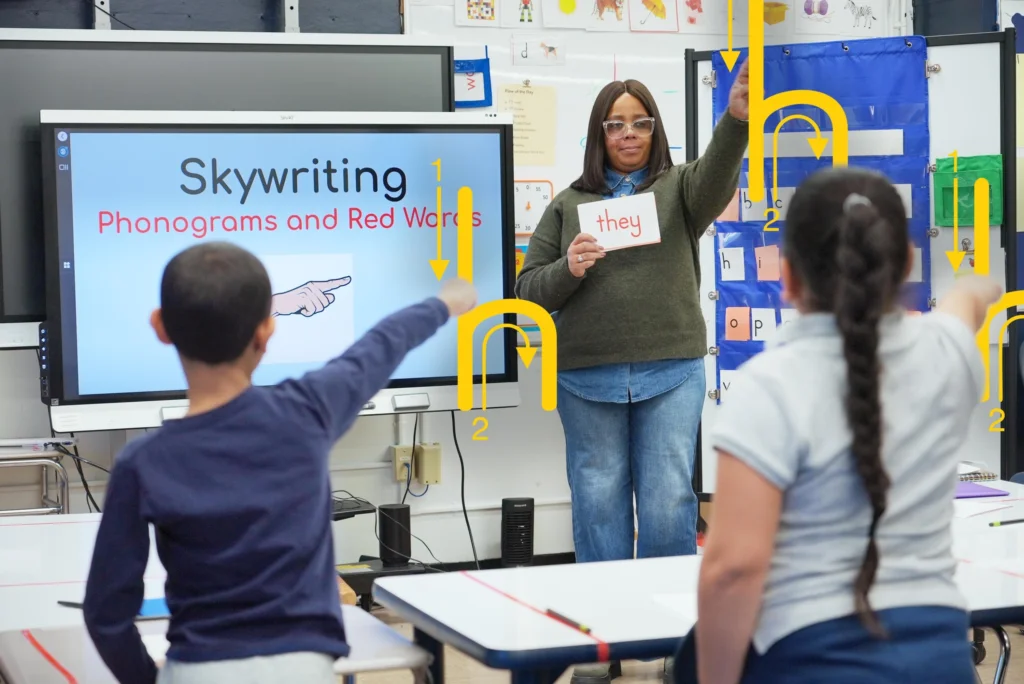
We know students need to learn the names of the letters of the alphabet AND the sounds that those letters represent. While many of us tend to teach these skills in isolation, there's some evidence that teaching letter names in conjunction with letter sounds, articulation, and letter formation can help map the information in the brain.
We will refer to this process of teaching letter names and sounds simultaneously as sound-letter correspondence. When we teach the relationship between sounds (phonemes) and letters (graphemes), we are teaching students the code to unlock words.
When students are just learning sound-letter correspondence, we use key words and illustrations to support their learning.
Let's watch! Using flash cards, each with an alphabet letter and corresponding picture, teacher DeAngela Huggins, of Burgess-Peterson Academy in Atlanta, practices short vowel sounds with her students by having then say the letter name, keyword, and sound.

Hide Video Transcript
Show Video Transcript
DeAngela Huggins: So let's drill our vowels. So we're going to do only our short vowel sounds. Are you guys ready? And let's go. We have ...
Students: 'a', apple, /ă/ ...
DeAngela Huggins: Very good.
Students: 'u', up, /ŭ/ ...
DeAngela Huggins: Alright.
Students: 'i', itch, /ĭ/ ...
DeAngela Huggins: Very good. And we have ...
Students: 'o', octopus, /ŏ/ ...
DeAngela Huggins: Very nice. And we have ...
Students: 'e', Ed, /e/ ...
DeAngela Huggins: Very good.

 Your Turn!

