- Fluency
Building Fluency with Two-Syllable Words
Hide Video Transcript
Show Video Transcript
Khadijah Williams: Good morning, y'all.
Students: Good morning.
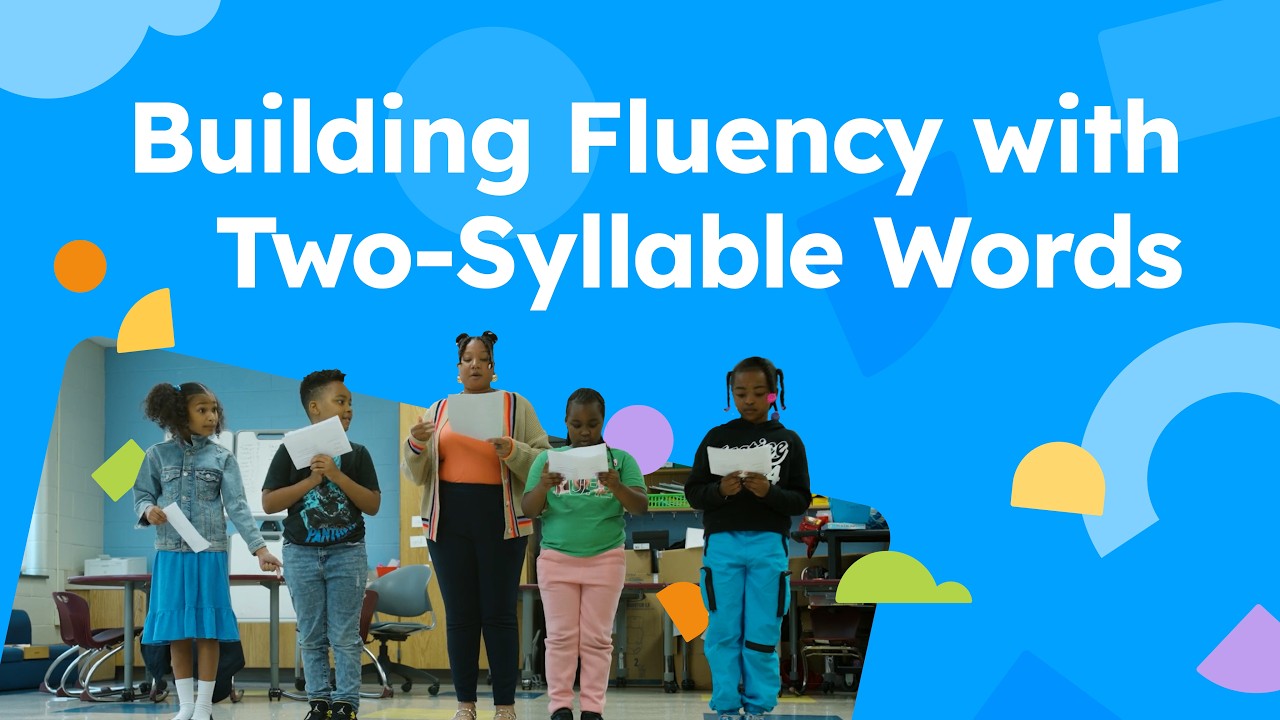
Narrator: Today, Hope-Hill Elementary teacher Khadijah Williams is working on fluency with a small group of second graders. They're focused on reading two syllable words.
Khadijah Williams: So this year we've learned about four different syllable types.
Narrator: First, they do a quick review of the syllable types they've already learned. Magic 'e', closed syllables, open syllables, and bossy 'r' or r-controlled syllables.
Khadijah Williams: We have 'ar', 'or; and the bossy 'r' triplets.
Narrator: Next, Ms. Williams leads them in a sorting activity.
Khadijah Williams: I'm going to show you a syllable and then we're going to talk about, we're going to sort it, okay? So it's either going to be r-controlled or bossy 'r', magic 'e', closed syllable, or open. Very good. So first of all, tell me what you notice. Kaya, what do you notice?
Kaya: It's got an O-R at the end.
Khadijah Williams: O-R. Very good. So is it going to be closed or is it going to be bossy 'r'?
Students: Bossy 'r'.
Khadijah Williams: Very good. And can we read that?
Students: Four.
Khadijah Williams: Awesome.
Narrator: This sorting work is really fluency in disguise. Every time students categorize a syllable, they're building the automatic pattern recognition fluent readers rely on.
Khadijah Williams: All right. Let's do one more. All right. What do we notice? Madison, what do you notice about this syllable?
Madison: It's a magic 'e'.
Khadijah Williams: Very good. Now, can we read that?
Madison: Cade.
Narrator: Now that they've practiced as a group, it's time for students to try sorting syllables on their own.
Khadijah Williams: Please don't say your syllable out loud yet, okay? I'm going to call on you one at a time to sort and say your syllable. Okay? So I'm going to start with Amina.
Amina: This is 'bur' and it has 'ur' in it, so that's a bossy 'r'.
Khadijah Williams: Awesome job. Robert, can you do one of your syllables?
Robert: Jum, and it's getting blocked by the 'm' so it is closed.
Khadijah Williams: Awesome. Madison?
Madison: Bo.
Khadijah Williams: Bo. Very good. And do you think it's bossy 'r', a magic 'e', closed, or open?
Madison: Open.
Khadijah Williams: Why?
Madison: Because there's no constant blocking 'o'.
Khadijah Williams: Awesome. Great job.
Narrator: Now the real fun begins. Students will combine syllables to create real words. This chunking activity mimics what our brains do when we read fluently, bridging the gap between recognizing syllable patterns and reading those patterns in a text.
Khadijah Williams: If we combine two syllables, right? I think we can make some words. Let me show you. So I'm going to take ar, cade. "Arcade. What is an arcade?
Student: Somewhere you could play games.
Khadijah Williams: Awesome.
Madison: I get to eat candy.
Khadijah Williams: Of course. Candy and pizza and all the things. Very good.
Narrator: It only takes one example to get students excited to start combining on their own.
Khadijah Williams: This word means big. What is the word?
Amina: Jumbo.
Khadijah Williams: Jumbo. Awesome.
Amina: Another word! Forbid.
Khadijah Williams: Ooh, forbid. Oh, you are just on it. Go ahead. Forbid. What does forbid mean?
Madison: When you forgive something?
Khadijah Williams: It means you can't do it or you shouldn't do it. When your mom tells you, "I forbid you to go outside and play in the rain," right? So I'm going to place two cards in front of us, okay? One at a time, and I want you to read each syllable and then we're going to pull them together. Okay? All right.
Students: In.
Khadijah Williams: Very good. And?
Students: Fect.
Khadijah Williams: Fect. Let's scoop it together.
Students: Infect.
Khadijah Williams: Very good.
Students: Shel. Ter.
Khadijah Williams: Let's scoop it up. One, two, three.
Students: Shelter.
Narrator: All of this work — reading syllables in isolation first, and now reading words — is building towards something bigger. Reading multisyllabic words fluently in phrases.
Khadijah Williams: So you all have done a great job building words and reading words, okay? So now we're going to read these words in phrases and sentences, okay? We're going to play a game, all right? So I need you all to meet me on the floor. Okay?
Narrator: To close out the lesson, Ms. Williams takes the students on what she calls a fluency walk. This is a low stakes, high engagement way to practice choral reading in meaningful chunks, building confidence with the smooth, expressive reading that fluency is all about.
Khadijah Williams: So now that we've built our words, we're going to read them in phrases, okay? So for every word in the phrase, you're going to move one square. Okay? "I." "Forbid." "You." Now, my focus was just saying the words correctly or reading the words correctly, right? But now I'm going to say it like I'm speaking. Okay? I'm going to say it smooth. We're going to work on fluency. So I'm going to stop and I'm going to say, "I forbid you. " Did you notice a difference? It was choppy the first time, right? But the last time it was smooth, right? Okay. So you're going to read the phrases that are on the left side of the page. Okay? And you're going to start when I say start. Here you go. After the first phrase, we're all going to stop and then we're going to read it together. Okay?
Khadijah Williams: All right. On your mark, read.
Together: [slowly] I forbid you.
Khadijah Williams: One, two, three.
Students: [smoothly] I forbid you.
Khadijah Williams: Very good.
Together: [slowly] There are plenty.
Khadijah Williams: One, two, three.
Students: [smoothly] There are plenty.
Khadijah Williams: Very good.
Together: [slowly] The grand arcade. [smoothly] The grand arcade.
Khadijah Williams: Very good. All right, y'all. We have done a great job with our fluency work. I want us all to kiss our brains. Great job.
Narrator: Reading Universe is made possible by generous support from Jim and Donna Barksdale; the Hastings/Quillen Fund, an advised fund of the Silicon Valley Community Foundation; the AFT; the Emily Hall Tremaine Foundation; and anonymous donors. Special thanks to Hope-Hill Elementary, Reading Is Essential for All People; and Atlanta Public Schools. If you enjoyed this video, please subscribe to our YouTube channel @RUTeaching. Reading Universe is a service of WETA, Washington D.C., the Barksdale Reading Institute, and First Book.
Khadijah Williams: My name is Khadijah Williams, and this is Reading Universe.
