- Fluency
How to Give a Repeated Reading Fluency Assessment
Hide Video Transcript
Show Video Transcript
Linda Farrell: Hey Chloe, how you doing?
Chloe: Good.
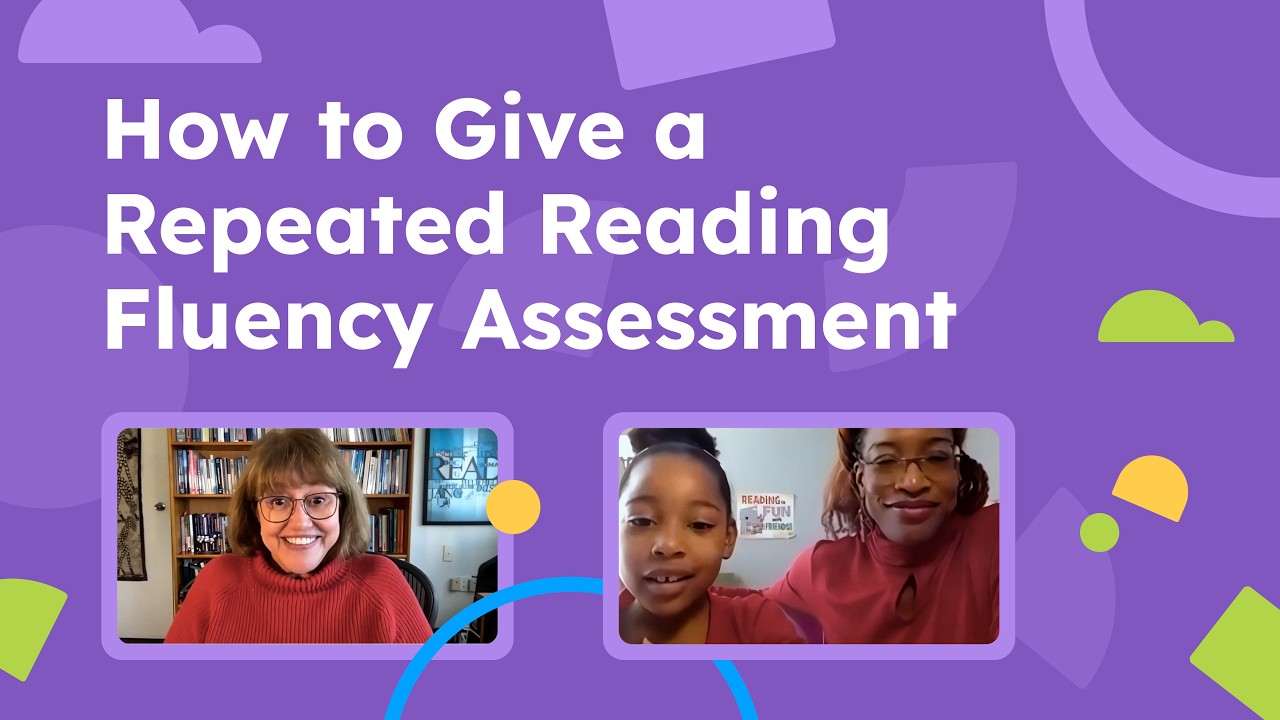
VO: Today, reading specialist Linda Farrell is wrapping up a remote reading tutoring session with a second grader named Chloe. To close out her session, Ms. Farrell will do a repeated reading fluency assessment focusing on automaticity, that sweet spot where Chloe is reading both accurately and at an appropriate rate, which means her reading sounds like spoken language. And Ms. Farrell has already identified a passage for Chloe to read and a specific target for Chloe to hit based on her reading ability.
Linda Farrell: So your goal is to read 60 words a minute and not make any mistakes. So what we're going to have you do, Chloe, is read for one minute. I'll time it, but you don't have to read fast. Just read naturally. I think you're going to be just fine on this. Most important is read the words that are there. Okay? So Olu, I think Chloe and I are ready to work together.
VO: Chloe will read the same passage three times and there's a lot to learn from each read. That first cold read will show Ms. Farrell where Chloe truly starts, her unpracticed accuracy, rate, and expression. And each read after that informs what areas may need work. If Chloe has a sharp increase in words read or accuracy, she'll just need practice and exposure. If she barely improves, she may need more explicit instruction on decoding. Ms. Farrell begins by highlighting a word in the passage that could be a tricky one for Chloe.
Linda Farrell: We have one word to review. It's the underlined word. That word is rough. Can you read rough?
Chloe: Rough.
Linda Farrell: Rough means it's not smooth.
Chloe: Or it's like if I have a bath cloth and it's rough.
Linda Farrell: Oh yeah, you need another one. Yeah, it hurts your skin. You know what rough means. So would you look at that word one more time and read it?
Chloe: Rough.
Linda Farrell: It is rough. Okay.
Chloe: Made a "ruff, ruff!"
Linda Farrell: Sometimes dogs go "ruff, ruff." That's spelled a different way.
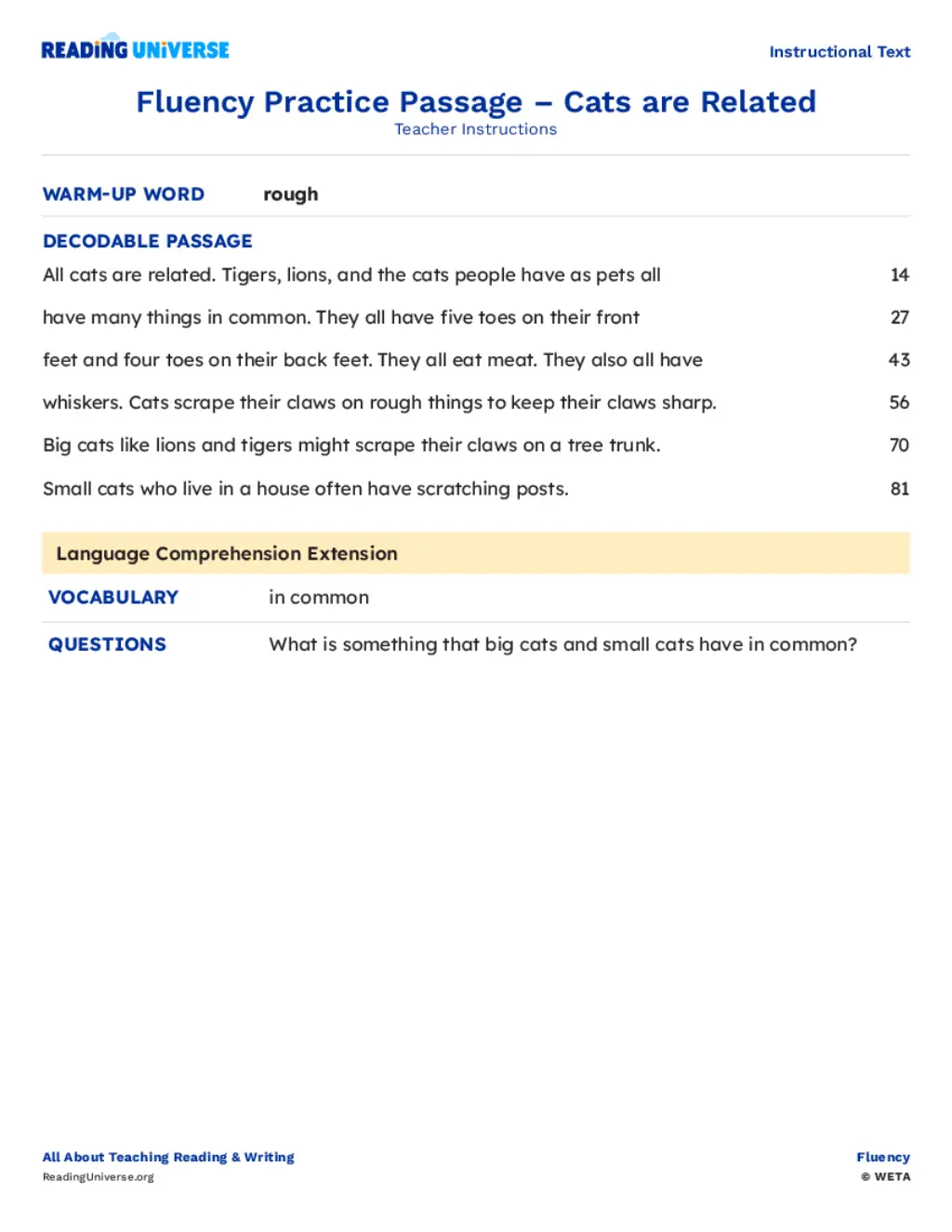
VO: Here's what the sheet Ms. Farrell is working from looks like. It's identical to the passage Chloe is reading from, except down the right hand side, you'll see the total word count after each line. And as Chloe reads for a timed minute, Ms. Farrell will simply put a slash through any word Chloe reads incorrectly. So what counts as an error? There are unknown words — when the student can't read a word within three seconds. Substitutions — when students say a different word than what's on the page. And omissions — when the student skips a word entirely. And what doesn't count as an error? Rereading a word or a self-correction made within three seconds. Let's watch as Chloe reads the passage for the first time.
Linda Farrell: Okay. Start.
Chloe: "All cats are related. Tigers, lions, and the cats people have as pets. All have many things to ...come ... come on. All ... they all have four toes on the front feet and four toes on their back feet. They all eat meat. They also all have whiskers. Cats scrape their claws on rocks."
Linda Farrell: [stopwatch clicks] Stop. That time you read 46 words.
VO: Here's how Ms. Farrell counted up Chloe's words read correctly, the 46 words. The last full word Chloe read was on. So Ms. Farrell starts with the total word count at the end of the last full line that Chloe read, which is 43. Then she adds each word Chloe read from the next line plus six. Finally, Ms. Farrell subtracts the three words she marked as errors. In, common, and their. 43 plus six, minus three, gives us 46 words read correctly in one minute. Next, Ms. Farrell will calculate Chloe's accuracy for this read.
Linda Farrell: And let's see what your accuracy was. You got 93% accuracy.
VO: To get that number, Ms. Farrell divided the 46 words Chloe read correctly by the 49 she read in total. That comes out to 93%.
Linda Farrell: Now we're looking to get at least 98% accuracy.
VO: Before the second reading, Ms. Farrell takes a minute to give Chloe some coaching.
Linda Farrell: So let's look at the first line, the last word. What's that word?
Chloe: All.
Linda Farrell: All. Okay. Now go to the next line and read that. Just read the rest of that sentence.
Chloe: "...have many things in comm-on."
Linda Farrell: That's common. Can you read common?
Chloe: Common.
Linda Farrell: So if you have something in common, it means that you both have it. Like today, we have something in common, we're wearing red.
Chloe: Red, red, red.
Linda Farrell: So what do we have in common?
Chloe: Red.
Linda Farrell: We're wearing red. So can you ask me, say, "Linda, what do we have in common?"
Chloe: "Linda, what do we have in common?"
Linda Farrell: I'm going to tell you besides red, both of us talk a lot, Chloe. I talk a lot and you talk a lot. So we have that we wear red and we talk a lot. So what's that word? What's the word that we just looked at? Find the word we just looked at.
Chloe: Common.
Linda Farrell: It is common. Now keep going. Read this sentence that starts with they.
Chloe: Oh yeah I see it. "They all have four toes on their front feet."
Linda Farrell: Right. Now that word their, you read as the, so we need to make sure you read that as their. So we underline their.
Chloe: Underline their.
Linda Farrell: And underline in common.
Chloe: Okay.
Linda Farrell: Okay. So you're going to pay special attention when you get there and read those correctly.
VO: With each reading, Ms. Farrell listens for how Chloe's accuracy and pace improve as the passage becomes more familiar. The goal isn't just for Chloe to read faster, though. It's for her to read at the speed of oral language because when reading sounds like talking, it frees her up to focus on what the words actually mean.
Linda Farrell: Are you ready to start again?
Chloe: I'm going to keep my eyes open like this.
Linda Farrell: Yeah, that's what you have to do. Okay. Start again. [stopwatch clicks]
Chloe: "All cats are related. Tigers, lions and the cats people have as pets. All have many things in common. They all have four toes on their front feet and four toes on their back feet. They all ... They all eat meat. They also all have whiskers. Cats scrape ..." [stopwatch clicks]
Linda Farrell: Chloe, you got 48 words right that time. 100% accuracy. We're going to read it again and see if we can meet the 60 words per minute goal. Let me turn my timer on. 60 words a minute. No mistakes, just like last time. That was so good the way you did it last time. All right. When you're ready, I'm ready. Start! [stopwatch clicks]
Chloe: "All cats are related. Tigers, lions and the cats [cough] people have as pets all have many things in common. They all have four toes on their front feet and four toes on their back feet. They all eat meat. They also all have whiskers. Cats scrape their claws on rough things to keep their claws sharp. Big cats like lions and tigers might ..."
Linda Farrell: Stop. Okay. So then ...
Chloe: We left off on ...
Linda Farrell: We left off on "might." So you got 63. 63 words correct and 100% accuracy. You read every word correctly and you didn't have any self-corrections or repetitions. You made it. You made your goal, girl.
VO: As Chloe keeps growing as a reader, today's assessment will help Ms. Farrell decide where to go next. Her focus will shift to phrasing and expression, which is when reading starts to sound like talking and meaning really comes alive.
Linda Farrell: So I think that that is a very good place to end our lesson.
VO: Reading Universe is made possible by generous support from Jim and Donna Barksdale; the Hastings/Quillin Fund, an advised fund of the Silicon Valley Community Foundation; the Emily Hall Tremaine Foundation; the AFT; and several anonymous donors. If you enjoyed this video, please subscribe to our YouTube channel @RUteaching. Reading Universe is a service of WETA Washington D.C. and was developed in collaboration with the Barksdale Reading Institute and First Book.
What did you notice?
Support Materials