Hide Video Transcript
Show Video Transcript
Carla Stanford: Wear our detective glasses. Get them out. We are searching for the who or what. We're searching for the replace, which is the pronoun. We're searching for the reword, which is the synonym. Those are the things we're searching for. And they all should trace and mean the same thing. And at the end, we should be able to answer the question, Who? or What? is the passage about? Are you ready?
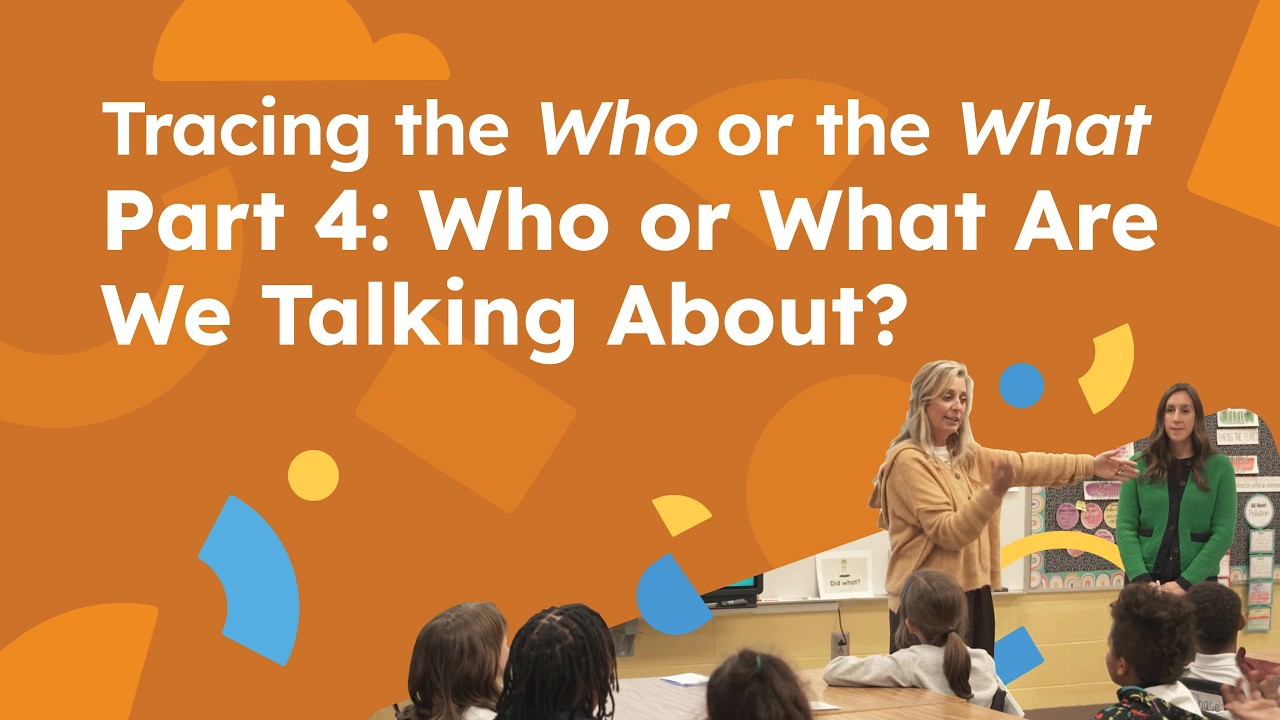
Narrator: Teacher Julie Turner and reading specialist Carla Stanford have been working with third graders at Burgess-Peterson Academy in Atlanta on how to trace the subject, the who or the what in a sentence. In this part of the lesson, students get more practice spotting the pronouns and synonyms whose job it is to stand in for the subject in a passage about desert plants.
Julie Turner: All right, boys and girls. Ready?
Together: "Plants have to adapt to survive in their habitats. Desert plants like cactus can store water in their fleshy stems. They use the stored water when rain is scarce. These water-efficient plants are able to thrive in the desert."
Carla Stanford: Touch your temple and think. Good readers, who or what is this passage about?
Students: Plants.
Carla Stanford: Plants. Does everyone agree?
Students: Yes.
Carla Stanford: Plants. Let's look and trace it all the way through and see if we can be more specific than just plants. Are you ready? Okay. Let's look at the second sentence, which is here. And I want you to think about who or what is that sentence about.
Student: Plants.
Carla Stanford: Plants?
Student: Yes.
Student: Desert plants, like cactus.
Carla Stanford: This is a longer description. So instead of just plants ... [Ms. Stanford highlights text.] Look at that one. Right? More specific. Giving us more information about the who or what. Are you ready for the next sentence?
Students: Yeah.
Carla Stanford: Here we are. You ready?
Students: They.
Carla Stanford: What is that?
Students: They.
Carla Stanford: One more time.
Students: They!
Carla Stanford: What kind of word is they?
Students: A pronoun.
Carla Stanford: A pronoun. So what is they replacing?
Students: [overlapping voices]
Carla Stanford: I think they have it.
Julie Turner: I think they got it.
Carla Stanford: I love it. "They use the stored water when rain is scarce." What does scarce mean?
Student: Not a lot.
Carla Stanford: Not a lot of rain, right? A very scientific word for scarce amount of rain is drought. Everyone say drought.
Students: Drought.
Carla Stanford: Good. Read with me.
Together: "These water-efficient plants are able to thrive in the desert."
Carla Stanford: Who or what is this sentence about?
Students: Water-efficient plants.
Carla Stanford: You guys, there's no tricking you. You're really thinking. You are tracking that who or what all the way through. And this is what good readers do. Good readers realize that when you're reading a book or maybe on the computer where we're gaining knowledge or reading a chapter book, the author is not going to repeat the same word over and over.
We have to be detectives and we have to follow because good readers are constantly making meaning. Every word. And if you read and you get to a point and you're not understanding, it's your job to go back and track it and figure it out. And now you have a plan for figuring out the who or what.
Narrator: With all the guided practice tracing the who or the what under their belts, the next step for these students is to try it on their own.
Carla Stanford: I think you're ready to do one by yourselves. Do you think you're ready to do one by yourselves?
Students: Yes.
Narrator: Reading Universe is made possible by generous support from Jim and Donna Barksdale; the Hastings/Quillin Fund, an advised fund of the Silicon Valley Community Foundation; the AFT; the Emily Hall Tremaine Foundation; and anonymous donors. Special thanks to Burgess-Peterson Academy, Reading is Essential for All People and Atlanta Public Schools. If you enjoyed this video, please subscribe to our YouTube channel @RUTeaching. Reading Universe is a service of WETA Washington D.C., the Barksdale Reading Institute and First Book.
