- Grammatical Building Blocks Skill Explainer
The Suffix '-ing' and Helping Verbs

Hide Video Transcript
Show Video Transcript
Carla Miller: So I want to talk to you about our suffix '-ing'. We've learned that suffix '-ing' means what?
Student: Happening right now.
Carla Miller: Happening right now. Happening now. Good. We're going to look at some sentences that have suffix '-ing' in them.
Narrator: At Burgess-Peterson Academy in Atlanta, Georgia, teacher Carla Miller is leading her first graders through a lesson on the suffix '-ing'.
Together: "The kid is snacking."
Narrator: This little suffix often gets tacked onto action verbs to show that something is happening right now. But the action verbs usually need a partner, a helping verb, like the words is, am, and are.
Together: "The kids are snacking."
Narrator: Dr. Miller begins by reviewing simple sentence structure.
Carla Miller: Okay. So we have learned that every single sentence has a who or what and a does what, right? All of my sentences have two parts. I have a who or what and a does what. So look at the sentence, "The kid is snacking." We know snacking is our does what? That's what's happening in the sentence. I want everybody to tell me, who is this sentence about?
Students: The kid.
Carla Miller: The kid. Good. The next sentence, "I am snacking." Who is this sentence about?
Students: I.
Carla Miller: I. Very good. Thank you to all my friends that I can hear. I want to hear everybody. The last one. Let's see, you can get this one. The last sentence is, "The kids are snacking." Who is this sentence about?
Students: The kids!
Carla Miller: So good. The kids. You got it. We know the who in the sentence is the kid. We know what they're doing is snacking. I want everybody to notice there's a little, small little word in each sentence right before snacking. Does everybody ... Touch your nose if you see that word. Touch your nose. That word is helping out the verb, which the does what is our verb, right? Snacking is our verb. That word is helping out our verb. That little word is called a "helping verb." Everybody say "helping verb."
Students: "Helping verb."
Carla Miller: Snacking needs a little help to show that it is an action. Okay. In this sentence the word is our helping verb. So when we see "is snacking," that is our does what? That's what's happening in the sentence. That's what we're doing in the sentence. What's our base word everybody?
Students: Sing!
Carla Miller: Sing. What word do we have now?
Students: Singing!
Carla Miller: Singing. Okay. We are going to build a simple sentence. Our simple sentence needs a who and a does what, right? So we have singing. Now it needs a who. What's our who?
Students: Steve.
Carla Miller: Steve. What I need to do is I need that helping verb. Let's see. Let's read it together.
Together: "Steve is singing."
Carla Miller: What is our who in the sentence?
Students: Steve.
Carla Miller: And what is he doing?
Students: Singing!
Carla Miller: He is singing. Good. Is my sentence complete?
Students: No.
Carla Miller: Who can raise your hand and tell me what does my sentence need? Leo, what does it need?
Leo: It needs a period.
Carla Miller: It sure does. It needs a period. Now let's read this sentence together, everybody.
Together: "Steve is singing."
Carla Miller: I've got my who. I've got my ... does what. And then I have my what? Helping verb. Let's try another one. Okay. Base word. What is it everybody?
Students: Wish.
Carla Miller: Wish. What word do we have now?
Students: Wishing.
Carla Miller: What is it?
Students: Wishing!
Carla Miller: Wishing. This is my does what. This is what we're doing in the sentence. It's happening now. This is my action. This is who the sentence is about. Who is the sentence about? Who is the sentence about?
Students: I. I have to have a helping verb to help out this sentence. So now let's read together.
Together: "I am wishing."
Carla Miller: Good. Who can tell me who is the sentence about? Carson, say it.
Carson: I.
Carla Miller: Good. What am I doing everybody?
Students: Wishing.
Carla Miller: I am wishing. Good job. Good job. And we need a ...
Students: Period.
Carla Miller: Period. Today you guys did such an amazing job today. We learned how to take our words with suffix '-ing' and add a helping verb with them to make the do what of our sentence. You guys did such a great job. I think we deserve an "oh yeah!" What do you think? One, two, three.
Students: "Oh yeah!"
Carla Miller: Oh yeah! Good job guys.
Narrator: Reading Universe is made possible by generous support from Jim and Donna Barksdale; the Hastings/Quillin Fund, an advised fund of the Silicon Valley Community Foundation; the AFT; the Emily Hall Tremaine Foundation; and anonymous donors. Special thanks to Burgess-Peterson Academy, Reading Is Essential for All People, and Atlanta Public Schools. If you enjoyed this video, please subscribe to our YouTube channel @RUTeaching. Reading Universe is a service of WETA Washington D.C., the Barksdale Reading Institute, and First Book.
Carla Miller: I'm Dr. Carla Miller and this is Reading Universe.
What did you notice?
Support Materials
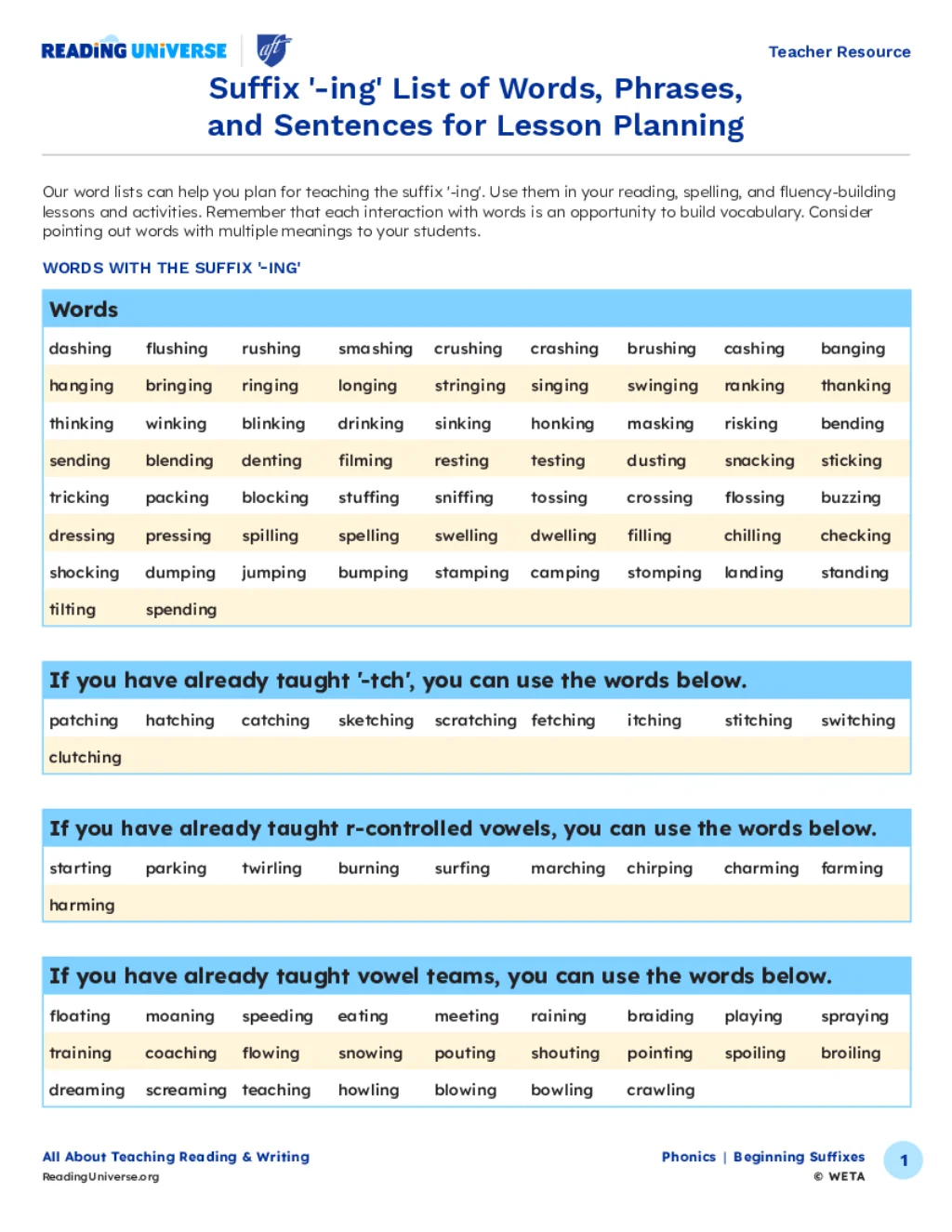
Suffix '-ing' List of Words, Phrases, and Sentences for Lesson Planning
Our word lists can help you plan for teaching the suffix '-ing'. Use them in your reading, spelling, and fluency lessons and activities.
