Hide Video Transcript
Show Video Transcript
DeAngela Huggins: So what we just did was we took one of those big words that sometimes can make us a little bit hesitant when we're getting ready to read, and we broke it into smaller parts to make it easier for us to put together.
Narrator: In DeAngelo Huggins' class, first graders are gearing up to read a decodable text with multisyllabic words. Earlier in this lesson, Ms. Huggins taught them how to divide, or chop, a long word into syllables. Now it's time for students to practice chopping on their own with words they'll see in the story.
DeAngela Huggins: You're going to chop your big word into its syllables, and then when I'm ready, I'm going to have you read your word to me. Okay? So the first thing we're going to do with our word is we're going to look for the what?
Student: Vowel.
Together: Vowel.
DeAngela Huggins: So everyone underline your vowels.
Narrator: After marking the vowels and consonants and then chopping their word, the students will decide if each syllable is open or closed.
DeAngela Huggins: All right, Leona. So take a look at your vowel. Is that an open or close?
Leona: Open.
DeAngela Huggins: How do you know that it's open?
Leona: Because there's nothing blocking the 'o'.
DeAngela Huggins: Very good. So how can we mark our vowel to show that it's open?
Leona: With a macron and a circle with an 'o' inside.
DeAngela Huggins: So now if it's open, what is it going to do to the vowel sound?
Leona: Make it long.
DeAngela Huggins: There you're going to make it long.
Leona: And 'o''s long sound is /o/.
DeAngela Huggins: Very good. Nice job. So everyone's ready to read their first word. What's your word?
Jackson: Traffic.
DeAngela Huggins: Say it flat.
Jackson: Traffic.
DeAngela Huggins: Very good. Jackson's word was ...
Students: Traffic.
DeAngela Huggins: Nice. All right.
Georgia: Problem.
DeAngela Huggins: Problem. What is Georgia's word?
Students: Problem.
Narrator: Watch next how Georgia's classmate Leona decodes the syllables individually and then reads the word as a whole. This helps build her fluency.
DeAngela Huggins: And then Leona's word is, let's see, read our first syllable.
Leona: 'Mot-', '-to'.
DeAngela Huggins: Put it together.
Leona: Motto.
DeAngela Huggins: Everyone, what's her word?
Students: Motto.
DeAngela Huggins: Motto. Everyone say it fast.
Students: Motto.
DeAngela Huggins: We're going to say it fluently. When you have a motto, it's like a saying or a phrase that shows something that you believe in, like "I can do it!" Everyone say, "I can do it!"
Students: I can do it!
DeAngela Huggins: So that is like a motto, something that you say, a phrase or saying.
Student: And the three musketeers' motto was, "One for all and all for one."
DeAngela Huggins: Very nice. All right. And the reason we're doing these specific words — because we're going to actually read today — we're going to read a ...
Student: Oooh.
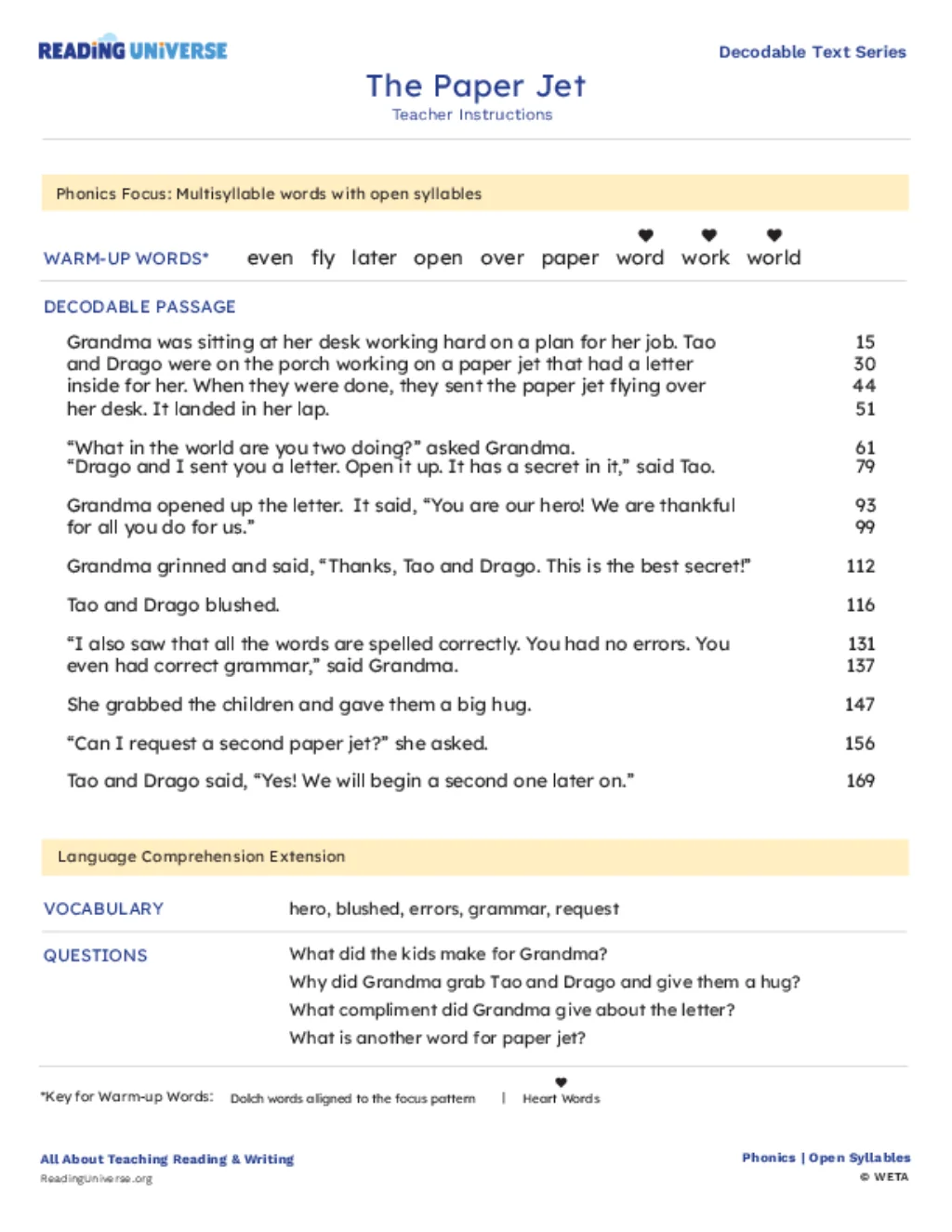
DeAngela Huggins: I know. And these multisyllable big words are going to be in what we read today. So it's important that we figure them out now so that when we get ready to read, we're able to read without having to spend a lot of time trying to figure out the words. All right. So we are going to read a story.
Narrator: Each step we've seen was intentionally planned by Ms. Huggins in order to set the students up for success when they read their story.
DeAngela Huggins: What's our title?
Students: "The Problem on Rabbit Hill."
DeAngela Huggins: So as we "The Problem on Rabbit Hill," you're going to whisper read it, and then I'm going to listen in to some of you read aloud to me. Okay? And as you read, I also want you to be thinking about our purpose for reading. I want you to be thinking about what is the problem on Rabbit Hill.
Student: Duh. Duh. Duh!
DeAngela Huggins: I love the sound effects. All right. All right. So read aloud to me please.
Student: Jess and Jack.
Narrator: Ms. Huggins listens to each student briefly offering help when needed.
DeAngela Huggins: Good job. Read aloud to me from wherever you are.
Student: They had a motto: "We can do it. Yes, we can!" They did chant that, the motto as they ran. The day for the splendid plan...
Narrator: Chopping words help students read accurately.
DeAngela Huggins: Very good.
Narrator: An important step toward the ultimate goal comprehension. And that's exactly what Ms. Huggins checks for now.
Student: Splendid!
DeAngela Huggins: Very good. So how many of you have read it at least once? Oh, everyone's read it at least once. So remember, the title was "The Problem on a Rabbit Hill." So what was the problem?
Students: There was no place to get out of the sun.
DeAngela Huggins: Very good. And how did they solve that?
Leona: They followed a rabbit under a rock and had their muffin picnic.
DeAngela Huggins: Good job. So you guys did some really great work today on chopping up those big words and using that strategy, when you came to some of those big words in our story, "The Problem at Rabbit Hill." So give yourselves a high five. Give me a high five.
Narrator: Reading Universe is made possible by generous support from Jim and Donna Barksdale, the Hastings/Quillin Fund, an advised fund of the Silicon Valley Community Foundation, the AFT, the Emily Hall Tremaine Foundation, and anonymous donors. Special thanks to Burgess-Peterson Academy and Atlanta Public Schools. If you enjoyed this video, please subscribe to our YouTube channel @RUteaching. Reading Universe is a service of WETA, Washington D.C., the Barksdale Reading Institute, and First Book.
DeAngela Huggins: This is Reading Universe.