Hide Video Transcript
Show Video Transcript
Sarah Martin: Good morning, friends.
Students: Good morning.
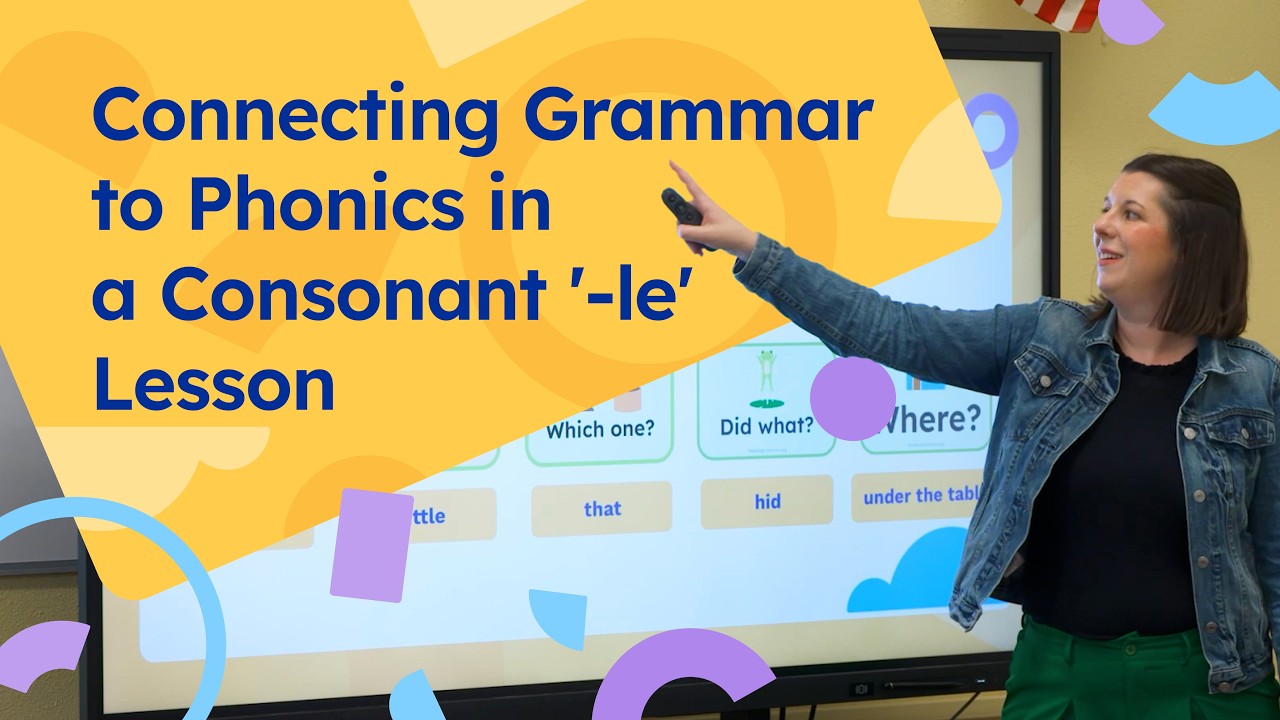
VO: Reading specialist Dr. Sarah Martin is in the middle of a review lesson on the consonant '-le' spelling pattern with third graders at Holy Family School in Cincinnati, Ohio. A phonics lesson like this one is a natural place to weave in grammar. Bringing the two together puts words in context. Students can see how each word is used, which strengthens both their fluency and their writing. And during sentence dictation, Dr. Martin puts that idea to work using function questions to help her students unpack the meaning behind every word in the sentences they'll write.
Sarah Martin: P-L-E. /p/, /l/.
VO: She begins with a simple sentence, a sentence with just a subject and an action.
Sarah Martin: Let's read this sentence together. Ready?
Together: "The staple fell."
Sarah Martin: If I ask the question, "Who or what is this sentence about?" Who or what is this sentence about everyone?
Students: The staple.
Sarah Martin: And if I asked, "did what?", what did the staple do?
Students: Fell.
Sarah Martin: Fell. The staple is our "who" or "what," and fell is our "did what."
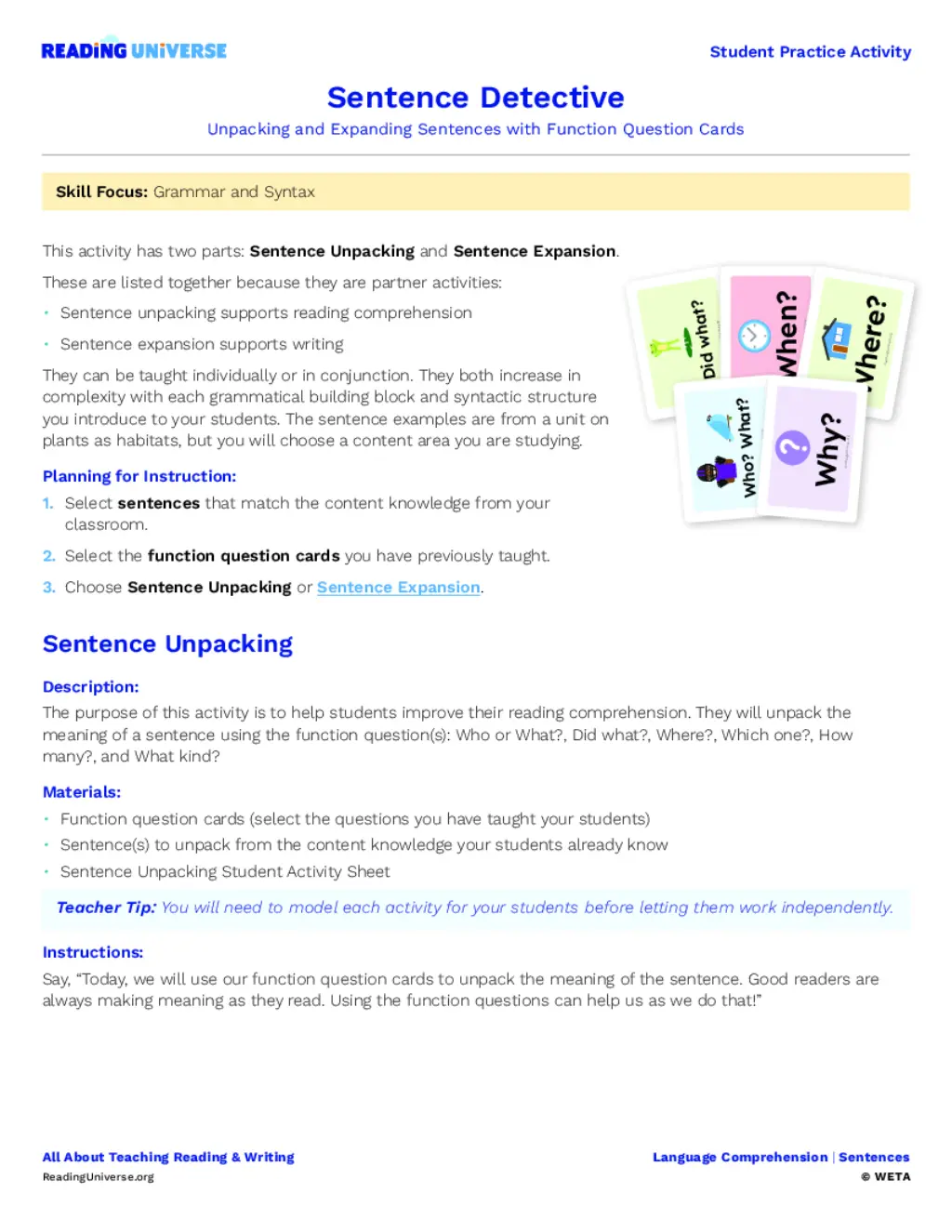
VO: Asking function questions, "Who? or What?", "Did what?", "Where?", "What kind?", "How many?", and "Which one?" makes grammar feel less like rules to memorize and more like a way to explore meaning. Dr. Martin introduced and explicitly taught these questions earlier. And now students get a chance to practice during dictation.
Sarah Martin: Our sentence is, "The tiny staple fell on the ground." Let's say it together.
Together: "The tiny staple fell on the ground."
Sarah Martin: Go ahead and write that. "The tiny staple fell on the ground." All right. Are we ready to check our sentence? Take a look up on the board and we're going to check. So now we're going to take this sentence and we're going to unpack it and find out what jobs these words are doing in the sentence. So our first question is "Who or What?" Who or what is this sentence about?
Together: Staple.
Sarah Martin: So the staple is our who or what. What kind of staple?
Students: Tiny.
Sarah Martin: Tiny staple. "Did what?" What did the staple do?
Students: Fell on the ground.
Sarah Martin: So think about this. Let's make it really short. What happened to that staple? It did what?
Students: It fell.
Sarah Martin: Good job. And here's another question we can ask. "Where?" Where did that staple fall?
Students: On the ground.
Sarah Martin: On the ground. Where did it fall?
Students: On the ground.
Sarah Martin: Good job. So now we know the "who" or "what," what kind of "who" or "what," what did it do and where did it fall? All of these words help us to understand the meaning of the sentence.
VO: Now Dr. Martin encourages students to group words and phrases together as they're reading, or as she calls it, to "scoop" them.
Sarah Martin: So what I can do when I'm trying to read, I can scoop these to help me to read it fluently. So I can say, "The tiny staple fell on the ground." Ready? Let's do that together. Ready?
Together: [read slowly in portions] "The tiny staple fell on the ground."
Sarah Martin: Now let's read it all together.
Together: [read smoothly] "The tiny staple fell on the ground."
Sarah Martin: Great job. So we're going to do one more sentence the same way. We're going to write the sentence. We're going to unpack it and think about the meaning of the words and then scoop it to read it fluently. Our next sentence is, "That little bug hid under the table." Let's do it together.
Together: "That little bug hid under the table."
Sarah Martin: Ready? Go ahead and write. "That little bug hid under the table." Do you see a consonant '-le' word in that sentence?
Students: Yeah.
Sarah Martin: What's our consonant '-le' word?
Students: [mixed responses] "Little." "Table."
Sarah Martin: Do we have more than one?
Students: Yeah.
Sarah Martin: What's the first one?
Students: "Little."
Sarah Martin: "Little." What's the second one?
Students: "Table."
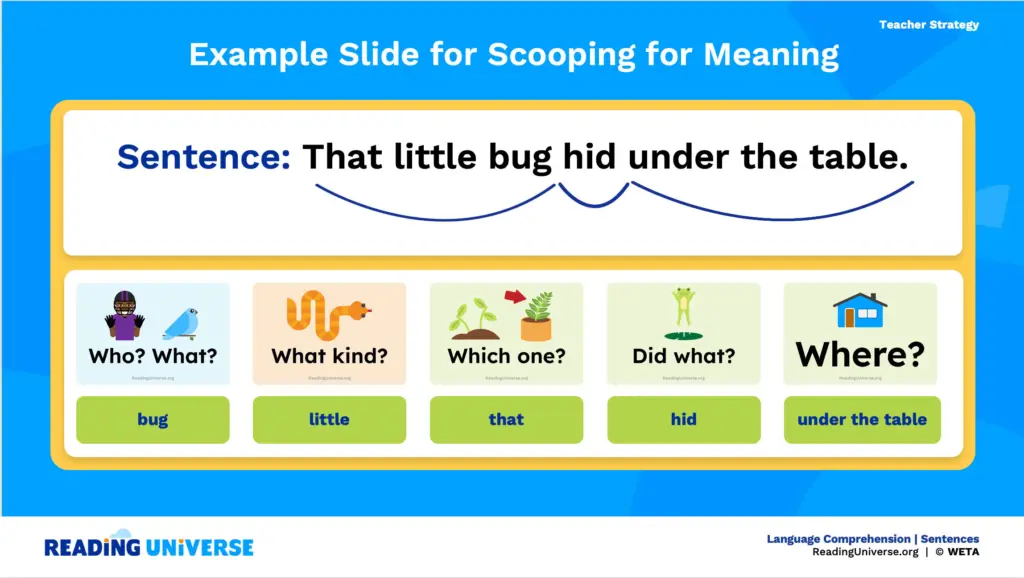
Sarah Martin: "Table." So now we're going to unpack this sentence. We're going to think about the jobs these words have in a sentence and that helps us to understand the meaning of the sentence. So who or what is this sentence about?
Students: A bug.
Sarah Martin: A bug. Good job. What kind of bug?
Students: Little.
Sarah Martin: A little bug. So that tells me it's not a really big bug, which I'm glad it's not a big bug. It's just a little bug.
Which bug am I talking about? There's lots of bugs. Which one am I talking about?
Students: Under the table.
Sarah Martin: So "under the table" is going to tell me where the bug is. Which one is going to tell me the difference between ... "that" tells me which bug. It's "that bug," not "this bug," it's "that bug." So which bug are we talking about?
Students: That bug.
Sarah Martin: Great job. And what did the bug do? What did it do?
Students: Hid.
Sarah Martin: It hid. Good job. And then where did it hide?
Students: Under the table.
Sarah Martin: Under the table. Wow. Look at how we can think about the jobs that these words, I can understand what they mean and help me to make that picture in my head and understand when I'm reading a book or a passage. So now let's scoop these words and I'm going to model it and then we'll do it together. Ready? "That little bug hid under the table." Ready to scoop it together?
Together: [read slowly in portions] "That little bug hid under the table."
Sarah Martin: Excellent. Now let's read it one more time.
Together: [read smoothly] "That little bug hid under the table."
VO: When students learn to ask the right questions as they read, they're uncovering the meaning right in front of them. It's a grammar lesson that feels intuitive rather than academic.
Sarah Martin: You guys are so, so smart. Thank you so much for being readers and writers with me today. You did a great job. Go ahead and kiss your brain. Round of applause. Excellent work.
VO: Reading Universe is made possible by generous support from Jim and Donna Barksdale; the Hastings/Quillin Fund, an advised fund of the Silicon Valley Community Foundation; the Emily Hall Tremaine Foundation; the AFT; and several anonymous donors. Special thanks to the Center for Reading Science at Mount St. Joseph University and Holy Family School located in Cincinnati, Ohio. If you enjoyed this video, please subscribe to our YouTube channel @RUTeaching. Reading Universe is a service of WETA, Washington D.C. and was developed in collaboration with the Barksdale Reading Institute and First Book.