- Consonant '-le' Skill Explainer
Spelling Words with the Consonant '-le' Pattern
Hide Video Transcript
Show Video Transcript
Dr. Sarah Martin: Good morning friends.
Narrator: The consonant '-le' pattern can be tough for young readers because the spelling doesn't match what they hear. Today, reading specialist Sarah Martin is leading a review lesson for third graders at Holy Family School in Cincinnati, Ohio using a sound-to-spelling strategy to tackle that tricky pattern.
Dr. Sarah Martin: You've learned about consonant '-le' words before, right? Show me a thumbs up if you remember consonant '-le' words. Those make two syllable words and they end with a consonant and an '-le'. So we have B-L-E, /bl/. Let's do that together. Ready?
Together: B-L-E, /bl/. D-L-E, /dl/. F-L-E, /fl/.
Narrator: Beginning the lesson with flashcards helps students get warmed up. They get to see and say consonant '-le' patterns first, which primes their brains for spelling later on.
Dr. Sarah Martin: Excellent. Great job. So what we're going to do today, you're going to use this paper in front of you and we have steps that we are going to take. We're going to say a word, we're going to tap it. Then we're going to do boxes around how many sounds we have. And I'll show you what that looks like in a minute. And then we'll write the sounds. And then in this last box all the way over here, we're going to write the whole word after we've done the sounds.
Narrator: This is a routine to help students strengthen the connection between sounds and the letters that represent them.
Dr. Sarah Martin: Marble. Say marble.
Students: Marble.
Dr. Sarah Martin: Good job. Get your tappers up. Let's tap it. Ready?
Together: /m/, /ar/, /b/, /l/.
Dr. Sarah Martin: Excellent. How many sounds?
Students: Four.
Dr. Sarah Martin: Good job. So I'm going to draw a box around those first four boxes. So that helps my brain to remember there's four sounds and I can focus on the sounds now. So can you make a box around those first four? Just make a box. Good job. All right. What was that first sound?
Students: /m/.
Dr. Sarah Martin: Letter?
Students: 'M'.
Dr. Sarah Martin: Good job. Go ahead and write it. Marble. Second sound?
Students: /ar/.
Dr. Sarah Martin: Oooh. That's a vowel 'r', an r-controlled vowel sound. How do we spell that?
Students: A - R.
Dr. Sarah Martin: Awesome. Go ahead and write that. One sound, one box. One sound, one box. But we have two letters to spell that sound. Our next sound is /b/. What letter makes that sound everyone?
Students: 'B'.
Dr. Sarah Martin: And then our last sound, /l/. And we know with our consonant, what comes at the end?
Students: L-E.
Dr. Sarah Martin: L-E. Great job. There's marble. And then we're going to write it at the end. Great work. All right. Ready to go a little faster on this next one now that we know what to do?
Students: Yes.
Dr. Sarah Martin: The word is gentle. What's the word?
Students: Gentle.
Dr. Sarah Martin: Let's tap it.
Together: /j/, /n/, /t/, /l/.
Dr. Sarah Martin:
How many sounds?
Students: Five.
Dr. Sarah Martin: Draw a big box around five boxes. This one's a tricky one. That first sound is ...
Together: /j/.
Dr. Sarah Martin: What's the first sound?
Students: /j/.
Dr. Sarah Martin: We hear that /j/ sound. And I heard some friends, what letter do we use to represent that sound?
Narrator: 'G'.
Dr. Sarah Martin: 'G'. How do we know that that's going to be a 'g'? How do we know that's going to be a 'g'? Yes.
Narrator: 'e'.
Dr. Sarah Martin: Because it has an ...
Narrator: 'e', 'i', or 'y'.
Dr. Sarah Martin: It has an 'e' after it. And if we have a /j/ sound with a 'e', 'i', or 'y' after it, we know we spell it with a 'g'. Excellent job.
Narrator: Notice how Dr. Martin weaves previously learned skills into our consonant '-le' lesson, like when to use the soft 'g' sound.
Dr. Sarah Martin: Our next word is bugle. Say bugle.
Students: Bugle.
Dr. Sarah Martin: Ready? Let's tap it.
Narrator: Next, she dives a little deeper into the word students are writing by talking about meaning.
Dr. Sarah Martin: First sound ... /b/. Letter?
Students: 'B'.
Dr. Sarah Martin: Great. For bugle. Does anybody know what a bugle is?
Narrator: When students know what a word means, they're more likely to remember how to spell it.
Dr. Sarah Martin: Do you see this instrument that she's playing right here? What does it look like?
Students: It's a trumpet.
Dr. Sarah Martin: It looks like a trumpet, but the difference between a bugle is the trumpet has those little keys that they press to make the sound. This has no keys on it. So she has to make that sound with her mouth. She changes the shape of her mouth to make the sounds. Pretty neat, huh? That takes a lot of talent. What is this?
Students: Bugle.
Dr. Sarah Martin: What is it?
Students: Bugle.
Dr. Sarah Martin: Awesome. Our next word is staple. Say, staple.
Students: Staple.
Dr. Sarah Martin: Ready? Let's tap it.
Together: /s/, /t/, /ā/, /p/, /l/.
Dr. Sarah Martin: How many sounds?
Narrator: Now Dr. Martin's going to use the word staple to weave some grammar work into this lesson. She's going to help the students think about the word's function.
Dr. Sarah Martin: Who knows what a staple is?
Student: Something that you put in papers to stick them.
Dr. Sarah Martin: Yes. That's a .. a "what." What's another word for a "what"? We call these "who" or "what"? We call these ...
Together: Nouns.
Dr. Sarah Martin: It's a thing, right? A staple. I can pick it up. It's a thing. It's a "what."
Narrator: Dr. Martin chose to discuss the meaning of the word "staple" because it's more than just a noun.
Dr. Sarah Martin: Does anyone know another meaning of the word "staple"? When I use that little machine and I put it in there, I'm stapling it. That's a "did what"? Can you say "did what"?
Students: "Did what."
Dr. Sarah Martin:
That's an action. When I staple it, I'm doing something, right? I have the thing, a staple. The "what," the "who or what" or noun, and then I have the "did what." Staple when I press it down and it staples together. So this word can mean two different things.
Narrator: The last step in this review is for students to read what they wrote.
Dr. Sarah Martin: Ready? So let's start up at the top and read our words back fluently. Ready?
Together: Marble. Gentle. Yugle.
Dr. Sarah Martin: Ooh, what's this one?
Students: Bugle.
Dr. Sarah Martin: Bugle. Very good. And ...
Students: Staple.
Dr. Sarah Martin: Staple can have two different jobs. It can be a "who or what," a noun, and it can be a "did what," a verb. You guys are so, so smart. Thank you so much for being readers and writers with me today. You did a great job. Go ahead and kiss your brain.
Narrator: Reading Universe is made possible by generous support from Jim and Donna Barksdale; the Hastings/Quillin Fund, an advised fund of the Silicon Valley Community Foundation; the Emily Hall Tremaine Foundation; the AFT; and several anonymous donors. Special thanks to the Center for Reading Science at Mount St. Joseph University and Holy Family School located in Cincinnati, Ohio. If you enjoyed this video, please subscribe to our YouTube channel @RUTeaching. Reading Universe is a service of WETA, Washington D.C. and was developed in collaboration with the Barksdale Reading Institute and First Book.
What did you notice?
Support Materials

Consonant '-le' Flash Cards with Pictures
Print these 5x7 letter flash cards with pictures to help students practice the consonant '-le' patterns, like '-ble' and '-gle'.
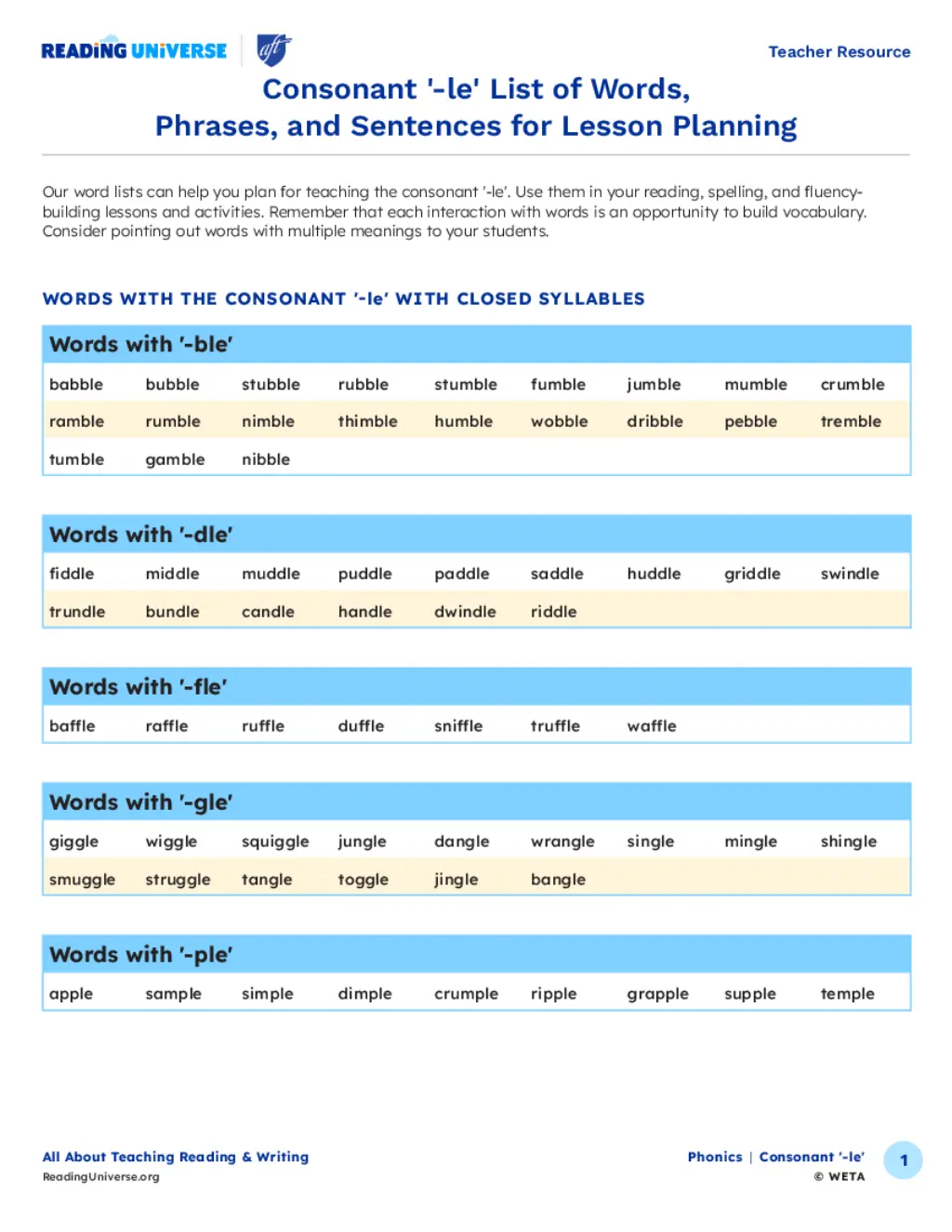
Consonant '-le' List of Words, Phrases, and Sentences
Our word lists can help you plan for teaching the consonant '-le'. Use them in your reading, spelling, and fluency lessons and activities.
