- Phonics
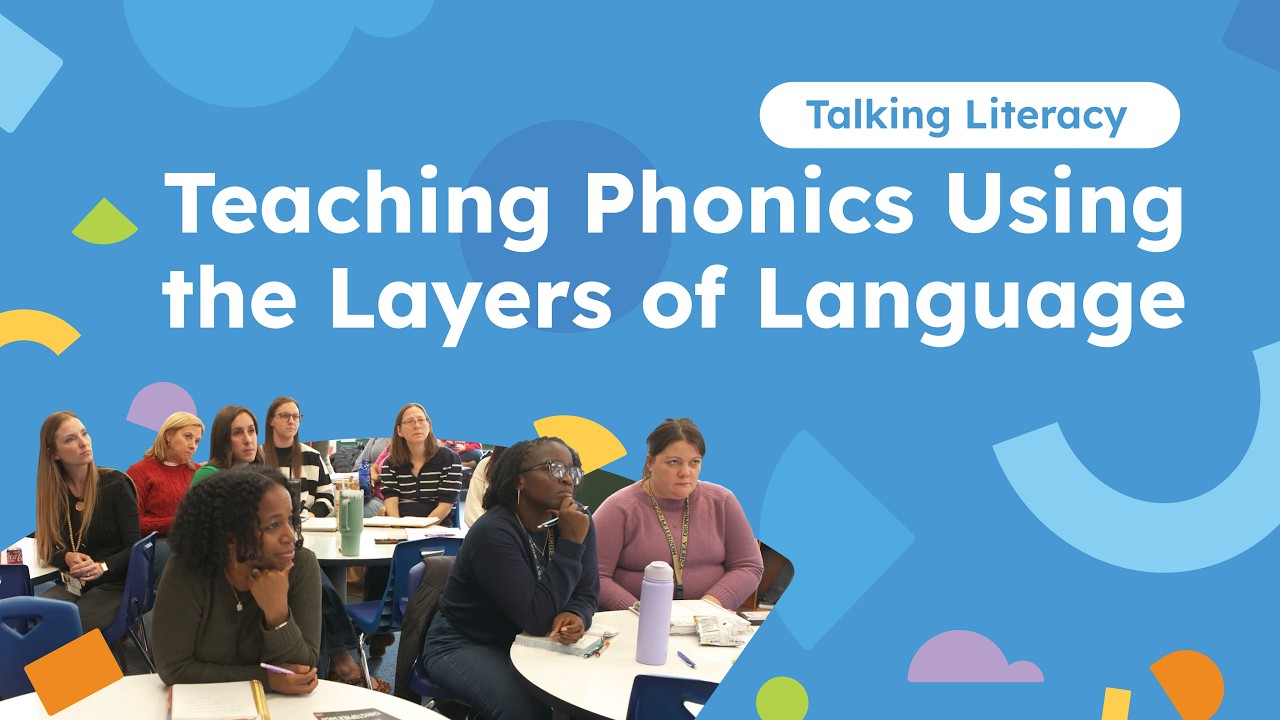
Talking Literacy: Teaching Phonics Using the Layers of Language
Hide Video Transcript
Show Video Transcript
Carla Stanford: So thank you for being on this journey with us today. This learning that we're going to embark on is learning for me too. So I just want to say that in this work, the whole goal is to give you more tools to do more work with your kids. And the goal is to bump it up and to take what you already know about phonics and then elevate it. No one is expecting that this work be perfect, but we really want to lean in how to use what we know about phonics to lean into language comprehension. And I just want to give you a little research that syntax, which is sentence structure, is what comes first when kids are comprehending. So I've done a lot of unpacking of like, oh my goodness. When I first started reading this, I was like, I don't even know what syntax is.
So understanding that syntax is sentence structure, that sentence structure is built with grammatical building blocks. Old school us call them nouns and verbs, right? Adverbs. And that how do we take on what we know about a phonics block and start to learn? This is all about us learning together. It's not going to be about you going back and trying to be perfect with anything. It's about learning together how we can not have our day siloed. There's not enough hours in the day to say, "in phonics, I'm only going to do this. And now in grammar, I'm going to do this. And now in language comprehension, I'm going to do this. And now in reading, I'm going to do this. And now, oh my goodness, there's no time for writing." So everything we do, we're going to really examine it through the lens of we're going to think about how we can introduce it in phonics.
This is all going to be about teacher knowledge and you playing with it. But I want to start talking about what are the layers of language. So when we encounter a word, these are the things that a word can represent. It can represent phonology, so that's the sounds in the word. Right? So we're talking about phonemic awareness here. What does it sound like? We can also think about orthography. That's how it's spelled. What letters come together, what the patterns are, like the '-dge' in lodge. Semantics. That's all about meaning. And it's not just single word meaning. It's overall meaning because groups of words can have meaning together. Right? And then syntax. We already talked about it, but we'll continue to come back to it. If you forget, don't worry, I forget often, when I'm learning something new. It's the rules of sentence structure. How do we put sentences together in our language?
Just like there are rules for phonics. There are rules for syntax that we can learn and we can explicitly teach. And then morphology. Morphology for us in this room really bleeds into our phonics work. So we don't always pull that apart when we think about it. We think about it within our phonics time, but it's the rules, the structure of the way words are put together. So we have our prefixes, our suffixes, our bases, and our roots. So this is what we're talking about when we're thinking about language. Language at the word level, but also oral language. I'm from here. You can hear the accent. I probably have a thicker accent than most of you. We all come to this world with an oral language that we were given to from our family. So when kids come to school, they already have a lot of this.
They learned it orally because that's how we get the language. We listen, we pick it up and we have it. So when we're at school, we're learning the explicit rules that match academic English. So oral language, kids are bringing, and it might not always match, and that's okay. Kids' oral language is what they're bringing to the table and it's amazing. It's how they make meaning. It's how they have conversation. It's actually how they, if you think about it, that's their inner voice. The way I talk out loud is also the way that I am making meaning when I'm reading silently. Okay. The simple view of reading. We're always going to bring things back to the research. Our goal is reading comprehension. That's our goal always. Word recognition and language comprehension is what we're using to get there, right? Our phonics instruction heavily lives here in word recognition.
Our goal is to pull some of this language comprehension work into this phonics. We're going to look at some research and talk about why really quick. Same thing here when we're thinking about the Reading Rope. Our phonics lives here. We're doing all our decoding, our word recognition, our sight words, our phonemic awareness. But our goal is: Every time we decode a word, the word has meaning. It's bringing something to the table. How can we capitalize on it? So that's kind of our goal and that's going to be our "bump it up" piece for us as learners and then for our students as we move forward. All right. Just a little research because I don't want you to think this is something that we just made up, but this is ... Well, it's important, right? It's important. And the research from, this is Maryanne Wolf and colleagues, says that from neuroscience, there are five aspects of word knowledge that are essential for kids to become strong comprehenders.
Orthographic mapping, phonological knowledge, semantic knowledge, morphological knowledge. Oop, I didn't get that one highlighted, syntactic knowledge. Those are the ones you just saw, right? So this is the world we're going to live in, really unpacking what this means. And then just one last. I'm not going to read this out loud. This is also Maryanne Wolf. Connecting linguistic knowledge. So connecting language to decoding is essential, and that systematic and explicit teaching and practice is necessary for kids to learn to read. So I just want to keep us here because I've been working with a team. Phonics is very constrained. It's very tight. I can say, "Okay, today I'm going to teach you the '-ck' rule. After a short vowel at the end of a one syllable word, when you hear /k/: '-ck.' Hooray!" Right? Very tight. I want to teach you about how to identify the "who" or "what" in a sentence, which then every time you read a sentence is different and the structure is different every single time.
That feels a little more willy-nilly, and we call that unconstrained. So we're going to work on using our constrained content, our phonics content that's really tight, to give us a place to practice our unconstrained content. So that then we feel good about the content, and then we can go by the end of the year or planning for next year, and we can distribute this all day long. But phonics is a nice, tight place to start. Does that make sense? Okay. It feels doable to me also, by the way, in planning. So we're going to use this tool, I'm going to call it, called the Word Knowledge Network. And the Word Knowledge Network is going to be a planning tool that we use to think about all of the layers of language that a word brings to the table. And it's okay if we don't know them and we can't say them. By the end of the year, you're going to think about words. The goal would be you look at a word and you can't quit thinking about it. You're like, "Oh, I want to use that word. It brings so much to the table." That's the goal, that it would become automatic. Really quick, phonology. Just call out, what is phonology related to?
Teacher: Sounds.
Carla Stanford: Sounds, right? Sound, symbol. That's that orthography. That's the graphemes, right? The one to one, I say the sound, it's represented with this letter or grapheme. Syllables. That's how the word is broken apart. What the vowel is doing. We teach our kids this in phonics. Semantics, the study of the meaning of the language, not just an individual word. Morphology, the study of word parts and their meaning, what they're bringing to the table. And I'm going to add this too, because I really want you to think about this. Carla and I did a lesson, planned a lesson together that really made me think about: When you see '-ing' it's indicating something, right? What is it indicating?
Teacher: Happening right now.
Carla Stanford: Happening now. And another thing we dove into, it's always got ... tell them, Carla. A helping verb!
Carla Miller: Oh yes! That's what I said. That's literally what my lesson was on.
Carla Stanford: It's always got a helping verb! It's always got a helping verb. I've never taught it that way before. I've always taught: "'-ing' happening now. Isolation." But if you think about, "'-ing' happening now, morphology," what is it bringing to the table? The sentence structure is always with a helping verb. "Is helping," "am helping," "are helping," "we're helping." So by teaching that way, now in phrase dictation with help with '-ing' words, I can dictate these. Then as Carla did today, we can add our subject, right? Our "who" or "what", and we talk about how they match. And it's explicit. It's not, "does it sound right?" Because guess what? To some kids, it sounds right not to have a helping verb and that's okay. "Does it sound right?" Won't be our go- to. We're going to explicitly instruct, because that's culturally responsive. And then we have syntax and we're going to live here in syntax.
We're going to live in the study of word function, which is going to be grammar. We're going to do old school grammar in a really fun way. Sentence instruction. And here's the kicker: The impact on comprehension and writing. We are always going to talk about the reciprocal relationship. What does it mean for reading comprehension? What does it mean for written composition? Today in Turner's class, we did this whole tracking. It's called tracing the referential chain. We didn't tell the kids that. And literally you teach the kids to think about who or what. Find the pronouns, find the synonyms, you track it, you comprehend. But as a writer, guess what? You do the opposite. And we played with that with her kids today and it was so fun. Her kids were lovely. So I just want you to know this is what this is going to lead us to.
Now we're going to talk about lodge. All right. Phonology. That's the sounds. Everyone say, lodge.
Teachers: Lodge.
Carla Stanford: Tappers up.
Everyone: /l/ /ŏ/ /j/
Carla Stanford: How many sounds?
Teachers: Three.
Carla Stanford: Good. Right? This is an important thing we teach our kids. Three sounds. Is that the same amount of graphemes? No. It's a big deal. It's a big deal for kids. Here are your sounds, there are your letters. How many syllables?
Teachers: One.
Carla Stanford: What kind of syllable?
Teachers: Closed.
Carla Stanford: Closed. Why is that important? Short vowel. It's all about getting to the vowel, right? So what we're doing in phonics is important. It's important that you stay true. Kids have to learn how to pull words off the page. If you don't teach them, who's going to? But pulling the words off the page is the gateway to, then, comprehension. Right? So we don't have time to decode, decode, decode, decode. Oh, then five years later, we're going to teach comprehension and writing. We have to start teaching kids this part of the word knowledge network at the same time.
So, semantics. ["Lodge"] can mean stuck, "a mountain cabin," "a beaver's home." Probably more things than that. Morphology. Can you think of any others besides dislodge, lodges, lodge, lodging? What'd you say?
Teacher: Lodger.
Carla Stanford: Lodger! A lodger is someone who?
Teachers: Lodges.
Carla Stanford: So lodge, right? Noun. Add suffix '-er.' Changes noun, place to a person. And now we have our syntax. It's a namer, or a who or what, and it's a did what. It can be both. So it can be "the lodge," a who or what, a noun, a namer, or it can be lodged, an action. So this is the thinking we're going to use while we're planning our phonics to help us get to our grammar and syntax. So it feels doable because we can choose phonics words that we were already going to use. And we're not going to go through judge. Okay. We're going to take this function-based approach. It's going to feel weird at first. You're going to have to play with it. But a function-based approach is: Instead of teaching kids, just, "a noun is a person place or thing. What is this? It's a noun." We're going to work on trying this function-based approach, which is, "what is the word's job in the sentence?"
Because that helps unpack meaning. It's really tricky because I want to tell you, when I was teaching first grade, I had the cutest song for teaching nouns. It was just the cutest. And the kids would do a dance and they would sing it. And that was that. They knew what a noun was. They knew it was a person, place, thing, or an idea.
So what? I was missing the point of, "wait, the who or what helps me unpack meaning." Every time I am teaching them about grammar, we're going to really have that question that goes with it. And we have these cards to share with you if you would like them. So we're going to take our phonics lesson. And one of the things I'm going to encourage you to do is to stay true. If you're dropping things out of phonics, consider why you're dropping it. And if you should put it back in. You are always driving the bus. I will say that to you every single time we work together. You are driving the bus. Your kids, once you teach them this, their cognitive load is not spent on, "what in the world is she going to do today?" They know what you're doing, and then their cognitive load can be spent on doing the work.
What you can do as you move through this, you can make your listening game shorter, or you can make sure you [say], "I want to do more dictation with phrases today, so I'll do less words, and we're going to bump it up in different ways," But we're going to try to stay true as we move and manipulate things around. The reason the phonics lesson is arranged the way it is, it is research based, is it goes from the sound level, and then it goes to this individual, "I see the letter, I can give the sound," and it builds incrementally. So it's a scaffold in place. And then you're driving the bus and you're making decisions throughout. And we're going to walk through a fonts lesson, and we're going to model how selecting a word and how that word selection and that intentional thought for where we're going can really push and bump up and get your kids understanding grammatical building blocks.
The goal is syntax. The goal is by the time they get to fifth grade — teachers, where are you? Fifth grade teachers? We want our kids when they get to you to know how to comprehend and know how to write. We want to have given them the building blocks. And then you are adding on the complexities that I can't even wrap my head around because you teach fifth grade. So that's the whole goal. So here, in the listening game, Ms. Gannaway and I were together, and our whole goal in this lesson is: we're going to review '-dge' and '-ge.' When do you make this decision? A lot of meta work like making decisions and then also categorizing words. Is it a who or what, or is it a did what? The word selection here was barge. So as we did the listening game, I say my word is badge. Repeat.
Everyone: Badge.
Carla Stanford: Roller coasters up. /b/ /a/ /j/ Where's your /j/ sound?
Everyone: At the end.
Carla Stanford: At the end, right? So we went through these words. The kids identified where they heard it. They identified the vowel, which was really indicating their spelling. So we'll do another one. My word is ... My word is lunge. Repeat.
Teachers: Lunge.
Carla Stanford: Do it with me.
Everyone: /l/ /ŭ/ /n/ /j/
Carla Stanford: Vowel?
Everyone: /ŭ/
Carla Stanford: Right? Tricky. We have /n/ and then the /j/. So we went through and then when we got to barge. So we're going to watch and then talk about the instructional moves that are based on the grammar and the syntax.
[video plays for teachers]
teacher in video (Marlene Gannaway): The word is lodge. What's the word?
Students: Lodge.
teacher in video (Marlene Gannaway): Stop. Think. Tap. /l/ /ŏ/ /j/.
Carla Stanford: Write it.
Narrator: Exploring words with multiple meanings helps students build a deeper vocabulary and teaches them the flexibility to understand language in many contexts. At Burgess-Peterson Academy in Atlanta, this exploration can happen at any time, even during a phonics lesson. Today, second grade teacher Marlene Gannaway and reading coach Carla Stanford are focused on the '-dge' spelling pattern. So they'll take time during dictation to introduce words like judge and lodge.
Carla Stanford: Everyone say lodge.
Students: Lodge.
Carla Stanford: Say it again. Say lodge.
Students: Lodge.
Carla Stanford: Okay. I'm going to give you a sentence and you repeat. "The beaver built a lodge on the river." Repeat.
Students: "The beaver built a lodge on the river."
Carla Stanford: Thumbs up if you've ever heard of that meaning of lodge. Do you guys know about beavers?
Students: Yeah.
Carla Stanford: Do you know they build little homes?
Students: Yeah.
Carla Stanford: We call them a lodge. Say, "A beaver builds a lodge."
Students: "A beaver builds a lodge."
Carla Stanford: My goodness. Wait a minute. Have you ever been to the mountains and there's a little cabin? And we don't stay there all the time. We might just visit on a vacation or something? And we might call it a mountain ...
Students: Lodge.
Carla Stanford: Say it again. Mountain ...
Students: Lodge.
Carla Stanford: Oh my goodness. So we might think about the word "lodge" when we think about a mountain ...
Students: Lodge.
Carla Stanford: Okay. I have another one. What if I was in a hurry and I jammed all of my things inside of my desk? And I was like, "Oh my goodness. Ms. Gannaway asked me to get out my binder and I can't. It is ...
Everyone: Lodged in there.
Carla Stanford: Oh my goodness. What does that "lodge" mean?
Student: It means stuck.
Carla Stanford: What does it mean?
Students: Stuck.
Carla Stanford: You guys, that is amazing. You were word detectives. You took this one word and now we know three meanings. Everyone say, "a beaver's lodge."
Students: "A beaver's lodge."
Carla Stanford: Say, "My notebook is lodged."
Students: "My notebook is lodged."
Carla Stanford: Say, "the mountain lodge."
Students: The mountain lodge.
Carla Stanford: A beaver lodge. A place.
Student: Yeah.
Carla Stanford: Right? A mountain lodge.
Students: A place.
Carla Stanford: But if I lodge something.
Student: It's stuck.
Carla Stanford: It's something that I do. Oh my goodness.
Student: It's a verb.
Carla Stanford: Its a verb! Lodge can be like a noun, a person, place, thing, or idea. But lodge can also be like a verb. "I lodged the notebook in." So now we are going to be word detectives. You already know how to read these words, but now we have to make sure we can think about what they mean and how we use them. I'm going to show you the word. We're going to read it. We're going to talk about, is it a namer or is it an action? Or could it be both? Are y'all ready? What's our word? Everyone read it.
Students: Judge.
Carla Stanford: Turn and talk with your seat partners. Talk about the meaning and talk about it. Is it a namer or an action or both?
Student: Somebody is judging someone off what they do, I guess?
Carla Stanford: I'm hearing all these amazing things. I heard some amazing work all around. I'm going to have Amy share her thinking. What do you think about the word judge? Can it be a namer? Can it be an action or can it be both? And explain your thinking.
Amy: It can be both because it can be like a person that's a judge.
Carla Stanford: Wait a minute. Wait, do you guys agree? Can it be a person that's a judge?
Students: Yes.
Carla Stanford: Oh my goodness. Okay. All right. We're all on the same page. Keep going.
Amy: Or it could be like someone is judging another person.
Carla Stanford: Wait, if you're judging someone, is it something you're doing?
Students: Yes.
Carla Stanford: Do you guys agree it's something you're doing?
Students: Yes.
Carla Stanford: Say, "I am judging the food on how good it is." Say that.
Students: "I am judging the food on how good it is."
Carla Stanford: So if I was like the judge, the person in a cooking contest, then I would actually do the action of judging. Can you guys give her air high five? And pat yourselves on the back. What is this?
Students: A bridge.
Carla Stanford: What is it?
Students: A bridge.
Carla Stanford: Yeah. So this thing right here.
Students: Barge.
Carla Stanford: A barge. How would you describe the barge? Is it large or small?
Students: Large.
Carla Stanford: Okay. So it is a large ...
Students: Barge.
Carla Stanford: Say that again.
Students: "Large barge."
Carla Stanford: So the large barge. Oh my goodness. So it is, to me, it looks like the large barge is trying to get under the bridge. Oh my goodness. But it looks to me like ...
Student: It is stuck.
Carla Stanford: It got stuck. Oh, what is that word?
Student: It got lodged!
Carla Stanford: It got what? It got ...
Students: Lodged!
Carla Stanford: But why did it get lodged? I think that maybe the captain of the barge misjudged. Everyone say ...
Everyone: Misjudged.
Carla Stanford: So do you guys know 'mis-'? What does 'mis-' mean?
Students: Not. It means 'not.'
Carla Stanford: Bad or wrong, right?
Student: Misspelled.
Carla Stanford: Misspelled means I spelled it ...
Students: Wrong.
Carla Stanford: So if I misjudged it, I judged it ...
Students: Wrong.
Carla Stanford: So the large barge, right? He's trying to go under the bridge, but the captain must have misjudged and so now the barge is ...
Students: Lodged.
[Video ends]
Carla Stanford: This was a lesson that Marlene was willing to play along with me on, that we have these words that we have in our phonics lesson for '-dge' and '-ge.' That was the goal of the phonics that week. And all of these words bring more meaning to the table than just a singular meaning. However, we can't really capitalize on meaning if we don't give them context. And so how can we begin to let them practice and have context within our phonics lesson? So I'm just going to walk you through so you can begin to think about ways that you could take our Word Knowledge Network, which was that tool.
We're going to do that in a minute. And you could think about a word and then you can think about the intentionality and how you could embed some of this work tomorrow. So here, when I was planning the listening game, I just intentionally chose a word. I looked over the word list. So you guys already have a word list — Reading Universe has free word lists if you ever want to look at them — and selected words that I thought would be high dollar, be good for kids to know, and match the phonics pattern, right? So barge can have more than one meaning, but here we talked about a flat bottom boat and we just quickly talk about it. So then, we went into split dictation, which really works when you're doing a contrastive kind of feature. Like today in Gannaway's room, we did 'oi' 'oy', and that's a really nice split dictation where kids, they say the word, they repeat the word, they find the sound, they touch where it goes and then they write it in that column.
So we did split dictation where they really had to do a lot of cognitive, meta, "oh here now I have to make this choice." Because if you think about '-dge' and '-ge', it's bossy 'r', it's a constant blocker, it's magic 'e'. Those are all ways that you won't get to use '-dge'. And the constant blocker can be super tricky. The words were selected because they had more than one meaning. And we really talked and thought that through. So we chose lodge, and this is like kind of the thinking about lodge. It's a namer, it's an action, it's a who or what, it's a did what. I thought through the meaning and the uses. So I was prepared. I was ready to talk it through with them. I have found that once I've done this, I can't stop. I do it every time I'm selecting a word, that all of a sudden you begin to think about it.
So a lot of intentionality about word choice. And then there was the sort. And if you think about your phonics lesson, I'm just going to give you some thought. I've thought about this. Monday, Tuesday. If you take a week, if you teach on a week span, Monday's your intro day, Friday's your assessment day. So maybe by Wednesday or Thursday to bump it up, you could do some of this kind of work where you chose words to sort them in one way or another. Today in Gannaway's room, instead of doing a sort like this, just when we dictated 'oy' 'oi', when they read it back, Lisa asked them, "Is this a who or what or a did what?'" And we intentionally put a word in there that could be both because we want them to understand that can happen. And the word was point, because you can point and then Ms. Ganaway had so magically given them all brand new pencils that had a nice, sharp point on it.
So just considering your phonics lesson, thinking about if it's Wednesday or Thursday and I want to bump it up, I'm not really teaching anything new. I'm reviewing, right? Our kids should be having practice and getting faster. And so that's when we can start really thinking about our word selection. And it can be words that you called on Monday and Tuesday. That doesn't matter. You're really layering in meaning and use. And then you get here to phrases, so that kids could see "in the lodge." What role is lodge having here? It's a place. So it could be the who or the what. It's in a prepositional phrase. It's answering where, but it's a place. And then here, "lodged in." What is the indicator of its use here?
Teacher: Suffix '-ed'.
Carla Stanford: Suffix '-ed'. It's an indicator, right? And now I know, is it a who or what, or is it a did what?
Teacher: Did what.
Carla Stanford: Okay. So I know that you know this, but they don't know this, because we haven't explicitly taught them, or at least I haven't. I can only speak for myself. Explicitly saying, "Oh, Suffix '-ed,' it's an indicator. It's a clue. It's a marker." It doesn't matter what word you use. I now know this is the did what. The action often is going to be our predicate, right? And your language will build with your kids. I'm going to encourage you to start from the very beginning. Build slow. If you hadn't been doing it, it doesn't matter. We could build slow. We could build the who or what did what. And next time we're together, I'm going to show you how the knowledge builds for you and for them. We only have an hour together today. So just consider from now until the next time we're together, your phrases.
Today in Gannaway's class, our phrases were answering the question where? We said, who or what? "The boy." "Did what?" "Pointed." That's our kernel sentence. I want you to remember: the boy, 'oy', Pointed, 'oi'. We're practicing our phonics. We have a kernel sentence. Lisa said to them, "This is a kernel sentence. It has a who or what and a did what. It's what a sentence has to have. We're going to expand. We're going to answer the question "where?" And then all their phrases they dictated answered the question "where?" So dictation now is linked to the grammatical building block and we didn't tell them it was a prepositional phrase today. Eventually they can know that when you're ready to tell them that. We're giving them the structure to write sentences, written composition, and to unpack sentences, reading comprehension. Does that make sense? Okay. But we are going to not stress.
We're going to take it a little bit at a time and we're going to learn ourselves together. I literally am like a month ahead of you. And we're going to unpack how we think about grammar, phonics, and syntax. So we've kind of already laid out a little bit right now. So let's just think about grammar. If we taught who or what, did what, right? We have a kernel sentence. So if we teach who or what, and we're like, "Oh wait, these are namers. They're nouns. They're proper nouns. They're common nouns." Today in Turner's class, we talked about pronouns that replace. All of that is who or what. And then we teach them in grammar. There's a did what. That's essential. Whatever we're teaching in phonics can be our space, our content. I'm using sentences that match the phonics content. So their cognitive load, they're practicing 'oi' 'oy,' they're practicing '-ing', they're practicing whatever phonics skill you're working on, and then you're moving from your phonics to your syntax, which is now, "This is what you need to build a sentence."
And you've gone from grammar to phonics to syntax. So in the phrases and sentences, this is what the kids did. This is what I was thinking. The whole point of this PD is your learning, how you think about planning. So, "in the lodge." I'm anticipating that lodge is a namer. "Lodged in," I'm anticipating that it's an action on that '-ed'. And then the sentence was really thought about a lot. But the point is, kids got to use this "lodged." They got to think about the meaning. Also, there's a lot of business happening here. Because Marlene's kids knew a lot, I could do a lot, right? So misjudged, that was great. Look at e-drop happening and they did it. I feel like that's where most of your brain capacity is going to be spent, on how to choose a sentence that lets kids take a word that maybe you have explored via grammar, and then put it in a syntactical structure in a sentence and then they can spell all the words, which is a lot.
I wanted to do something with Marlene's class today and I realized they might not know Suffix '-ly'. So I couldn't have them answer the question "how?" So that's why we went with the question "where?" Because we could answer that. So there's a little gymnastics you're going to have to do with considering what your kids know. And then that's just the thinking that went behind it. That was all intentional. So they got to practice it. And how many times did they say the word lodge? Maybe as many times as I said, "Oh my goodness." And that's what it takes! That's what the science says. They need to practice these words and they need a lot of choral response. That's what Anita Archer would say. I don't know if you guys ever follow her work. She really talks about what structured literacy looks like. Lots of opportunities for everyone to engage, whatever that looks like in your classroom.
And then, teaching students to syntactically parse. Scoop. That's what scooping is. Syntactically parsing. Using meaningful units, who or what, did what, did what and where, actually builds the fluency that we're looking for. The fluency that is bringing meaning to the table. I don't know about you, but I have scooped many times and I never thought about why I was scooping. I was scooping because Carla thought I should scoop it that way. I don't know. But thinking about, "Oh, let's read the who; or what: 'a large barge,'" right? "Let's read the did what." So we're going to come back to the impact that understanding syntax plays on fluency another day. We have more time. That is the lesson. I just want to show you, this is the thinking that went into it, right? Normal lesson plan. And then here's the extra thought that I put into it.
I've done it a few times now. It comes much more natural. So remember when you first were learning phonics and it felt really clunky and you felt weird and awkward and you didn't know what to say and you had to read your script. This work is going to feel that way too, and that's okay. You don't have to be perfect. You don't have to be right. You can be wrong. You can say, "I don't know. I'll get back to you tomorrow." I used to say, "I don't know. I'm going to phone Jenny Miller. I'm going to find out the answer. I'll tell you tomorrow." So I want to say that this is more about your learning and your work right now so that eventually it gets to the kids, but we have to give ourselves grace to learn this and we're going to learn it slowly together.
So today for your ticket out the door, I'm going to give you a word knowledge network so you have it to keep. I would love for you to select a word that you could teach tomorrow in your phonics lesson. I want you to think all the way through it and just go through this exercise. This is going to be a piece you're going to do for like five minutes. This is for you to keep.
Teacher: We'll work together.
Everyone: [Chatter]
Carla Stanford: You're going to select a word that you could teach tomorrow or next week in your phonics unit, and you're going to move through the Word Knowledge Network. When you're done, you can drop it in the bucket. And thank you guys so much.
Narrator: Reading Universe is made possible by generous support from Jim and Donna Barksdale; the Hastings/Quillin Fund, an advised fund of the Silicon Valley Community Foundation; the AFT; the Emily Hall Tremaine Foundation; and anonymous donors. Special thanks to Burgess-Peterson Academy and Atlanta Public Schools. If you enjoyed this video, please subscribe to our YouTube channel @RUTeaching. Reading Universe is a service of WETA, Washington, D.C., The Barksdale Reading Institute, and First Book.
