- Phonological Awareness
Teaching English Learners: Phonological Awareness and English Learners
Hide Video Transcript
Show Video Transcript
As we think about that foundational skill that we call phonological awareness, it's that ability to process the sounds, manipulate the sounds, and play with the language through sounds. And it's a foundational skill that we find can benefit reading in English and many other languages across the world. And so as we look at phonological awareness, one of the things we can capitalize upon and think about is first using the sounds that already exist from the home language to English. So I might want to say a word like said in English, and I know that I have those sounds in the Spanish language, so I might ask them, tell me the sounds of said ... /s/, /ĕ/, /d/. Let's use what you know transfers across languages. And this can help them to process the sounds and produce the sounds. So what's going to look different about this instruction, where you're playing with the sounds of this new language, is that you're going to add vocabulary to it and making sure that they understand what words they just produced and what words and sounds they just manipulated to form new words, right?
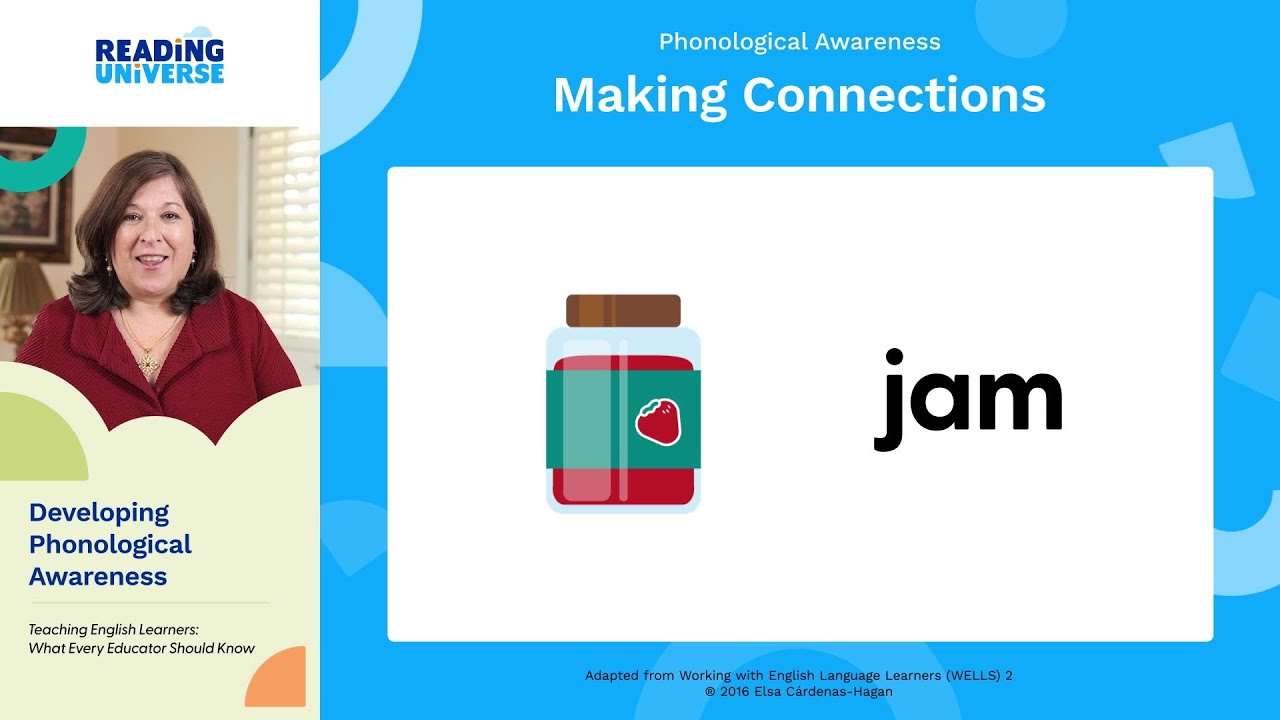
Can I form some words with those sounds and teach 'em those words, but have them process the sounds, produce the sounds, manipulate the sounds. And then that's going to be important because that tells us how well they're going to be able to decode and read. It's a foundational skill. And when we think about this, I'm going to start first with what they know, and then I'm going to start with some challenging sounds. So my phonological awareness instruction is going to look a little bit different because I'm going to specifically target a new sound. So I mentioned earlier that the sound /j/ is a challenging sound, right? So I'm going to say some words. Say the word ham. I want you to change the sound /h/ to /j/. What's my new word? Jam. Oh, it's that ... I have a picture of jam to show you. It's what I put on my toasted bread, and I can eat it and it's sweet. Jam. Say it again: jam. Very good. Say the word hog. Now change it to ... change the /h/ to /j/. What's my new word? Jog, kind of running in place. Let's all try and get up and run, run slowly. That's a jog.
Narrator: Now let's see what this looks like. Here's Dr. Cárdenas-Hagan working one-on-one with nine-year-old Emilio.
Dr. Elsa Cárdenas-Hagan: So I want you to, say this word after me. Say beanie.
Emilio: Beanie.
Dr. Elsa Cárdenas-Hagan: Very good. Now, I want you to change the first sound, /b/. Just listen. Can you change it to /j/?
Emilio: Genie.
Dr. Elsa Cárdenas-Hagan: Genie, like "I Dream of Jeannie." Do you know what a genie is? Tell me. Can you tell me in your words?
Emilio: It's like a ghost.
Dr. Elsa Cárdenas-Hagan: Like a ghost, okay. It's like a magical character that comes out and then can grant you all your wishes, right? Did you ever watch the movie "Aladdin"?
Emilio: No.
Dr. Elsa Cárdenas-Hagan: No? You never saw that? Oh, right. So that "Aladdin" had a genie. I'll have to show you something about "Aladdin," right? Let's say the next word. Say Kim.
Emilio: Kim.
Dr. Elsa Cárdenas-Hagan: Can you change the sound /k/ to /j/?
Emilio: Gym.
Dr. Elsa Cárdenas-Hagan: Gym. So I can work out at your school gym? Can you tell me a sentence with gym for your school?
Emilio: Can I go to the gym?
Dr. Elsa Cárdenas-Hagan: Can I go to the gym? That was an excellent sentence. My goodness. Say the word lent.
Emilio: Lent.
Dr. Elsa Cárdenas-Hagan: Can you change the /l/ to /j/?
Emilio: Gent.
Dr. Elsa Cárdenas-Hagan: Oh, he's such a gent. That kind of can be short for gentlemen, right?
Emilio: Yeah.
Dr. Elsa Cárdenas-Hagan: Can you say the word bell?
Emilio: Bell.
Dr. Elsa Cárdenas-Hagan: Can you change the /b/ to /j/?
Emilio: Gel.
Dr. Elsa Cárdenas-Hagan: What did you put in your hair this morning?
Emilio: Gel.
Dr. Elsa Cárdenas-Hagan: Gel. En español es gel. ¿Verdad? ¿Tienes gel?
Emilio: Sí.
Dr. Elsa Cárdenas-Hagan: ¿Sí? Very good. Can you tell me a sentence in English with the word gel?
Emilio: I put my gel.
Dr. Elsa Cárdenas-Hagan: I put my gel on ...
Emilio: ... my head.
Dr. Elsa Cárdenas-Hagan: On your ... on my head?
Emilio: Hair!
Dr. Elsa Cárdenas-Hagan: ... on my ...
Emilio: hair
Dr. Elsa Cárdenas-Hagan: ... on my hair. Let's put it all together. I put ...
Emilio: I put ...
Dr. Elsa Cárdenas-Hagan: ... the ...
Emilio: ... the ...
Dr. Elsa Cárdenas-Hagan: ... gel ...
Emilio: ... gel ...
Dr. Elsa Cárdenas-Hagan: ... on my ...
Emilio: ... on my hair.
Dr. Elsa Cárdenas-Hagan: Now you do it all by yourself. I ...
Emilio: I put my gel on my hair.
Dr. Elsa Cárdenas-Hagan: That was an excellent sentence, and you also got our new sound /j/.
So what did I do? I expanded my phonological awareness by targeting a new sound. I had them do manipulation. I expanded it with vocabulary. I gave them some visuals, I gave them some verbal support, and maybe we could even create a sentence with it to work on that oral language as we're working on phonological awareness. Can you see how we integrated language with phonological awareness? That is an example of what you can do in your classroom with this foundational skill called phonological awareness. You can build language while you're doing that skill, and you can be very targeted in your instruction.
