- Prefixes Skill Explainer
Practicing the 'e' Drop Rule During Dictation
Hide Video Transcript
Show Video Transcript
Khadijah Williams: All right. Now we're going to go ahead and begin our dictation portion of our lesson.
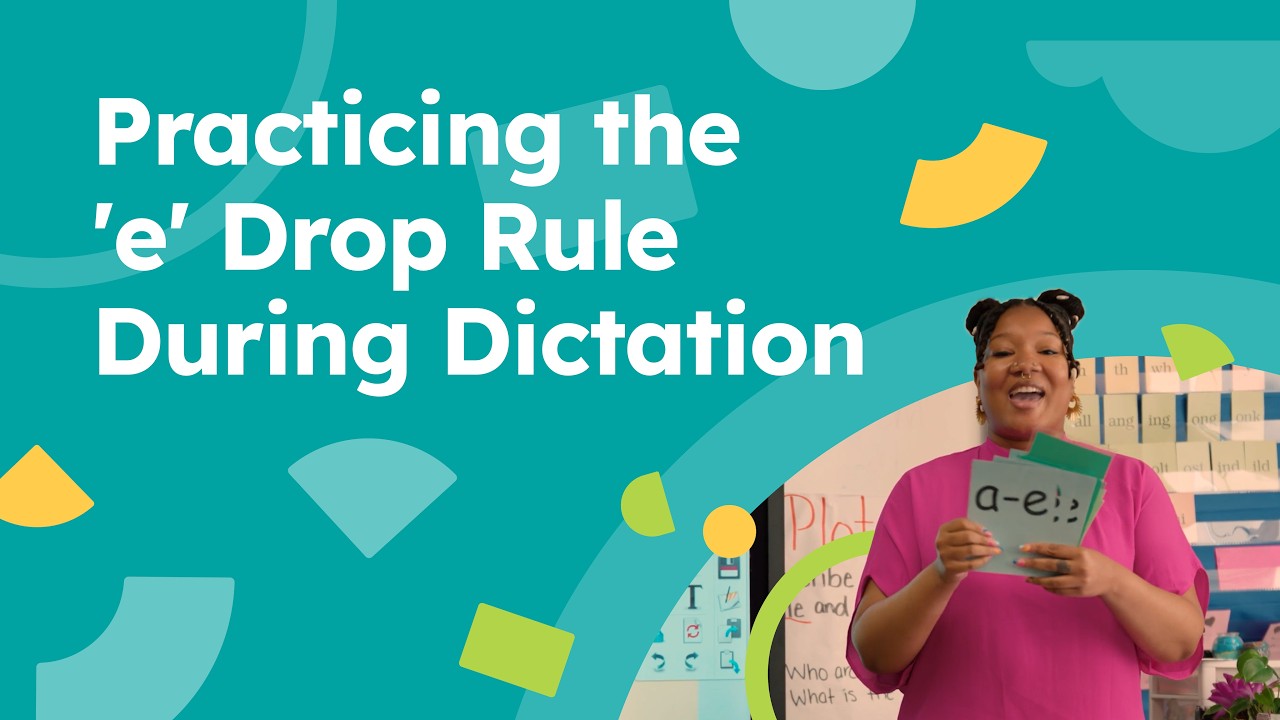
Narrator: When we add a suffix to a magic 'e' word, like adding suffix '-ing' to the word bake, students have a decision to make. Will the magic 'e' stay or will the 'e' drop and get replaced by the suffix? In this lesson, Hope-Hill Elementary teacher Khadijah Williams introduces her second graders to the 'e' drop rule, which turns a tricky spelling choice into a simple, reliable strategy.
Khadijah Williams: On that first blank line, I want you to write the base word, okay? And on that second line, I want you to write the either the consonant suffix or the vowel suffix. Okay? Number one, the base word is hope. Hope. Hope. Think about how that 'o' is saying its name. How do we spell hope?
Students: H-O-P-E.
Khadijah Williams: Very good. H-O-P-E. Hope. Very good. Hope. On that next line right here, I want you to add the suffix or write the suffix. That means "full of." The consonant suffix that means "full of." Kaya?
Kaya: F-U-L.
Khadijah Williams:
F-U-L. Very good.
Narrator: Before they can decide if the 'e' will stay or go, student's first job is to identify the suffix type. Is it a vowel suffix? A suffix that begins with a vowel, like suffix '-ed', suffix '-ing', or suffix '-er'. Or is it a consonant suffix, which begins with a continent like in suffix '-ful', suffix '-s', or suffix '-less'.
Khadijah Williams: We know that "hope" has a magic 'e', right? So we have to look at that suffix. Is that a constant suffix or a vowel suffix?
Students: Constant suffix.
Khadijah Williams: A constant suffix. So is 'e' going to stay or is 'e' going to go away?
Students: Stay.
Khadijah Williams: It's going to stay. Very good. So on your last line, you should have what?
Student: Hopeful.
Khadijah Williams: Hopeful. Very good. Hopeful. And the magic 'e' stays. Very good. And you can just put a macron, the macron over the 'o' so we know it's making its long sound. Very good. Number two. The root word is going to be very familiar. I want you to write hope. Hope. On that second line, I want you to write the suffix that means "happening now." "Happening now."
Narrator: Ms. Williams has a trick to help students remember when to use the 'e' drop rule. She tells them that when the magic 'e' sees a vowel, it runs away. When 'e' sees a consonant, it stays.
Khadijah Williams: We know that "hope" is a magic 'e' word, right? Now we have to look at suffix '-ing'. Is suffix '-ing' a vowel suffix or a consonant suffix?
Student: A vowel suffix.
Khadijah Williams: A vowel suffix. Right. So what are we going to have to do? So is 'e' going to stay or 'e' going to ...
Student: Drop.
Khadijah Williams: ... 'e' drop? Very good. 'E' has to go away, right? So how are we going to write that though? Can we spell it together?
Together: H-O-P-I-N-G.
Khadijah Williams: Very good. Because that 'e' had to go away, right?
Student: Yes.
Khadijah Williams:
An 'e' had to go away. So our new word is hoping. Very good. So go ahead and write "hoping." Make sure you have that magic 'e' hiding. Next word. I want you to write the word smile. Smile. Smile. How do we spell smile, Koyuki?
Koyuki: S-M-I-L-E.
Khadijah Williams: 'E'. Very good. Smile. Very good. Smile. And smile is a what kind of word? Magic ...
Students: 'E'.
Khadijah Williams: Magic 'e'. Very good. The suffix I want you to write is a suffix that means "in the past." In the past. What is it, Quentin?
Quentin: E-D.
Khadijah Williams: Suffix '-ed'. Great job. All right. Now "smile" is a magic 'e' word, right? But we have to look at our suffix. Is suffix '-ed' a vowel suffix or a consonant suffix? Mina?
Mina: Vowel suffix.
Khadijah Williams: A vowel suffix. So remember, when 'e' sees a vowel, it needs to go away. So we're going to have to ...
Students: 'E' drop.
Khadijah Williams: 'E' drop. Very good. So how are we going to spell smile?
Narrator: Notice what happens with the final 'e' in the base word "smile." We aren't simply adding the letter 'd'. The magic 'e' drops and is replaced with the suffix '-ed'.
Students: S-M-I-L-E-D.
Khadijah Williams: Very good because this magic 'e' is hiding. Okay? It's hiding. It's hiding. Very good.
Narrator: Reading Universe is made possible by generous support from Jim and Donna Barksdale; the Hastings/Quillin Fund, an advised fund of the Silicon Valley Community Foundation; the AFT; the Emily Hall Tremaine Foundation; and anonymous donors. Special thanks to Hope-Hill Elementary, Reading Is Essential for All People; and Atlanta Public Schools. If you enjoyed this video, please subscribe to our YouTube channel @RUTeaching. Reading Universe is a service of WETA, Washington D.C., the Barksdale Reading Institute, and First Book.
Khadijah Williams: My name is Khadija Williams, and this is Reading Universe.
