Hide Video Transcript
Show Video Transcript
Heather Adams: All right, so welcome back from lunch. I hope you had a good time.
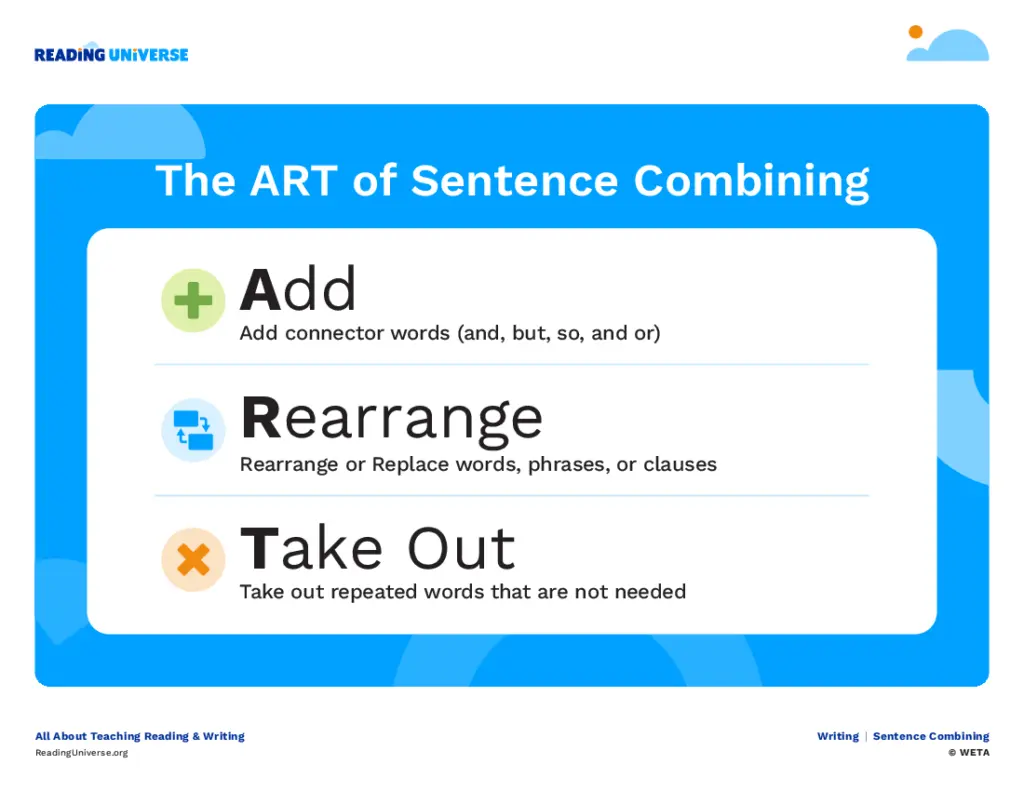
VO: Today, teacher Heather Adams at Oak Street Elementary is introducing her third graders to a powerful writing strategy. It's called the Art of Sentence Combining. When students combine two simple sentences, they have lots of choices to make and the "ART" mnemonic device can help keep them organized. "ART" stands for adding words using conjunctions or connector words, replacing or rearranging words for flow, and taking out repeated or unnecessary words.
Heather Adams: We talked about how we can turn our simple sentences into more interesting, complex sentences. And what did we learn about? What kind of words did we add into our sentences? We did some adding. What were those kinds of words? Say it if you remember.
Students: [overlapping] Conjuntions. Connecting words.
Heather Adams: I heard two answers. I heard "conjunctions." If you said conjunctions, pat on the back. And I heard "connecting words." If you said connecting words, also pat on the back. Conjunctions are connecting words, right? They allow us to combine our simple sentence ideas into a more sophisticated sounding sentence. Right? We also learned some other strategies. Sometimes we realize we should take out some words. We don't want to be super repetitive. And sometimes we even move them around or replace them. We used "they" or "it."
VO: Here's what this looks like in action. To combine the sentences, "The dog barked" and "The dog ran to the door," you can add the conjunction "and," rearrange the order so the action flows naturally, and take out the repeated use of "the dog" to create the complex sentence. "The dog ran to the door and barked."
Heather Adams: So we're going to be using all of these strategies that we talked about and these are just some different ways of sentence combining and there's not just one right way to do it. Remember last time some of us added different conjunctions or replaced different words. So we're going to get to have some fun and really just kind of show that artistic side of writing today. Here's a sentence that I have up here and I was looking at the important body parts part of my notes. So I wrote, "Tigers have sharp teeth. Tigers have sharp claws. Tigers have a tail." What's something you notice about the way those sentences are written?
Student: They're very short.
Heather Adams: Exactly. These sentences are really, really short. I noticed that too. What word do you notice that I used over and over? What word?
Students: [overlapping] "Have." "Tigers."
Heather Adams: "Tigers." Exactly. And "tigers" is repeated and every sentence starts with "tigers have," "tigers have," "tigers have." It almost makes my writing sound like another list. And we don't want our writing to sound like a list. A lot of you suggested that maybe I should use this powerful strategy. Adding conjunctions helps me to make simple sentences into combined, complex sentences. So let's try to see if maybe we can do better. Are there any details here that are related? Remember our "and" conjunction puts related ideas together. If you had to pick two related ideas here, what are kind of related? What are sort of related ideas in my simple sentences? Molly.
Molly: Sharp claws and teeth.
Heather Adams: Yeah. I noticed Molly, when she just said that, she said "sharp claws and teeth." Wow. Molly, first of all, deserves an air high five because I want to show you what Molly just did. "Tigers have sharp claws and teeth." So Molly not only added a conjunction, she took out a repeated word that wasn't really needed. It makes more sense and I think it sounds better. When I heard Molly's sentence, I was like, "That's it. It sounds right." So what we just did here was we used a few of these different strategies. We added conjunctions. We took out repetitive words that just didn't make our sentences sound polished. They didn't make our sentences sound sophisticated. We don't need to say "tigers" 800 times, right? We don't need to say, "tigers have this, tigers have this, tigers have this." We're going to use the power of conjunctions, the power of taking out unnecessary words, maybe even rearranging words or replacing them with words that sound better. And that's how we're going to start writing our first paragraph, our first part for each one of our animals.
VO: Reading Universe is made possible by generous support from Jim and Donna Barksdale; the Hastings/Quillin Fund, an advised fund of the Silicon Valley Community Foundation; the Emily Hall Tremaine Foundation; the AFT; and several anonymous donors. Special thanks to Keys to Literacy, Franklin Public Schools, and Oak Street Elementary located in Franklin, Massachusetts. If you enjoyed this video, please subscribe to our YouTube channel @RUTeaching. Reading Universe is a service of WETA, Washington D.C. and was developed in collaboration with the Barksdale Reading Institute and First Book.