Hide Video Transcript
Show Video Transcript
Hannah Tomassetti: All right, boys and girls, we have a new chart right here that has parts of a sentence.
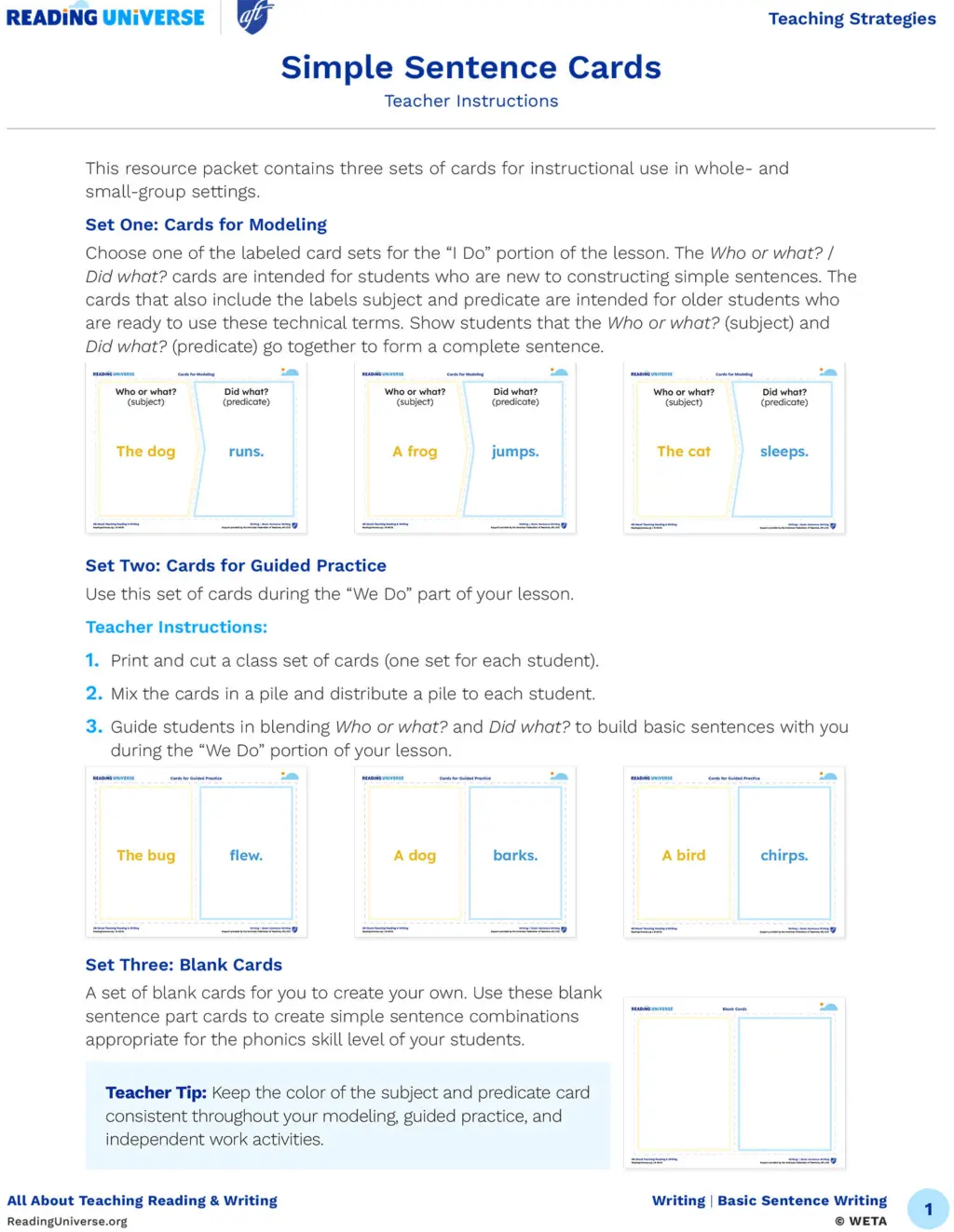
VO: Kindergarten is where sentence writing typically begins, but before you can write a sentence, you have to know all its parts. In this lesson, teacher Hannah Tomassetti is reviewing just that with her kindergartners at Orrville Elementary in Ohio.
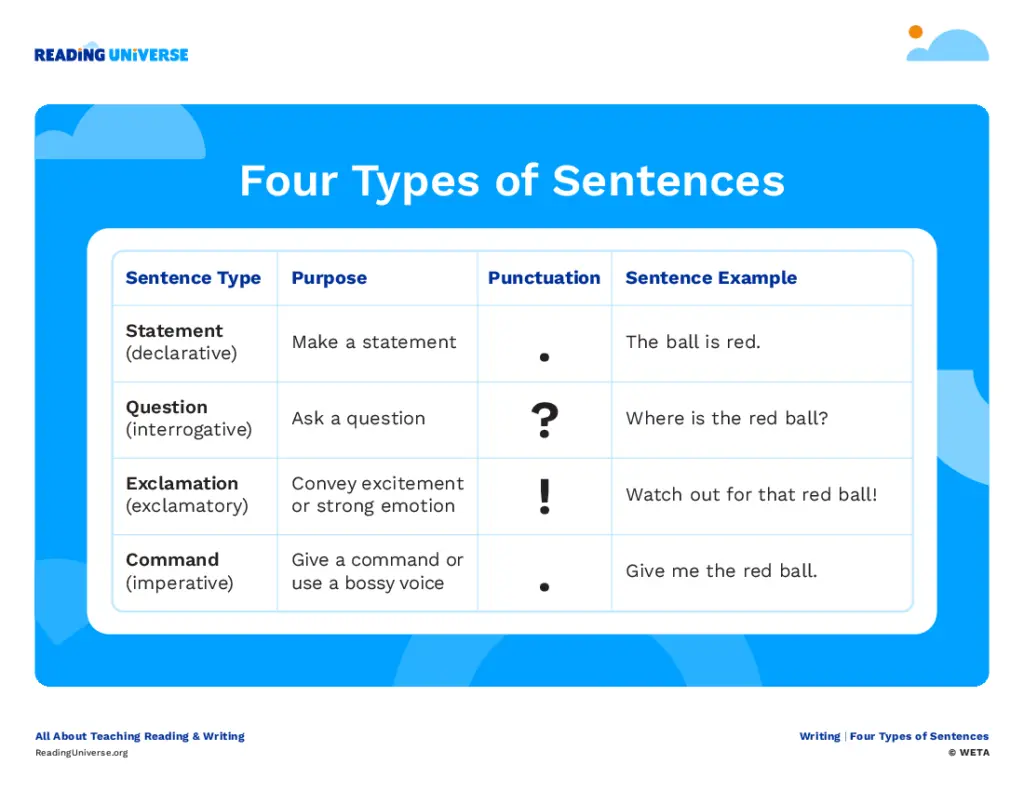
Hannah Tomassetti: But a sentence always needs a capital letter. Every time you start a sentence, I need a big uppercase letter. You always have to have an end mark. You can choose which one you think sounds better — period, question, or exclamation mark. Period just means I'm telling you something. Question mark means I'm asking you a question. I need an answer. An exclamation mark means I'm really excited. So if you want to say something with excitement, you want to use an exclamation mark.
VO: While no sentence is complete without capitalization and proper punctuation, the real stars of the show are the namer, the subject, and the action, the predicate.
Hannah Tomassetti: Next we have our naming part. Who is in the sentence? A beautiful cat or a beautiful person. And then you have your action. What is that person or animal doing in your sentence?
VO: To build in some practice, Ms. Tomassetti works through a couple of examples as a group, asking students to identify the parts of a sentence.
Hannah Tomassetti: So we're going to start with the first sentence and then I need hands to help me figure out the action and the naming part. Are you ready? I read, you echo. "The dog ran."
Students: "The dog ran."
Hannah Tomassetti: Who can raise their hand? And tell me, let's start with the naming part. Who is in my sentence? Zaiden, do you think you can tell me who's in my sentence? "The dog ran." Who's the naming part?
Zaiden: Dog.
Hannah Tomassetti: Very good job. So in this sentence is the dog. What is this dog doing? Stella, do you want to tell me what our dog did? He ...
Stella: Run.
Hannah Tomassetti: He runs or he ran. Very good job. I'm going to read sentence number two. I read, you echo me. So hands down because I haven't asked a question yet. "A cat sat."
Students: "A cat sat."
Hannah Tomassetti: Ooh, very good job. Who is in the sentence? Okay. Who's our naming part? Roxton in the back. Roxton, who is in our sentence?
Roxton: The cat.
Hannah Tomassetti: The cat. Very good job. So our naming part is the cat. Who can tell me the action? What is the cat doing or what did the cat do?
Ember: Sit down.
Hannah Tomassetti: Yes, he sat or is sitting down. I like that very good job, Ember.
VO: And the last step as always is to double check that each sentence has all the parts.
Hannah Tomassetti: So Ms. T had a naming part and an action part. So if I was to check these boxes off, I'd put a big check. Check. Do I have a capital letter in both?
Students: Yes.
Hannah Tomassetti: Yes. Check. Do I have an end mark in both?
Students: Yes.
Hannah Tomassetti: Check. You are all strong writers. Kiss your smart brains. I am very proud of you. Pat yourself on the back and say, I'm so proud of myself.
Students: I'm so proud of myself.
Hannah Tomassetti: Very good job. Thank you.
VO: Reading Universe is made possible by generous support from Jim and Donna Barksdale; the Hastings/Quillin Fund, an advised fund of the Silicon Valley Community Foundation; the Emily Hall Tremaine Foundation; the AFT; and several anonymous donors. Special thanks to Keys to Literacy and Orrville Elementary School located in Orrville, Ohio. If you enjoyed this video, please subscribe to our YouTube channel @RUteaching. Reading Universe is a service of WETA Washington D.C. and was developed in collaboration with the Barksdale Reading Institute and First Book.