Hide Video Transcript
Show Video Transcript
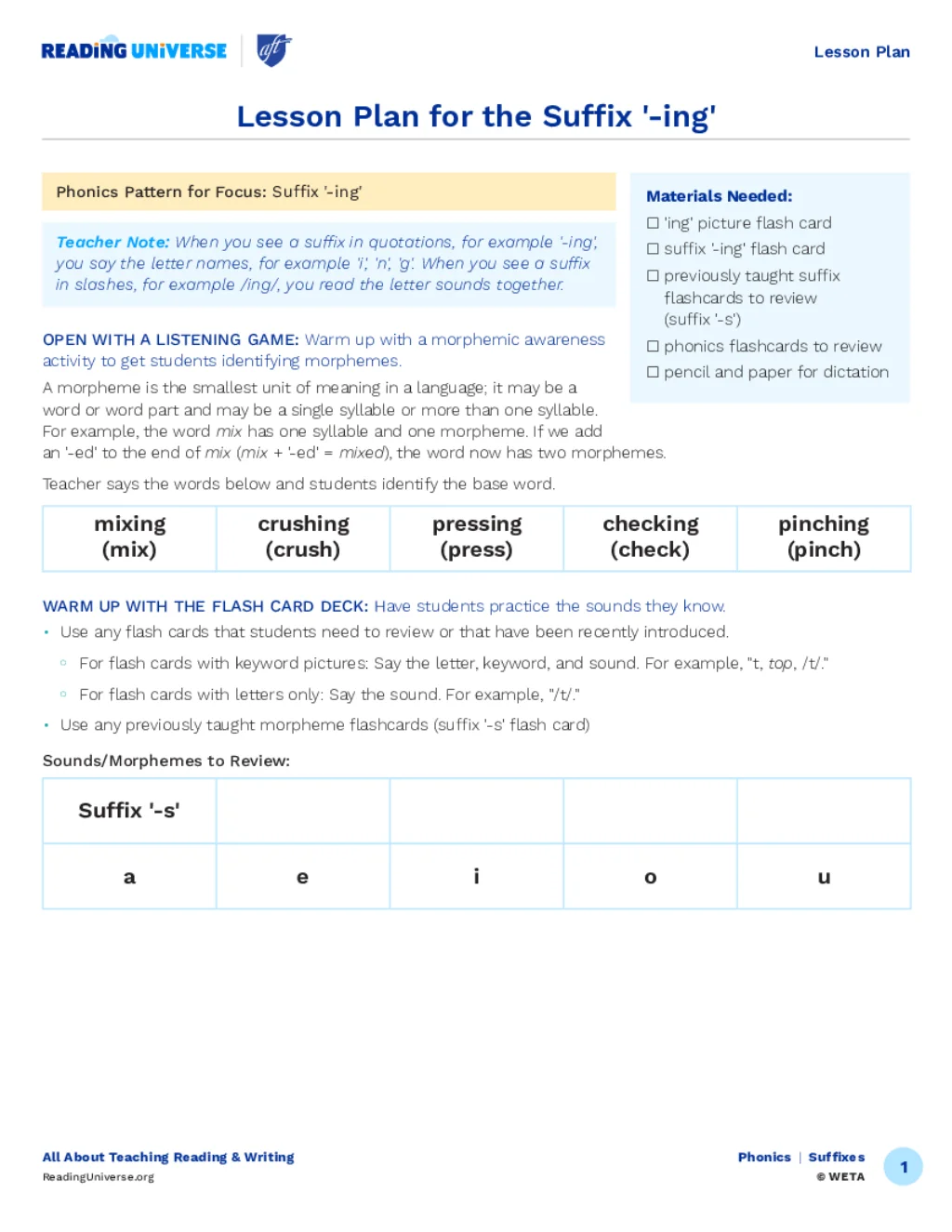
Carla Miller: Okay friends, we're going to start with some listening games. Are you ready?
Students: Yes.
Carla Miller: Okay. Did everybody bring their listening ears? Put 'em both on. One, two. Okay.
Narrator: First grade teacher Carla Miller has been teaching her students all about suffixes. Today she's getting ready to review the suffix '-ing'. She begins with a listening game.
Carla Miller: For listening games today, I'm going to give you a word and this word has a suffix at the end. Okay. I want you to give me the base word. What are you going to give me?
Students: The base word.
Carla Miller: Okay. Now I want you to listen and think about these words and see if you can think of something that all of these words have in common. Okay? The word is swimming. What word?
Students: Swimming.
Carla Miller: Base word?
Students: Swim.
Carla Miller: Good. The next word is flying. What word?
Students: Flying.
Carla Miller: Base word?
Students: Fly.
Carla Miller: Good job. The last word is flocking. What word?
Students: Flocking.
Carla Miller: Base word?
Students: Flock.
Narrator: Next, they warm up with flashcards including letter sounds and the suffixes they've been working on.
Students: /ch/.
Carla Miller: Good.
Students: /o͞o/
Carla Miller: Good job.
Students: /ē/.
Carla Miller: Sound.
Students: /ō/.
Carla Miller: Good.
Together: Suffix '-s'. /s/. /z/.
Students: Plural. More than one.
Carla Miller: Excellent.
Together: Suffix '-es' is ...
Students: Plural. More than one.
Carla Miller: Next one.
Together: Suffix '-ing'. /ing/. Happening now.
Carla Miller: Very good. Very good. Okay. Are you guys ready to read some words?
Students: Yes.
Carla Miller: Okay. During our listening games today, all of our words had suffix '-ing'. Right? So we're going to read some words that have suffix '-ing'. What word?
Students: Duck. Ducking.
Carla Miller: Good.
Students: Snack. Snacking.
Carla Miller: Good job.
Students: Splash. Splashing.
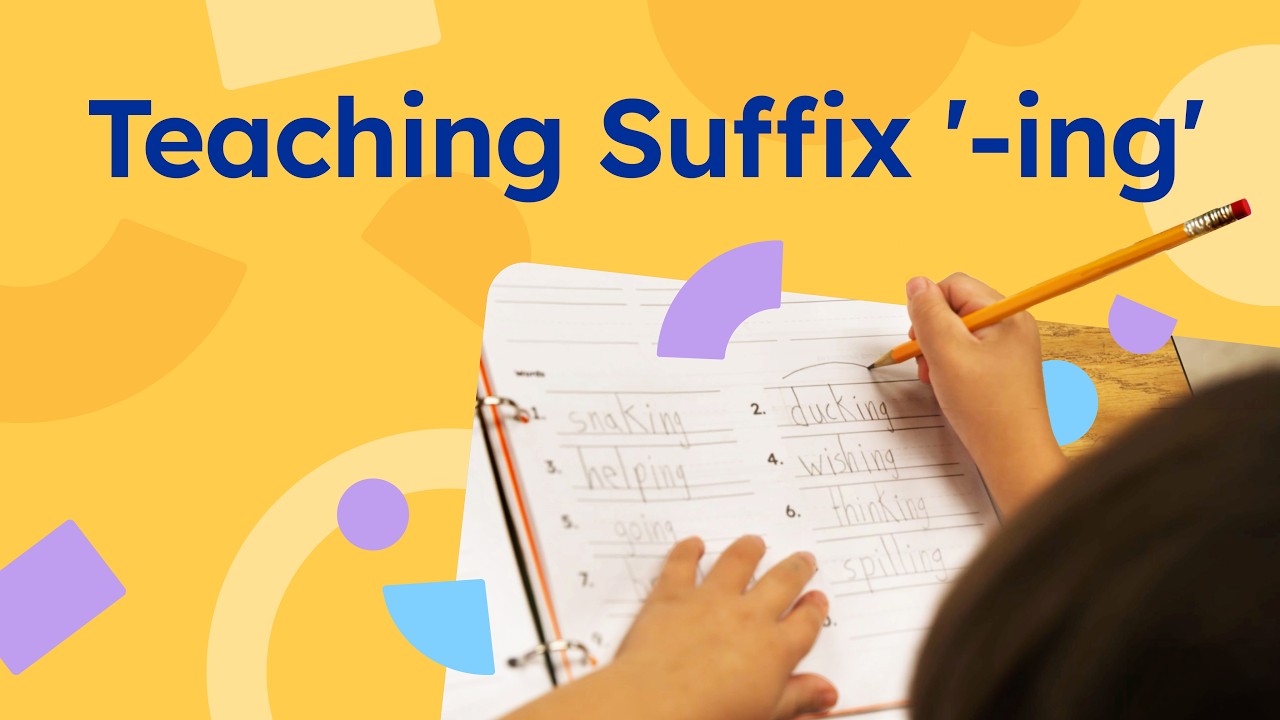
Narrator: Next up is word dictation, where they'll be spelling and writing their suffix '-ing' words.
Carla Miller: First word. The word is snacking. What word?
Students: Snacking.
Carla Miller: Base word?
Students: Snack.
Carla Miller: I want you to write snacking.
Narrator: Notice how Dr. Miller follows each '-ing' word with its base word. This helps students to spell the base word correctly before adding the suffix.
Carla Miller: Jude, can you spell snacking for me?
Jude: S-N-A-C-K-I-N-G. Snacking.
Carla Miller: Jude, when is this happening?
Jude: Now.
Carla Miller: It's happening right now. Good. If I'm snacking, I'm doing it right now. Okay. Next word. The word is wishing. What word?
Students: Wishing.
Carla Miller: Base word?
Students: Wish.
Carla Miller: Write "wishing." Can everybody spell wishing for me?
Students: W-I-S-H-I-N-G. Wishing.
Carla Miller: Excellent. Excellent. When is this happening? When am I wishing?
Students: Right now.
Carla Miller: Right now I'm wishing. Good job. Good job. Make sure your paper looks like my board.
Narrator: After students have worked through the full list of words, Dr. Miller asked them to read what they wrote.
Carla Miller: Okay, let's go ahead and read back our words.
Narrator: This gives students a chance to check their work against the board, and reinforces the sound spelling connection.
Carla Miller: First word.
Students: Snacking.
Carla Miller: Good.
Students: Ducking.
Carla Miller: Good.
Students: Helping.
Carla Miller: Excellent.
Students: Wishing.
Narrator: Now it's time to discuss meaning.
Carla Miller: I want you to look at these words. I want you to circle the word that means to cover for safety. You're going to cover your head for safety. Circle that word. What am I doing? Arla, what word did you circle?
Arla: Ducking.
Carla Miller: Ducking. Good. Can you say that one more time for me?
Students: Ducking.
Carla Miller: Ducking. Can you say ducking?
Arla: Ducking.
Carla Miller: If I'm ducking for cover, I'm going to cover my head for safety, right? If there was a ball coming at my head, I might have to duck. So if I'm doing it right now, the word is what?
Students: Ducking!
Carla Miller: Ducking. Ducking. I should have circled ducking.
Student: Not this duck. Quack, quack, quack.
Carla Miller: And not that duck. Good, good, good. Okay. One more word that I want you to think about. Okay. I want you to underline the word that means you're doing something to make a job easier. You're doing something ... you might do it for someone to make their job easier. Think about that for a second. Think about that for a second. Azaya, what word did you underline?
Azaya: Helping.
Carla Miller: Helping.
Narrator: All of these words were chosen intentionally. Dr. Miller chose "helping" to show that some words can have multiple meanings.
Carla Miller: Friends, can I tell you something about the word helping? There is another definition for helping. So as I underline that word, because we know that if I'm helping somebody, I might be making their job easier, right?
Student: Yeah.
Carla Miller: But I could also use the word helping in a different way. Last week during Thanksgiving, last week, I asked for an extra helping of turkey. I wanted an extra helping of turkey. Who can tell me what do you think helping means if I wanted an extra helping of turkey? Aurora?
Aurora: You wanted another piece?
Carla Miller: I wanted another piece. Exactly. I wanted another serving. So helping could mean making something easier for somebody or helping could mean I want another serving. When I like something and it's super yummy, I want another helping.
Narrator: Next, during the fluency section of the lesson, Dr. Miller takes the opportunity to weave in some elements of grammar. They'll be talking about who or what each sentence is about. This helps students build the skills they'll need to understand more complex sentences later.
Carla Miller: We're going to look at some sentences that have suffix '-ing' in them. Eyes on the board. Let's go ahead and read.
Together: "The kid is snacking."
Carla Miller: Very good. Next sentence.
Students: "I am snacking."
Carla Miller: Good job. Eyes on the board, please. Next sentence.
Together: "The kids are snacking."
Carla Miller: Okay, so we have learned that every single sentence has a who or what, and it has a does what, right? All of my sentences have two parts. I have a who or what and a does what. What do all of these sentences have in common? I'm going to call on my friend over here, Monroe. What do they all have in common?
Monroe: They all have the word snacking.
Carla Miller: They all have the word snacking. Thumbs up if you see that. Thumbs up if you see that they all have snacking. Very good.
Narrator: By keeping the action, the did what, consistent for each sentence, Dr. Miller is able to focus students' attention on the subject. The who or the what each sentence is about.
Carla Miller: We know snacking is our does what? That's what's happening in the sentence. I want everybody to tell me, who is this sentence about?
Students: The kid.
Carla Miller: The kid. Good. The next sentence. I am snacking. Who is this sentence about? I. Very good. Thank you to all my friends that I can hear. I want to hear everybody. The last one, let's see who can get this one. The last sentence is the kids are snacking. Who is this sentence about? So good. The kids, you got it.
Narrator: Now Dr. Miller points out something special in sentences that have a suffix '-ing' action. The helping verb.
Carla Miller: I want everybody to notice there's a little, small little word in each sentence right before snacking. Does everybody ... Touch your nose if you see that word. Touch your nose. It's a little word here right before snacking. That word is helping out the verb, which the does what is our verb, right? Snacking is our verb. That word is helping out our verb. That little word is called a helping verb. Everybody say helping verb.
Students: "Helping verb."
Carla Miller: These ... snacking needs a little help to show that it is an action. Okay? So in this sentence, the word is is our helping verb. So when we see "is snacking," that is our does what. That's what's happening in the sentence. That's what we're doing in the sentence.
Narrator: On top of the steps that anchor every phonics lesson — the listening game, warming up with flashcards, word dictation and fluency — Dr. Miller also worked in word meaning, words with multiple meanings, sentence structure, and the helping verb.
Carla Miller: You guys did such a great job. I think we deserve an "oh yeah!" What do you think?
Students: Yeah!
Carla Miller: One, two, three.
Students: Oh yeah!
Carla Miller: Oh yeah! Good job guys.
Narrator: Reading Universe is made possible by generous support from Jim and Donna Barksdale; the Hastings/Quillin Fund, an advised fund of the Silicon Valley Community Foundation; the AFT; the Emily Hall Tremaine Foundation; and anonymous donors. Special thanks to Burgess-Peterson Academy, Reading Is Essential for All People, and Atlanta Public Schools. If you enjoyed this video, please subscribe to our YouTube channel @RUTeaching. Reading Universe is a service of WETA Washington D.C., the Barksdale Reading Institute, and First Book.
Carla Miller: I'm Dr. Carla Miller and this is Reading Universe.