- Vocabulary
Teaching English Learners: Using Cognates to Teach Vocabulary
Hide Video Transcript
Show Video Transcript
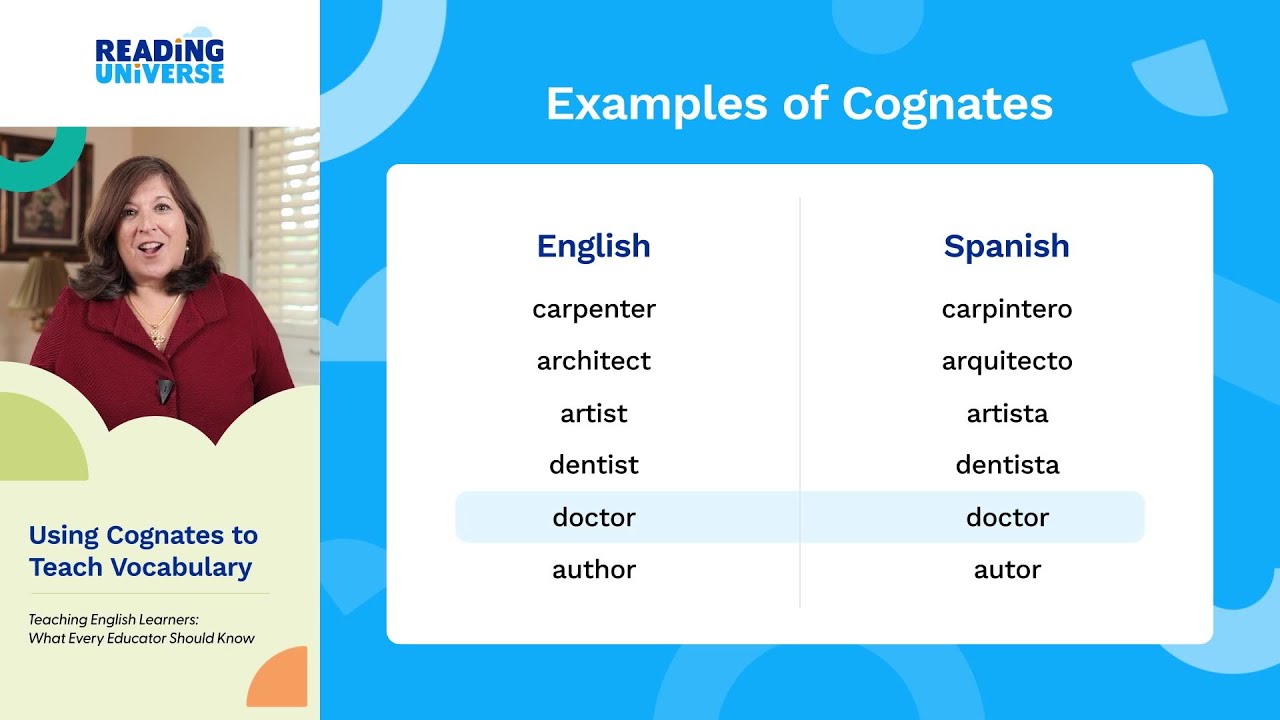
Now, I'd like to speak to you about vocabulary and some of the best word learning strategies for vocabulary building amongst English learners. One of the best strategies includes cognates and what we call cognate awareness. What's a cognate? A cognate is a word that looks very similar across languages, similar in spelling, and it's also similar in meaning. And there are many cognates that exist across languages, and they can be related to English words. And so this cognate awareness can really help our students. And I give an example of canoe and how in the Spanish language it's canoa, right? And in other languages you can actually picture the word in German, even in Vietnamese, that word for canoe. But we have to be careful about what we call false cognates. False cognates are words that look similar in spelling, but they're not quite the same meaning. So one of the famous ones between Spanish and English would be embarrassed, embarazada. One means you're embarrassed. The other one means you're pregnant, right? So you got to look up. Don't forget, don't just assume because they look similar in spelling that they're similar in meaning. And one of the ways that you can help the students is by thinking about cognates and introducing them around a central idea. For example, when I speak, for example, about occupations, and I think about, wow, look at all the words that are similar, especially in the Spanish and English language. Some report that it's 25% or 30% of words can be cognates. But here's what I want to tell you. I can study about occupations. Here's my central topic. And I might have word like a carpenter. In Spanish, that would be carpintero. In English, I can say architect. And that would be arquitecto, right? Or "docTOR," doctor. So when we think about cognates, it's very wonderful to introduce them. But I want to go a step further with the cognates. So let's think about that word carpenter. Let's make sure you processed it correctly. "Car-pen-ter." Put your hand under your chin. Let's see how many syllables it has in English: "car-pen-ter." Ah, you open your mouth how many times? "Car-pen-ter." Three times. Ah, it has three syllables. Let's try it in Spanish. "Car-pin-te-ro."
Ah, how many times did you open your mouth? This time it was four. There was actually four vowel sounds. Every time you're producing a vowel sound and every time you're opening your mouth, that's a syllable, cause every syllable has one sounded vowel. So that's how it's different. Carpenter. Carpintero. Right? I can also have them think about the sounds in the word carpenter. Let's see, students. Can you get the sounds? We're getting at the phonology, the sounds. /c/-/ar/-/p/-/ĭ/-/n/-/t/-/er/. How many sounds? Seven. Now let's see in the Spanish language. Be careful with this one: /c/-/a/-/rr/-/p/-/ē/-/n/-/t/-/ĕ/-/⟨r⟩/-/ō/. That's like nine. So we had more sounds, right, and more syllables in the Spanish language. And really it is true if you look at English words and words that are fancy words and have lots of syllables are probably Latin based words. And that's a hint to you that I can make a connection and maybe a possible cognate there.
Now, I not only want to get to the sounds and the syllables, the phonology, I want to get to the meanings. What is a carpenter and what does a carpenter do? I needed some cabinets for my kitchen. And the carpenter came and he brought the wood and he made the beautiful cabinets in my kitchen. That is what a carpenter can do. Now, can you use the word carpenter in a sentence? I described what happened in my kitchen. Can you think of how you would express that? The carpenter created beautiful cabinets for the kitchen. Very nice. Now a carpenter is a person, right? So that's a noun, and you used it as a noun in that sentence. So here I'm not only teaching the cognates, I brought in the sounds, I brought in the words, I brought in the word meanings. We're thinking about if there's any meaning units in there. We're also thinking about using it in a sentence and making sure we used it as a noun. And so that is bringing in language skills while I'm teaching this wonderful strategy for English learners. It's so useful. Some of the best word learning strategies: cognate awareness, having an awareness that these words across languages are similar in spelling and meaning.
