Hide Video Transcript
Show Video Transcript
Sarah Hughes-Green: All right, my friends, we are going to be reading chapter 10 today of our novel "Finding Someplace." Before we start, we're going to learn a new vocabulary word. The word is fragments. Can everyone say fragments?
Students: Fragments.
Sarah Hughes-Green: Beautiful.
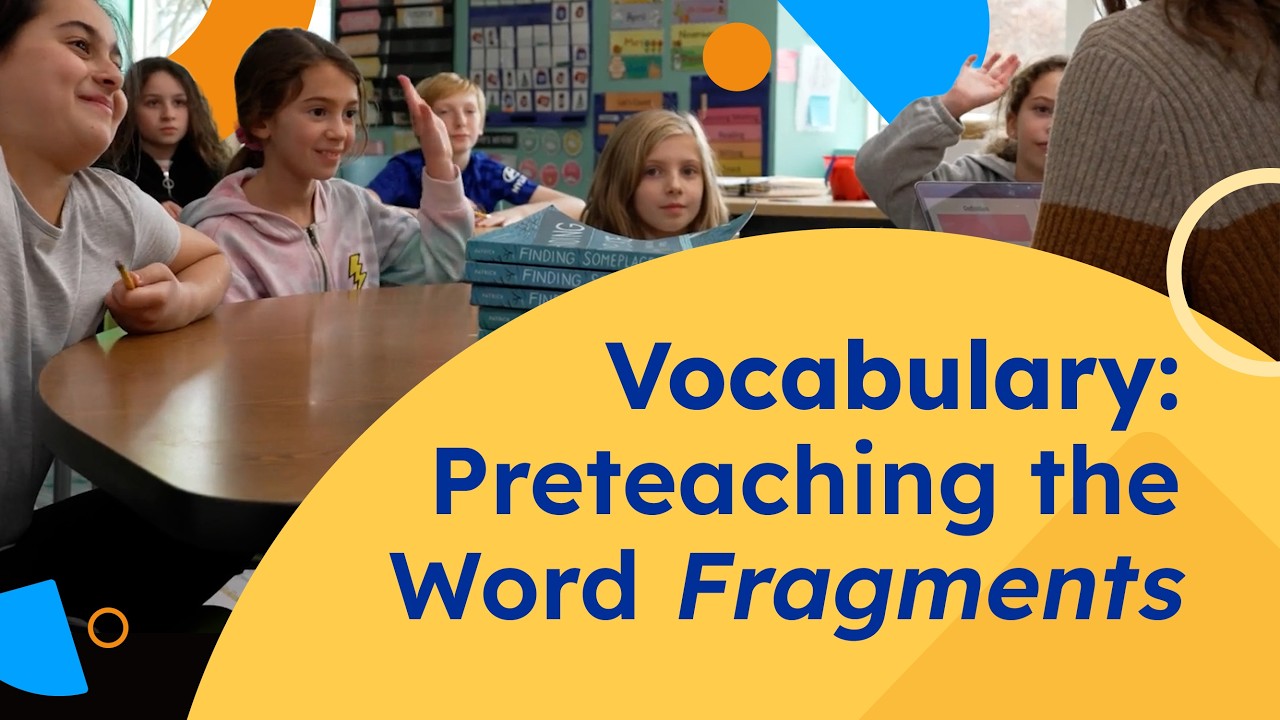
VO: At AIM Academy in Conshohocken, Pennsylvania, fourth grade teacher Sarah Hughes-Green is pre-teaching the vocabulary word fragments to our students before they come across it in the novel they're reading. That way they'll be more likely to understand the story. Using a graphic organizer called a word map, Ms. Hughes-Green guides her students through the features of the new word, beginning with a part the students already know.
Sarah Hughes-Green: So when we look at the word fragments, do you notice any suffix on the word fragments? What suffix do you notice, Maggie?
Maggie: 'S'.
Sarah Hughes-Green: Yes. What does it mean when we see the suffix '-s' on a word, Emerson?
Emerson: More than one.
Sarah Hughes-Green: Yeah. More than one. So we know that "fragments" is going to be more than one of something, right? Okay. So the definition of fragments is small pieces of something that has been broken. So I'm going to show you a couple of pictures that go with this definition and I want you to think what are their fragments of? So with a quiet hand, what's one thing you might see fragments of?
Student: Pieces like broken pieces of glass.
Sarah Hughes-Green: Yeah. So there's some fragments of a glass that broke. What else do we see fragments of, Lily?
Lily: Like a pot.
Sarah Hughes-Green: Yeah, fragments of pottery. So these are all things that were whole and were broken and now they are in fragments. So a sentence that we could use to help us understand this might be, "I had to clean up all of the glass fragments after I dropped my cup." So we had a cup, we dropped it and it broke and now it is fragments of glass on the ground.
VO: Notice how many times Ms. Hughes-Green uses the word "fragments" as she teaches the lesson. Next, she talks about the role the word fragments plays in a sentence. Its parts of speech.
Sarah Hughes-Green: Do we think fragments is a noun, a verb, or an adjective? So I want you to show me with your fingers. Is it a noun, a verb or an adjective? What do you think based on what we have learned about the parts of speech? [Students hold up one, two, or three fingers to indicate their answer.] Okay. I see everyone is showing me one finger for nouns. So are fragments a person, a place, a thing, or an idea? Which one is it, Maggie?
Maggie: Things.
Sarah Hughes-Green: They are a things. Yeah. So fragments are a noun. What is a synonym for fragments? So something that means the same thing as fragments, Sydney?
Sydney: Maybe like pieces.
Sarah Hughes-Green: Pieces, absolutely. Emerson?
Emerson: Like bits.
Sarah Hughes-Green: Oh, bits is a good one, too. So some other ideas, pieces I know someone said, and remnants is kind of a fancier synonym. And then the opposite, the antonym of fragments, which is kind of tricky. So I'm just going to tell you, is entirety. It's hard to come up with one word to mean the opposite of fragments.
Student: Whole.
Sarah Hughes-Green: Whole is similar. Yep.
VO: A definition tells you what a word means, but including synonyms and antonyms helps build a network around the word, deepening understanding.
Sarah Hughes-Green: I have our vocabulary recording pages. You are going to be writing the word fragments. What word are we writing?
Students: Fragments.
Sarah Hughes-Green: Next to the definition, "small pieces of something that has been broken." We're going to draw or write something to help us remember what fragments means. So think for a second, what might you draw? Anyone have a thought on what they might draw? Lily?
Lily: Like pieces of something.
Sarah Hughes-Green: Pieces of something. Anyone have a different thought of what they might be drawing?
Student: Glass falling from a shelf.
Sarah Hughes-Green: Awesome. Okay. So I'm going to give you maybe, a lot of you are already on the picture, so maybe one more minute to work on this.
VO: Drawing a picture might seem like it's a break, but it's not. Asking students to think about the word and draw their own example of it helps encode the meaning in their memory.
Sarah Hughes-Green: All right. So as we read today, we're going to be on the lookout for the word fragments.
VO: All this groundwork was leading here. Students ready to hunt for the word where it lives in a story.
Sarah Hughes-Green: "Watch out for the glass, Dré warned. A tree limb had crashed through the roof and ceiling. Light rain was pattering through the leaves. Part of the tree had taken out the window near Ms. Martine's bed and landed on her chifforobe. The window glass had exploded into dozens of tiny fragments that were sprinkled all over everything in the small room. Reese's sneakers crunched on the floor." So what has happened in Ms. Martine's bedroom? What has happened in the bedroom, Sydney?
Sydney: A tree fell on it.
Sarah Hughes-Green: A tree fell on the roof and ... Louden?
Louden: There were fragments.
Sarah Hughes-Green: Fragments of what?
Louden: Glass.
Sarah Hughes-Green: Yeah. So when the tree hit the roof, it broke the window, and now there are glass fragments all over the floor and the bed and Reese's sneakers are crunching as she walks on these fragments.
Student: Isn't that really dangerous because a piece of glass can go through your shoe?
Sarah Hughes-Green: It's not safe. You're correct.
VO: Learning what an individual word means is not the finish line. It's one step on a longer journey toward the ultimate goal of understanding what we read.
Sarah Hughes-Green: All right, middle of page 76. "This is bad, Miss M. ..."
VO: Reading Universe is made possible by generous support from Jim and Donna Barksdale; the Hastings/Quillin Fund, an advised fund of the Silicon Valley Community Foundation; the Emily Hall Tremaine Foundation; the AFT; and several anonymous donors. Special thanks to AIM Academy and the AIM Institute for Learning and Research in Conshohocken, Pennsylvania. If you enjoyed this video, please subscribe to our YouTube channel @RUTeaching. Reading Universe is a service of WETA Washington D.C. and was developed in collaboration with the Barksdale Reading Institute and First Book.
