1. An Overview of Schwa
Schwa Skill Explainer
Sarah E. Martin Ed.D.What is schwa?
Introducing Schwa
Watch instructional coach Dr. Carla Miller use the "Call the Dog" strategy to help her second graders identify where that tricky, unstressed vowel sound, or schwa, can be found in multisyllabic words … with plenty of practice along the way.

Hide Video Transcript
Show Video Transcript
Dr. Carla Miller: Good morning, guys.
Students: Good morning.
Dr. Carla Miller: Today we're going to start by drilling our deck. Okay. Short sound.
Students: /ĕ/.
Dr. Carla Miller: Long sound.
Students: /ē/.
Dr. Carla Miller: Short sound.
Students: /ĭ/.
Dr. Carla Miller: Long sound.
Students: /ī/.
Narrator: How many sounds can a vowel make? Based on the rules our students have learned about sound-letter correspondence, it might seem like an easy question with a predictable answer.
Dr. Carla Miller: Each of these vowels had how many sounds?
Students: Two.
Dr. Carla Miller: Two sounds. All of them had two sounds.
Narrator: But then along comes schwa. Schwa is the sound of an unstressed vowel, like /ŭ/, in sofa or /ĭ/, in basket. Watch as instructional coach Dr. Carla Miller teaches our students to be flexible with the rules and spot where schwa might be hiding in multisyllabic words.
Dr. Carla Miller: So vowels can actually make a short sound, a long sound, and they can also make a sound called schwa. Everybody say schwa.
Students: Schwa.
Dr. Carla Miller: Schwa. So they can make that third sound called schwa. Before we talk about schwa, we're going to talk about multisyllable words. So I want to tell you today how you can figure out what the stressed part of a multisyllable word is and the unstressed part of the multisyllable word. Do you want to know? You want me to tell you?
Students: Yes.
Dr. Carla Miller: Okay. So I have a dog. His name is Carson. What's his name?
Students: Carson.
Dr. Carla Miller: When I call my dog, I say "Carson!" Okay. Can you call the dog with me?
Together: Carson!
Dr. Carla Miller: Okay. So I want you to think about how I said that word. "Car-." I gave it a lot of attention, right? I gave all the air to the "Car-" part of the word, and then "-son." It was quieter. It was more relaxed, right? So let's try it again.
Together: Carson!
Dr. Carla Miller: Okay. So "Car-" is the stressed part of the word, right? I gave it all my attention, all my focus. It had all the air. And then "-son" was a quieter part of the word. It's unstressed. Okay? So what we're going to do today is we're going to figure out the stress part and the unstressed part of a couple of different words. Are you ready for me?
Student: Yes.
Dr. Carla Miller: Okay. I'm going to give you a word. I'm going to say it, and then we're going to call it like we're calling the dog. You ready? Okay. The first word is teacher. Ready to call the dog?
Together: Teacher!
Dr. Carla Miller: Good. Did you hear that stressed part of the word? That TEAcher! That "teach-" was the stressed part of the word, and "-er" was that quieter, unstressed part of the word
Narrator: Calling the dog helps students tune into which syllable is stressed and which is unstressed.
Together: Recess!
Narrator: And that unstressed syllable is where schwa often lives.
Dr. Carla Miller: Schwa is the sound that a vowel makes in that unstressed part of the word. Remember that unstressed part where we took all of the air out? Schwa is that sound. So when schwa is making that sound, it's actually taking the sound of another vowel. I'm going to write Carson on the board. Remember my dog Carson?
Student: Yes.
Dr. Carla Miller: Let's call him one more time.
Together: Carson!
Dr. Carla Miller: Okay. So which part of that word was stressed?
Students: "Car-."
Dr. Carla Miller: "Car-." This was my stressed part of the word. So this means that this part of the word has to be my unstressed part of the word. Correct? So I said Carson! Did I say "car-son"?
Students: No.
Dr. Carla Miller: What sound was the 'o' making when I said ...
Student: /ĭ/.
Dr. Carla Miller: What sound was it making?
Student: /ĭ/
Dr. Carla Miller: It was actually making the /ĭ/ sound. So in the unstressed part of the word, the 'o' is taking the sound of another vowel. And instead of saying /ŏ/, it's actually saying /ĭ/. And we mark that with a schwa symbol. And that is an upside down 'e'.
Narrator:
And because the unstressed /ŏ/ or /ĭ/ sound that schwa makes can be spelled by any vowel, it's important students get direct, explicit instruction and lots of opportunities to practice.
Dr. Carla Miller: Here's some words that you probably know where the 'a' is making its schwa sound. Everybody say pizza.
Students: Pizza.
Dr. Carla Miller: What sound is that 'a' making?
Students: /ŭ/.
Dr. Carla Miller: /ŭ/. Excellent. That is my schwa. Everybody say about.
Students: About.
Dr. Carla Miller: What sound is the 'a' making?
Students: /ŭ/.
Dr. Carla Miller: /ŭ/. Good. Let's go to the next one. Children.
Students: /ĭ/.
Dr. Carla Miller: /ĭ/. Good. So in the unstressed part of the word, the 'e' is taking the sound of another vowel. So if I said, Children! ... everybody.
Students: Children!
Dr. Carla Miller: That 'e' is making its schwa sound. So most of the time when you hear the schwa sound, it's going to either say /ĭ/ or /ŭ/. What are the two sounds you're going to hear?
Students: /ĭ/ or /ŭ/.
Dr. Carla Miller: Very good. So before we go on, I want to talk about the three things that we've learned already. We know that vowels can make how many sounds?
Students: Three.
Dr. Carla Miller: Three different sounds. Good. We know that in a multisyllable word we hear a stressed part of the word and an unstressed part of the word. And then we also know that a schwa is a special vowel sound in the unstressed part of the word. And when you hear that vowel sound, it's taking the sound of another vowel. Most of the time when you hear the schwa in the word, what two sounds do you hear?
Students: /ŭ/, /ĭ/.
Dr. Carla Miller: /ŭ/ and /ĭ/. Good. You guys are doing an amazing job. And the last thing I wanted you to remember — when you see this symbol, this tells us that the vowel is going to schwa
Narrator: Time to put the skills they just learned to work. Dr. Miller gives her students a word, they "call the dog," and then mark where they hear schwa.
Dr. Carla Miller: The word is carpet. What word?
Students: Carpet.
Dr. Carla Miller: Call the dog.
Together: Carpet!
Dr. Carla Miller: Which part of the word is unstressed?
Together: "-pet."
Dr. Carla Miller: "-pet." Very good. Can you mark your 'e' with the schwa symbol? Good, Daniel. The last one is problem. Which one is unstressed? You want to do it again, Bobby? Problem.
Together: Problem!
Dr. Carla Miller: What sound is the schwa 'e' making?
Students: /ŭ/.
Dr. Carla Miller: /ŭ/. It's making that /ŭ/ sound. Very good.
Narrator: Schwa might be tricky; but with some flexibility, guidance, and plenty of practice, students can learn to read these kinds of words.
Dr. Carla Miller: Guys, you learned so much today. You did an amazing job. And now you know all about schwa!
Narrator: Reading Universe is made possible by generous support from Jim and Donna Barksdale; the Hastings/Quillin Fund, an advised fund of the Silicon Valley Community Foundation; the AFT; the Emily Hall Tremaine Foundation; and anonymous donors. Special thanks to Burgess-Peterson Academy, Reading Is Essential for All People, and Atlanta Public Schools. If you enjoyed this video, please subscribe to our YouTube channel @RUteaching. Reading Universe is a service of WETA, Washington D.C., the Barksdale Reading Institute, and First Book.
Dr. Carla Miller: I'm Dr. Carla Miller, and this is Reading Universe.
How Schwa Works
Say the word salad out loud and listen to the vowel sounds:
The schwa sound in oral language often goes unnoticed. Our mouths naturally make the sound to allow our speech to flow. But reading and spelling these words is more difficult. We need to be flexible in our vowel sounds, something that students need practice with to apply the skill independently. Take a look at the following list of common words that students might have in their vocabulary but could stumble on how to read and spell the schwa sound.
| Sample Word | Unstressed Syllable | Expected Vowel Sound | Schwa Sound |
|---|---|---|---|
| salad | -ad | /ăd/ … rhymes with bad | short, quick /ĭd/ … /əd/ |
| basket | -ket | /kĕt/ … rhymes with bet | short, quick /kĭt/ … /kət/ |
| fossil | -sil | /sĭl/ … rhymes with pill | short, quick /sŭl/ … /səl/ |
| cotton | -ton | /tŏn/ … rhymes with con | short, quick /tĭn/ … /tən/ |
| cactus | -tus | /tŭs/ … rhymes with fuss | short, quick /tĭs/ … /təs/ |

Teacher Tip
The Origin of Schwa
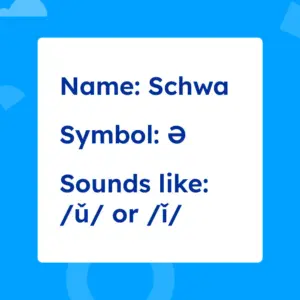
The word schwa comes from a Hebrew word that means "emptiness" or "nothingness," and that is exactly how this sound exists in words. It's an emptied out vowel, a sound with the stuffing taken out of it, as Dr. Louisa Moats says.
When we notate pronunciation, we represent schwa with an upside down 'e': /ə/.
Finding the Unstressed Syllable
Schwa can happen in any unstressed language. In English we do not use accents or stress marks when we spell words, which can make reading and spelling the schwa sound difficult.
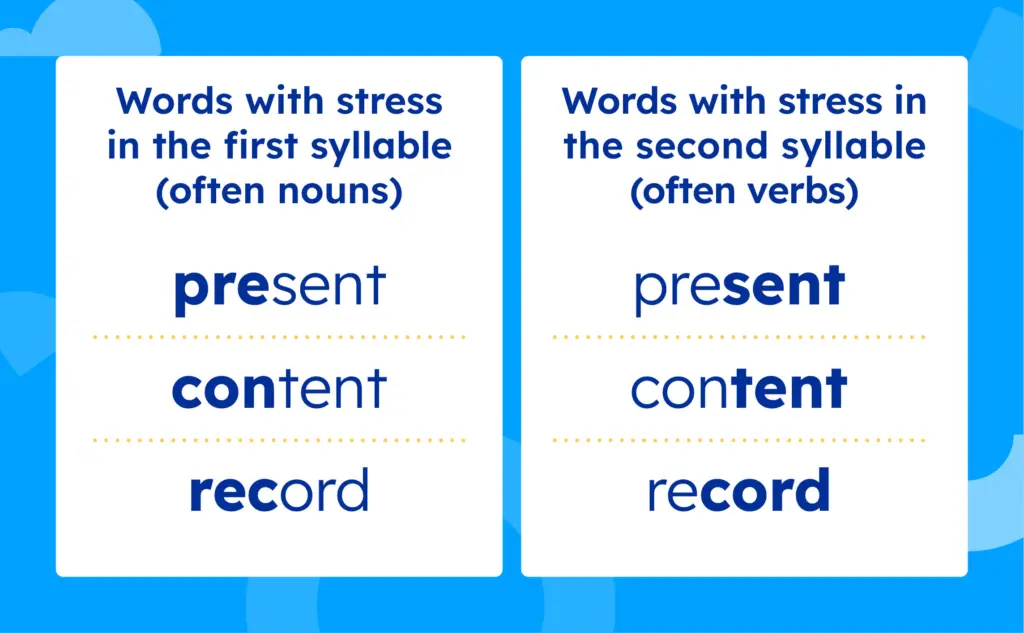
It can become even more challenging with heteronyms, words that are spelled the same but have different pronunciations and meanings. This group of words can often have a schwa sound in the unstressed syllable. Listen for example, to the two pronunciations of the word content.