- Grammar
Tracing the Who or the What - Part 3: Sentence Detectives
Hide Video Transcript
Show Video Transcript
Carla Stanford: We have a passage. We're going to read it together. We're going to identify the "who" or "what," and we're going to have to be word detectives.
Narrator: At Burgess-Peterson Academy, third graders are learning how to track the subject, the "who" or "what," through a story. Teacher Julie Turner and reading specialist Carla Stanford have already taught them how writers use pronouns and synonyms to avoid repetition. Now students get a chance to practice identifying those in a passage.
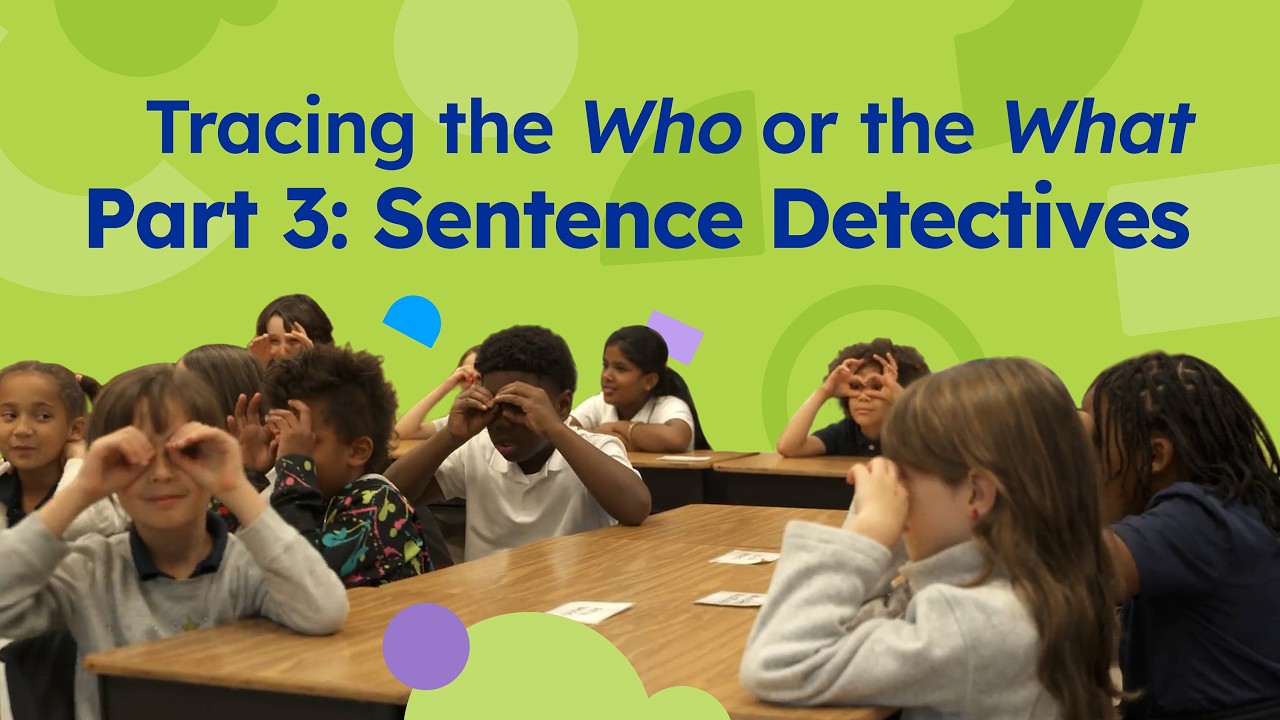
Carla Stanford: Reach in your pocket. Pull out your word detective glasses. Put them on. We're going to be "who" or "what" word detectives. Are you ready?
Julie Turner: Let's read it together. Ready?
Everyone: "After 50 years, white and yellow flowers bloom atop the cactus. The blooms will open for one night only. They attract birds, bees, and bats who are all looking for nectar. The flowering part dries up after a month."
Carla Stanford: Who or what is this passage about? Why don't you turn and talk to your partner and work this thinking out? I want to hear some debates and thinking. Who do you think? What is this about? The white and yellow flowers. These friends have a decision about the 'who" or "what," so let's listen to their thinking and see if we agree. Can you share girls?
Students: The white and yellow flowers.
Carla Stanford: The white and yellow flowers. Do you guys agree with that?
Students: Yes!
Carla Stanford: Is this passage about white and yellow flowers? Yes. If that is the "who" or "what," now we have to go searching. Did the author repeat "white and yellow flowers" over and over and over?
Students: No.
Carla Stanford: I agree with you guys. The author made some really wise word decisions. Some other ways to say "white and yellow flowers." Turn and work with your partners, and figure out the other ways that the "who" or "what" is represented. Turn and talk. What are you guys thinking?
Students: The blooms.
Carla Stanford: The blooms. Okay. Anything else?
Students: [unintelligible]
Carla Stanford: Word detectives. I think you have figured this out. This back row back here is going to work us through this passage, and you guys are going to listen and give a thumbs up if you agree. The four of you ... you were working together, such great thinking. We decided that the "who" or "what" of our passage is white and yellow flowers. And then what other ways did this author represent the "who" or "what"?
Student: The blooms.
Carla Stanford: Do you guys agree?
Students: Yeah.
Carla Stanford: The blooms. Another way that the "who" or "what" is represented?
Student: Flowering.
Carla Stanford: Flowering. I think there's one more part. Can you start this sentence right here?
Student: "The flowering part dries up after a month."
Carla Stanford: Okay. What is the "who" or "what" in the sentence "The flowering part dries up after a month"? Who or what is this sentence about?
Student: The flowering ...
Carla Stanford: The flowering ...
Student: Part.
Carla Stanford: The flowering part. The flowering part is a synonym or another way to say ...
Student: White and yellow flowers.
Carla Stanford: White and yellow flowers or ...
Student: Just like the blooms.
Carla Stanford: The blooms! I think you're getting it. I love that you know. Look right here. We have white and yellow flowers. And bloom is our "did what." It's our action. We have "the blooms," which is the "who" or "what," which is the subject. Again, so we have it here. We have it here. Huh. Everyone read this word?
Students: They.
Carla Stanford: What is they referring back to?
Students: [cross talk] The blooms! The flowers!
Carla Stanford: Yes. The blooms. So they is the pronoun. Pronouns refer back. The way it works is they is going to refer back to the last "who" or "what." So they refers back to the last "who" or "what," which is "the blooms." So they refers back to "the blooms," and "the blooms" ...
Students: "The blooms" refers back to white and yellow flowers!
Carla Stanford: And they're always to represent the same thing.
Narrator: Now that students have practiced how to identify the "who" or "what" and the pronouns and synonyms that support it, the next step in their lesson will be to remove some of the guardrails and shift towards tracing the subject on their own.
Carla Stanford: It's not always going to be the same word, the cactus, the cactus, the cactus, the cactus, right? It's not going to be "the bloom," "the bloom," "the bloom," "the bloom." It's not going to be Mom, Mom, Mom, Mom. You now know how to trace it all the way through the passage. Whoo! That was some good work. Say, "Whoo!" You ready for one more?
Narrator: Reading Universe is made possible by generous support from Jim and Donna Barksdale; the Hastings/Quillin Fund, an advised fund of the Silicon Valley Community Foundation; the AFT; the Emily Hall Tremaine Foundation; and anonymous donors. Special thanks to Burgess-Peterson Academy, Reading is Essential for All People, and Atlanta Public Schools. If you enjoyed this video, please subscribe to our YouTube channel @RUTeaching. Reading Universe is a service of WETA Washington, D.C., the Barksdale Reading Institute, and First Book.
