Hide Video Transcript
Show Video Transcript
Gina Inzitari: Today we're going to learn about a new sound that the letter 'g' can say. Okay? But before we get started, I want us to look at these pictures and we're going to try to figure out how we can sort these pictures by their sounds. So what do you think this picture shows?
Students: Gems.
Gina Inzitari: It could be gems or jewelry. This one we're going ... it's gems.
Narrator: Today, Gina Inzitari's first graders at Still Meadow Elementary in Stanford, Connecticut are learning how to tell if the letter 'g' will say it's hard sound, /g/, like in guitar or it's soft sound, /j/, like in gerbil.
Gina Inzitari: This?
Students: Guitar.
Gina Inzitari: A guitar.
Narrator: She kicks off the lesson with a listening game using picture cards to help students hear the two sounds that 'g' can make.
Gina Inzitari: And our last one is a ...
Students: Gerbil.
Gina Inzitari: ... gerbil. What does a gerbil look like?
Students: A hamster.
Gina Inzitari: A hamster, right? Or a mouse, right? So we got to remember gerbil, because in the story we're going to read later, it has a gerbil in it, right? So that's a picture of it. So we can keep that picture out so we remember have a good idea of what a gerbil looks like in case we forget.
Blake: Okay.
Gina Inzitari: Alright, we got a bunch of pictures here. I want to see if there is a way we can sort these pictures. Does anybody have an idea of how we can sort these pictures?
Blake: By their sound?
Gina Inzitari: By their sound. Good job, Blake. What sounds are we hearing?
Blake: /j/ and /g/.
Gina Inzitari: We're hearing /j/ and /g/. Good job. So let's start to sort these in /j/ and /g/ piles. What picture you want to start with?
Michael: Gerbil.
Gina Inzitari: You want to do gerbil? All right, so what sound do you hear in gerbil?
Michael: /j/.
Gina Inzitari: /j/. So let's put the /j/ on this side. Okay, Blake, you want to do the next one? What picture?
Blake: Goat.
Gina Inzitari: You want to do goat? What sound do you hear in goat?
Blake: /g/.
Gina Inzitari: /g/. So let's put the /g/ ones on this side.
Narrator: By using a picture sort Ms. Gina Inzitari helps students focus on listening without worrying about spelling — building confidence in hearing the sounds of soft 'g' and hard 'g' first.
Gina Inzitari: So now we have our gerbil, germ, gem, giraffe, gym. What sound do you hear for all of those?
Students: /j/.
Gina Inzitari: The /j/. And then we have gum, guitar, goat, gold, glue. What sound do you hear for all of those?
Students: /g/.
Gina Inzitari: Awesome. What letter do we know makes that sound 'g'? What letter do we know says /g/?
Students: 'G'.
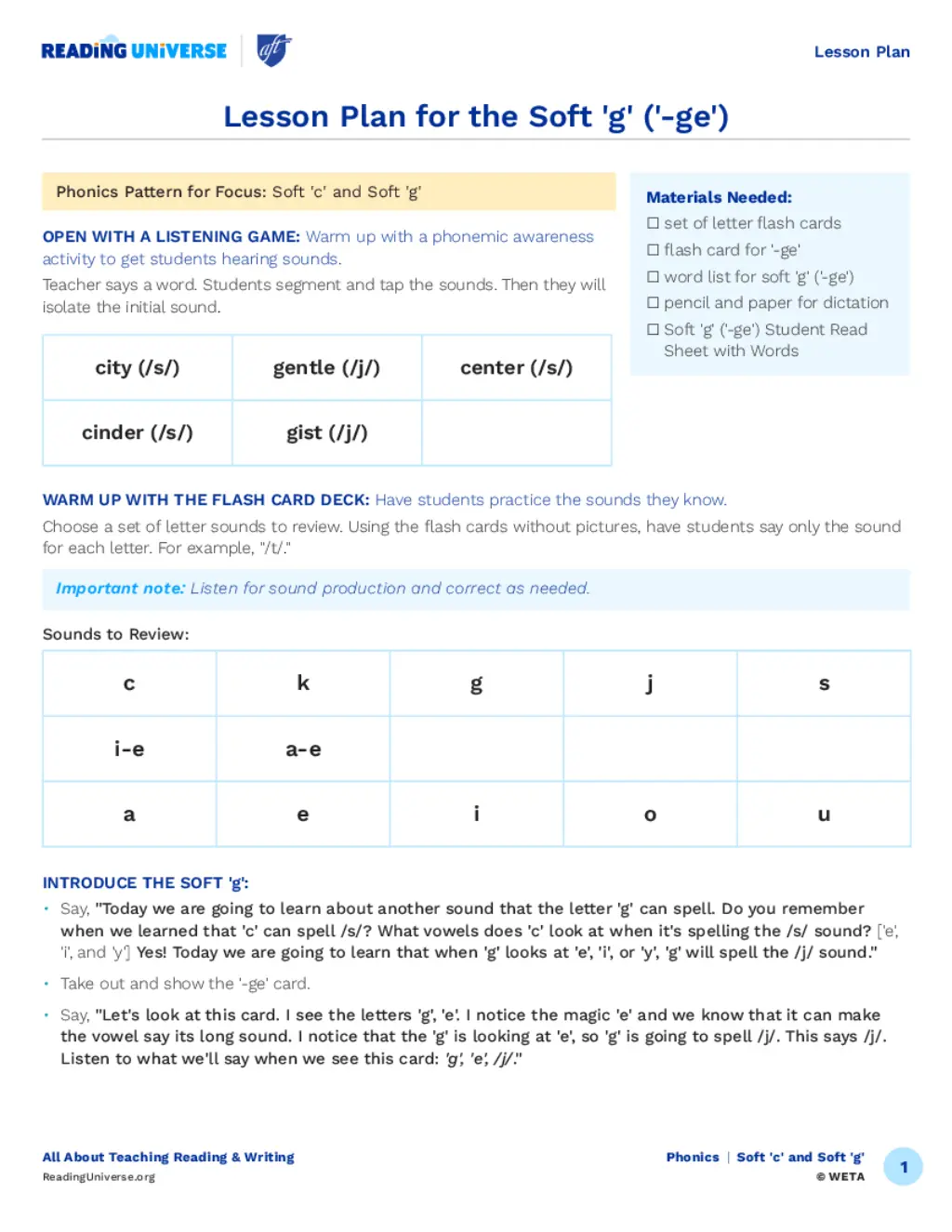
Gina Inzitari: 'G' says /g/. So let me write down 'g' here. 'G' or letter 'g' says /g/. But 'g' also says ...
Students: /j/.
Gina Inzitari: It says /j/ too! That's what we're going to be learning today. That 'g' can say two sounds. 'G' can say /g/.
Students: 'G' can say /j/.
Gina Inzitari: And 'g' can say /j/. Awesome. So I'm going to put 'g' can say /g/ and 'g' can say /j/. We practiced hard and soft 'c'. Do you remember the two sounds that 'c' can say? Blake, what's one?
Blake: /s/.
Gina Inzitari: 'C' can say /s/.
Blake: And /k/.
Gina Inzitari: And /k/. Good job, Blake.
Narrator: Reviewing hard and soft 'c' helps students make the connection to a spelling pattern they've already learned.
Gina Inzitari: Now what I would like us to do is I need us to know how we even figure out when a word is going to say the soft sound /j/ or when it's going to say the hard sound /g/. Do you remember how we figured out the rule with soft 'c' and hard 'c'? When does 'c' say the /s/ sound? Anybody remember?
Blake: 'E' or 'i' or 'y'.
Gina Inzitari: Oh my goodness, Blake. Good job. And then what about when 'c' says the /k/ sound?
Michael: It can spell cake.
Gina Inzitari: Like in cake? What vowels do we remember have the when it says the /k/ sound?
Aaron: 'A'.
Gina Inzitari: 'A' is one.
Blake: 'A', 'e' ...
Aaron: 'O'.
Gina Inzitari: 'A' and 'o'.
Catherine: 'U '.
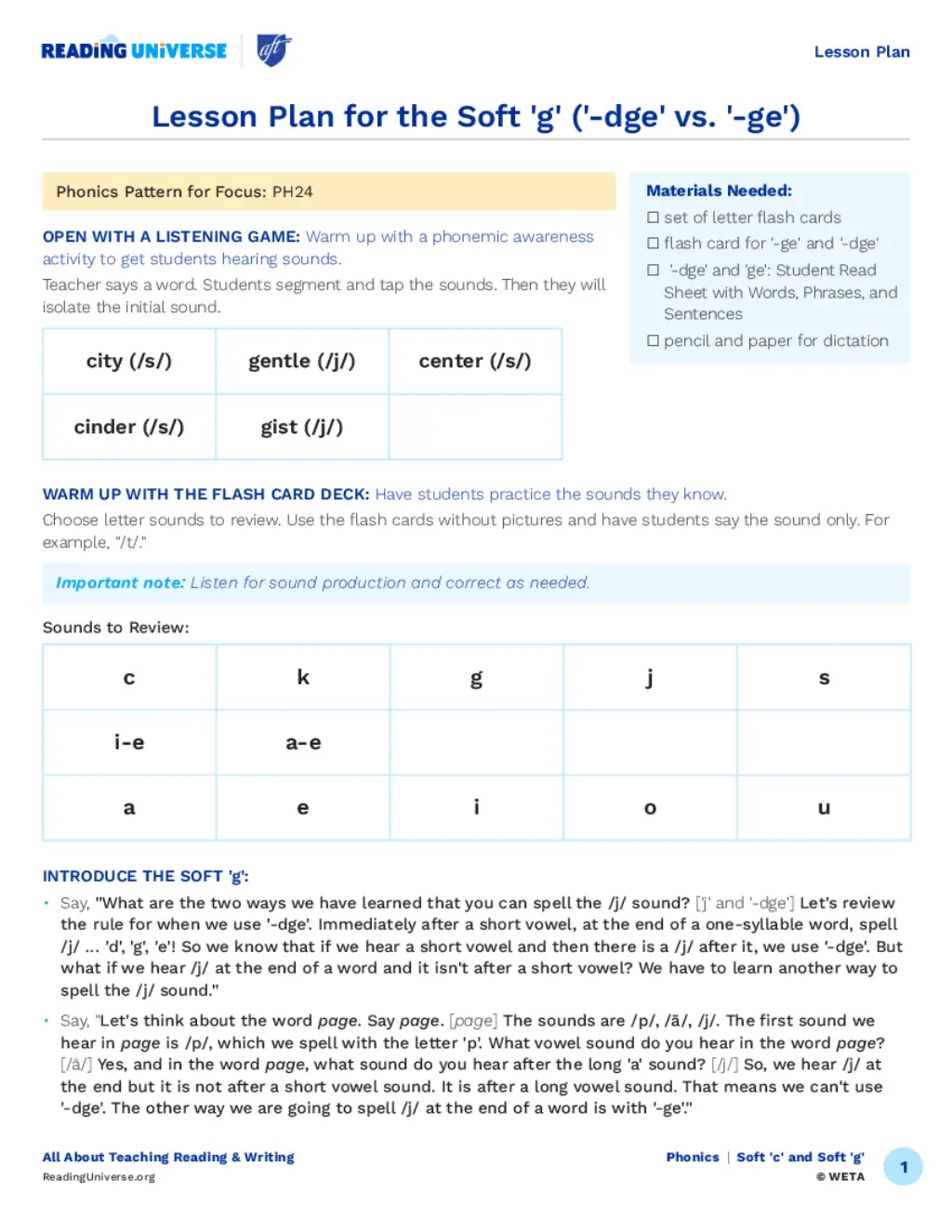
Gina Inzitari: And 'u'. Good job Catherine. 'A', 'o', and 'u'. So the same rule goes with 'g'. 'g-e', 'g-i', or 'g-y'. It's probably going to say the /j/ sound, right? We say probably because there's always some rule breaker that doesn't follow that rule, but most of the time if we see 'g and 'e' together, 'g' and 'i', or 'g' and 'y', it's going to say /j/.
Students: /j/.
Gina Inzitari: So if we have 'a',
Together: 'o', or 'u'
Gina Inzitari: or any other consonant letter like g' and 'r', 'g' and 'l', it's going to say the hard 'g' sound. Now that we practiced the rule a little bit, I want us to read some words.
Narrator: Ms. Inzitari builds on the sorting routine she began the lesson with. Students will read and sort words instead of pictures.
Gina Inzitari: Are you ready to read some words? And we're going to sort the words if they have soft 'g' sounds or hard 'g'. Okay? So we have soft 'g' like gerbil. Soft 'g' says ...
Students: /j/.
Gina Inzitari: Hard 'g' like gold. Hard 'g' says ...
Students: /g/.
Gina Inzitari: Awesome. Alright, let's start off with some words to sort out.
Students: Go. Go.
Gina Inzitari: Go! Alright, that one we'll do together. That's an easy one. Where's "go" going to go? Who can raise their hand and tell me? Michael, does it make the hard 'g' sound or the soft 'g' sound?
Michael: Hard 'g'.
Gina Inzitari: Hard 'g'. Move it on over. Good job. Alright, this one. Don't call it out yet. Who would like to read it? Blake, you want to read it?
Blake:
Yeah. Germ.
Gina Inzitari: Germ. Good job, Blake. Where should germ go? Which one?
Blake: To the soft 'g'.
Gina Inzitari: Soft 'g'? Because 'g' and 'e' are together, the 'g' is going to make it say ...what sound?
Blake: /j/.
Gina Inzitari: /j/. Awesome. Alright, so now we have our hard 'g' and our soft ' figured out. We're going to get ready to read our story.
Narrator: Ms. Inzitari and her students are reading "Ginger the Gerbil," a decodable text focusing on their new skill — the hard and soft 'g' sounds.
Together: Miss Greta has a huge chart with a list of tips to help us take care of Ginger. This is what the chart says.
Gina Inzitari: Good job. I have a question. If we go back to this word right here, what was that word?
Blake: Huge.
Gina Inzitari: Huge. Why do we have to say the /j/ sound for huge?
Blake: It's because there's an 'e' at the end.
Gina Inzitari: 'G' and 'e'.
Blake: 'e-g.'
Gina Inzitari: A 'g' and 'e' are together. It's going to say the /j/ sound.
Narrator: Now students get the chance to show what they know with a quick game of Word Detective.
Gina Inzitari: So I want to see really quick, can you find any soft 'g' words? Did you find a soft ...
Michael: /g/. "Gentle with Ginger."
Gina Inzitari: Gentle is one that's a soft 'g' word. Do you have one that you can find Aaron?
Aaron: Giant.
Gina Inzitari: Giant. Is that a soft 'g' sound? [Aaron nods] Yeah. The 'g' and 'i' together make the soft 'g' sound. We found a bunch. You all did so good today. I am so proud of you. Give yourselves a pat on the back. Good job.
Narrator: Reading Universe is made possible by generous support from Jim and Donna Barksdale, the Hastings/Quillin Fund, an advised fund of the Silicon Valley Community Foundation, the AFT, the Emily Hall Tremaine Foundation, and anonymous donors. Special thanks to Literacy How, Still Meadow Elementary School, and Stanford Public Schools in Stanford, Connecticut. If you enjoyed this video, please subscribe to our YouTube channel @RUteaching. Reading Universe is a service of WETA, Washington D.C., the Barksdale Reading Institute, and First Book.
Gina Inzitari: This is Reading Universe.