Hide Video Transcript
Show Video Transcript
Lisa Glickman: All right. We are going to get ready to get started with our listening game. Are you ready? Okay. I'm going to say a word. You're going to repeat the word. We are going to tap the sounds in the word. Today, we are going to listen for the sound /oi/. Everybody say /oi/.
Students: /oi/.
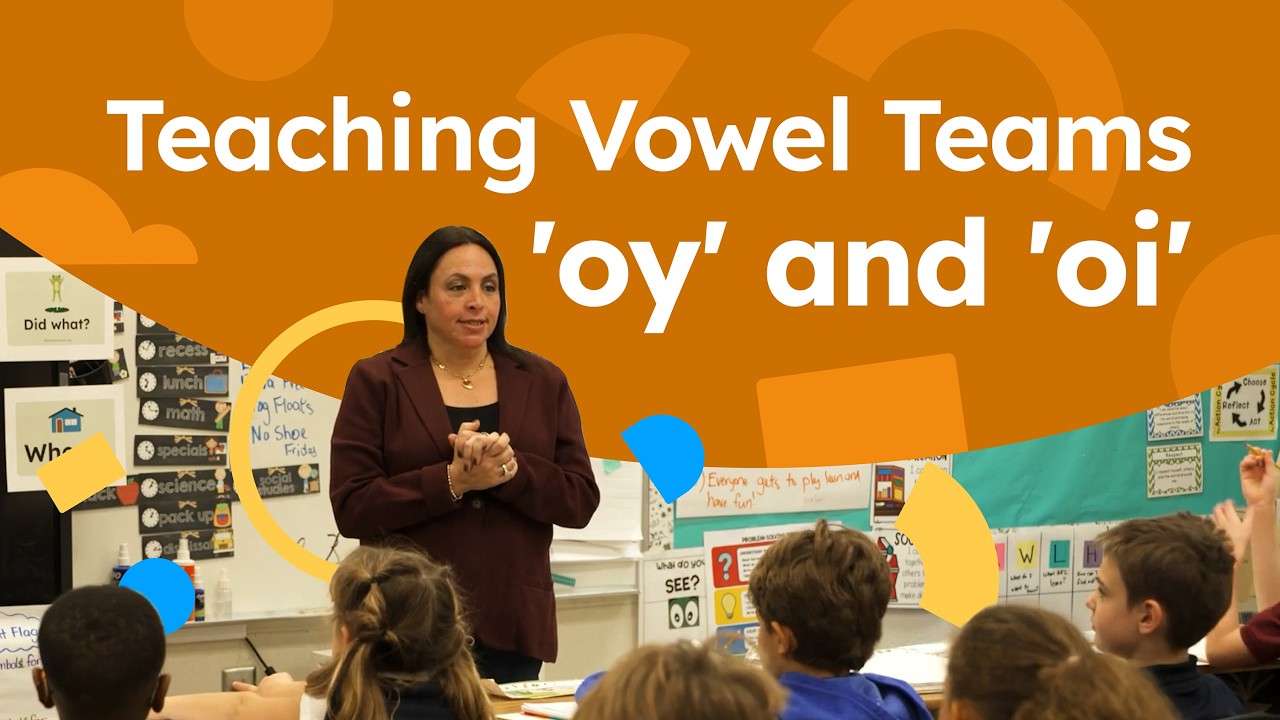
Narrator: Today, reading specialist Lisa Glickman is teaching second graders at Burgess-Peterson Academy in Atlanta how to spell the /oi/ sound with vowel team 'oy' or vowel team 'oi'. She begins with a listening game to help tune students' ears into where in the word they hear that /oi/ sound.
Lisa Glickman: We're going to listen to hear if we hear the sound /oi/ at the beginning, in the middle or the end of the word. First word, joy.
Students: Joy.
Lisa Glickman: Let's tap it.
Together: /j/, /oi/.
Lisa Glickman: Where did we hear the /oi/ sound in that word?
Student: End.
Lisa Glickman: At the end. Good. Next word. Spoil.
Students: Spoil.
Lisa Glickman: Let's tap it.
Narrator: Where that /oi/ sound appears in a word, the beginning, middle or end, is the key to unlocking the correct spelling.
Lisa Glickman: Okay, ready? Next word. Hoist.
Narrator: Hoist.
Together: /h/, /oi/, /s/, /t/.
Lisa Glickman: Where did we hear the /oi/ in that word?
Students: Middle.
Lisa Glickman: In the middle. And to hoist is to lift. So now we are going to look at letters that spell the /oi/ sound that we were just listening for. Everybody say O-Y.
Students: O-Y.
Lisa Glickman: Toy.
Students: Toy.
Lisa Glickman: /oi/.
Students: /oi/.
Lisa Glickman: And in the word toy, that /oi/ sound is at the end. O-Y spells /oi/ at the end of a word. Everybody say, "O-Y at the end."
Students: "O-Y at the end."
Lisa Glickman: And what does this say?
Students: /oi/.
Lisa Glickman: Great job. The other way we can spell the /oi/ sound is O-I. Everybody say O-I.
Students: O-I.
Lisa Glickman: Boil.
Students: Boil.
Lisa Glickman: /oi/.
Students: /oi/.
Lisa Glickman: This spelling for O-I comes at the beginning of a word, like oil, or in the middle. So everybody say O-I.
Students: O-I.
Lisa Glickman: Beginning or middle of a word.
Students: Beginning of the middle of the word.
Lisa Glickman: And what does O-I say?
Students: /oi/.
Lisa Glickman: /oi/. Okay. Ready for your next direction? Take out your dictation notebook and a pencil.
Narrator: This rule is fairly simple. We use O-Y to spell /oi/ at the end of words, like in joy or toy. And we use O-I to spell /oi/ at the beginning or in the middle of words like in oil or hoist. So Ms. Glickman gets right to student practice, beginning with sound dictation.
Lisa Glickman: Okay. The first thing we're going to do is practice writing the letters that spell the /oi/ sound. Okay. Watch what I'm going to do. I'm going to write and say at the same time. Nobody's writing yet. Watch me. 'O', 'y', /oi/, at the end of a word. Can you all do that in your book and say it? Let's say it together.
Together: 'o', 'y', /oi/, at the end of a word.
Lisa Glickman: So everybody should have O-Y on their paper. What does this say?
Students: /oi/.
Lisa Glickman: It says /oi/. Now we're going to write the other spelling for /oi/. Watch me. Eyes up here. Don't do it yet. Listen to what I'm saying. 'O', 'i', /oi/, in the beginning and the middle. Everybody write 'O', 'i'.
Together: 'O', 'i', /oi/.
Lisa Glickman: And where does it come?
Together: At the beginning or in the middle.
Lisa Glickman: Good job.
Narrator: The next step in this lesson is word dictation.
Lisa Glickman: Now, when we do our word dictation, you're going to have to listen for where in the word that /oi/ comes so that you know which way you're going to spell /oi/. Okay? The word is hoist. What's the word?
Narrator: Hoist.
Lisa Glickman: Hoist. I hear /h/, /oi/, /s/, /t/. Everybody write the word hoist. Nice job. Everybody park your pencils for a minute. Everybody say, "To hoist is to lift."
Narrator: "To hoist is to lift."
Lisa Glickman: So if I was saying, "I need to lift this heavy box," I could also say, "I need to hoist this heavy box." Hoist is to lift. So is that a who or a what? Or is hoist something that you could do, a did what?
Students: A did what.
Lisa Glickman: It's a did what. Good job. Are you ready? Next word. Your next word is boy. What's the word?
Students: Boy.
Lisa Glickman: Everybody write the word boy. Nice writing everyone. Okay. Check your work. Did you use the right /oi/ sound spelling? The right /oi/ spelling? Is boy a who or a what? Or a did what? Everybody on three. Let's see. Who or what or did what? One, two, three.
Together: Who!
Lisa Glickman: It's a who. It's telling us who. Good.
Narrator: After reading back the words they've written down, it's time for sentence dictation.
Lisa Glickman: Great job. Are you ready for your sentence? What we're going to do now is I'm going to say a sentence to you. We're going to repeat it and you're going to write it. Okay? The sentence is, "The box was hoisted into the van." "The box was hoisted into the van." Say it.
Students: "The box was hoisted into the van."
Lisa Glickman: Good job. Write it. "The box was hoisted into the van." "The box was hoisted into the van."
Narrator: Ms. Glickman gives students plenty of time to write before putting the sentence on the board so they can check their work.
Lisa Glickman: Okay. Eyes up here. Let's read this whole thing together. Are you ready? Go.
Narrator: "The box was hoisted into the van."
Lisa Glickman: Okay. Now we have to be detectives. All right. Park your pencils. Everybody think in your head. In this sentence, "the box was hoisted into the van." What is the who or the what of this sentence? Everybody think for a minute. What is the who or the what in this sentence? Everybody?
Students: The box.
Lisa Glickman: The box.
Student: And the van.
Lisa Glickman: The box is the who or what that it's about. Yes, a van is also a what. That is so smart. The box is the who or the what that the sentence is talking about. Did what? What did we do with the box, everybody?
Students: Hoisted!
Lisa Glickman: We hoisted. Everybody show me hoisted with your hands. Hoisted. Everybody say, "Hoisted means lift."
Students: "Hoisted means lift."
Lisa Glickman: Hoist means to lift. We have a what was the box. We have a did what. It was hoisted. And where. Into the van. So when you are reading and you are reading sentences and you think about the who or the what, did what, where, it helps you to understand what's happening in the story. Everybody, you guys did a great job. Everybody give yourselves a round of applause. [clapping]
Narrator: Reading Universe is made possible by generous support from Jim and Donna Barksdale; the Hastings Quillen Fund, an advised fund of the Silicon Valley Community Foundation; the AFT; the Emily Hall Tremaine Foundation; and anonymous donors. Special thanks to Burgess-Peterson Academy, Reading is Essential for All People, and Atlanta public schools. If you enjoyed this video, please subscribe to our YouTube channel @RUTeaching. Reading Universe is a service of WETA, Washington D.C., the Barksdale Reading Institute, and First Book.