- Prefixes Skill Explainer
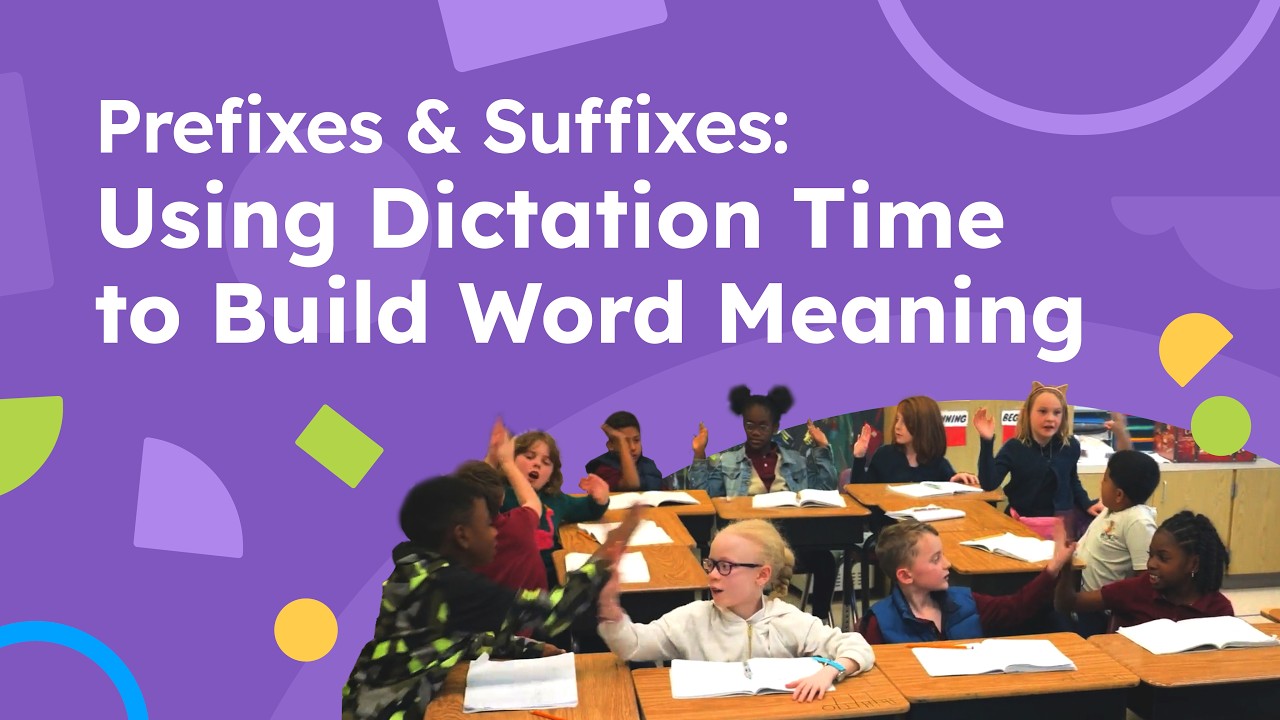
Prefixes and Suffixes: Using Dictation Time to Build Word Meaning
Hide Video Transcript
Show Video Transcript
Lidra West: Great morning guys.
Students: Good morning.
Lidra West: So today we are going to dive a little bit deeper into our prefixes that we've been focusing on this week. Okay?
Narrator: At Burgess-Peterson Academy in Atlanta, Georgia, Lidra West is teaching her third grade students how prefixes and suffixes impact the meaning of base words.
Lidra West: We can learn the meaning of new words by looking at the parts of our words, right? So I'm going to say parts of a word. And when I say parts of the word, I want for you to think about what does this word possibly mean? I'm going to give you the word. I'm going to also give you the sentence for the word. So I really want you to be deep thinkers when you hear this. Are we ready?
Students: Yes.
Lidra West: All right. Our first word, 'mis-' plus guide plus suffix '-ed'. 'Mis-' plus guide plus suffix '-ed'. Have three parts here. What's my new word?
Students: Misguided.
Lidra West: Misguided.
Narrator: For this lesson, she'll be using prefixes and suffixes students have already learned.
Lidra West: So the weather report misguided me. 'Mis-' means what? Not. Very good. And then suffix E-D, what tense is that?
Students: Past.
Lidra West: So the weather report misguided me in the past. So was I prepared when I came outside?
Students: No.
Lidra West: So misguided means that I was guided the wrong way. Right? Listen to the next one. 'Mis-' plus calculate plus suffix '-ing'. What's my new word?
Students: Miscalculating.
Narrator: The next step in this lesson is sound dictation.
Lidra West: Pick up your pencils. Let's start writing. We're going to go right into our sound.
Narrator: Ms. West will give students a definition and they'll write the prefix that matches. Is it prefix 'mis-', 'un-', or 'dis-'?
Lidra West: Your first prefix means not or the opposite of. Not or the opposite of. Write your prefix. Okay. Track the board. Let's see if we got this. The prefix that means not or the opposite of. You should have prefix 'un-'. Did we get it?
Narrator: Ms. West writes the prefix on the board to provide a model for students and they get the chance to fix any mistakes they make.
Lidra West: Prefix number two. This prefix means incorrect, wrongly, or badly. Go ahead and write your new prefix. Your prefix is prefix 'mis-'. And don't forget, I put those little lines after my prefix because that lets me know that there's a base word that comes after it. So I put a little dash there. Okay?
Narrator: Including the dash is important. It reminds students that prefixes can't stand alone and must be attached to a base word. Next up is word dictation.
Lidra West: All right, let's go to our word. Today I'm going to give you the word, and then I'm also going to give us some examples of how the word can really be used.
Narrator: To get her students ready to write, you'll notice Ms. West says the word, has students repeat it back, and then asks her students to say any prefixes or suffixes allowed.
Lidra West: Your word is disbanded.
Students: Disbanded.
Lidra West: Disbanded.
Students: Disbanded.
Lidra West: Is there a prefix or suffix on disbanded?
Students: Yes.
Lidra West: You have your prefix in your head? With the prefix.
Students: 'dis-'
Lidra West: Is there a suffix on disbanded?
Students: Yes.
Lidra West: Suffix ...
Students: '-ed'.
Lidra West: Suffix ...
Students: '-ed'.
Lidra West: Go ahead and write disbanded.
Narrator: Now Ms. West is going to again model the correct response. And when she does this, she will also review the meaning of the word. Building students' vocabulary during dictation practice.
Lidra West: You should have as your prefix, prefix 'd', 'i', 's'. "Band." I hear /b/, /ă/, /d/, /d/. And you all told me that we have suffix, '-ed'. If you got to give me a yes.
Students: Yes!
Lidra West: And so let's talk about disbanded. Listen to this definition of disbanded. Disbanded means when a band of people go apart from each other. When a band of people go apart. Here's my sentence for disbanded. "The middle school soccer team disbanded after winning, after a winning season, sending many players off to high school." "The middle school soccer team disbanded after a winning season, sending many players off to high school." What happened to the players of the middle school team? They were disbanded, but what does it mean when they disband?
Student: Separate.
Lidra West: They separate. Have you all ever had a situation where you were disbanded, whether it's good or bad?
Narrator: Don't be surprised if students wander onto multiple meanings of a base word all by themselves. The band in disbanded, for instance, might take a student straight to the image of a musical band.
Lidra West: Go ahead, Orion. You want to do one?
Orion: In one of the Trolls movie, all the brothers were in a band, but one of the players did something wrong and then they all left each other.
Lidra West: Can you give me the word disbanded in your ...
Orion: The group of trolls got disbanded after someone made a mistake in a show.
Lidra West: They were disbanded after a mistake in a show.
Narrator: By examining the meaningful parts of a word, prefix, base word, and suffix, Ms. West is teaching students more than just word knowledge. She's giving them a strategy they can use to unlock the meaning of unfamiliar words when reading on their own.
Lidra West: You guys did a great job today. Go ahead and turn to your neighbor and give your neighbor a high five and tell them good job.
Narrator: Reading Universe is made possible by generous support from Jim and Donna Barksdale; the Hastings/Quillin Fund, an advised fund of the Silicon Valley Community Foundation; the AFT; the Emily Hall Tremaine Foundation; and anonymous donors. Special thanks to Burgess-Peterson Academy, Reading Is Essential for All People, and Atlanta Public Schools. If you enjoyed this video, please subscribe to our YouTube channel @RUTeaching. Reading Universe is a service of WETA, Washington D.C., the Barksdale Reading Institute, and First Book.
