1. An Overview of Prefixes
Prefixes Skill Explainer
What is a prefix?

Prefix Review
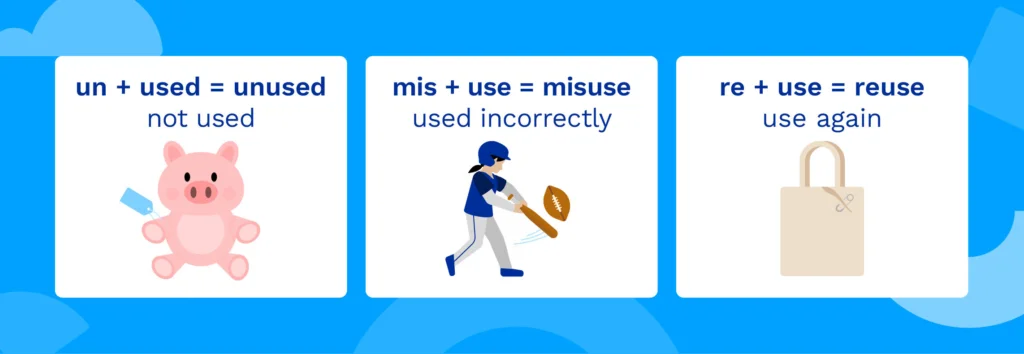
Below, you'll find the prefixes that we'll cover along with their meaning and examples.
| Prefix | Meaning | Example |
|---|---|---|
| un- | not, opposite of | unlock, untidy |
| re- | back or again | replay, redo |
| non- | not | nonstick |
| dis- | not, opposite of | dislike |
| pre- | before | preview, preset |
| mis- | bad or wrong | misjudge, misspell |
Teacher Tip
Derivational Morphemes
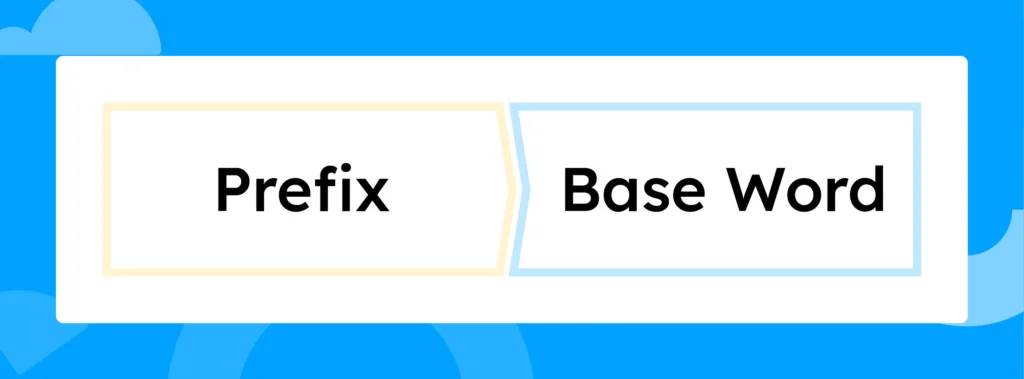
When we add a prefix to a base word, it forms a new word with a distinct meaning ... a meaning that is derived from the original word. So we call prefixes "derivational morphemes." This also means that a word with a prefix added may have a new dictionary entry! For example, happy and unhappy have two different dictionary entries, each focused on the meaning of the individual word (which are opposites!). And at times a derivational morpheme can also change the part of speech of the base word. For example, if you add 'en-' to large to make enlarge, you're changing an adjective (large) to a verb (enlarge).
Derivational Morphemes
When we add a prefix to a base word, it forms a new word with a distinct meaning ... a meaning that is derived from the original word. So we call prefixes "derivational morphemes." This also means that a word with a prefix added may have a new dictionary entry! For example, happy and unhappy have two different dictionary entries, each focused on the meaning of the individual word (which are opposites!). And at times a derivational morpheme can also change the part of speech of the base word. For example, if you add 'en-' to large to make enlarge, you're changing an adjective (large) to a verb (enlarge).