With your help, we can improve literacy instruction in every classroom. Support Reading Universe!

Skill Explainer

3.6 Explicitly Teach the Prefix 'dis-'

Prefixes Skill Explainer
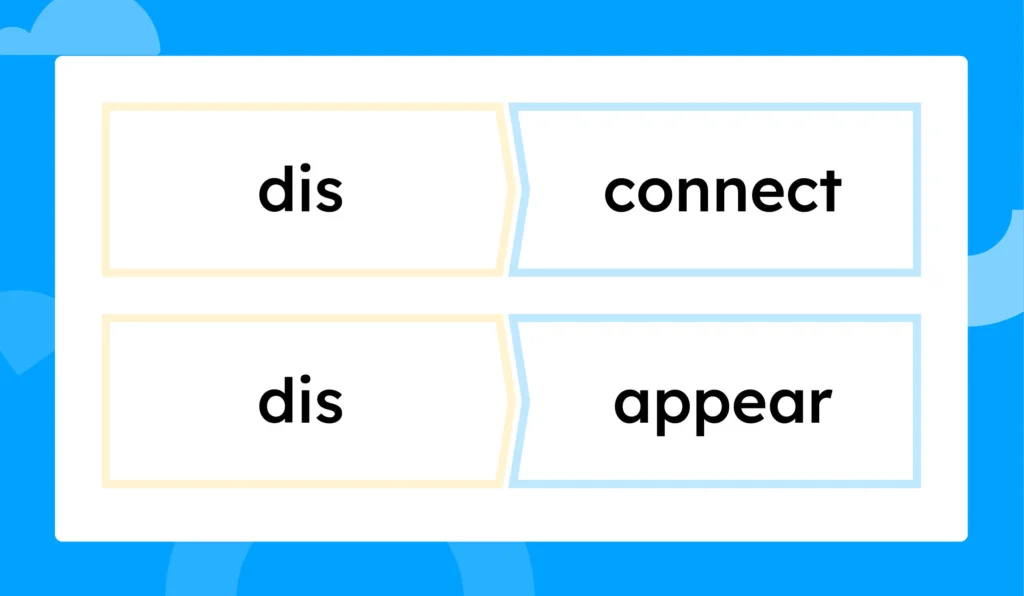
The prefix 'dis-' is a morpheme that means "not" or "opposite of." When you add 'dis-' to a base word, it changes the meaning of the base to its opposite:

  • dis + connect = disconnect (not connected)

  • dis + appear = disappear (the opposite of appear)

Unlike some prefixes, the prefix 'dis-' is generally stable and is usually pronounced /dĭs/, as in disobey. 

When we teach the prefix 'dis-' or talk about it with our students, we spell it out: "the prefix 'd', 'i', 's'." It sounds like this:

Now it's time to teach!
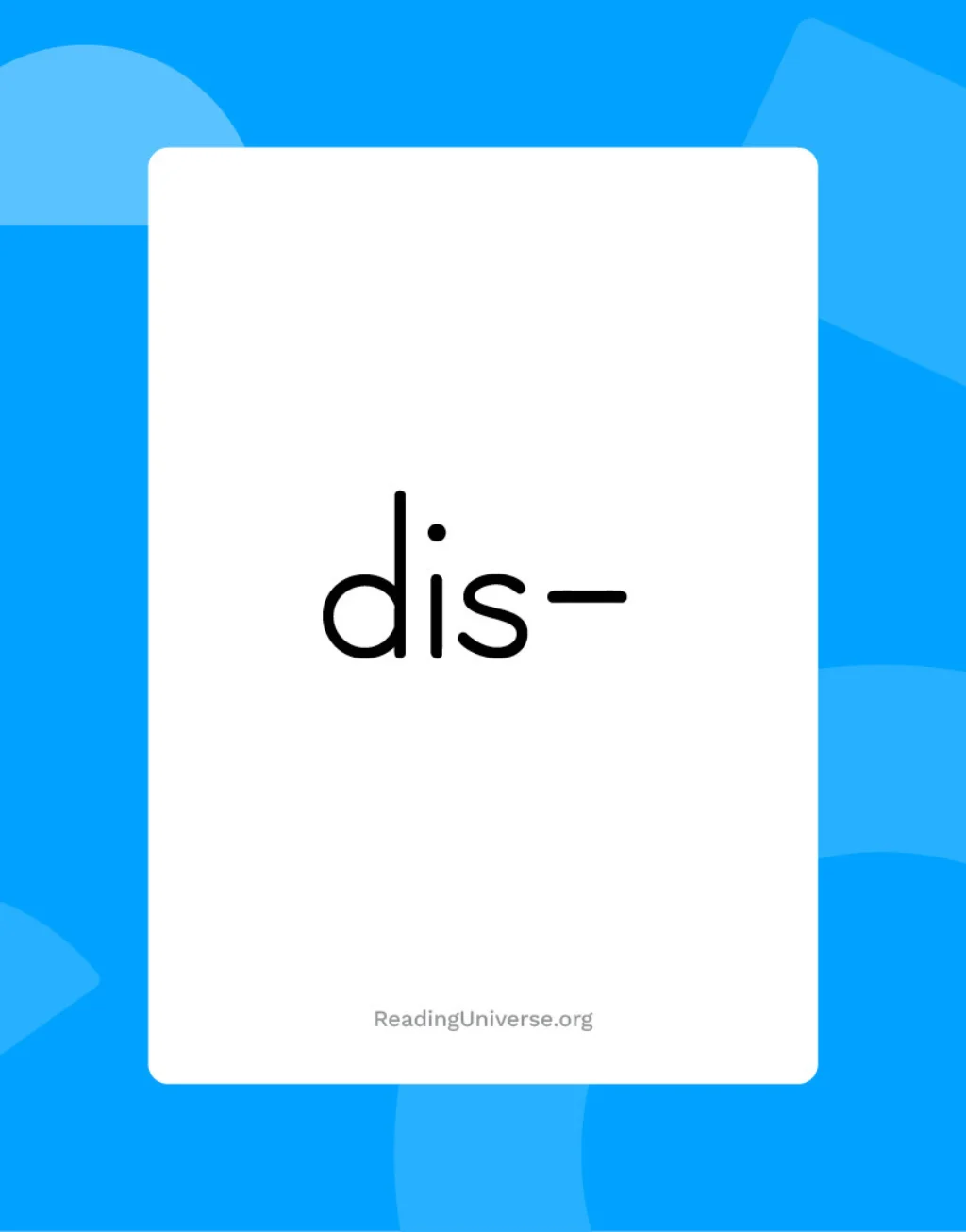
Today, we are going to learn another new prefix. Remember, prefixes come before a base word and hold meaning.

This is the prefix 'dis-'. 

The prefix 'd-i-s' means "not" or "opposite of."

Repeat.

The prefix 'd-i-s' means "not" or "opposite of."

If I add the prefix 'dis-' to the word like, what is the new word?

dislike

Yes, dislike, like in the sentence, “I dislike eating broccoli." The word dislike has the prefix 'dis-', which tells us that I do not like eating broccoli.

Remember, unlike our letters, patterns, and suffix cards, we don't say what the prefix “says” when we do the flash cards, because the sound can change depending on the base word it's added to. When we see a prefix card, we will spell the prefix and say the letter names.

Watch and listen to what we will say when we see this card. The prefix 'dis-' means "not" or "opposite of."

The prefix 'dis-' means "not" or "opposite of."

Reading Universe is made possible by generous support from Jim & Donna Barksdale; the Hastings/Quillin Fund, an advised fund of the Silicon Valley Community Foundation (opens in new window); the AFT (opens in new window); the Emily Hall Tremaine Foundation (opens in new window); and three anonymous donors.