7.1 Articulation and Spanish-Speaking English Learners
Articulation Skill Explainer
Lydia BreisethWhat do I need to know about teaching articulation to English Learners (ELs) who speak Spanish as a first language?
How do I teach my ELs sounds that are the same in Spanish and English?
How can I teach NEW sounds to my ELs?
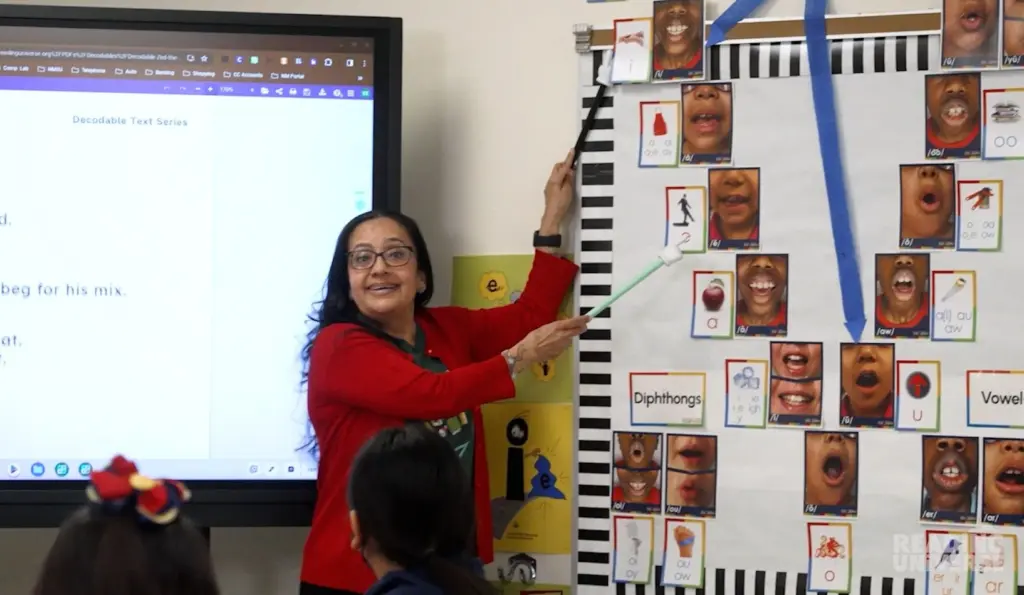
The same goes for your English Learners. It makes sense that your ELs will need to try to pronounce new language sounds like /j/, /r/, or /ĭ/ many times, and they may need to be taught in a few different ways, with lots of modeling, examples, and repetition.
In addition, keep in mind that these sounds may be difficult for your ELs to hear as well as say. They may need extra practice distinguishing these sounds from others in your phonological awareness activities. The following list offers a general approach to teaching new sounds to your ELs.
What does this approach look like in a real lesson?
Video Example 1: Reviewing the Difference Between Short 'i' and Short 'e', with Teacher Estella Escajeda

Hide Video Transcript
Show Video Transcript
Estella Escajeda: Okay, you ready, boys and girls? Today we're going to be talking about the short 'i' and the short 'e'. Okay.
Narrator: Teacher Estella Escajeda is helping her multilingual third graders hear and produce the very subtle difference between the short 'i' sound and the short 'e' sound.
Estella Escajeda: So here we have the /ĭ/ as in itch, and then we have the /ĕ/ as in edge, like if you're at the edge of something, right? So, the /ĭ/ and the /ĕ/. Can somebody tell me, what do you notice? What do you see? Maritza?
Maritza: They're close together. [She answers in Spanish.]
Estella Escajeda: They're close together. That is correct. Do you guys notice? Look at the Vowel Valley.
Narrator: Maritza is comfortable answering in her home language, Spanish. That's because Ms. Escajeda encourages children to use all of their language resources to tackle the complex process of learning to read in English.
Estella Escajeda: So everybody, put your fingers next to your lips. Say /ĭ/ ...
Students: /ĭ/ ...
Estella Escajeda: Say /ĕ/ ...
Students: /ĕ/ ...
Estella Escajeda: What did you notice? What did you feel? Maria Eugenia?
Maria Eugenia: [The student answers the question in Spanish.]
Narrator: Ms. Escajeda provides her students with a bridge from Spanish to English by talking explicitly about the connections between the two languages.
Estella Escajeda: If you notice, when we hear /ĭ/, do we also hear it in Spanish? One of our vowels. Everybody say, icky ...
Students: icky ...
Estella Escajeda: What do you hear in the beginning?
Students: /ĭ/ ...
Estella Escajeda: Say echo.
Students: "echo" ...
Estella Escajeda: Say echo with your opera voice.
Students: echo ...
Estella Escajeda: Yes. You hear the difference? Good job.
Narrator: Next up, they'll use their new skills to take on dictation ... spelling words with short 'i' and short 'e'.
Estella Escajeda: Get your magnetic letters ready and you're going to get your boards ready.
Narrator: If you enjoyed this video, please subscribe to our YouTube channel @RUTeaching. For more information, please visit ReadingUniverse.org. Special thanks to Loma Linda Elementary School, Vado Elementary School, the Gadsden Independent School District, and the New Mexico Public Education Department. Reading Universe is made possible by generous support from Jim & Donna Barksdale, the American Federation of Teachers, The Emily Hall Tremaine Foundation, and anonymous donors. Reading Universe is a service of WETA, Washington, D.C., The Barksdale Reading Institute, and First Book.
Video Example 2: Introducing the /j/ Sound to Spanish Speakers, with Dr. Elsa Cárdenas-Hagan
Hide Video Transcript
Show Video Transcript
[music]
Dr. Elsa Cárdenas-Hagan: [laughing] Now you've got it. Say gerbil! That's a new word for you! Alright. Ready?
[music]
Dr. Elsa Cárdenas-Hagan: Hi, Emilio. How are you doing today?
Emilio: Good.
Dr. Elsa Cárdenas-Hagan: ¿Cómo estás?
Emilio: Bien.
Dr. Elsa Cárdenas-Hagan: Muy bien.
Today, bilingual reading expert and speech pathologist Dr. Elsa Cárdenas-Hagan will be working with Emilio, a third grade student at Kenmont Montessori School in Brownsville, Texas.
Emilio is learning to read in his second language, which is English, and he's facing two challenges that all English learners face: learning spelling patterns and sounds that are different from his first language (which is Spanish) and learning English vocabulary. Dr. Cárdenas-Hagan has chosen to target the /j/ sound today with Emilio.
Let's watch as she takes Emilio through a thoughtfully planned reading lesson that covers:
producing the /j/ sound,
spelling the /j/ sound with the letter 'g',
building English vocabulary with Spanish cognates,
and fluent and expressive reading.
And notice how Dr. Cárdenas-Hagan embeds oral language and vocabulary knowledge throughout.
Dr. Cárdenas-Hagan: I first met Emilio when he was four years of age.
He was in a dual language program, which means, you know, half of the time is spent in Spanish, half in English.
It was the Spanish reading that gave him the confidence to take a stab at that, that English reading, to really say, oh, okay, it's the same. I think I can do this.
Dr. Cárdenas-Hagan and Emilio start their lesson today with a listening game … playing with sounds.
Dr. Cárdenas-Hagan: Today you're going to learn a new sound in the English language. Alright?
And we're going to play with the sounds. Alright? So I want you to, say this word after me. Say beanie.
Emilio: Beanie.
Dr. Cárdenas-Hagan: Very good. Now, I want you to change the first sound, /b/. Just listen. Can you change it to /j/?
Emilio: Genie.
Dr. Cárdenas-Hagan: Let's say the next word. Say Kim.
Emilio: Kim.
Dr. Cárdenas-Hagan: Can you change the sound /k/ to /j/?
Emilio: Gym.
Dr. Cárdenas-Hagan: Gym. So I can work out at your school gym? Can you tell me a sentence with gym for your school?
Emilio: Can I go to the gym?
Dr. Cárdenas-Hagan: Can I go to the gym? That was an excellent sentence. My goodness. Can you say the word bell?
Emilio: Bell.
Dr. Cárdenas-Hagan: Can you change the /b/ to /j/?
Emilio: Gel.
Dr. Cárdenas-Hagan: What did you put in your hair this morning?
Emilio: Gel.
Dr. Cárdenas-Hagan: Gel. En Espanol es gel.
Notice how Dr. Cárdenas-Hagan explicitly compares Spanish and English during this playful sound exercise. And she brings in word meanings … since it's crucial for English learners to be familiar with the meaning of the words they are decoding.
Dr. Cárdenas-Hagan: Every single one of the items that I did today was targeting that new sound and that new pattern, and I added the vocabulary that went with them; and I also had them extend it into a sentence. So I brought in some vocabulary and some language use as we were working on phonological awareness, and that didn't add too much time.
Dr. Cárdenas-Hagan: Can you tell me a sentence in English with the word gel?
Emilio: I put my gel on my hair.
Dr. Cárdenas-Hagan: Oh, that was an excellent sentence. And you also got our new sound /j/, and you actually learned the sound /j/. Do you remember what letter we used before when we learned it? It was the letter what?
Emilio: 'j'
Dr. Cárdenas-Hagan: The letter 'j'. Can you say the sound? /j/
Emilio: /j/
Dr. Cárdenas-Hagan: I worked with him in really producing that sound of /j/. He had already practiced it and knew it in those kind of early phonological awareness and phonics concepts of that letter 'j' is most common in the English language for /j/. He also knows that the letter 'g' says /g/ both in Spanish and English.
But both in Spanish and English that letter 'g' changes when it's before 'e' or 'i'. And so I wanted to show him that pattern and show him that there's a new, a new kind of sound for that 'g' in English. It's /j/. And as you saw, he used his Spanish knowledge of /h/, right. /h/. So 'g' before 'e' says /h/ in Spanish, and in English it says /j/.
Now Emilio is ready for a direct and explicit lesson on his new spelling pattern … using the letter 'g' to spell the sound /j/. It's a tough one for Spanish speakers, so Dr. Cárdenas-Hagan takes her time to make sure Emilio gets it, starting with accurate articulation.
Dr. Cárdenas-Hagan: Today we're going to learn another way in English that you can say /j/ with another different type of letter. I want you to listen. Say the word gelatin.
Emilio: Gelatin.
Dr. Cárdenas-Hagan: Gentle.
Emilio: Gentle.
Dr. Cárdenas-Hagan: Genie.
Emilio: Genie.
Dr. Cárdenas-Hagan: What sound did you hear at the beginning?
Emilio: /jŭ/
Dr. Cárdenas-Hagan: /j/. Can you say it really short? Say /j/.
Emilio: /jŭ/
Dr. Cárdenas-Hagan: Oh, I heard you say /jŭŭŭ/. Let's say /j/.
Emilio: /j/
Dr. Cárdenas-Hagan: That was better. Say /j/.
Emilio: /j/
Dr. Cárdenas-Hagan: It's a sound that's clipped; and I didn't want him to stretch it out or add another vowel sound, because when you read, there's not going to be an extra vowel there. It's, you have to watch the next vowel that comes after it.
Dr. Cárdenas-Hagan: /j/
Emilio: /ch/
Dr. Cárdenas-Hagan: Ah! That was /ch/.
Emilio and Dr. Cárdenas-Hagan: [laughter]
Dr. Cárdenas-Hagan: Remember? Put your hand on your throat. Say /ch/, /ch/, /ch/.
Emilio: /ch/, /ch/
Dr. Cárdenas-Hagan: It didn't vibrate. Now remember how we did the /j/ … /j/, /j/, /j/.
Emilio: /j/, /j/, /j/
Dr. Cárdenas-Hagan: It vibrated alright? But we're not going to say /jŭŭŭ/, are we? No, no.
Dr. Cárdenas-Hagan: When I was showing Emilio to … and demonstrating to him that he could touch his vocal cords and feel that when he was saying /ch/ for that 'g-e', instead of saying /j/, he said /ch/ … that he could feel that it was voicing /ch/. And the very same sound of /ch/ … if you add your voice, it becomes the target sound /j/ that I was looking for.
By giving immediate feedback and explaining the differences in the two sounds, Dr. Cárdenas-Hagan is ensuring that Emilio develops good habits from the start.
Dr. Cárdenas-Hagan: Alright, so we have a new way of showing that. Let me show you the letters. The letters are 'g-e', and our word is genie.
Emilio: Genie.
Dr. Cárdenas-Hagan: Look. See the picture of the genie? Have you ever seen anything like that?
Emilio: No.
Dr. Cárdenas-Hagan: No? Okay, so that was … oh, see where the genie comes out? Yeah. Can grant magical wishes. Like "I give you three wishes," right?
Emilio: Mm-hmm.
Dr. Cárdenas-Hagan: So say 'g-e'.
Emilio: 'G-e'.
Dr. Cárdenas-Hagan: Genie.
Emilio: Genie.
Dr. Cárdenas-Hagan: /j/
Emilio: /j/
Dr. Cárdenas-Hagan: Very good. And en espanol is /h/, /ā/,
Emilio: /h/
Dr. Cárdenas-Hagan: Genio, /h/
Emilio: Genio, /h/
Dr. Cárdenas-Hagan: Genio, /h/. Pero in ingles: 'g-e'.
Emilio: 'G-e'.
Dr. Cárdenas-Hagan: Genie.
Emilio: Genie.
Dr. Cárdenas-Hagan: /j/
Emilio: /j/
Dr. Cárdenas-Hagan: So when the 'g' comes before the 'e', the sound changed from /g/ to /j/.
Emilio: /j/
Dr. Cárdenas-Hagan: There you go. That was perfect.
Dr. Cárdenas-Hagan: So now we're going to practice some of this reading. So let's look here. So all of these … what do you see that looks the same?
Emilio: 'g'.
Dr. Cárdenas-Hagan: What letters?
Emilio: 'g-e'.
Dr. Cárdenas-Hagan: 'g-e'. What letters?
Emilio: 'g-e'. 'g-e'. 'g-e'. 'g-e'.
Dr. Cárdenas-Hagan: They all have 'g-e', right? So let's prepare row one. You think you can read them? Okay. Read the first word.
Emilio: Gerum. Germ.
Dr. Cárdenas-Hagan: Uh huh. There's not an extra letter there. Germ.
Emilio: Germ.
Dr. Cárdenas-Hagan: Oh, I don't want to get any germs. Do you?
Emilio: No.
Dr. Cárdenas-Hagan: No? Okay. Let's try this one.
Emilio: /jŭ/
Dr. Cárdenas-Hagan: /j/
Emilio: /j/
Dr. Cárdenas-Hagan: /er/
Emilio: /er/, /b/, /ĭ/
Dr. Cárdenas-Hagan: Let's divide it. Here. Let's divide it right here. /jer/
Emilio: /jer/, /bĭl/
Dr. Cárdenas-Hagan: I had him work on the finer features where we were having him work on accents. See, that's really challenging for English learners, knowing okay, typically you accent on that first syllable.
Dr. Cárdenas-Hagan: And we say it … let's think about how we accent it. Can you say gerbil?
Emilio: Gerbil.
Dr. Cárdenas-Hagan: Where does the accent fall? How do you produce it? What's the precision of that production?
Dr. Cárdenas-Hagan: We're going to accent the first syllable. Gerbil.
Emilio: Gerbil.
Dr. Cárdenas-Hagan: That's a, that's a, a type of little rodent, little animal. Let's try this one.
Emilio: Re, gent. Regent.
Dr. Cárdenas-Hagan: Very good.
Emilio: Gen, tle. Gentle.
Dr. Cárdenas-Hagan: Okay.
Emilio: Gem.
Dr. Cárdenas-Hagan: Say it again?
Emilio: Gem.
Dr. Cárdenas-Hagan: Gem. Look, my ring! It has a gem. What color is it?
Emilio: Red.
Dr. Cárdenas-Hagan: Red.
Next, Dr. Cárdenas-Hagan and Emilio will work on dictation, sometimes known as spelling or encoding.
Dictation: /j/ Spelled with 'g'
Dr. Cárdenas-Hagan: So now what we're going to do … this is … oh, I don't know if you're going to like this, but this is spelling time. [laughter] I know spelling can be quite challenging.
In this part of the lesson, Emilio will reinforce the sound-letter connections he's been practicing. Dr. Cárdenas-Hagan will say a word with the /j/ sound, and Emilio will write it down, using what he's just learned to pick the right letters. He'll need to be careful to use English spellings instead of Spanish right now.
Dr. Cárdenas-Hagan: Let me see. I want you to look and listen. Look at me. And I want you to say this word after me. And remember our pattern. It's going to have what letters?
Emilio: 'g-e'.
Dr. Cárdenas-Hagan: Oh, you were right. Ready? Say gem.
Emilio: Gem.
Dr. Cárdenas-Hagan: Wait. Tell me the sounds
Emilio: /j/, 'e', /m/
Dr. Cárdenas-Hagan: Oh, that says jeem. It's /j/, /ĕm/. Again.
Emilio: /m/
Dr. Cárdenas-Hagan: Again?
Emilio and Dr. Cárdenas-Hagan: /j/, /ĕ/, /m/
Dr. Cárdenas-Hagan: Alright. Write … aaah! What letters did you use?
Emilio: /j/, /ĕ/
Dr. Cárdenas-Hagan: 'g'.
Emilio and Dr. Cárdenas-Hagan: 'g', 'e', 'm'.
Dr. Cárdenas-Hagan: And that spells?
Emilio: Gem.
Dr. Cárdenas-Hagan: Gem. Very good.
Dr. Cárdenas-Hagan: I want you to write the word geeenie.
Emilio: 'g'.
Dr. Cárdenas-Hagan: Ah, that's in Spanish.
Emilio: Oh, I know. 'g'. Geee …
Dr. Cárdenas-Hagan: That 'i-e' is saying …
Emilio: Oh!
Dr. Cárdenas-Hagan: … 'e'. That's right! Geee-nie. What letters did you use?
Emilio: 'g', 'e', /n/, 'e', 'i' …
Dr. Cárdenas-Hagan: Can you name the letters? 'g', 'e' …
Emilio: 'g', 'e', /n/ …
Emilio and Dr. Cárdenas-Hagan: 'n', 'i', 'e'.
Dr. Cárdenas-Hagan: 'g', 'e', 'n'. Let's say the sounds: /j/, /ē/
Emilio: /ē/
Dr. Cárdenas-Hagan: /n/
Emilio: /n/
Dr. Cárdenas-Hagan: /ē/
Emilio: /ē/
Dr. Cárdenas-Hagan: Genie.
Emilio: Genie.
Dr. Cárdenas-Hagan: Oh, spelling. You did it.
Dr. Cárdenas-Hagan: Okay. Tell me a sentence with gem.
Emilio: I have a gem.
Dr. Cárdenas-Hagan: All right. Let's write that sentence. Right. We'll get some writing in. I …
Emilio: I … have … a gem.
Dr. Cárdenas-Hagan: Very good. What do we need at the end? A period. All right, number two. Let's try giant. Can you think of a sentence with giant? Tell me the sentence first.
Emilio: I seen a giant. [writing] I … seen … a … giant.
Dr. Cárdenas-Hagan: What do we need at the end? And we … so you said, "I have." And remember the contraction "I've." 'i', 'v', 'e'. I've …
Emilio: … seen a giant.
Dr. Cárdenas-Hagan: I've seen a giant.
Dr. Cárdenas-Hagan: The last one is a genie. Can you think of a sentence with genie? Remember what the genie looks like. That was a new word for you.
Emilio: Hm. [writing] I … saw … a … ge … nie.
Dr. Cárdenas-Hagan: Okay. And remember, that's in Spanish.
Emilio: So it's an 'e'.
Dr. Cárdenas-Hagan: Mmmhmm. I didn't even have to tell you. You fixed it. How do we do it in, ah-ha. And what do I need at the end? All right. Read your sentences to me.
Emilio: I have a gem. I seen a giant. I saw … I saw a genie.
Dr. Cárdenas-Hagan: Very good. But I wanted to extend your sentence. "I saw a genie in the bottle." And let's see if you remember '-tle' at the end.
Dr. Cárdenas-Hagan and Emilio: … in … the …
Emilio: bot …
Dr. Cárdenas-Hagan: … tle. Oh good, you … you remembered that doubling. Very good. Alright, let's erase.
Dr. Cárdenas-Hagan: Nice work. Nice spelling and writing.
Developing English Learner Vocabulary Using Spanish Cognates
Now Dr. Cárdenas-Hagan will take some time to work explicitly on vocabulary with Emilio, in addition to the vocabulary she's been dropping in throughout their time together. English learners have a wealth of existing knowledge in their home language. English vocabulary instruction helps them access that knowledge and boost their reading comprehension.
Dr. Cárdenas-Hagan: Now we're going to move to some of our vocabulary. We've been talking about different musical instruments, and I want to show you some pictures of some instruments. All right. Do you have … do they have anything at school where you get to play instruments?
Emilio: Nope.
Dr. Cárdenas-Hagan: No? Nothing at your school?
Dr. Cárdenas-Hagan: So in the lesson, I was introducing vocabulary that was related to a central topic and used what we call cognates. These are words that are similar in spelling and meaning across languages.
Dr. Cárdenas-Hagan: What do you see there? That's called what?
Emilio: Violin?
Dr. Cárdenas-Hagan: A violin. Very good. This one is like a tuba. So these are instruments. In Spanish we say instrumentos. This person is in charge.
Emilio: He's a conductor.
Dr. Cárdenas-Hagan: He's the conductor. In Spanish, conductor, right? Do those look the same in Spanish and English?
Emilio: Mm-hmm.
Dr. Cárdenas-Hagan: Almost, right? What looks different between instruments and instrumentos.
Emilio: Mmm … that instead of … they add an 'o' at the second one.
Dr. Cárdenas-Hagan: They added an 'o' at the end. Right? So how many more letters does it have? Count them?
Emilio: One.
Dr. Cárdenas-Hagan: It has one extra letter.
Dr. Cárdenas-Hagan: This is an excellent word learning strategy, knowing that words are similar across languages in meanings and spelling. Now, I not only asked about the meaning, I was asking him to tell me some of the sounds that he heard in the words, how they were similar, how they were different, how many syllables they had in them, whether he was familiar with that, how you pronounced it, what were the differences?
Dr. Cárdenas-Hagan: Ooh, this one looks the same.
Emilio: Tuba. Tuba.
Dr. Cárdenas-Hagan: Very good. This one …
Emilio: Cheely …
Dr. Cárdenas-Hagan: This one is clar-i-net.
Emilio: Clarinet.
Dr. Cárdenas-Hagan: En español clarinete.
Emilio: Clarinete.
Dr. Cárdenas-Hagan: Let's see if that one has more syllables. Clarinet.
Emilio: Clar-i-net.
Dr. Cárdenas-Hagan: How many syllables?
Emilio: Three.
Dr. Cárdenas-Hagan: And clarinete?
Emilio: Ca-dee-men-te. Four.
Dr. Cárdenas-Hagan: Clarinete … has four. Very good.
Dr. Cárdenas-Hagan: Teachers can really incorporate cognates in, into their instruction, and you don't have to know the language to do that. You can very … I mean we have so much at our fingertips with, you know, the internet; so we can very quickly look up, you know, what would be that word in this language?
Dr. Cárdenas-Hagan: This is a what? You told me already.
Emilio: Violin.
Dr. Cárdenas-Hagan: And in Spanish we have it with an accent: violín, right?
Emilio: Violín.
The next step for Emilio is reading a passage that includes the cognates they just reviewed. Each repeated reading gives Emilio the chance to practice the elements that make up reading with fluency: accuracy, automaticity, and expression, which reflects his understanding of the text.
Dr. Cárdenas-Hagan: All right. So we're going to do now a passage about these instruments.
Emilio: Yeah.
Dr. Cárdenas-Hagan: All right. So let's prepare sentence one, and let me see how you read sentence one.
Emilio: The music director spoke to us about musical instruments.
Dr. Cárdenas-Hagan: Next sentence …
Emilio: The director said that the musical instruments are —
Dr. Cárdenas-Hagan: Instruments. Let's put the accent on the first syllable. Instruments.
Emilio: — are very different.
Dr. Cárdenas-Hagan: Students who are brought up in bilingual, biliterate homes who are in dual language programs, they're going to need a lot of work on that phrasing and that intonation.
Dr. Cárdenas-Hagan: Whistle.
Emilio: The clarinet has a sweet …
Dr. Cárdenas-Hagan: Do your pencil swing …
Emilio: … a sweet tone.
Dr. Cárdenas-Hagan: … tone. Oh yeah, because we knew that there was a comma there. Very good!
Emilio: Ready tone … reedy tone.
Dr. Cárdenas-Hagan: Pause after the word sweet. Pause after the word sweet cause there's a comma there … sweet [exaggerated pause] reedy tone.
Emilio: … reedy tone.
Dr. Cárdenas-Hagan: That's good.
Emilio: The tuba is a giant instrument and has a, has a very deep, mighty tone.
Dr. Cárdenas-Hagan: Oh, you did it like that … deeeep, mighty tone. Good job!
Dr. Cárdenas-Hagan: In the initial repeated reading, he was just trying to read each of the sentences. And then I had them really listen and try to do the phrasing.
Dr. Cárdenas-Hagan: Let me get my timer here. Now you know how to read with some fluency, right, and you're also going to read with the phrasing. All right. Are you ready? Begin.
Emilio: The musici- the music director spoke to us about musical instruments. The director said that the musical instruments are very different. The trumpet is shiny and had a nice brassy tone.
Dr. Cárdenas-Hagan: And through the repeated readings, I hope you noticed that he began to improve. He began to kind of monitor his own phrasing, and he began to use more inflection in his voice and became more confident in that repeated reading.
Emilio: The ladies, gentlemen in the symphony sat in the semicircle facing us, so we were able to see every musician. The symphony was a magical experience.
Dr. Cárdenas-Hagan: Wow! You did it! Give me five. Give me five. That was awesome.
Dr. Cárdenas-Hagan: Sometimes we say that it's so boring. This decoding practice. But you know, you look at the student and they're getting excited because they see that they're reading it. Okay. I read it okay. But now I'm adding these extra features of phrasing and, and more expression. And it's not boring to them. They feel success and they get excited and they feel more confident so that when they come across another text, they're gonna remember: you know, I can do this!
Dr. Cárdenas-Hagan now asks questions about the passage … to make sure Emilio understands what he's decoding.
Dr. Cárdenas-Hagan: Now, who said that the musical instruments are very different? Who said it?
Emilio: The director.
Dr. Cárdenas-Hagan: Can you tell me in a complete sentence?
Emilio: The director said that the musical instruments are very different.
Dr. Cárdenas-Hagan: Where did the ladies and gentlemen sit that were playing in the symphony?
Emilio: In a semicircle.
Dr. Cárdenas-Hagan: Tell me in a complete sentence … the ladies …
Emilio: The ladies in the, and gentleman in the symphony sat in a semicircle.
Dr. Cárdenas-Hagan: That's very good. Alright …
Dr. Cárdenas-Hagan: Today, I learned a lot about him, and I learned about what went well, what he needs more practice on. And I know what I need to do tomorrow.
Dr. Cárdenas-Hagan:All right. We'll end our session today. Since we've been talking all about all the wonderful things that music brings to us, I want to talk to you about a very special person. Her name is Celia Cruz.
Dr. Cárdenas-Hagan: Can you say that?
Emilio: Celia Cruz.
Dr. Cárdenas-Hagan: We have to differentiate our instruction to meet the needs of our students. And you can teach these students and some of them will have the opportunity
to be in dual language classrooms. The majority of them will be in English as a second language or English medium classrooms. But you can still bring in their assets, what they, what they know, and you can connect to that. And you don't have to know the language in order to do so.
Reading Universe is made possible by generous support from Jim & Donna Barksdale; the Hastings/Quillin Fund, an advised fund of the Silicon Valley Community Foundation; the AFT; the Emily Hall Tremaine Foundation; and anonymous donors.
This video was produced by Noel Gunther, James Allgood, and Christian Lindstrom.
Our video editor was Mandana Tadayon.
Our field crew was Edwin Noe Mendoza, Jessenia Vidales, and Arnold Martinez.
And our narrator was Danielle Famble.
If you enjoyed this video, please subscribe to our YouTube Channel … at-R-U Teaching.
Reading Universe is a service of WETA-Washington, D.C., the Barksdale Reading Institute, and First Book.
What if my students struggle?
When students mispronounce a word, when and how should I address that?
Antonio Fierro, Ed.D., an ESL/Bilingual specialist and distinguished reading teacher, provides a thoughtful video response to this important question.
Hide Video Transcript
Show Video Transcript
Hi, I'm Antonio Fierro. Let's listen to this next question. "When students mispronounce a word, when and how should I address that?" Address that mispronunciation, right? Well, that's a tricky question, and you have to think about it from a different standpoint.
Let's think about where your English learner might be as far as language acquisition. I've spoken about the fact that many of our newcomers who have never heard English before or have pronounced any English words, are going to be in that silent period or that pre-production stage of language acquisition. Now, if they're slowly coming out of this stage or this phase and going into the early emergent phase, then be careful because I want them to be using words, right? I want them to experiment with those words. I want them to use vocabulary — and congratulations, because the student is feeling safe. You have provided a safe environment, a welcoming environment that says, "oh, okay, I can go ahead and try out words, or try out my new words that I am learning."
So take that. Go ahead and listen to that. Yes, applaud that. Make a big thing out of it, that there are, they are actually now expressing themselves. If you feel that the student is okay, won't be perhaps disappointed or take it personally, then you can recast. So for example, if the student says, "I chase it, the cat yesterday." I would just come back and say, "Oh, Antonio, you chased the cat yesterday, right?" And again, if this child is feeling self-confident, feels good about it, about himself or herself, then you can go and say, "Hey, why don't you say that with me? All right, I chased the cat yesterday. That's wonderful." All right, so we can go ahead. I say it, I want them to go ahead and hear it. And then what about them trying it along with you as well? Now you can go the next step and say, "Okay, now you try it by yourself.
All right, you do it. You say it." Now, for the student who is already in a speech emergence phase, for example, 3000 plus words, then I would absolutely do the recast. I want them to go ahead and say the word with me. "I chased the cat yesterday." Right? We'll say it together, let them say it, and hey, better yet, you know what, why don't you say that sentence to your neighbor, to your peer, to your friend, and have them try that as well.
So really it's about professional judgment. Be careful and be mindful and meet your student at the level that they are currently at. Okay? Have fun with it.
PDF: English Sounds That Are Challenging for Spanish Speakers
This printable handout provides an overview of English sounds that may be challenging for Spanish speakers. Students may need extra practice identifying and pronouncing the sounds on this list.
