3.1 Prepare for Irregularly Spelled High-Frequency Words Instruction
Irregularly Spelled High-Frequency Words Skill Explainer
Hide Video Transcript
Show Video Transcript
Carla Stanford: We are going to talk about irregularly spelled words. Irregularly spelled words are words that have a part that does not match the sound-letter correspondence that we've taught our children. And these words have many names. We call them heart words because there's a part that we want kids to learn by heart. Or they're called trick words because there's a tricky part that our kids are going to have to understand. Or we might call them red words because we need them to stop and think because there's something in it that is not doing what is expected. Or sometimes teachers even call them sight words. Regardless of what we call them. It's all about how we instruct these words. And it's really important that we differentiate how we do this work because there are parts of these words that are not following the rules. And kids need to know that. First, we're going to say the word and we're going to have our kids repeat the word. So today, boys and girls, we're going to learn a new heart word. There's going to be a part in this word that is not doing what is expected. Our word is said. Repeat. Said. Good. Now let's think about how many sounds. We'll say the sounds, and I'm going to mark them with a line. Let's say our word together. /s/, /ĕ/, /d/. Good. Let's do it again. /s/, /ĕ/, /d/. So we have three sounds. Now we're going to go through and we're going to think about which of these sounds are matching our sound-letter correspondences that we know. We have /s/. It's making the /s/ sound and it matches the 's'. We have /d/. We hear /d/, and it's going to be spelled with a 'd'. It's matching the patterns that we know. And this middle sound right here, this middle sound is our heart part. It's the part that is not matching what we know. We hear /s/, /ĕ/, /d/. Here we're hearing /ĕ/, and that sounds like short 'e', but this is our heart part. So I'm going to mark it with a heart. And that is spelled with an 'a', 'i'. In the word said, the heart part is in the middle. We hear /ĕ/ and it's spelled in a very unexpected way. Let's spell it together. S-A-I-D. Said. One more time. S-A-I-D. Said. Good. Let's read it. Said. Repeat after me. My mom said, hurry up. And they would repeat. And so that's a great way that you can move through this routine. You can your kids, they know what is expected. They know you're going to tell them the word. They know. You're going to show them the sounds and tell them the heart part or the part that's unexpected.
Here's one way they could practice. You could say, Hey, we just learned this word said. Now we're going to get some practice. Just like if you're at soccer or gymnastics or piano, you have to practice in order to get really good at something. We are going to practice with the word said so that we can get when we see it, that we can read it and when we want to spell it, we have the letters that we need to spell it. So pick up your pencil and let's spell it out loud and write together. S-A-I-D. Said. Good. Second one. Again, S-A-I-D. Said. Now you can have them mark the heart part if you would like. That's up to you. As long as they know how to read it and spell it, once you've identified the heart part, that's all they needed to know. But if that's something that helps kids remember it, feel free to do that.
Keep going. S-A-I-D. Said. One more time. S-A-I-D. Said. And then you can have your kids read back. Said. Said. Said. Said. And that is one way that you can use your dictation time to practice your heart words or your irregularly spelled words. From there, you can use these words in your phrases and in your sentences. And as kids are writing their sentences, they can look back up at the top of their paper and they have access to make sure they've spelled it correctly because you've checked all along the way. One thing we want to remember is that these irregularly spelled words appear out in text, and kids need to use them when they're writing. So this intentional opportunity to learn them through direct instruction and then practice them daily in our phonics lesson is really important. So kids become accurate and automatic as they're reading and spelling these words.
Narrator: Reading Universe is made possible by generous support from Jim and Donna Barksdale; the Hastings/Quillen Fund, an advised fund of the Silicon Valley Community Foundation; the AFT, the Emily Hall Tremaine Foundation; and anonymous donors.
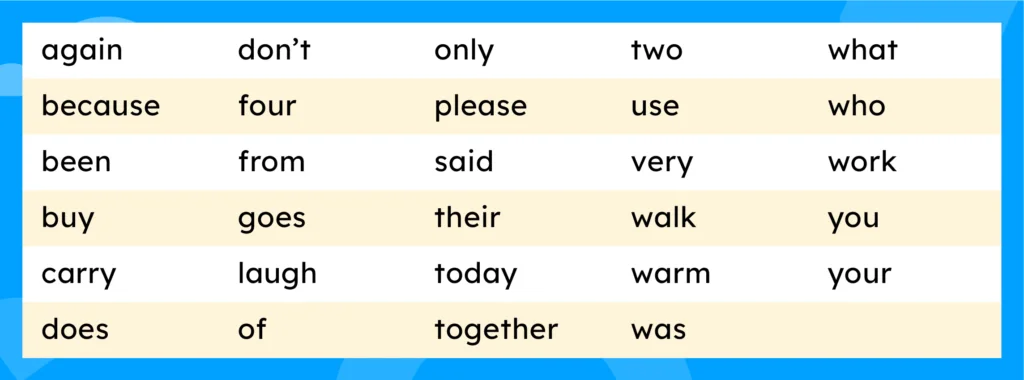
How to Choose High-Frequency Words
Words Lists for You


Teacher Tip
Since these words are introduced very early in the year and kindergartners are still developing phonemic awareness and sound-letter knowledge, you may want to start by introducing only one irregular word per week. As students build their phonics skills, you can gradually increase the number of words introduced each week.
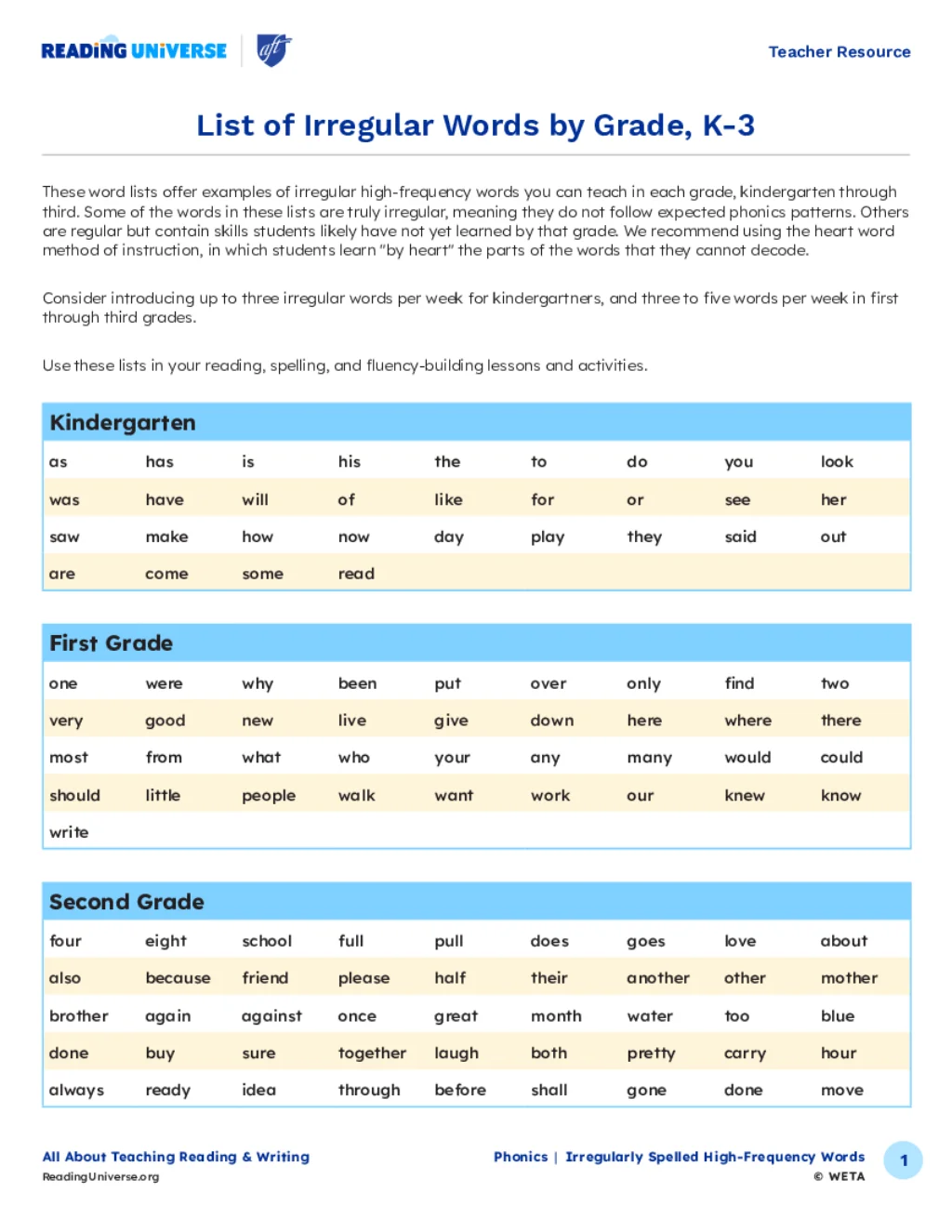
List of Irregular Words by Grade, K-3
These word lists offer examples of irregular high-frequency words you can teach in each grade, kindergarten through third.

Dolch Word List with Irregular and Decodable High-Frequency Words
This is a list of 256 decodable and irregular words from the Dolch Word List. The words are organized by always irregular, common irregular patterns and decodable phonics patterns.
