3.1 Prepare for Short Vowel Instruction
Short Vowels Skill Explainer
Select the Vowel for Focus
Consider Teaching Strategies to Use in Your Lesson

Hide Video Transcript
Show Video Transcript
Fadia Olrich: So, the roller coaster strategy helps us figure out the sounds in words, especially the middle vowel sound, because sometimes that gets a little tricky, doesn't it? So, we're going to use our roller coaster strategy to help us with those sounds. So, watch this first word. This word is met. Say met.
Students: Met.
Ms. Orlich: So, watch what I do. I'm going to start at the bottom of the roller coaster.
Ms. Orlich and students: /m/, /ĕ/, /t/. Met.
Ms. Orlich: Good.

Hide Video Transcript
Show Video Transcript
Antonio Fierro: Build-A-Word strategy is a strategy that helps students spell words with a new pattern they are learning. Using the routine that I'm going to model for you, students practice recognizing that connection between that phoneme and that grapheme. Let me show you what we can do, and I'm going to use a closed syllable word, right? The word is mop. What's the word? Mop. "I use the mop to clean the floor." Let's go ahead and tap the number of phonemes or identify the phonemes in the word "mop." /m/, /ǒ/, /p/. Wonderful. Let's go ahead and put it here on the board. /m/, /ǒ/, /p/. All right. This first phoneme is /m/. Hmm. Which grapheme represents that sound? "M." What about this one? /ǒ/. Which grapheme represents that sound? "O." Right? "O." And my final phoneme is /p/. Hmm. I think, we know it's the "p," right? Mop. Mop. Let's go ahead and write it. Mop. Mop. Right.

Hide Video Transcript
Show Video Transcript
Morgan Walton: These are the motions we use to help students remember the short vowel sounds ... /ă/, apple, /ĕ/, edge, /ĭ/, itch, /ŏ/, octopus, /ŭ/?, up.

Hide Video Transcript
Show Video Transcript
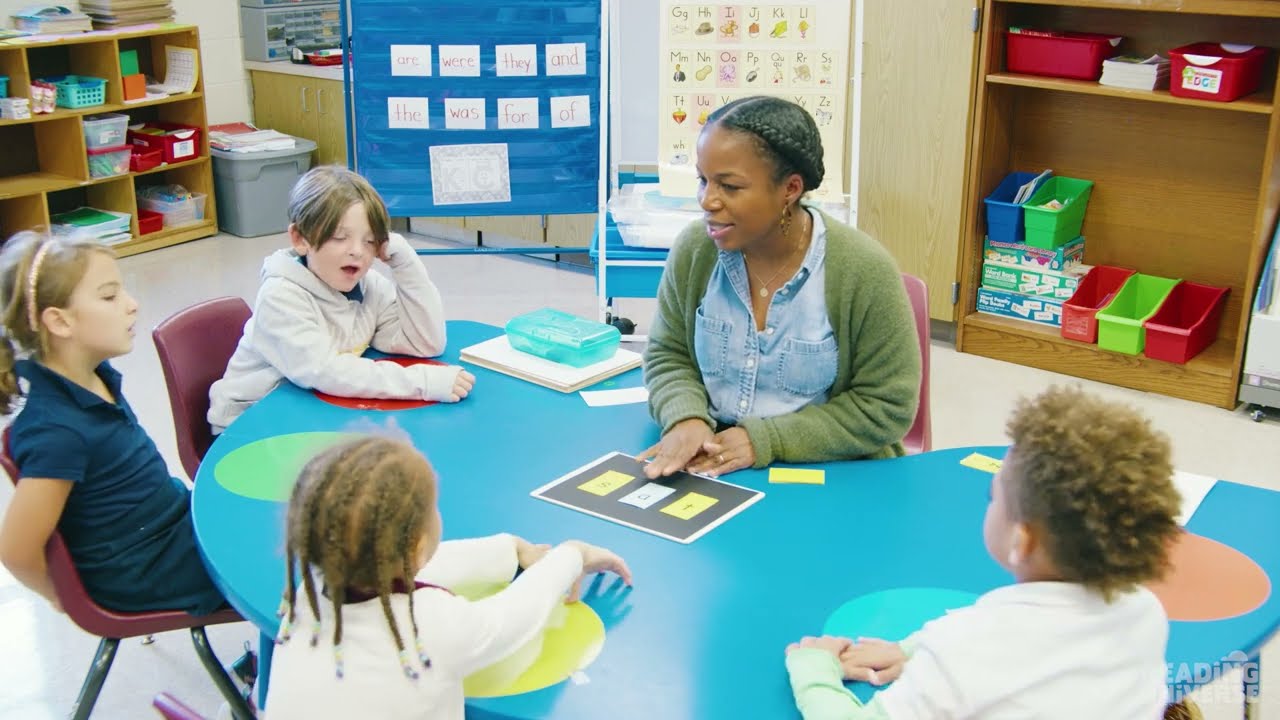
Carla Miller: Okay. I want everybody to pay attention because I might ask you to read his same word. Okay. Ready? So what word was this one more time, Avery?
Avery: Sat.
Carla Miller: Sat. What did I just do?
Illya: Cat.
Carla Miller: Good. What word did she read?
Hadley: Cat.
Carla Miller: Good. What did I just do?
Hadley: Cap.
Carla Miller: Good. What word was that?
Student: Cap. Nap.
Carla Miller: Nap. Good. I'm going to go to Ilya. Illya, what word was that?
Illya: Nap.
Hadley: Look, I'm changing my vowel in the middle. What word do we have now?
Illya: /n/, /ē/ ... /n/, /ĭ/, /p/. Nip.
Carla Miller: I love how you tapped that word out. Excellent. What word did she just read?
Student: Nip.
Avery: Nap.
Carla Miller: Well, let's tap it together.
Everyone: /n/, /ĭ/, /p/. Nip.
Carla Miller: Excellent. What did I just do?
Avery: /d/, /ĭ/, /p/. Dip.
Carla Miller: Excellent. I'm moving over here to you. What word did he read?
Avery: Dip.
Carla Miller: What word do we have now?
Hadley: Hip.
Carla Miller: Excellent. What word is this?
Student: Hip.
Carla Miller: Hip. Good. I'm going to change my vowel in the middle again. Are you ready?
Student: Hop.
Carla Miller: Excellent. We're going to move right here to Hadley. Hadley, what word was that?
Hadley: Hop.
Carla Miller: What did I just do?
Hadley: Bop.
Carla Miller: Excellent. Illya, what word?
Illya: Bop.
Carla Miller: Okay. What's this word?
Illya: /m/, /ŏ/, /p/... /m/, /ŏ/, /p/... /m/, /ŏ/, /p/. Mop.
Carla Miller: Excellent. I love how you pulled it together at the end.
Hide Video Transcript
Show Video Transcript
Carla Miller: We're going to start by just reading a word. Okay. We're going to stick each sound in the word, and then I'm going to move them a little bit closer together, and then we're going to say the sounds, and then I'm going to move 'em a little closer together, but we're not going to read it until they are touching and I say, catch it. Are you ready?
Students: Yes.
Carla Miller: Okay. So I want to hear everybody's voice. Let's do it.
Students: /s/... /ă/... /t/. /s/ .. /ă/ .. /t/.
Carla Miller: Listen for the word. Are you guys ready? We're going to catch it this time. Good. Okay.
Students: Sat!
Together: /s/, /ă/, /t/. Sat.
Carla Miller: Good. Okay.
Gather the Materials You'll Need

These letter flash cards with pictures are 2x4 in size, allowing eight small cards to print on a single page.

These letter flash cards with pictures are 5x7 in size so that two cards print per sheet of paper.

These letter flash cards without pictures are 2x4 in size, allowing eight small cards to print on a single page.

These letter flash cards without pictures are 5x7 in size so that two cards print per sheet of paper.

Short Vowels Word List
Our word lists can help you plan for teaching short vowels. Use them in your reading, spelling, and fluency building lessons and activities.
