8. For Students Who Need Additional Support with Short Vowels
Short Vowels Skill Explainer
Louise Spear-Swerling, Ph.D.What does the instruction look like?
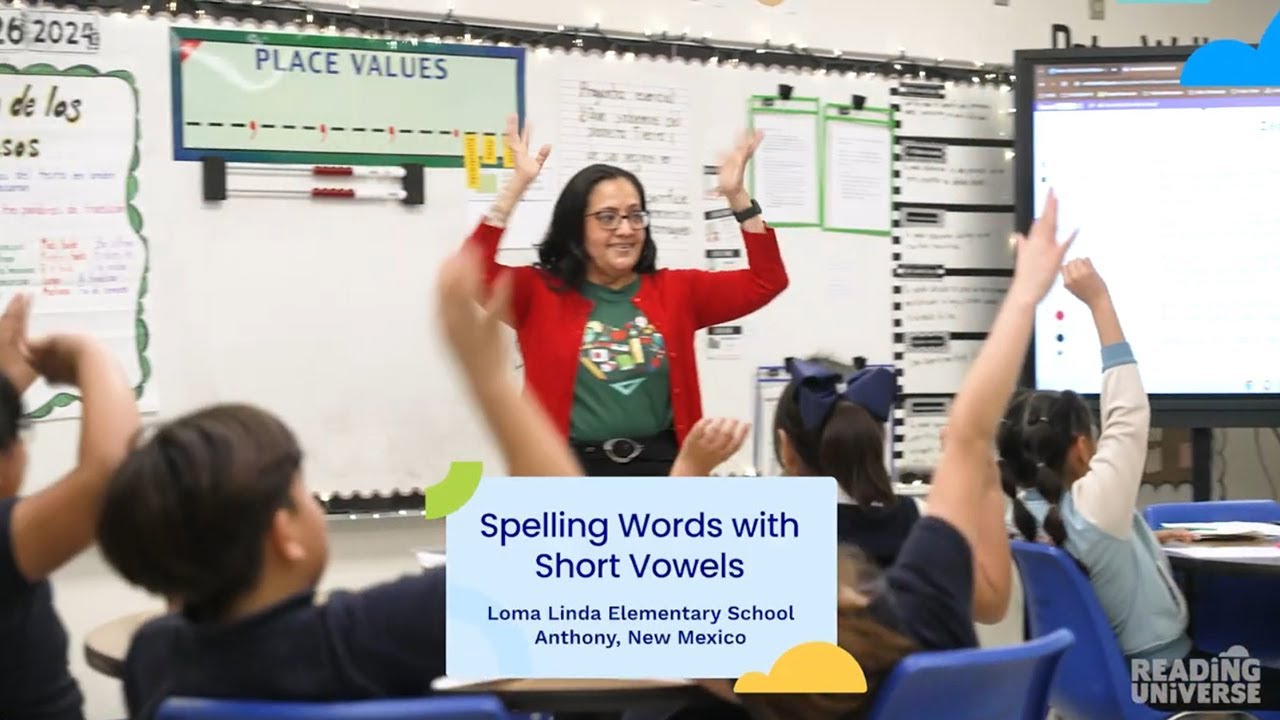
Hide Video Transcript
Show Video Transcript
Estella Escajeda: Are you guys ready to learn? Yes! We're all ready to learn, right?
Narrator: Estella Escajeda is about to guide her third graders through dictation. It's the spelling portion of her phonics lesson on the difference between short 'i' and short 'e'. They begin with individual words.
Estella Escajeda: I'm going to give you a word, you repeat the word, and then we're going to segment it into individual phonemes. Okay? Are we ready? The first word is met. Say met.
Students: "met" ... /m/, /ĕ/, /t/ ... met ...
Estella Escajeda: What is the first letter in met?
Students: /m/ ... /ĕ/, /t/ ...
Estella Escajeda: Good job.
Narrator: Once they identified each phoneme, they matched letters to the sounds, allowing them to spell the word.
Estella Escajeda: Our next word is going to be bet. Say bet.
Students: bet ... /b/, /ĕ/, /t/ ... bet ...
Narrator: Ms. Escajeda has created routines that allow them to quickly add new words. She checks for accuracy as they go, making sure they get the vowel sounds right.
Estella Escajeda: Our next word is going to be bit.
Students: /b/, /ĭ/, /t/ ... bit ...
Estella Escajeda: So what is our new vowel now?
Students: 'i'
Estella Escajeda: How does 'i' sound?
Students: /ĭ/ ...
Estella Escajeda: Say bit ...
Students: bit ...
Estella Escajeda: Good job.
Narrator: Now they're ready to move on to writing phrases and sentences that have words with short 'i' and short 'e'.
Estella Escajeda: You did wonderful. Kiss Your Brains. Good job.
Narrator: If you enjoyed this video, please subscribe to our YouTube channel @RUTeaching. For more information, please visit ReadingUniverse.org. Special thanks to Loma Linda Elementary School, Vado Elementary School, the Gadsden Independent School District, and the New Mexico Public Education Department. Reading Universe is made possible by generous support from Jim & Donna Barksdale, the American Federation of Teachers, The Emily Hall Tremaine Foundation, and anonymous donors. Reading Universe is a service of WETA, Washington, D.C., The Barksdale Reading Institute, and First Book.

Hide Video Transcript
Show Video Transcript
Estella Escajeda: So, everybody get your magical popsicle sticks. You're going to need your magical popsicle sticks to follow along.
Narrator: In this part of Esella Escajeda's lesson on the short 'e' and short 'i' vowel sounds, students now will read phrases . They're building on the spelling they did earlier in the lesson. Scaffolding learning in this way develops accuracy and supports fluency.
Estella Escajeda: We're going to read these phrases three times, okay? So, these are phrases, they're not sentences, remember they're phrases. We're going to read it three times. The first time we're going to read it to be sure we read the word correctly. The second time, we're going to make sure we read it at a good speed — not too fast and
Students: ... not too slow.
Estella Escajeda: Right? ... Not too slow. And then the third time, we're going to read it, we're going to make sure that what we read matches what the words are trying to tell us. Are we ready? Okay, so we're going to go across, okay? The first one is "in the bed."
Students: "in the bed" ..."the big net" ... "is not wet" ...
Narrator: Ms. Escajeda leads her third graders in guided oral reading, which helps students with accuracy, speed, and expression — or fluent reading. It's a bridge between word recognition and reading comprehension.
Ms. Escajeda and students: "a red pen" ...
Estella Escajeda: Good job. How do you think we did?
Students: Good ...
Estella Escajeda: I think we did good.
Narrator: If you enjoyed this video, please subscribe to our YouTube channel @RUTeaching. For more information, please visit ReadingUniverse.org. Special thanks to Loma Linda Elementary School, Vado Elementary School, the Gadsden Independent School District, and the New Mexico Public Education Department. Reading Universe is made possible by generous support from Jim & Donna Barksdale, the American Federation of Teachers, The Emily Hall Tremaine Foundation, and anonymous donors. Reading Universe is a service of WETA, Washington, D.C., The Barksdale Reading Institute, and First Book.

Hide Video Transcript
Show Video Transcript
Estella Escajeda: Okay, you ready, boys and girls? Today we're going to be talking about the short 'i' and the short 'e'. Okay.
Narrator: Teacher Estella Escajeda is helping her multilingual third graders hear and produce the very subtle difference between the short 'i' sound and the short 'e' sound.
Estella Escajeda: So here we have the /ĭ/ as in itch, and then we have the /ĕ/ as in edge, like if you're at the edge of something, right? So, the /ĭ/ and the /ĕ/. Can somebody tell me, what do you notice? What do you see? Maritza?
Maritza: They're close together. [She answers in Spanish.]
Estella Escajeda: They're close together. That is correct. Do you guys notice? Look at the Vowel Valley.
Narrator: Maritza is comfortable answering in her home language, Spanish. That's because Ms. Escajeda encourages children to use all of their language resources to tackle the complex process of learning to read in English.
Estella Escajeda: So everybody, put your fingers next to your lips. Say /ĭ/ ...
Students: /ĭ/ ...
Estella Escajeda: Say /ĕ/ ...
Students: /ĕ/ ...
Estella Escajeda: What did you notice? What did you feel? Maria Eugenia?
Maria Eugenia: [The student answers the question in Spanish.]
Narrator: Ms. Escajeda provides her students with a bridge from Spanish to English by talking explicitly about the connections between the two languages.
Estella Escajeda: If you notice, when we hear /ĭ/, do we also hear it in Spanish? One of our vowels. Everybody say, icky ...
Students: icky ...
Estella Escajeda: What do you hear in the beginning?
Students: /ĭ/ ...
Estella Escajeda: Say echo.
Students: "echo" ...
Estella Escajeda: Say echo with your opera voice.
Students: echo ...
Estella Escajeda: Yes. You hear the difference? Good job.
Narrator: Next up, they'll use their new skills to take on dictation ... spelling words with short 'i' and short 'e'.
Estella Escajeda: Get your magnetic letters ready and you're going to get your boards ready.
Narrator: If you enjoyed this video, please subscribe to our YouTube channel @RUTeaching. For more information, please visit ReadingUniverse.org. Special thanks to Loma Linda Elementary School, Vado Elementary School, the Gadsden Independent School District, and the New Mexico Public Education Department. Reading Universe is made possible by generous support from Jim & Donna Barksdale, the American Federation of Teachers, The Emily Hall Tremaine Foundation, and anonymous donors. Reading Universe is a service of WETA, Washington, D.C., The Barksdale Reading Institute, and First Book.
