4. Videos: See Phoneme Segmentation and Blending in the Classroom
Phoneme Segmentation and Blending
Blending Phonemes with DeAngela Huggins
In this video, teacher DeAngela Huggins of Burgess-Peterson Academy in Atlanta does an oral exercise in which students blend individual phonemes into words.

Hide Video Transcript
Show Video Transcript
DeAngela Huggins: All right. The first listening game that we're going to do is mystery word. Okay. I'm going to give you the sounds, and on my signal, which is going to be a thumbs up, you are going to put those sounds together and tell me my mystery word. So, for example, if I said /c/, /ӑ/, /t/ ... what's my mystery word? Cat would be my mystery word.
So you guys ready? Yes. All right. So first mystery word is /b/, /r/, ...
Students
/b/, /r/, ... bar.
Ms. Huggins: Very good. /C/, /r/ ...
Students: Car.
Ms. Huggins: Oh, this is a tricky one. /Sh/, /r/, /p/ ...
Students: Sharp.
Ms. Huggins: Very good. Yes. The next one ... /f/, /or/ ...
Students: Four.
Ms. Huggins: Very good. /M/, /or/ ...
Students: More.
Ms. Huggins: And last mystery word is /p/, /or/, /ch/ ...
Students: Porch.
Ms. Huggins: Good job. You guys are really good.
Narrator: For more information, please visit reading universe.org. Special thanks to Burgess Peterson Academy and Atlanta Public Schools. Reading Universe is made possible by generous support from Jim and Donna Barksdale, the Emily Hall Tremaine Foundation, and two anonymous donors. Reading Universe is a service of WETA, Washington, DC, the Barksdale Reading Institute, and First Book.
DeAngela Huggins: This is Reading Universe.
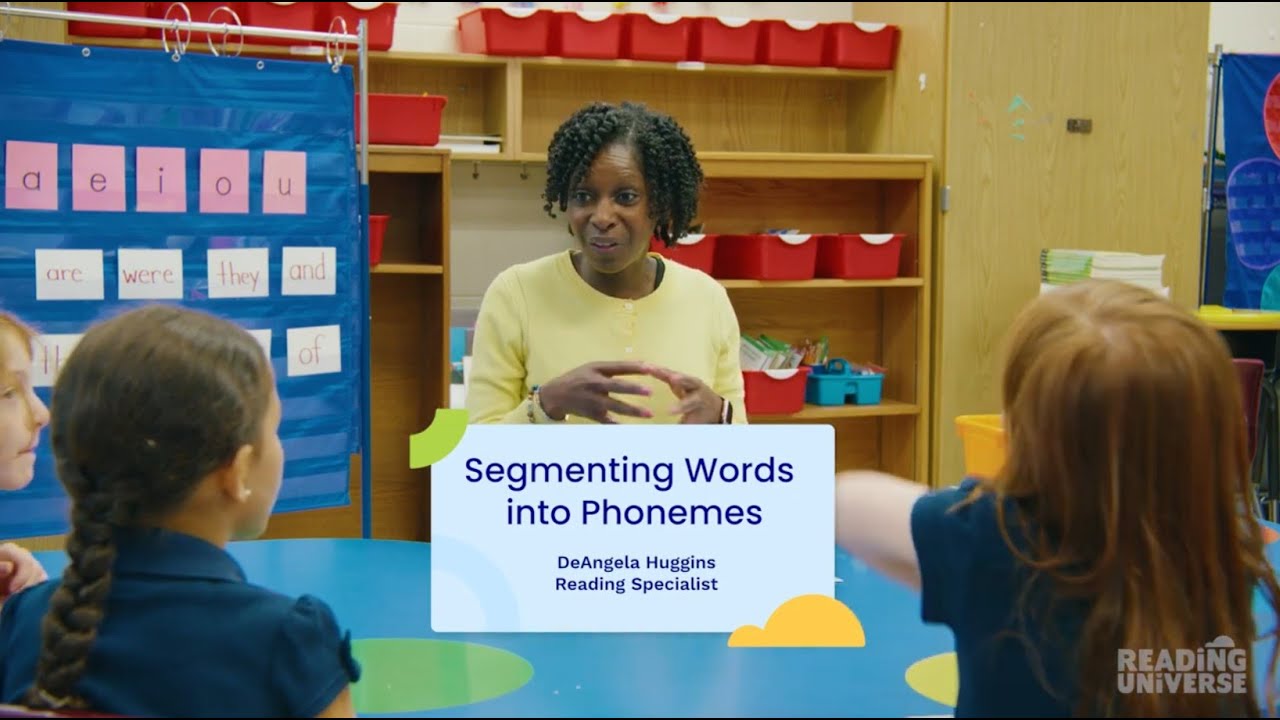
Segmenting Phonemes with DeAngela Huggins
Here Ms. Huggins of Atlanta teaches students to “tap out” sounds as a way of segmenting them.
Hide Video Transcript
Show Video Transcript
Students and DeAngela Huggins: [background noise]
DeAngela Huggins: ... All set and we are ready! Our next listening game, we're going to segment or break the word apart into sounds. So I'm going to give you the entire word, and then you're going to help me tap out the sounds. What are we going to do?
Students and DeAngela Huggins: Tap out the sounds ...
DeAngela Huggins: And then you're going to show me on your fingers how many sounds were in that word. Okay. So let's use my mystery word cat again. If we said /k/, /a/, /t/. Let's tap it.
Students: /k/, /a/, /t/
DeAngela Huggins: How many sounds are in that word?
Students: Three.
DeAngela Huggins: Three. So you're going to just show me so I can see that everyone is hearing all of these sounds okay. So you ready? All right. First word, we're going to segment it. The first word is far.
Students: far
DeAngela Huggins: Tap out the sounds.
Students: /f/, /ar/
DeAngela Huggins: How many sounds? [Students hold up two fingers.] There are two sounds in that word. Next word. Let's listen. Listen, very carefully. Chart.
Students: chart
DeAngela Huggins: Let's tap it.
Students: /ch/, /ar/, /t/
DeAngela Huggins: How many sounds? Three. Very good. The next word ... listen ... has a blend ... start.
Students: start
DeAngela Huggins: start
Students: [students count the phonemes with their fingers] /s/, /t/, /ar/, /t/
DeAngela Huggins: How many sounds?
Students: Ooh.
DeAngela Huggins: How many sounds Felix? [students hold up four fingers] Four. There are four sounds. You guys are doing so good! All right. Next word is block.
Students: block
DeAngela Huggins: Say the word block.
Students: block
DeAngela Huggins: All right. Let's tap the sounds.
Students and DeAngela Huggins: [Students count the sounds with their fingers.] /b/, /l/, /o/, /ck/
Students: block
DeAngela Huggins: How many sounds? Four [students hold up four fingers]. Very good. In our last one, because you guys are so smart, the word's going to be smart. What's the word?
Students: smart
DeAngela Huggins: Let's tap all those sounds.
Students: [Students count out the sounds with their fingers.] /s/, /m/, /ar/, /t/
DeAngela Huggins: Smart. How many sounds? [Students hold up four fingers.] Good job you guys give your brains a big kiss.
Narrator: For more information, please visit ReadingUniverse.org. Special thanks to Burgess Peterson Academy and Atlanta Public Schools. Reading Universe is made possible by generous support from Jim and Donna Barksdale, the Emily Hall Tremaine Foundation, and two anonymous donors. Reading Universe is a service of WETA, Washington DC, the Barksdale Reading Institute, and First book.
DeAngela Huggins: This is Reading Universe.
Quick Look: Segmenting Phonemes
Watch Atlanta teacher Princess Watts-Blount helping her first graders segment the phonemes in train.

Hide Video Transcript
Show Video Transcript
Princess Watts-Blount: Your first word is train. Repeat.
Students: Train.
Princess Watts-Blount: All right. Let's tap it.
Students: /t/, /r/, /ā/ /n/.
Princess Watts-Blount: All right. Now do it with your pop-it.
Students: /t/, /r/, /ā/ /n/.
Princess Watts-Blount: All right. Can somebody give me the sounds in train? Yes.
Student: /t/, /r/, /ā/ /n/.
Princess Watts-Blount: How many phonemes?
Students: Four.
Princess Watts-Blount: Four. /t/, /r/, /ā/ /n/.
Quick Look: Blending Phonemes
Watch first grade teacher Jenifer Rogers guide her Atlanta students as they blend the sounds for two words, best and mask.

Hide Video Transcript
Show Video Transcript
Jenifer Rogers: Here we go. We're going to blend our phonemes. We're going to blend our phonemes. I'm going to give you the sounds separate. You're going to pull them all back together for me. Here we go: /b/, /e/, /s/, /t/.
Students: Best.
Jenifer Rogers: /m/, /a/, /s/, /k/
Students: Mask.
Teaching Strategy Demo: Stretch and Shrink
Watch Mississippi teacher Monique Ealey demonstrates the Stretch and Shrink strategy.

Hide Video Transcript
Show Video Transcript
Monique Ealey: Today we are going to stretch and shrink the word map. When we stretch and shrink a word, we say all the sounds slowly so we can hear the individual sounds but still hear how they are connected. Watch and listen as I stretch and shrink the word map. Mmmmaaaaaap. Map! What was the first sound that you heard? /m/. What was the second sound? /ă/. And what was the last sound? /p/. Map.
Blending Sounds to Read Words with Short Vowels
Watch as Dr. Carla Miller first reviews the sound-letter correspondences her kindergarten students already know. Then, they work together to build words and Dr. Miller models how to blends sounds to read words using those letters.

Hide Video Transcript
Show Video Transcript
Carla Miller: Okay, friends. So today what we're going to do is we're going to start by drilling our deck. So what you need to do is take out your tracers. Okay. So we're going to go ahead and drill the card. Ready?
Ms. Miller and students: 's', snakes, /s/
Narrator: Today instructional coach Carla Miller will be working on blending sounds with her kindergartners. She begins the phonics lesson with a warm-up, running through flashcards with keyword pictures. This daily practice helps ensure children master the sound of each letter.
Ms. Miller and students: 'i', itch, /ĭ/
Ms. Miller: Who can raise their hand and tell me why is this a different color? Why is this a different color, Hadley?
Hadley: Because it's a vowel.
Ms. Miller: Tell me about a vowel. What's a vowel?
Hadley: It's something that has to be in a word.
Ms. Miller: Very good, very good. Let's keep going.
Ms. Miller and students: 'o', octopus, /ŏ/
Ms. Miller: I love those octopus arms.
Ms. Miller and students: 'm', man, /m/
Ms. Miller: Okay, you guys did that so well that we are going to try it with my itty-bitty baby deck. Okay? And this time there are no pictures. So we're just going to say the name of the letter and the sound. Are you ready?
Students: Yes.
Ms. Miller and students: 'z', /z/
Narrator: Next, she uses flashcards with no pictures to ensure the children can read the sound automatically in isolation.
Ms. Miller: Good.
Students: 'a', /ă/, 't', /t/, 'c', /k/
Narrator: Ms. Miller provides quick, direct, explicit instruction to correct errors.
Students: 'b' ...
Ms. Miller: Oh, let's look again. It says straight back, big belly, 'b'. Let's do it together.
Ms. Miller and students: 'b', /b/
Ms. Miller: Very good.
Ms. Miller and students: 'm', /m/
Ms. Miller: So what we're going to do today is we're going to have some fun making words. Are you ready to make words?
Students: Yes.
Ms. Miller: Okay, here we go. Some of the words are going to be real words, and some might be nonsense words. Who knows what a nonsense word is? Tell me, Ilia.
Iia: They're words that are not real.
Ms. Miller: Words that are not real. They do not make any sense. Avery already told us that our blue letters are different. What's different about the blue letters, Shane?
Shane: The vowels.
Ms. Miller: They're vowels. Very good. Okay, we're going to start by just reading a word. Okay. We're going to say each sound in the word, and then I'm going to move them a little bit closer together, and then we're going to say the sounds and then I'm going to move 'em a little closer together, but we're not going to read it until they are touching and I say "catch it." Are you ready?
Students: Yes.
Ms. Miller: Okay. So I want to hear everybody's voice. Let's do it.
Students: /s/, /ă/, /t/
Students: /s/, /ă/, /t/
Ms. Miller: [whispering] Listen for the word. Are you guys ready? We're going to catch it this time. They're touching.
Students: /s/, /ă/, /t/ ... sat.
Ms. Miller: Good. Okay. What word was that?
Students: Sat.
Ms. Miller: Sat. Okay. I want everybody to pay attention. I might ask you to read this same word. Okay. Ready? So what word was this one more time, Avery.
Avery: Sat.
Ms. Miller: Sat. What did I just do?
Ilia: Cat.
Ms. Miller: Good. What word did she read?
Hadley: Cat.
Ms. Miller: Good. What did I just do?
Narrator: Ms. Miller models and practices the step-by-step process for blending sounds into words. All the words she chooses for blending contain the sounds the children just practiced with their flashcards. Each child has an opportunity to do the work of blending sounds.
Ilia: /n/, /ĭ/, nip.
Ms. Miller: I love how you tapped that word out. Excellent. What word did she just read?
Students: nip ... nap ...
Ms. Miller: Well, let's tap it together.
Ms. Miller and students: /n/, /ĭ/, nip.
Ms. Miller: Excellent. What did I just do?
Avery: /d/, /ĭ/, /p/ ... dip.
Ms. Miller: Excellent. I'm moving over here to you. What word did he read?
Hadley: Dip.
Ms. Miller: What word do we have now?
Hadley: Hip.
Ms. Miller: Excellent. What word is this?
Shane: Hip.
Ms. Miller: Hip. Good. I'm going to change my vowel in the middle again. Are you ready?
Shane: Hop.
Ms. Miller: Hop. Excellent. We're going ...
Narrator: Children work at their own pace. Some do the work of tapping and blending aloud. Some do it in their heads.
Ms. Miller: Ilia, what word?
Ilia: Bop.
Ms. Miller: Okay. What's this word?
Ilia: /m/, /ŏp/ ... /m/, /ŏp/, ... /m/, mop.
Ms. Miller: Excellent. I love how you pulled it together at the end. Let's go ahead as a group. Can everybody see my words?
Students: Yeah.
Ms. Miller: Okay. We might run into some crazy nonsense words. Okay? Silly words that don't make sense while I do this, but let's do it. We're going to tap and read.
Ms. Miller and students: /m/, / ĭ/, /p/ ... mip ...
Narrator: The lesson ends with more practice with everyone tapping and reading words together.
Ms. Miller: Let's look at this one more time. This is a straight back, big belly. What letter is this?
Students: 'b'
Ms. Miller: What sound does 'b' make?
Students: /b/
Ms. Miller: Let's try that again.
Ms. Miller and students: /b/, /ĭ/, /p/ ... bip
Ms. Miller: Good. Is that a real word or a nonsense word?
Students: Nonsense.
Ms. Miller: All day long. Let's go to the next one.
Ms. Miller and students: /h/, / ĭ/, /p/ ... hip
Ms. Miller: Hip. Good. Real or nonsense?
Students: Real.
Ms. Miller: Real. Put your hands on your hips. Excellent. You guys did an amazing job blending our words. You're such great readers. I love it. Give yourself a little shine. Shine. I'll give you shine ...
Narrator: Enjoy this video? Don't forget to subscribe to our YouTube channel @RUTeaching. For more information, please visit ReadingUniverse.org. Special thanks to Burgess-Peterson Academy and Atlanta Public Schools. Reading Universe is made possible by generous support from Jim & Donna Barksdale, the American Federation of Teachers, the Emily Hall Tremaine Foundation, and three anonymous donors. Reading Universe is a service of WETA, Washington, D.C., the Barksdale Reading Institute, and First Book.
Ms. Miller: This is Reading Universe.
