- Vowel Teams and Diphthongs Skill Explainer
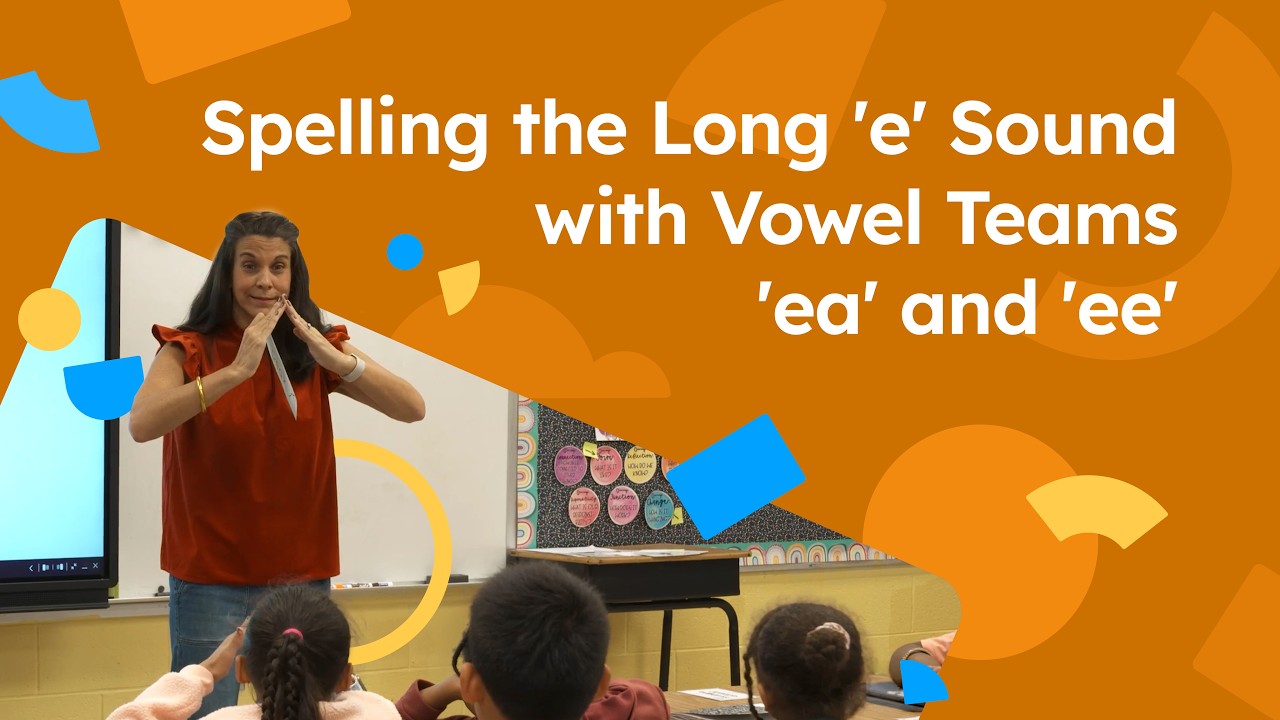
Spelling the Long 'e' Sound with Vowel Teams 'ea' and 'ee'
Hide Video Transcript
Show Video Transcript
Elizabeth Hogan: All right guys, we are going to get started. We're going to do our listening game.
Narrator: Today, reading specialist Elizabeth Hogan is teaching vowel teams to third graders at Burgess-Peterson Academy in Atlanta. They're learning how to spell the long 'e' sound using vowel teams 'ee' and 'ea'. She begins with a listening game.
Elizabeth Hogan: I am going to say the sounds. You're going to listen and blend the sounds together to figure out the word. All right? So the first word is this. Listen. /s/, /t/, /ā/, /n/.
Students: Stain.
Elizabeth Hogan: Good job. It was a little tricky. Okay. Listen to this next one. /th/, /r/, /ē/.
Students: Three.
Elizabeth Hogan: Three. Yes. All right. You're putting my sounds together to figure out my word. Ready?
Narrator: After students practice blending sounds together, Ms. Hogan moves to warming up with flashcards where she reviews vowel teams they've already learned, like 'ai' and 'ay'.
Elizabeth Hogan: Listen to this. This comes in the beginning or middle of words. Where do we see this?
Students: Beginning or middle of words.
Elizabeth Hogan: Yes. We're going to need that today for writing.
Narrator: Then she introduces the vowel teams they'll be working with today.
Elizabeth Hogan: Ooh, sound?
Students: /ē/.
Abby: This can be at any spot.
Elizabeth Hogan: You're exactly right, Abby. It can be in any place in the word, so that's a little tricky. When we're spelling today, I'll have to give you some hints about where it is. Okay? Sound?
Students: /ē/.
Elizabeth Hogan: Good job. All right. This can also be anywhere in a word. So we're going to work on this one a lot today because it's a little tricky.
Narrator: Today's vowel teams often appear in homophones. Words that sound the same, but are spelled differently and have different meanings. And because 'ee' and 'ea' can be found anywhere in a word, this means that students will need explicit instruction on how to use context to determine the correct spelling.
Elizabeth Hogan: What about, I want you to think in your head if I say the word /m/ /ē/ /t/ ... /m/ /ē/ /t/ ... what picture just popped in your head? Quiet hand. What picture just popped in your head if I just say the word /m/ /ē/ /t/? What do you think, Ellison?
Ellison: Like the food meat.
Elizabeth Hogan: The food meat, like, "Oh, we cooked the meat on the grill." Everyone say, "We cooked the meat on the grill."
Students: "We cooked the meat on the grill."
Elizabeth Hogan: "We cooked the meat on the grill." And that is this type. This vowel team, M-E-A-T. Yes. There is another type of /m/ /ē/ /t/. Show me with a quiet hand if you know the /m/ /ē/ /t/ that uses this vowel team. Sahanya, what do you think?
Sahanya: The one that you meet somebody.
Elizabeth Hogan: Yes. Like if you meet someone, like if I'm meeting you for the first time and I say, "Nice to meet you, Sahanya." Yes. That is this /m/ /ē/ /t/ with 'ee'. So do you see how that's a little tricky? We have this /m/ /ē/ /t/ and we have this /m/ /ē/ /t/. Okay. I'm going to teach you some other homophones today. The homophones we're going to talk about today are the words "peek" and Peak. There are two types of /p/ /ē/ /k/. It is a homophone, but they are spelled with different vowel teams that say /ē/. So the first word we're going to talk about today is the word "peek" with the 'ee' vowel team. Okay? And this one means like you're looking at something. So everyone's going to put their hands up and I want you to say, "I peak into the box." Everyone say it.
Students: "I peak into the box."
Elizabeth Hogan: Good. The word is peek. What's the word?
Students: Peek.
Elizabeth Hogan: Say "E-E, peek."
Students: "E-E, peek."
Elizabeth Hogan: And put up your binoculars. We're peeking around the classroom.
Narrator: Adding a hand motion while spelling helps students lock in the letters. And it keeps it fun.
Elizabeth Hogan: Amazing. That is p/ /ē/ /k/ with the 'ee' vowel team. We put up our binoculars for that peek. Okay? I'm going to put that one up here because we're going to need it later. All right. This is the next /p/ /ē/ /k/ with the 'ea' vowel team. Said the same way, but this one is spelled E-A and it means something totally different. So I want you to say "E-A, peak."
Students: "E-A, peak."
Elizabeth Hogan: This /p/ /ē/ /k/ means the very tip top of a mountain. All right. I want you to say, "This peak means the very tip top of a mountain."
Students: "This peak means the very tip top of a mountain."
Elizabeth Hogan: Nice. Say, "I hiked to the peak of Stone Mountain."
Students: "I hiked to the peak of Stone Mountain."
Elizabeth Hogan: Nice. And we're making a little mountain with our hands, right? And our tips of our fingers are the ... peak. Right? So this /p/ /ē/ /k/ say E-A, peak.
Students: "E-A, peak."
Elizabeth Hogan: "Means the top of a mountain."
Students: "Means the top of the mountain."
Elizabeth Hogan: Yes. All right. I'm going to put that one up here. This is the word /f/ /ē/ /t/. What's the word?
Students: /f/ /ē/ /t/.
Elizabeth Hogan: This is "E-E, feet."
Students: "E-E, feet."
Elizabeth Hogan: And I'm going to point because this /f/ /ē/ /t/ means our body part, right? The body part that helps us stand and walk. Everyone say "E-E, feet."
Students: "E-E, feet."
Elizabeth Hogan: And show me your feet. "Our body part."
Students: "Our body part."
Elizabeth Hogan: Nice. All right. I'm putting that one up next because we got it. So everyone say "E-A, feat."
Students: "E-A, feat."
Elizabeth Hogan: And a "feat" is a major accomplishment. You say it.
Students: "A feat is a major accomplishment."
Elizabeth Hogan: Nice job. All right. So now, do you know two types of /f/ /ē/ /t/?
Students: Yes.
Elizabeth Hogan: Did you ever know that before? Really cool. All right. So now we're going to review the words we talked about because you're going to be writing them today and you're going to need to know which one by listening to my sentence. So the thing is, if I just say /p/ /ē/ /k/, /p/ /ē/ /k/, you don't know which one to write. You're having to listen to the rest of my sentence to know which one I'm talking about. All right. So one more time. Let's review the words we did. Say "E-E, peek."
Students: "E-E, peek."
Elizabeth Hogan: "Means to look at something."
Students: "Means to look at something."
Elizabeth Hogan: Yes. And we put on our binoculars. Okay. Ready? Echo me. "E-A, peak."
Students: "E-A, peak."
Elizabeth Hogan: "Means the top of a mountain."
Students: "Means the top of a mountain."
Elizabeth Hogan: Yes. All right. Now let's move on to /f/ /ē/ /t/. Ready? Say "E-E, feet."
Students: "E-E, feet."
Elizabeth Hogan: "Means our body parts."
Students: "Means our body parts."
Elizabeth Hogan: Great. Good job. Did you point to your feet?
Students: Yes.
Elizabeth Hogan: Yes. Okay. Ooh. And our last one, say "E-A, feat."
Students: "E-A, feat."
Elizabeth Hogan: "Means a major accomplishment."
Students: "Means a major accomplishment."
Elizabeth Hogan: Everyone make their wow face for the feat.
Together: Wow.
Elizabeth Hogan: It might be like a home alone face. Okay, good job. I think you know these words. I think you're ready to get writing. Thumbs up if you're ready to open your dictation notebook.
Narrator: During sound and word dictation, Ms. Hogan gives students the chance to practice finding a word's meaning from context, which is the key to unlocking the correct spelling.
Elizabeth Hogan: The first word is the word peek. Repeat. Peek.
Students: Peek.
Elizabeth Hogan: "I will peek into the gift bag." Everyone say the sentence.
Together: "I will peek into the gift bag."
Elizabeth Hogan: I wonder if you're remembering the right /p/ /ē/ /k/. Sahanya, which /p/ /ē/ /k/ did you write?
Sahanya: E-E.
Elizabeth Hogan: Yes. Everyone say "E-E, peek."
Students: "E-E, peek."
Elizabeth Hogan: And put on your binoculars. All right. Next word. The word is peak. Repeat.
Students: Peak.
Elizabeth Hogan: Peak. Repeat.
Students: Peak.
Elizabeth Hogan: All right. You don't know yet. So listen to my sentence. "I ran to the peak of Stone Mountain." What's the sentence?
Students: "I ran to the peak of Stone Mountain."
Elizabeth Hogan: Yes. Jacob, which vowel team did you choose for that /p/ /ē/ /k/?
Jacob: E-A.
Elizabeth Hogan: Yes. Awesome. The reason he chose that is because he listened to my sentence and he heard me say, "I hiked up to the peak" and he listened the whole way. So he knew I wasn't talking about this type of peek, looking into something. It doesn't make sense. So we have to know which vowel team to use by listening to the clues in the sentence, right?
Students: Yes.
Elizabeth Hogan: Awesome. Great job. Okay guys, let's read the words we wrote today and then we're going to move on to phrases. Okay?
Students: Peak.
Narrator: After reading what they wrote, they move on to the next step of today's lesson — phrase dictation.
Elizabeth Hogan: We are going to use a set of our homophone words. So you're going to have to think about which one to use. Okay? So we're going to write two phrases. The first phrase is, "peeked at the prize." Repeat.
Students: "Peeked at the prize."
Elizabeth Hogan: Good. Let's write it. I hope you chose the right /p/ /ē/ /k/. Check yours with mine. Park your pencils when you're ready so I know we can go to our next phrase. Your second phrase is, "hike to the peak."
Students: "Hike to the peak."
Elizabeth Hogan: Again, "hike to the peak."
Students: "Hike to the peak."
Elizabeth Hogan: Good. Write it. Check your /p/ /ē/ /k/ with my /p/ /ē/ /k/ and make sure you chose the right one. Thumbs up if you chose the right /p/ /ē/ /k/. Good. We did E-A, peak.
Narrator: The last step of the lesson is sentence dictation. Students will pick one of the phrases and turn it into a complete sentence. By adding a "who" or a "what."
Elizabeth Hogan: All right. Get started turning one of these phrases into a complete sentence. You get to decide. You get to make it up. You want to say, "I peeked at the prize," talking about you? I like it. Okay, you do that. All right. Everyone has wrapped up their sentences. If you would like to share your complete sentence, show me a quiet hand and I am going to call on some friends to share their sentence. Hadley, I would love for you to share your sentence.
Hadley: "Addie and me peaked at the prize."
Elizabeth Hogan: Yes. Amazing. "Addie and me peaked at the prize." All right, Chase, I would love for you to share your sentence.
Chase: "At my birthday party, I peek at the prize."
Elizabeth Hogan: Ooh. At Chase's birthday party, he peaked at the prize. Amazing sentence. Good job. I love the work you put into your sentences and I saw a lot of others really creative sentences. Amazing. Pat yourself on the back. You guys are amazing.
Narrator: Reading Universe is made possible by generous support from Jim and Donna Barksdale; the Hastings/Quillin Fund, an advised fund of the Silicon Valley Community Foundation; the AFT; the Emily Hall Tremaine Foundation; and anonymous donors. Special thanks to Burgess-Peterson Academy, Reading Is Essential for All People and Atlanta Public Schools. If you enjoyed this video, please subscribe to our YouTube channel @RUTeaching. Reading Universe is a service of WETA, Washington D.C., the Barksdale Reading Institute, and First Book.
