1. An Overview of Vowel Teams and Diphthongs
Vowel Teams and Diphthongs Skill Explainer
How do we teach vowel teams?
What's a vowel team?
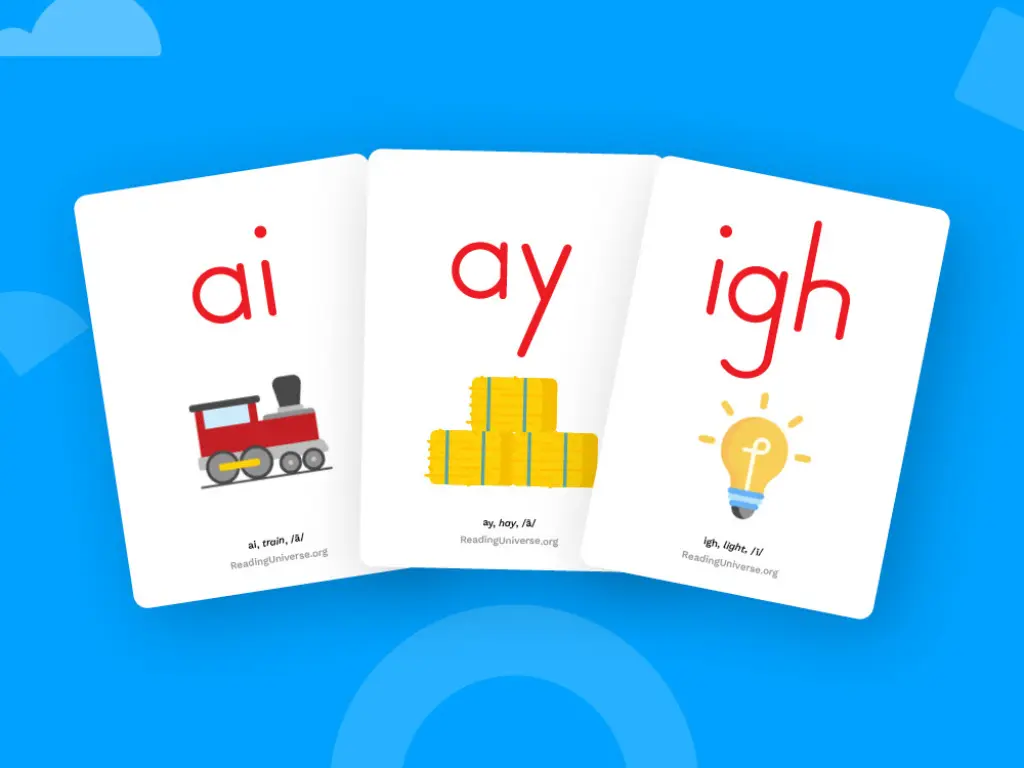
A vowel team is a group of two to four letters that represents a single vowel sound, like 'a-i' in nail or the 'e-i-g-h' in eight. The name "vowel team" can be deceiving because a vowel team can include both vowels and consonants, as in 'igh'.
What's important to remember is that these letters represent one single vowel sound. For example, the two letters 'a' and 'y' make the vowel team 'ay', which makes one single vowel sound in the word play: the long 'a' sound.
What's a diphthong?
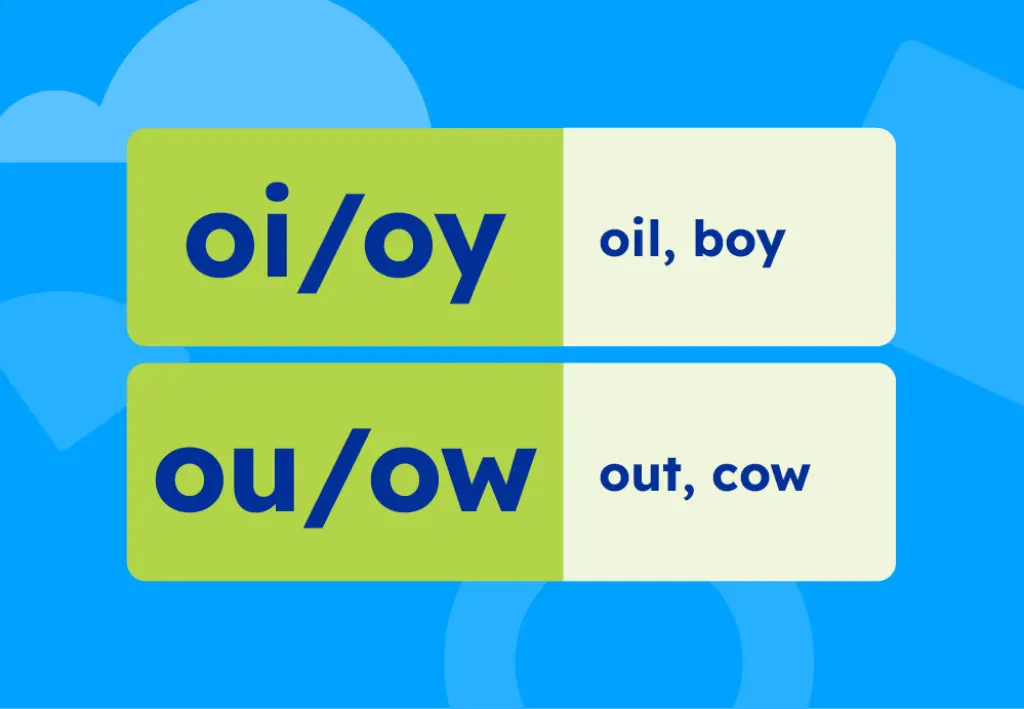
A diphthong (pronounced /dĭf-thŏng/) is a variation on a vowel team. A diphthong combines two vowel sounds in a single syllable, as in coin and loud. You'll notice the 'ou' vowel team in loud begins as one vowel sound and glides into another in the same syllable. Our mouths move as we say diphthongs, though they are only one syllable.
Click through the interactive below to hear and see the articulatory features of the sound and common spellings for the diphthong /ow/.
So how do we teach these?
Vowel Team Generalizations
Introducing Vowel Teams to Your Students
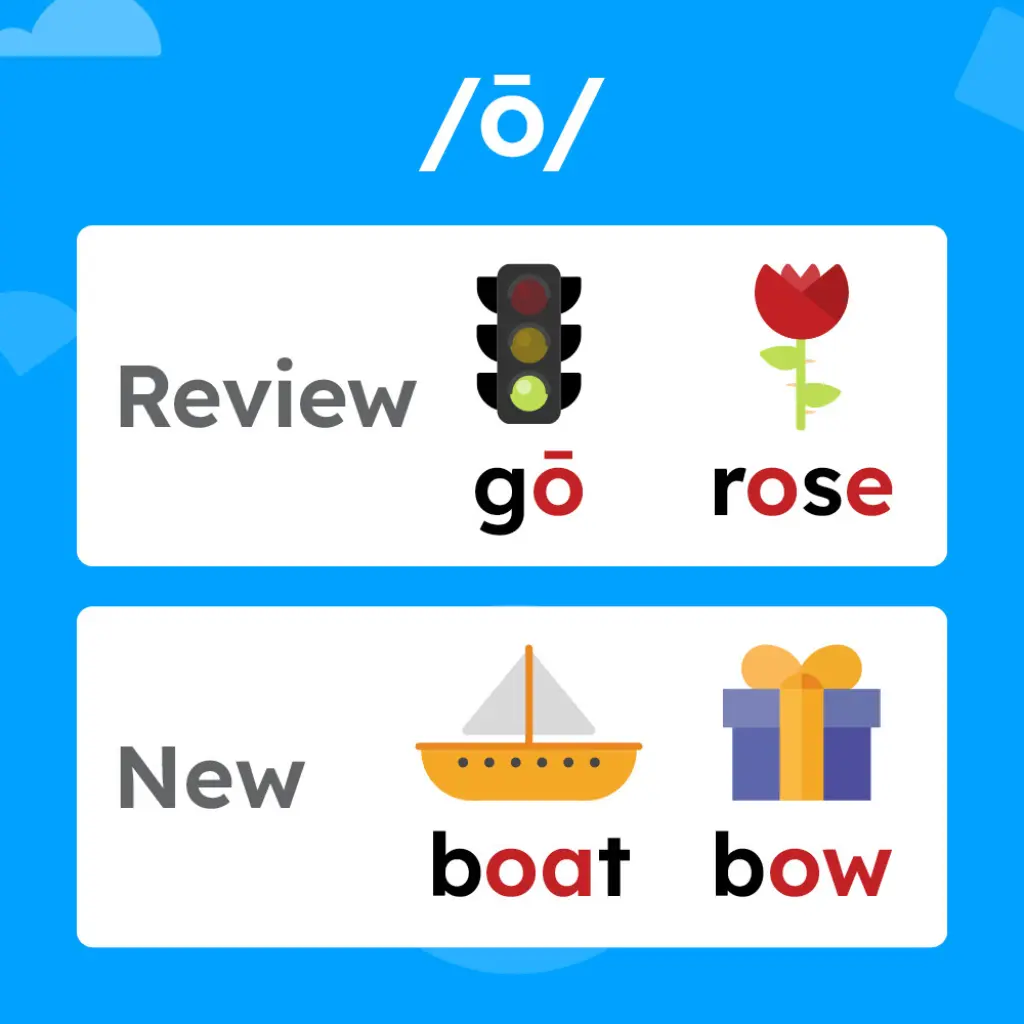
As you'll see in our How to Teach section, we start our vowel teams instruction by focusing on the vowel sound (not the new spelling), connecting to the ways students have already learned to spell that sound before introducing the new spelling. Here's an example:
Let's say you want to introduce the vowel team 'oa' to your students. You wouldn't tell them that to start. You would begin with the long 'o' sound, reviewing the two ways your students already know how to spell it … in an open syllable like in go and in a magic 'e' syllable like in rode.
Then you would tell them about the new long 'o' spellings … 'oa' and 'ow'. We teach these two vowel teams together because they have a generalization that students can remember for when to use each spelling, where they are typically found in a word.
'oa' is almost always at the beginning or middle of a word, like in oat and boat; and 'ow' is typically found at the end of a word, like in bow or know.
After introducing the two new vowel teams, students will end up understanding how one sound can be spelled four different ways.
With lots of practice and exposure to words with the 'oa' and 'ow' vowel teams, students will be able to absorb these generalizations. Then they'll know how to pronounce moat or tow when they come across it in a book — and they'll know how to spell coat or low when they need to write it.
Watch as second grade teacher Mikara Gallegos follows these steps. She starts by reviewing the previously taught sound-spelling correspondences of the long 'o' sound and then introduces the two new vowel teams 'oa' and 'ow'.

Hide Video Transcript
Show Video Transcript
Mikara Gallegos: Okay, boys and girls, we're going to work on long 'o' today. Okay? Are you ready? I'm going to give you a word. You're going to give me all the sounds and then you're going to tell me what vowel sound you hear. Are you ready?
Students: Yes.
Mikara Gallegos: Say boat.
Students: Boat.
Mikara Gallegos: Give me the sounds.
Students: /b/, /ō/, /t/.
Mikara Gallegos: What vowel sound?
Students: /ō/
Mikara Gallegos: Long 'o'. Good.
Narrator: Today, Mikara Gallegos is teaching second graders at Shull Elementary in San Dimas, California. How the vowel teams 'oa' and 'ow' can spell the long 'o' sound.
Mikara Gallegos: Say vote.
Students: Vote.
Mikara Gallegos: Sounds?
Students: /v/, /ō/, /t/.
Mikara Gallegos: What vowel sound?
Students: /ō/
Mikara Gallegos: Long 'o'.
Narrator: She begins the lesson with a listening game to help students tune their ears into that long 'o' vowel sound.
Students: Long 'o'.
Mikara Gallegos: Long 'o'. Say slope.
Students: Slope.
Mikara Gallegos: Give me the sounds.
Students: /s/, /l/, /ō/, /p/.
Mikara Gallegos: What's the vowel sound?
Students: Long 'o'.
Mikara Gallegos: Yeah. What do they all have in common?
Student: /ō/. Long 'o'.
Mikara Gallegos: Long 'o'. But there's so many different patterns to make long 'o', right?
Narrator: Ms. Gallegos' students already know two ways to spell the long 'o' sound. First in an open syllable word.
Together: No. Go.
Students: So. Bro.
Mikara Gallegos: Those all have long 'o's, right? 'O' at the end says /ō/.
Narrator: They also know how to spell long 'o' with magic 'e', or as Ms. Gallegos calls it, mama 'e'.
Mikara Gallegos: Mama 'e' says ...
Together: You say your name!
Mikara Gallegos: Okay, let's read it. Ready?
Students: /n/, /ō/, /t/. Note.
Mikara Gallegos: Good. Next one.
Students: /v/, /ō/, /t/. Vote. /r/, /ō/, /d/. Road.
Mikara Gallegos: Good reading. That's all 'o' with the mama 'e'. Well, I have two new long 'o' patterns for us today.
Narrator: She starts with the vowel team 'oa'.
Mikara Gallegos: Okay. Look at my examples. Are you ready? Here's 'o' and 'a'. It says oak.
Students: Oak.
Mikara Gallegos: Good. Next one.
Together: /ō/, /t/, oat.
Mikara Gallegos: Next one.
Students: /s/, /ō/, /k/, soak.
Mikara Gallegos: Awesome.
Students: /b/, /ō/, /t/, boat.
Mikara Gallegos: Last one.
Students: /k/, /ō/, /t/, coat.
Mikara Gallegos: Good job. So 'oa' says ...
Student: /ō/.
Mikara Gallegos: /ō/. Okay. I have another one. 'ow' says ... /ō/. Okay. Let's read it.
Students: /s/, /n/, /ō/, /w/, snow.
Mikara Gallegos: Good. What about this one?
Students: /g/, /l/, /ō/, /w/, glow.
Mikara Gallegos: What about this one?
Students: /g/, /r/, /ō/, /w/, grow.
Mikara Gallegos: "Grow." Do this one again.
Students: /g/, /r/, /ō/, /w/, grow.
Mikara Gallegos: What if I added '-ing'?
Students: Growing.
Mikara Gallegos: Growing. Oh, you guys are so smart. Okay, here's 'ow' again. But here's an 'n' at the end of it. 'O-W-N'. Let's read it.
Together: /ō/... /w/... /n/, own.
Mikara Gallegos: Good. Let's do this one.
Students: /g/, /r/, /ō/, /w/, /n/, grown.
Mikara Gallegos: Good. Last one.
Students: /f/, /l/, /ō/, /w/, /n/, flown.
Mikara Gallegos: Yeah. Let's do the 'F-L' blend again. /f/, /l/... . Let me hear it.
Students: /f/, /l/ ... /ō/, /w/, /n/, flown.
Mikara Gallegos: Good.
Narrator: Ms. Gallegos' kids have added two new long 'o' spellings to their repertoire with the vowels teams 'oa' and 'ow'. But vowel teams can be tricky. Eventually, these students will learn that 'ow' can also spell /ow/ as in cow. So consistent practice and lots of reading are key for students to build confidence with vowel teams.
Mikara Gallegos: Let's read it. Ready?
Together: /ō/ ... /t/, oat.
Mikara Gallegos: Oh, it's good. Let's go to the next one.
Narrator: Reading Universe is made possible by generous support from Jim and Donna Barksdale, the Hastings/Quillin Fund, an advised fund of the Silicon Valley Community Foundation, the AFT, the Emily Hall Tremaine Foundation, and anonymous donors. Special thanks to Schull Elementary School, Bonita Unified School District, and the Los Angeles County Office of Education. If you enjoyed this video, please subscribe to our YouTube channel @RUteaching. Reading Universe is a service of WETA Washington D.C., the Barksdale Reading Institute, and First Book.
Schull teachers: This is Reading Universe.

Teacher Tip
What's a grapheme?
You might know that a letter or a letter combination used to represent one sound can be called a grapheme. For example, the two middle letters of the word boat — 'o' and 'a' — are a grapheme representing the single sound /ō/ in the middle of the word. Using this terminology can help your students make the connection between a combination of letters (a grapheme) and one sound (a phoneme). And that can help with learning the concept of vowel teams.
Word Meanings, Homophones, and Homographs
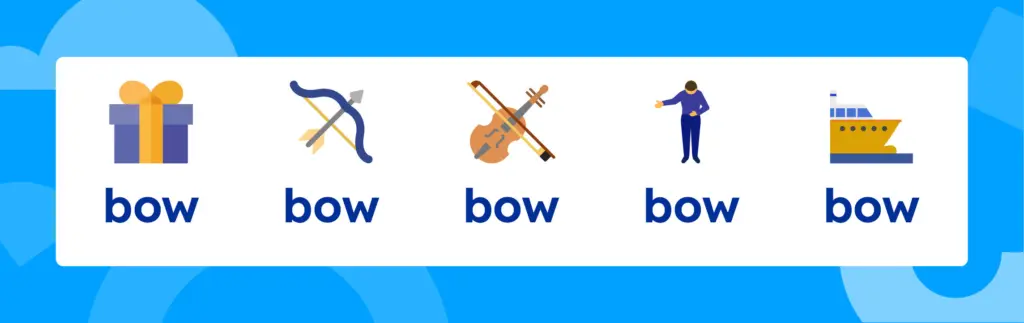
The pictures make it possible for you to know how to pronounce the vowel team 'ow'.
We also gain context from surrounding words when we find a vowel team in a paragraph or other text. Read the following lines out loud, and you'll instantly pronounce bow correctly for the circumstance:
- a bow on a package
- a bow and arrow
- a bow used to play the violin
- a conductor taking a bow
- the bow of a ship
So for your students, you'll teach the meanings of words with vowel teams through the context of a sentence with explicit instruction in homophone and homograph pairs. Many of these words are already part of students' oral language, so this guidance will deepen their understanding of the words.
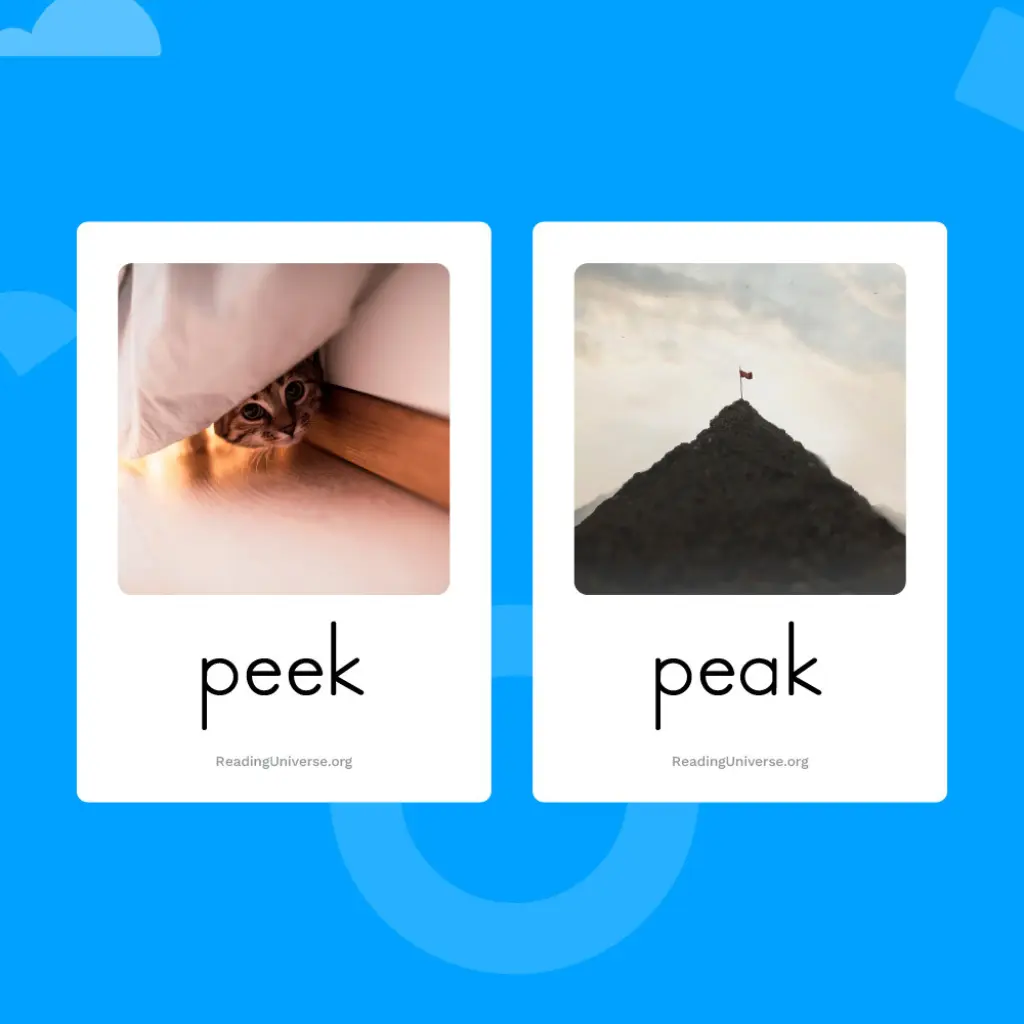
Here is a routine you can use to explicitly teach homophone pairs. For example, with peak and peek, you can follow this routine:
- Say the word: peak
- Give the vowel team spelling: 'p', 'e', 'a', 'k'
- Use in context: peak, 'e-a', peak, the top of a mountain
- Picture or motion: show a picture of a mountain peak or use your hands to make a peak
What We Hope You'll Learn
Most Common Vowel Teams
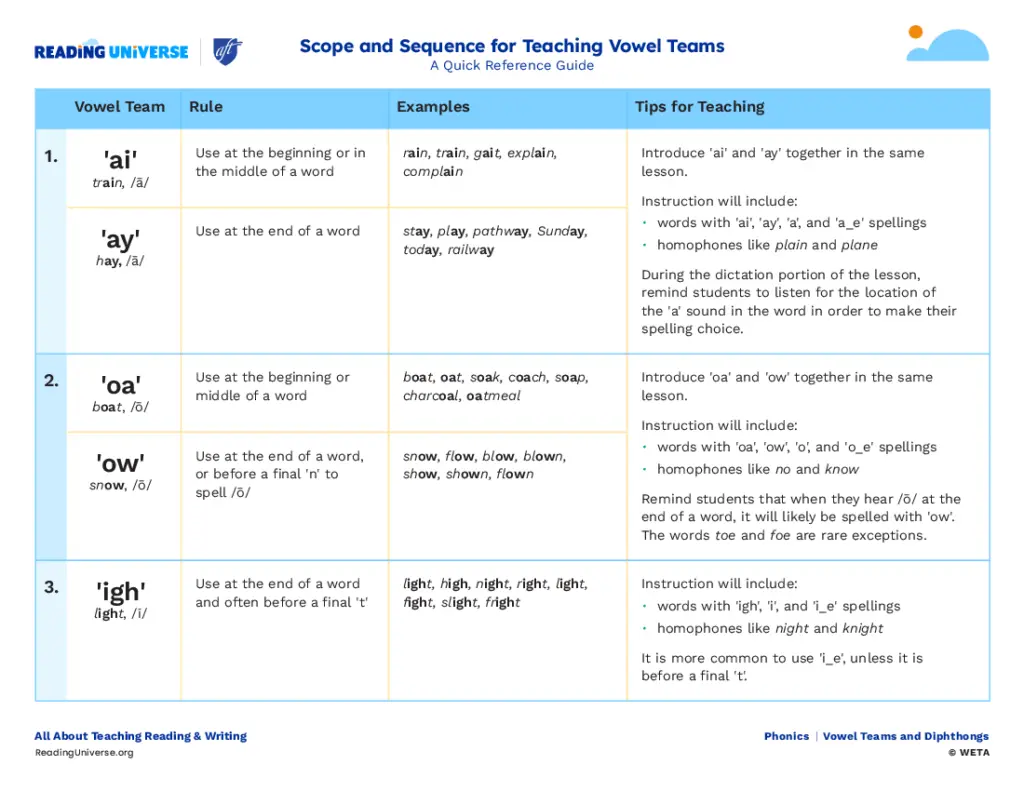
Scope and Sequence for Teaching Vowel Teams
Here is a quick reference chart to help you remember the vowel team spelling rules.
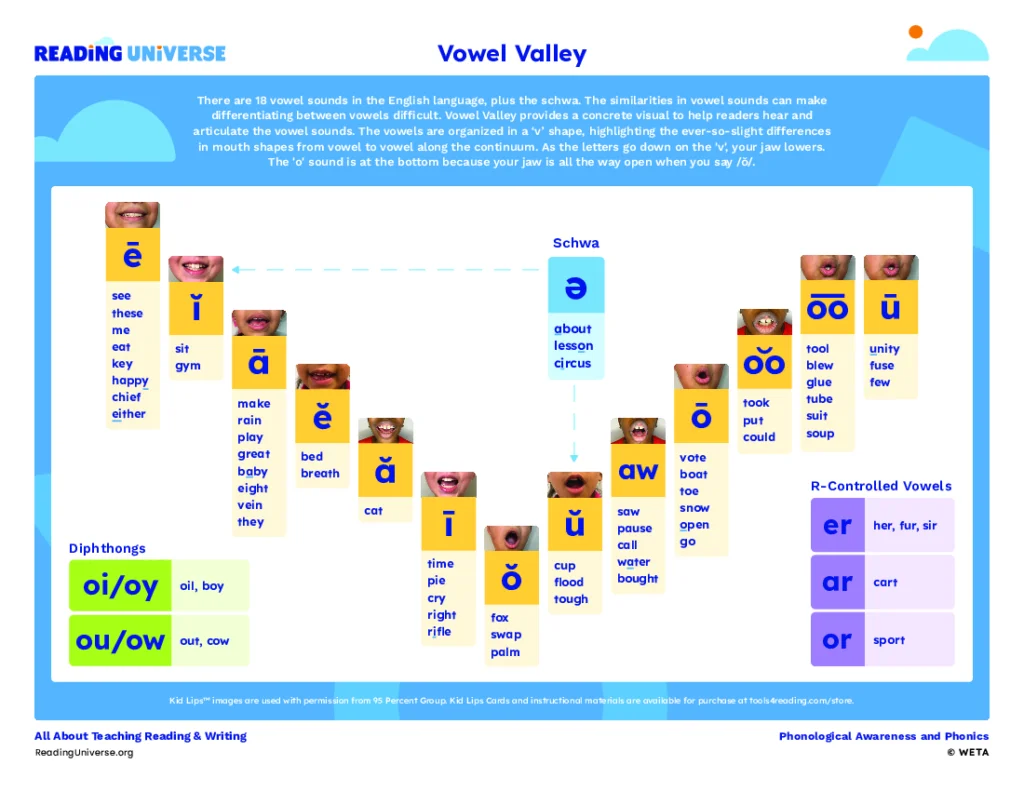
Vowel Valley
The vowel valley chart provides a concrete visual to help readers see, hear, and articulate the vowel sounds, including vowel teams. Use this resource to guide students in vowel sound pronunciation and spelling.
Teacher Tip
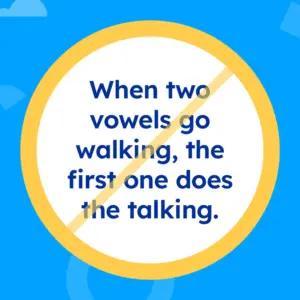
What about "When Two Vowels Go Walking?"
Have you ever heard this saying: "When two vowels go walking, the first one does the talking"? While this is true for some common words like treat, rain, and boat, what about the words head, break, and heard?
Although this is a catchy saying, this broad generalization is not reliable. It actually works less than half the time. For that reason we do not want students to rely on this, which is why we do not recommend teaching it.
