4. Videos: See Vowel Teams and Diphthongs in the Classroom
Vowel Teams and Diphthongs Skill Explainer
New Ways to Spell Long 'o': Vowel Teams 'oa' and 'ow'
Watch as second grade teacher Mikara Gallegos introduces how to spell the long 'o' sound with the vowel teams 'oa' and 'ow' by connecting them to spelling patterns her students already know: open syllables and magic 'e'.

Hide Video Transcript
Show Video Transcript
Mikara Gallegos: Okay, boys and girls, we're going to work on long 'o' today. Okay? Are you ready? I'm going to give you a word. You're going to give me all the sounds and then you're going to tell me what vowel sound you hear. Are you ready?
Students: Yes.
Mikara Gallegos: Say boat.
Students: Boat.
Mikara Gallegos: Give me the sounds.
Students: /b/, /ō/, /t/.
Mikara Gallegos: What vowel sound?
Students: /ō/
Mikara Gallegos: Long 'o'. Good.
Narrator: Today, Mikara Gallegos is teaching second graders at Shull Elementary in San Dimas, California. How the vowel teams 'oa' and 'ow' can spell the long 'o' sound.
Mikara Gallegos: Say vote.
Students: Vote.
Mikara Gallegos: Sounds?
Students: /v/, /ō/, /t/.
Mikara Gallegos: What vowel sound?
Students: /ō/
Mikara Gallegos: Long 'o'.
Narrator: She begins the lesson with a listening game to help students tune their ears into that long 'o' vowel sound.
Students: Long 'o'.
Mikara Gallegos: Long 'o'. Say slope.
Students: Slope.
Mikara Gallegos: Give me the sounds.
Students: /s/, /l/, /ō/, /p/.
Mikara Gallegos: What's the vowel sound?
Students: Long 'o'.
Mikara Gallegos: Yeah. What do they all have in common?
Student: /ō/. Long 'o'.
Mikara Gallegos: Long 'o'. But there's so many different patterns to make long 'o', right?
Narrator: Ms. Gallegos' students already know two ways to spell the long 'o' sound. First in an open syllable word.
Together: No. Go.
Students: So. Bro.
Mikara Gallegos: Those all have long 'o's, right? 'O' at the end says /ō/.
Narrator: They also know how to spell long 'o' with magic 'e', or as Ms. Gallegos calls it, mama 'e'.
Mikara Gallegos: Mama 'e' says ...
Together: You say your name!
Mikara Gallegos: Okay, let's read it. Ready?
Students: /n/, /ō/, /t/. Note.
Mikara Gallegos: Good. Next one.
Students: /v/, /ō/, /t/. Vote. /r/, /ō/, /d/. Road.
Mikara Gallegos: Good reading. That's all 'o' with the mama 'e'. Well, I have two new long 'o' patterns for us today.
Narrator: She starts with the vowel team 'oa'.
Mikara Gallegos: Okay. Look at my examples. Are you ready? Here's 'o' and 'a'. It says oak.
Students: Oak.
Mikara Gallegos: Good. Next one.
Together: /ō/, /t/, oat.
Mikara Gallegos: Next one.
Students: /s/, /ō/, /k/, soak.
Mikara Gallegos: Awesome.
Students: /b/, /ō/, /t/, boat.
Mikara Gallegos: Last one.
Students: /k/, /ō/, /t/, coat.
Mikara Gallegos: Good job. So 'oa' says ...
Student: /ō/.
Mikara Gallegos: /ō/. Okay. I have another one. 'ow' says ... /ō/. Okay. Let's read it.
Students: /s/, /n/, /ō/, /w/, snow.
Mikara Gallegos: Good. What about this one?
Students: /g/, /l/, /ō/, /w/, glow.
Mikara Gallegos: What about this one?
Students: /g/, /r/, /ō/, /w/, grow.
Mikara Gallegos: "Grow." Do this one again.
Students: /g/, /r/, /ō/, /w/, grow.
Mikara Gallegos: What if I added '-ing'?
Students: Growing.
Mikara Gallegos: Growing. Oh, you guys are so smart. Okay, here's 'ow' again. But here's an 'n' at the end of it. 'O-W-N'. Let's read it.
Together: /ō/... /w/... /n/, own.
Mikara Gallegos: Good. Let's do this one.
Students: /g/, /r/, /ō/, /w/, /n/, grown.
Mikara Gallegos: Good. Last one.
Students: /f/, /l/, /ō/, /w/, /n/, flown.
Mikara Gallegos: Yeah. Let's do the 'F-L' blend again. /f/, /l/... . Let me hear it.
Students: /f/, /l/ ... /ō/, /w/, /n/, flown.
Mikara Gallegos: Good.
Narrator: Ms. Gallegos' kids have added two new long 'o' spellings to their repertoire with the vowels teams 'oa' and 'ow'. But vowel teams can be tricky. Eventually, these students will learn that 'ow' can also spell /ow/ as in cow. So consistent practice and lots of reading are key for students to build confidence with vowel teams.
Mikara Gallegos: Let's read it. Ready?
Together: /ō/ ... /t/, oat.
Mikara Gallegos: Oh, it's good. Let's go to the next one.
Narrator: Reading Universe is made possible by generous support from Jim and Donna Barksdale, the Hastings/Quillin Fund, an advised fund of the Silicon Valley Community Foundation, the AFT, the Emily Hall Tremaine Foundation, and anonymous donors. Special thanks to Schull Elementary School, Bonita Unified School District, and the Los Angeles County Office of Education. If you enjoyed this video, please subscribe to our YouTube channel @RUteaching. Reading Universe is a service of WETA Washington D.C., the Barksdale Reading Institute, and First Book.
Schull teachers: This is Reading Universe.
Hearing where a sound falls in a word can help students determine how to spell it correctly. This is especially true when a sound can be spelled more than one way. Watch as reading specialist Lisa Glickman guides second graders through a phonics lesson on how to spell the /oi/ sound using the vowel teams 'oy' and 'oi', and when to use each one.
Hide Video Transcript
Show Video Transcript
Lisa Glickman: All right. We are going to get ready to get started with our listening game. Are you ready? Okay. I'm going to say a word. You're going to repeat the word. We are going to tap the sounds in the word. Today, we are going to listen for the sound /oi/. Everybody say /oi/.
Students: /oi/.
Narrator: Today, reading specialist Lisa Glickman is teaching second graders at Burgess-Peterson Academy in Atlanta how to spell the /oi/ sound with vowel team 'oy' or vowel team 'oi'. She begins with a listening game to help tune students' ears into where in the word they hear that /oi/ sound.
Lisa Glickman: We're going to listen to hear if we hear the sound /oi/ at the beginning, in the middle or the end of the word. First word, joy.
Students: Joy.
Lisa Glickman: Let's tap it.
Together: /j/, /oi/.
Lisa Glickman: Where did we hear the /oi/ sound in that word?
Student: End.
Lisa Glickman: At the end. Good. Next word. Spoil.
Students: Spoil.
Lisa Glickman: Let's tap it.
Narrator: Where that /oi/ sound appears in a word, the beginning, middle or end, is the key to unlocking the correct spelling.
Lisa Glickman: Okay, ready? Next word. Hoist.
Narrator: Hoist.
Together: /h/, /oi/, /s/, /t/.
Lisa Glickman: Where did we hear the /oi/ in that word?
Students: Middle.
Lisa Glickman: In the middle. And to hoist is to lift. So now we are going to look at letters that spell the /oi/ sound that we were just listening for. Everybody say O-Y.
Students: O-Y.
Lisa Glickman: Toy.
Students: Toy.
Lisa Glickman: /oi/.
Students: /oi/.
Lisa Glickman: And in the word toy, that /oi/ sound is at the end. O-Y spells /oi/ at the end of a word. Everybody say, "O-Y at the end."
Students: "O-Y at the end."
Lisa Glickman: And what does this say?
Students: /oi/.
Lisa Glickman: Great job. The other way we can spell the /oi/ sound is O-I. Everybody say O-I.
Students: O-I.
Lisa Glickman: Boil.
Students: Boil.
Lisa Glickman: /oi/.
Students: /oi/.
Lisa Glickman: This spelling for O-I comes at the beginning of a word, like oil, or in the middle. So everybody say O-I.
Students: O-I.
Lisa Glickman: Beginning or middle of a word.
Students: Beginning of the middle of the word.
Lisa Glickman: And what does O-I say?
Students: /oi/.
Lisa Glickman: /oi/. Okay. Ready for your next direction? Take out your dictation notebook and a pencil.
Narrator: This rule is fairly simple. We use O-Y to spell /oi/ at the end of words, like in joy or toy. And we use O-I to spell /oi/ at the beginning or in the middle of words like in oil or hoist. So Ms. Glickman gets right to student practice, beginning with sound dictation.
Lisa Glickman: Okay. The first thing we're going to do is practice writing the letters that spell the /oi/ sound. Okay. Watch what I'm going to do. I'm going to write and say at the same time. Nobody's writing yet. Watch me. 'O', 'y', /oi/, at the end of a word. Can you all do that in your book and say it? Let's say it together.
Together: 'o', 'y', /oi/, at the end of a word.
Lisa Glickman: So everybody should have O-Y on their paper. What does this say?
Students: /oi/.
Lisa Glickman: It says /oi/. Now we're going to write the other spelling for /oi/. Watch me. Eyes up here. Don't do it yet. Listen to what I'm saying. 'O', 'i', /oi/, in the beginning and the middle. Everybody write 'O', 'i'.
Together: 'O', 'i', /oi/.
Lisa Glickman: And where does it come?
Together: At the beginning or in the middle.
Lisa Glickman: Good job.
Narrator: The next step in this lesson is word dictation.
Lisa Glickman: Now, when we do our word dictation, you're going to have to listen for where in the word that /oi/ comes so that you know which way you're going to spell /oi/. Okay? The word is hoist. What's the word?
Narrator: Hoist.
Lisa Glickman: Hoist. I hear /h/, /oi/, /s/, /t/. Everybody write the word hoist. Nice job. Everybody park your pencils for a minute. Everybody say, "To hoist is to lift."
Narrator: "To hoist is to lift."
Lisa Glickman: So if I was saying, "I need to lift this heavy box," I could also say, "I need to hoist this heavy box." Hoist is to lift. So is that a who or a what? Or is hoist something that you could do, a did what?
Students: A did what.
Lisa Glickman: It's a did what. Good job. Are you ready? Next word. Your next word is boy. What's the word?
Students: Boy.
Lisa Glickman: Everybody write the word boy. Nice writing everyone. Okay. Check your work. Did you use the right /oi/ sound spelling? The right /oi/ spelling? Is boy a who or a what? Or a did what? Everybody on three. Let's see. Who or what or did what? One, two, three.
Together: Who!
Lisa Glickman: It's a who. It's telling us who. Good.
Narrator: After reading back the words they've written down, it's time for sentence dictation.
Lisa Glickman: Great job. Are you ready for your sentence? What we're going to do now is I'm going to say a sentence to you. We're going to repeat it and you're going to write it. Okay? The sentence is, "The box was hoisted into the van." "The box was hoisted into the van." Say it.
Students: "The box was hoisted into the van."
Lisa Glickman: Good job. Write it. "The box was hoisted into the van." "The box was hoisted into the van."
Narrator: Ms. Glickman gives students plenty of time to write before putting the sentence on the board so they can check their work.
Lisa Glickman: Okay. Eyes up here. Let's read this whole thing together. Are you ready? Go.
Narrator: "The box was hoisted into the van."
Lisa Glickman: Okay. Now we have to be detectives. All right. Park your pencils. Everybody think in your head. In this sentence, "the box was hoisted into the van." What is the who or the what of this sentence? Everybody think for a minute. What is the who or the what in this sentence? Everybody?
Students: The box.
Lisa Glickman: The box.
Student: And the van.
Lisa Glickman: The box is the who or what that it's about. Yes, a van is also a what. That is so smart. The box is the who or the what that the sentence is talking about. Did what? What did we do with the box, everybody?
Students: Hoisted!
Lisa Glickman: We hoisted. Everybody show me hoisted with your hands. Hoisted. Everybody say, "Hoisted means lift."
Students: "Hoisted means lift."
Lisa Glickman: Hoist means to lift. We have a what was the box. We have a did what. It was hoisted. And where. Into the van. So when you are reading and you are reading sentences and you think about the who or the what, did what, where, it helps you to understand what's happening in the story. Everybody, you guys did a great job. Everybody give yourselves a round of applause. [clapping]
Narrator: Reading Universe is made possible by generous support from Jim and Donna Barksdale; the Hastings Quillen Fund, an advised fund of the Silicon Valley Community Foundation; the AFT; the Emily Hall Tremaine Foundation; and anonymous donors. Special thanks to Burgess-Peterson Academy, Reading is Essential for All People, and Atlanta public schools. If you enjoyed this video, please subscribe to our YouTube channel @RUTeaching. Reading Universe is a service of WETA, Washington D.C., the Barksdale Reading Institute, and First Book.
Flash Card Demos
Hide Video Transcript
Show Video Transcript
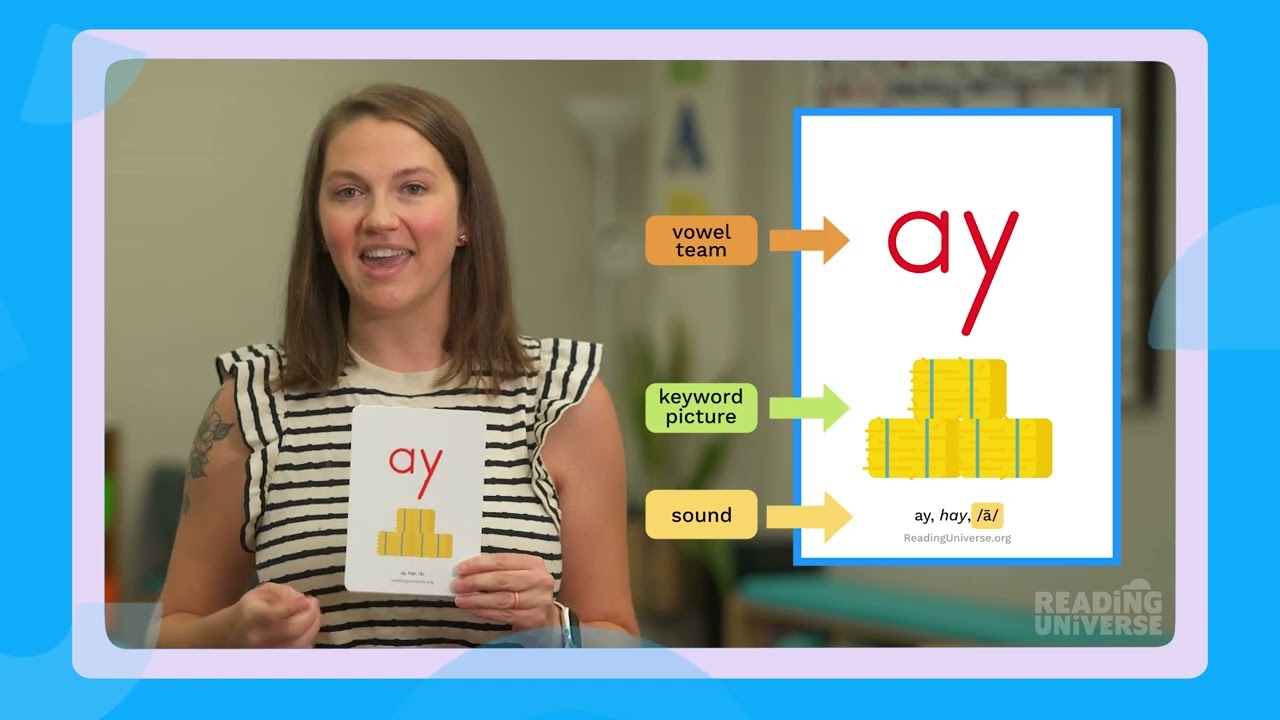
Two vowel teams that we like to introduce at the beginning are the vowel teams, 'ai' and 'ay', and the vowel teams, 'oy' and 'oi'. These are great to start with because they follow the same pattern and there are not a lot of exceptions to this rule. So it's a really clean one to start with with students and make it kind of concrete. So for 'ai', 'ai' says /ā/ at the beginning or middle of words. So we would say 'ai', train, /ā/. 'ay says /ā/ at the end of words. So we would say 'ay', hay, /ā/. Notice when I do the 'oi' and 'oy', it's the same verbiage. 'oi' says /oi/ at the beginning or middle of a word. 'oi', boil, /oi/. 'oy' says /oi/ at the end of a word. 'oy', toy, /oi/. 'oy' also has a couple rule breakers, specifically in these two syllable words. We find 'oy' in the middle when normally would come at the end. And those few words are royal, loyal, oyster, and voyage. And we like to say, "The royal loyal oyster went on a voyage." That's a great sentence to help us remember those rule breakers.

Hide Video Transcript
Show Video Transcript
These vowel teams make the /ō/ sound. 'oa' says /ō/ at the beginning or middle of words. 'oa', boat, /ō/. 'ow' says /ō/ at the end of words. 'ow', snow, /ō/. The second part to this rule is that 'ow' can also be used to spell /ō/ if it is followed by the letter 'n'. Most of these words are the past tense version of words like grow and show — grow, groan, show, shown.
Hide Video Transcript
Show Video Transcript
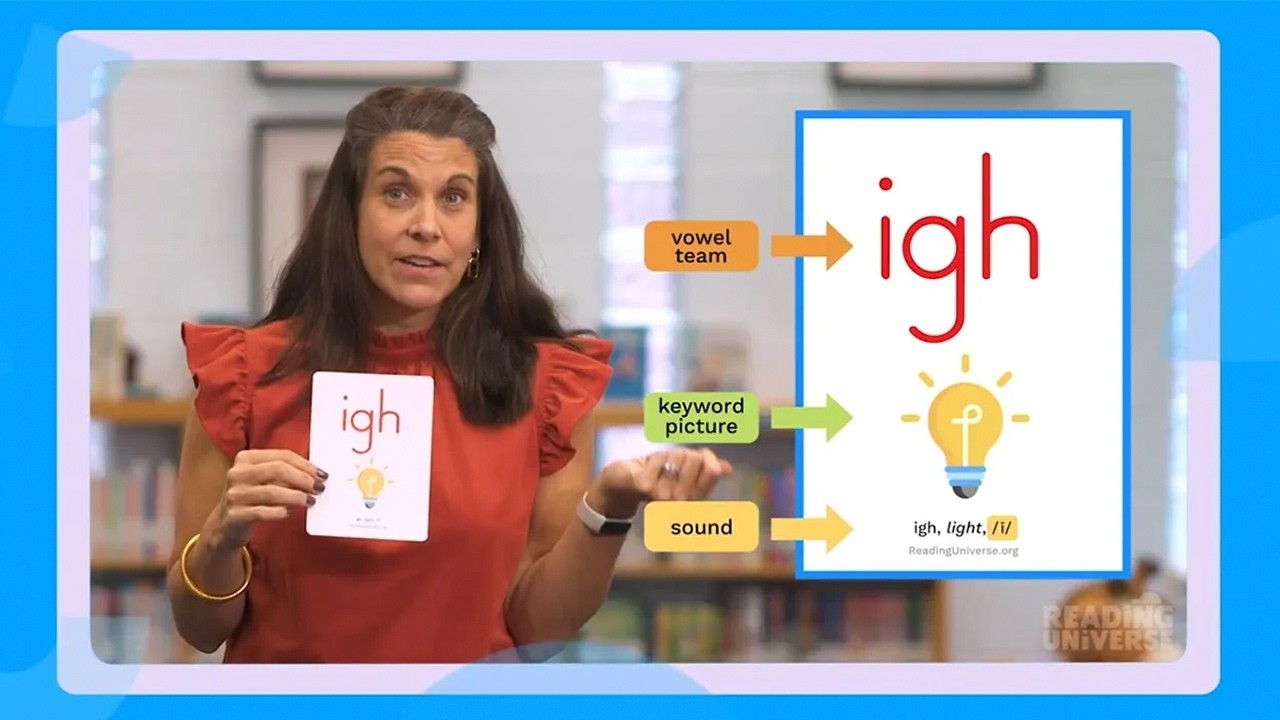
This is how we warm up the vowel team card 'igh.' 'igh' says /ī/. So we say the card, 'igh,' light, /ī/. And this vowel team can be used in the middle of words or at the end of words. So in the middle of words, this is often followed by a 't', like in the word light, might, night, bright, or it could be at the end of the word like sigh.

Hide Video Transcript
Show Video Transcript
This is how we warm up the 'oo' vowel team with cards. The 'oo' vowel team makes two sounds. So the first is 'oo', book, /o͝o/. The second is, 'oo', broom, /o͞o/.

Hide Video Transcript
Show Video Transcript
'ou' says /ow/ at the beginning and middle of words. 'ou', ouch, /ow/. 'ow' says /ow/ at the end of words. 'ow', cow, /ow/. 'ow' also is used to spell the /ow/ sound when it is followed by an 'n', an 'l', an 'el', or an 'er'.

Hide Video Transcript
Show Video Transcript
'au' says /aw/ at the beginning or middle of a word. 'au', August, /aw/. 'aw' says /aw/ anywhere in the word. 'aw,' saw, /aw/.
Pronounce the Vowel Sounds
Morgan Walton, a reading specialist at Stillmeadow Elementary School in Stamford, Connecticut, demonstrates how to pronounce each vowel sound, including short, long, and r-controlled vowel sounds as well as vowel teams, diphthongs, and the schwa. She gives examples of words for each of those sounds.

Hide Video Transcript
Show Video Transcript
Morgan Walton: I am going to demonstrate how to pronounce the vowel sounds. I'm going to start with the short vowel sounds. Vowels spell the short sound when they're enclosed-syllable words ... /ă/ as in apple ... /ĕ/ as in edge ... /ĭ/ as in itch ... /ŏ/ as in octopus ... /ŭ/ as in up. The next group of vowel sounds are long vowels. Vowels spell the long sound when they're found in an open syllable. The silent 'e' syllable, and some vowel teams ... /ā/ as in acorn ... /ē/ as in eagle ... /ī/ as in ice ... /ō/ as in oval ... /ū/ as in unicorn. The next group of vowel sounds are spelled with vowel teams or diphthongs. They make a distinct sound that is neither long or short ... /aw/ as in "saw" ... /o͞o/ as in ooze ... /o͝o/ as in book ... /ow/ as in house ... /oi/ as in oink. The next set of vowels are called r-controlled vowels ... /ar/ as in "arm" ... /er/ as in bird, fern, and turn ... /or/ as in horn. The last sound is called schwa. Schwa is the sound that we say in an unstressed syllable ... /ə/ as in balloon.
