7.3 Articulation and Students who Speak African American English
Articulation Skill Explainer
Nicole Ormandy, M.Ed., Logan McWilliams, M.Ed.What do I need to know about teaching articulation to students who speak AAE?
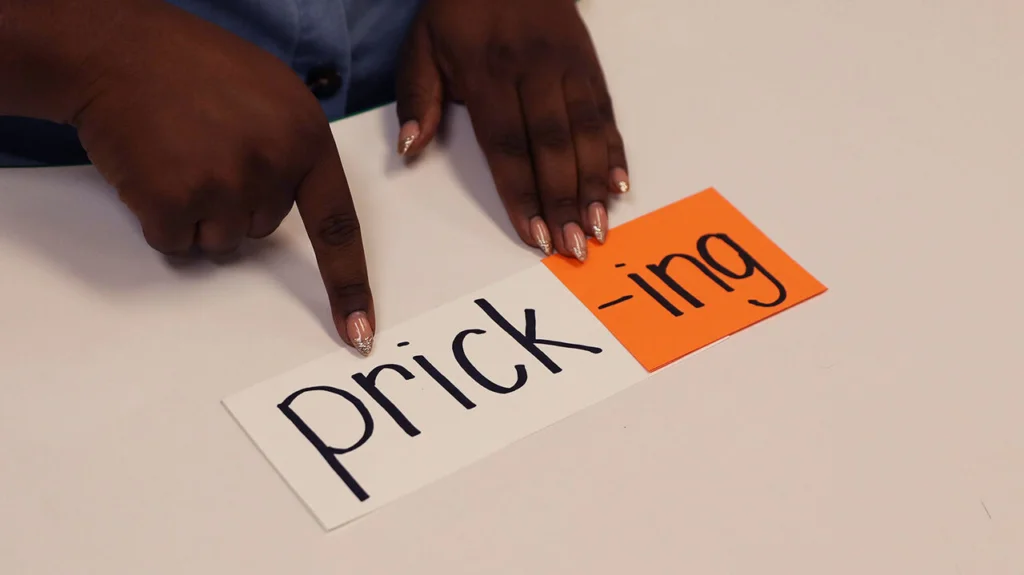
In order to determine whether one of your students who speaks AAE needs additional articulation support, you'll need to first understand the common phonological language variations of AAE:
- Consonant cluster reduction, when students drop a sound in a final blend — "tes" for "test"
- Dropping 'g' in the suffix -ing — "ridin" for "riding"
Hide Video Transcript
Show Video Transcript
We can teach children to read without getting rid of African American English, Appalachian English, Southern English, and instead incorporating it so that challenges to balance the need for kids to learn the language of the classroom with the need to respect the language of home to help them learn the language of the classroom. That is our challenge as educators and it is not a small issue. I know it's not. So one of the things that we've been talking about a lot in bidialectal children and teaching reading is translanguaging. We talked about code switching and code switching is this idea that you have two codes, you need the second code in order to learn to read and so we try to suppress the first one. Translanguaging says that children need access to their entire linguistic repertoire in order to learn to read. Just like that girl in South Africa, she needed access to her entire language system in order to do an oral language task and we know that's true for reading.
So the first thing you're going to do is not be so quick to try to eliminate the use of home language. In fact, it's more important for kids that you recognize that it's a home language and try to incorporate it into what you're doing. Don't correct examples of what kids are doing and make them feel like what they're doing is wrong. That's what I saw in our college students. They had been corrected so much that they were afraid to talk and that is not what we want to do. We don't want kids to be reticent to read out loud because they're afraid they're doing it wrong. We want to hear what they're doing. We want to hear if they're true mistakes or whether it's dialect and be able to respond to it. But if you make children afraid to read, they will not show you what they know.
In an article that Mark Seidenberg and I wrote together in "American Educator," I used an example that's often used of a little boy who was in a classroom second or third grade reading aloud. And instead of "ask," he said "axe," which is really common in African American speakers. So I "axed" him to do something instead of I "asked" him to do something. The teacher stopped him in the middle of reading in front of the whole class and said, "You said that wrong. Now you need to say it right." And she made him say it over and over again until she thought he had it right. Then she said, "Keep reading." So he kept reading and then he said "axe" again and she stopped him again and she did the same humiliating thing to him a second time. And then when she said, "Keep reading." Can you guess what he said? "I don't want to read." Because he's been humiliated about the way he uses language. And frankly, if you have kids in your classroom who are using certain features of a dialect, I promise you that most of the kids are doing it because it's regional or it's cultural. And if it's something that you want him to learn, he says "axe," but you also want him to know "ask," then that's something that you teach in a very different way than what this teacher was doing. Do not correct children in front of the class and don't treat it like a correction. Treat it like an extension. "Oh, you said 'ask' this way. You say 'axe.' There's another way to say this. 'Ask.' Let's see what that looks like. Let's write it." Help them to create a mental representation of this thing that you're adding to their repertoire. You're not getting rid of what they're doing, you're adding something new to it, but you're allowing them to use what they know to learn this new pronunciation of "ask."

Learn More About African American English
If this approach to AAE is new to you or conflicts with your understanding of language use in the classroom, we encourage you to listen to Dr. Julie Washington's timely talk, Teaching Reading to Children Who Speak African American English. She explains dialect and the importance of classroom practices that affirm students' identities while they expand their communicative and literacy repertoires across contexts.
Teaching Tips: How can I help my students?
What You'll See As They're Learning — And How to Respond
Supportive Print-Feedback Practices: Helping Your Students Build Upon Their Dialectal Strengths

This type of feedback affirms that their oral language usage is correct, and we're extending that understanding to support printed language. Continuing to incorporate lots of practice spelling words with /th/ in the middle or ending position after a vowel by having students repeat words after you, and ensuring they represent the sound accurately in print.
Feedback and instruction should become more explicit when:
- the student the draws on familiar phonological patterns when representing words in print (like in the example above)
- the student cannot distinguish between sounds (they don't hear the difference between /f/ and /th/)
- speech patterns are not characteristic of AAE (they're true articulation issues, like saying /w/ instead of /r/ — wun/run)
