3.2 Explicitly Teach Sentence Combining
Sentence Combining Skill Explainer
A Step-by-Step Lesson
Step 1. Activate and Build Background Knowledge

Teacher Tip
By third grade, students should be using the terms noun and verb to refer to the essential parts of a sentence rather than the function questions like, Who? or What? is this sentence about?

Hide Video Transcript
Show Video Transcript
Heather Adams: All right, welcome back. Did you have a good lunch?
Students: Yes.
Heather Adams: Awesome. Alright, well, Jeff's here to start writing with us. Say hi.
Students: Hi, Jeff.
Heather Adams: Hi. Jeff is ready. Our class pet is ready and today what we're going to be talking about is sentence combining and we're going to try to answer two questions. Why should I combine sentences and how do I do it?
Narrator: Today, Heather Adams is teaching her third graders at Oak Street Elementary how to transform simple sentences into more complex and interesting ones. They will be combining sentences using conjunctions or connector words.
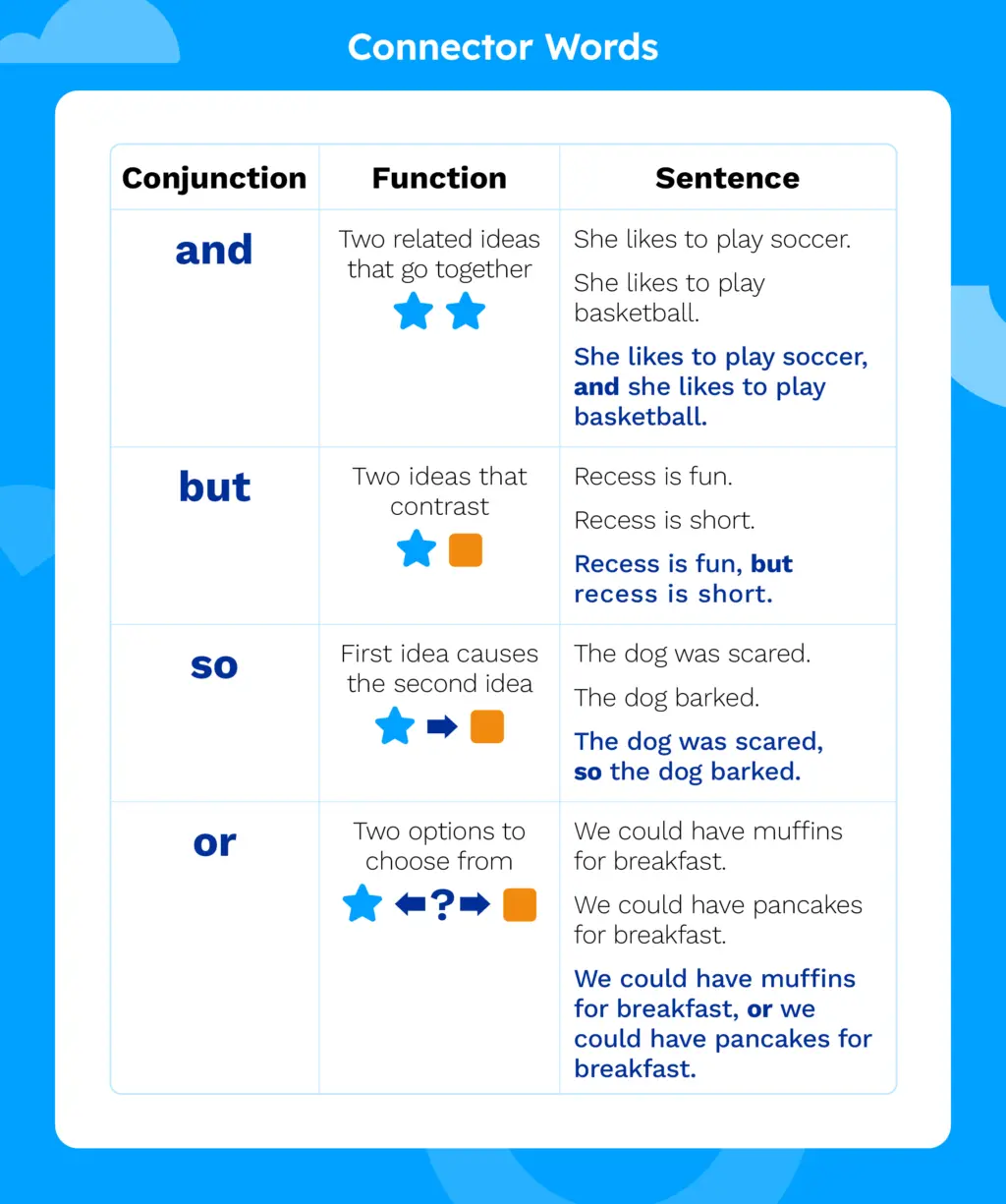
Heather Adams: So what we're going to talk about is some connector words. And these connector words are called conjunctions. What are they called?
Students: Conjunctions.
Heather Adams: And I know when I talk about conjunctions, I like to think about them as connectors.
Narrator: Knowing when and how to use conjunctions isn't always obvious to students. That's why Ms. Adams is breaking down the role of four key connector words today: and, but, or, and so.
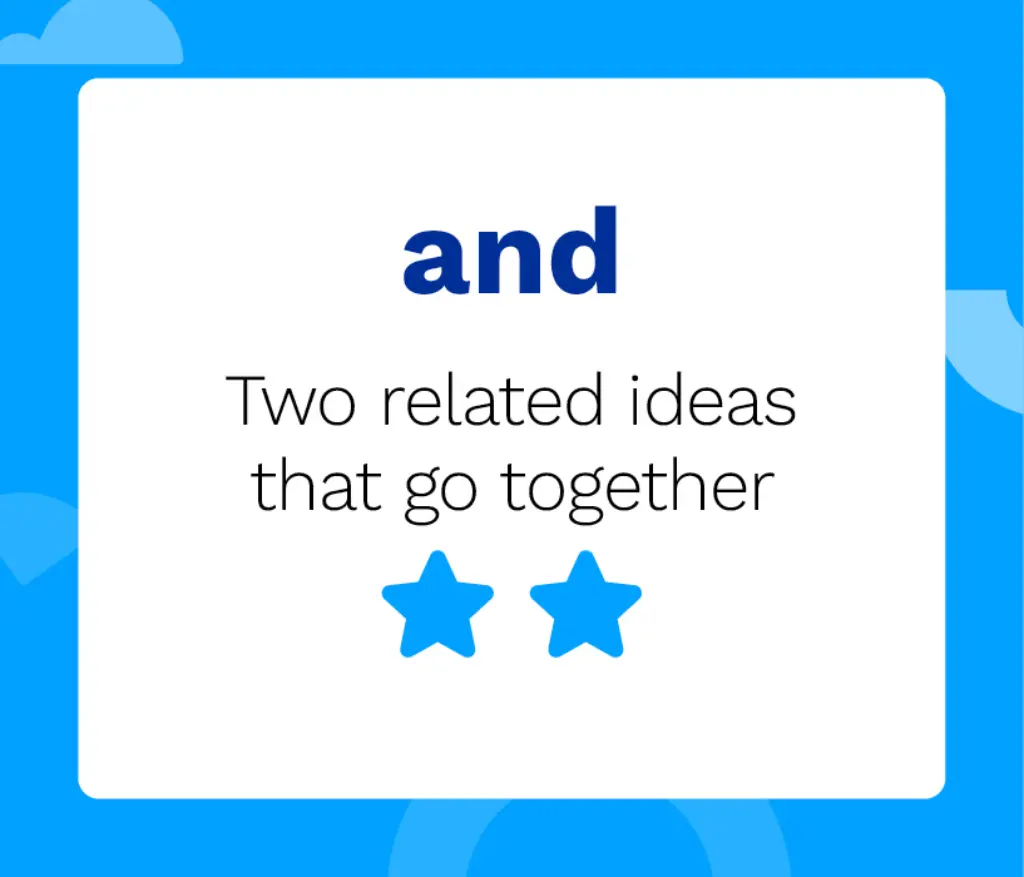
Heather Adams: They all have slightly different jobs to do. So we're going to go through and just understand what job does each one of these conjunctions do, and how can I use them when I'm combining ideas or simple sentences. So we're going to start with this first one. And I know you've used this word lots of times when you've been speaking, when you've been writing, you've seen it in your reading. It's the word and it's used for putting related ideas together. And is for combining two ideas that are the same. So Jeff ... If you are going to share that, Jeff likes tacos and Jeff likes ice cream. These are two related ideas. There are two things that Jeff ...
Students: Likes ...
Heather Adams: Likes, exactly! So we can use that connector word, that conjunction and to make a compound sentence. I think this sounds better. Jeff likes tacos and ice cream. Do you see what and is doing in that sentence? Connecting two similar ideas.
Narrator: Ms. Adams is diving deep into how each conjunction works with explicit and direct instruction. Focusing on these details now will make choosing the right conjunction more automatic for students later on.
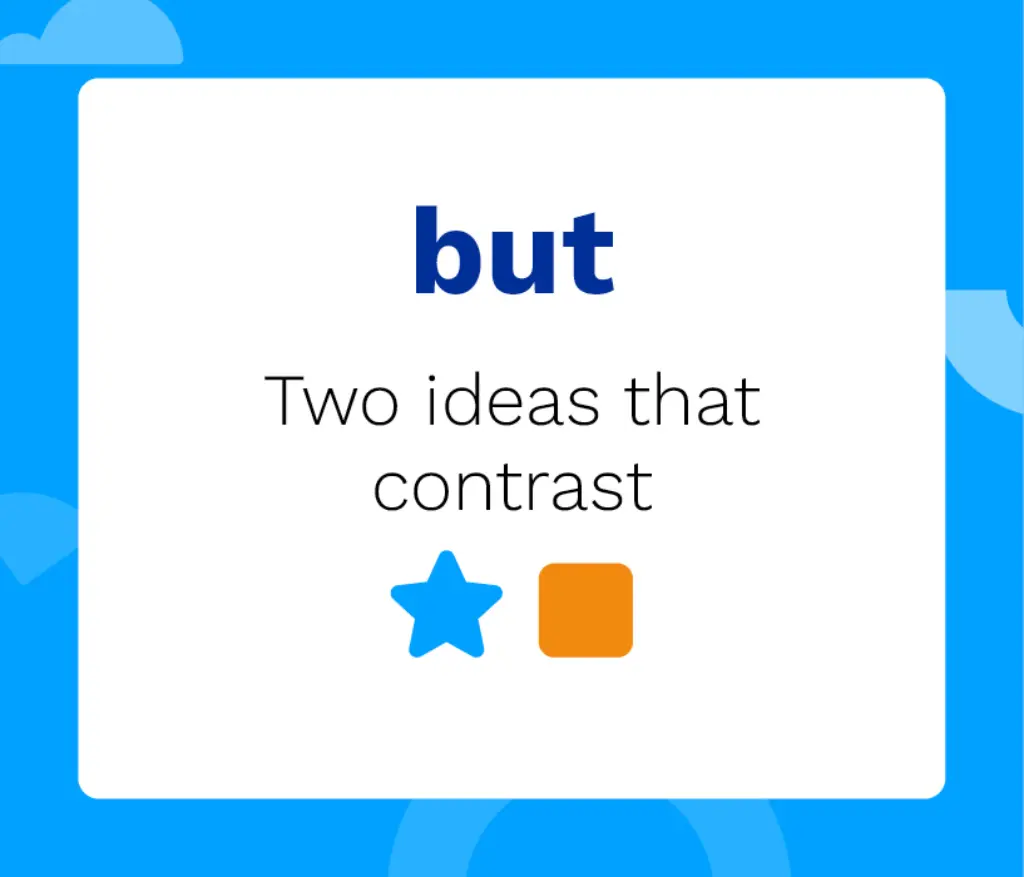
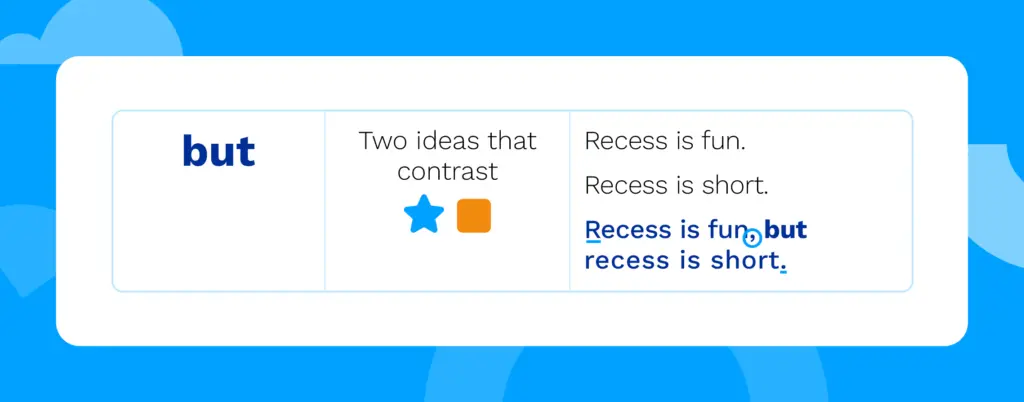
Heather Adams: Sometimes though you have two ideas that are different, two things that are not the same. And we want to show that they are contrasting, different ideas and we would use the conjunction but. See this picture, it kind of helps me remember these ideas are not the same. So here's what these simple sentences might sound like. Jeff enjoys sledding. Me too. Jeff doesn't enjoy shoveling. Actually, me neither. So if we wanted to kind of combine these two simple sentences, but they're not the same thing, we might combine them with but. Jeff enjoys sledding, but he doesn't enjoy shoveling. Does that make sense?
Students: Yeah.
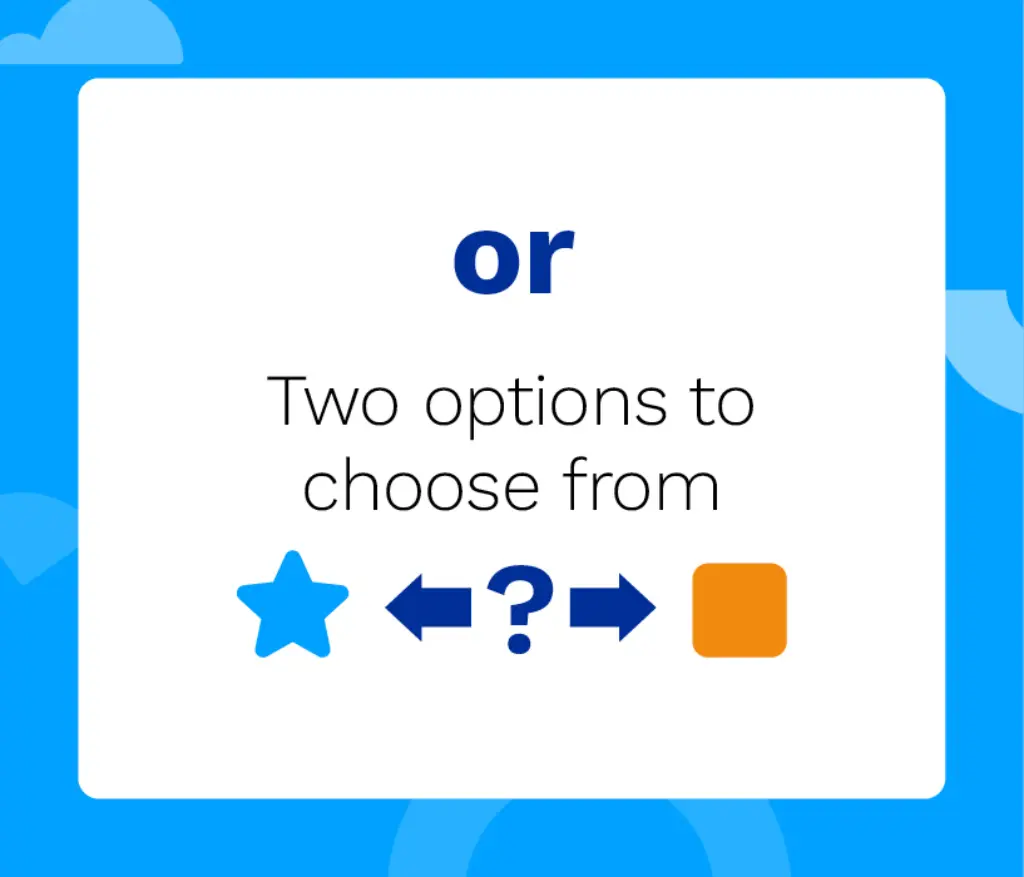
Heather Adams: Awesome. Our next one is or, and this is when we might put two options together. We just had lunch. Can you think of a situation where you might use "or" when you're talking about two different choices or two different options? Molly?
Molly: Would you like a chicken patty or a salad?
Heather Adams: Yeah, Molly. Exactly. So we would probably have a choice between a chicken patty or a salad. We weren't eating both of them. They were two options. Exactly. So let's check out Jeff's example of two options. Jeff can read at his desk, or Jeff can read at the library. We know these are two options for Jeff, but combining it with this conjunction or just makes it sound more interesting and sophisticated. Jeff can read at his desk or in the library. And we have one final conjunction left. This one's my favorite. It's so sophisticated because if you notice this last conjunction, what is it?
Students: So.
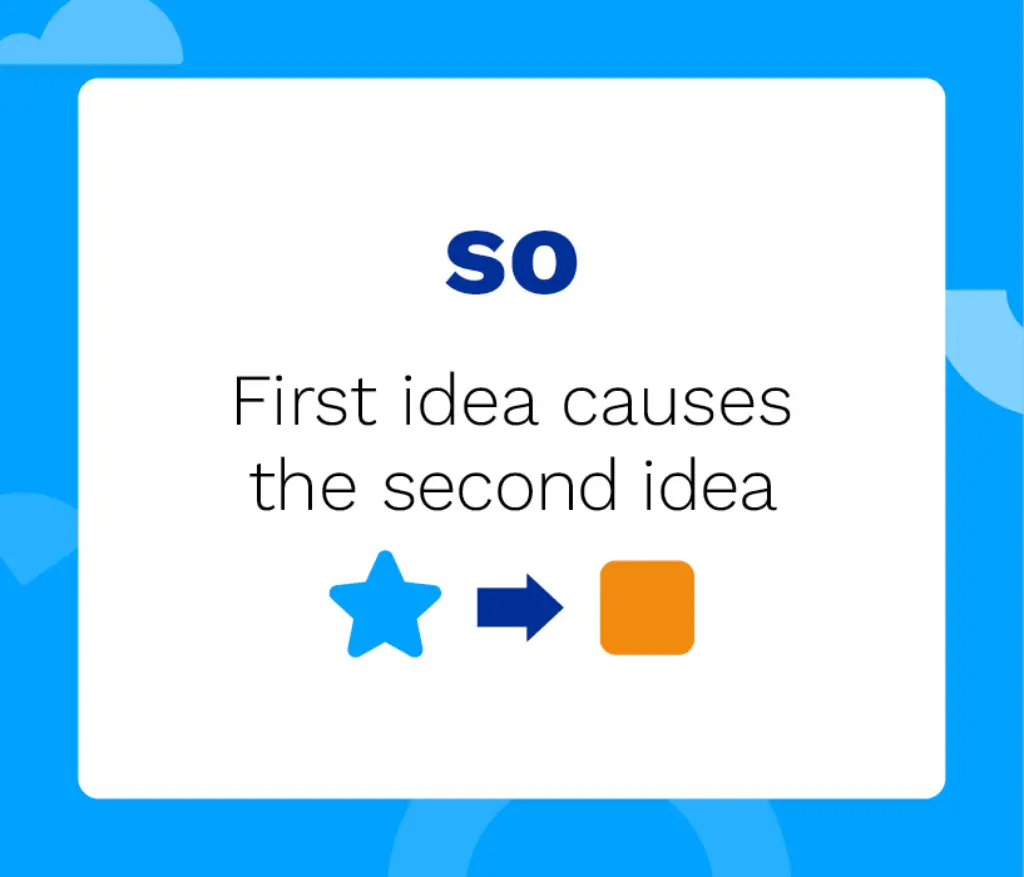
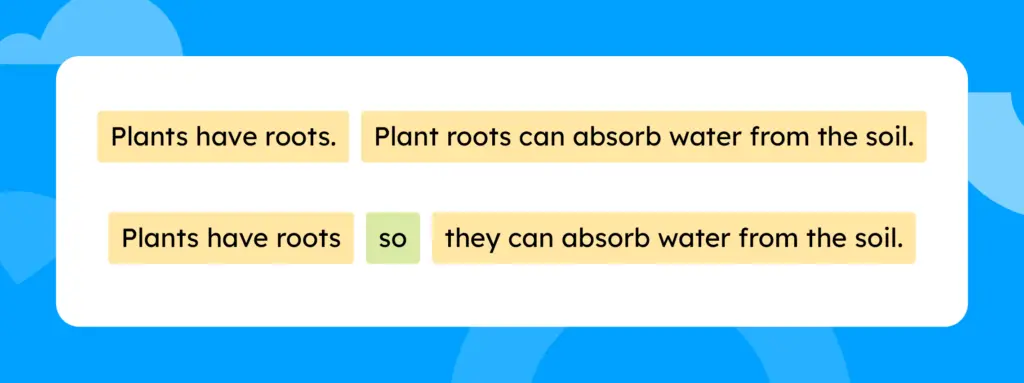
Heather Adams: So is such an interesting conjunction because it shows how one thing might lead to another thing. How one thing might cause something else to happen. And that's a relationship that we might use a lot in our writing. So let's look at Jeff's example. Jeff listens to directions. Good job. So Jeff understands what to do. Because he listens to directions, he understands what to do. And we might see the conjunction so in lots of places, because we know a lot about cause and effect.
Narrator: Now that they know the role, each conjunction plays, students are ready for the next step. They'll practice picking the right one to create more complex sentences.
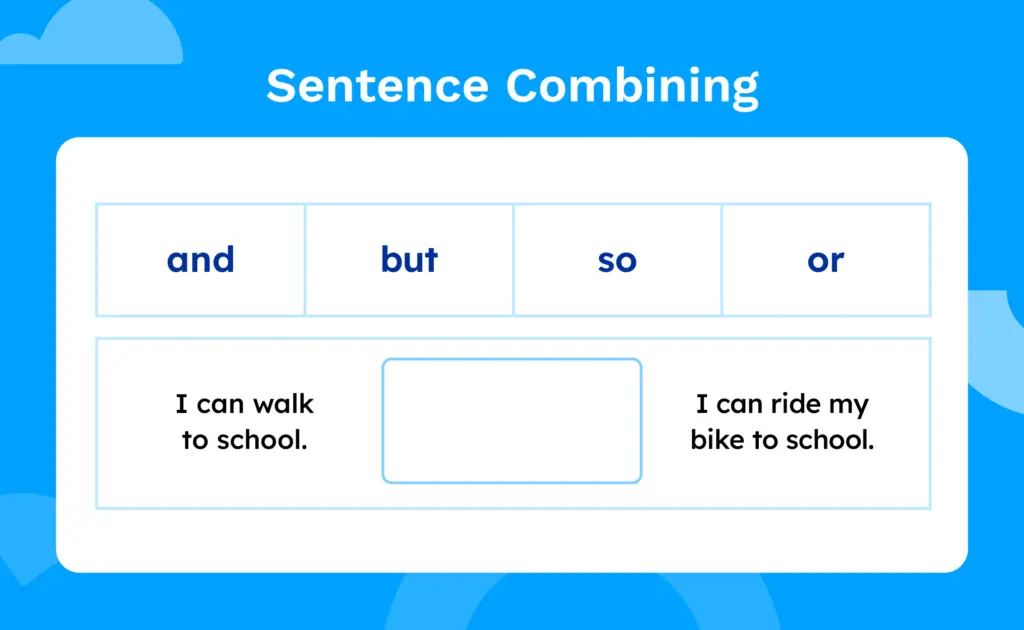
Heather Adams: So what we're going to do is we're going to try to put our conjunction knowledge to the test. We're going to try to choose a conjunction connector word that connects some simple sentences.
Teacher Tip
Depending on your grade level, you may want to tell students that sentence combining skills also strengthen reading comprehension. Learning how to combine simple sentences into more complex ones helps readers understand how a sentence is built, and also helps them break down long sentences into simpler ideas while they are reading.
2. I DO: Model the thinking and actions taken to combine two sentences into one.
Teacher Tip
Using the Comma
Once you move into complex sentences with because you'll explain that a comma is not always used. A comma is used when a dependent clause comes first (Because they're calling for rain, I will bring my raincoat). A comma is not used when the dependent clause follows the independent clause (I will bring my raincoat because they're calling for rain).
3. WE DO: Invite your students to try combining simple sentences together with you.

Hide Video Transcript
Show Video Transcript
Heather Adams: So what we're going to do is we're going to try to put our conjunction knowledge to the test. We're going to try to choose a conjunction, a connector word that connects some simple sentences, but we really have to think about which one are we using. Are we combining two ideas that are similar and related? Are we showing that two ideas are different than each other?
Narrator: Conjunctions help young writers connect ideas or combine sentences in a meaningful way. These third grade students in Heather Adams' class have already learned four essential conjunctions: and, but, or, and so. Now she's giving them a chance to practice choosing the right one. First, as a class. Then on their own.
Heather Adams: We've been reading "Matilda" and we're not quite finished yet, but we've gotten to know the main character Matilda, and we know a lot about her.
Narrator: You'll notice Ms. Adams provides pre-written short sentences on a topic that her students are familiar with. This lets them focus on just the task at hand — picking the correct conjunction.
Heather Adams: Here are two simple sentences about Matilda from our read aloud. Matilda reads at the library. Yeah, we know that to be true. Matilda reads in her bedroom. Now, we know Matilda would read just about anywhere, but we want to think about, are these two ideas related in a certain way? Matilda reads at the library. Matilda reads in her bedroom. Which of our conjunctions, which of our connecting words, would make sense if we wanted to combine these two simple sentences into a really sophisticated compound sentence? Which one? London?
London: And.
Heather Adams: And. Exactly. And London, why did you choose and as your connector where your conjunction?
London: Because it's kind of related.
Heather Adams: Right? These ideas are related. They're both about ...
Students: Reading.
Heather Adams: They're both about Matilda reading in different places. Exactly. Are you ready for another one?
Students: Yes.
Heather Adams: I think you're going to like this one. Mr. Wormwood is mean to Matilda. Matilda plays pranks on Mr. Wormwood Owen, which conjunction are you thinking makes sense here?
Owen: So, because it's kind of like cause and effect.
Heather Adams: Right? What's the cause here, Owen?
Owen: Mr. Wormwood is mean to Matilda, so Matilda plays pranks on Mr. Wormwood.
Heather Adams: Yeah. If he wasn't mean, she wouldn't have played those pranks, right? I agree. When we want to show cause and effect, we want to use the connector word, the conjunction, so. If I put that together as one complete sentence, it might sound like this — Mr. Wormwood is mean to Matilda, so Matilda plays pranks on Mr. Wormwood. I almost want to make another little change. Tell me what you think about this. Mr. Wormwood is mean to Matilda, so she plays pranks on Mr. Wormwood, or she plays pranks on ...
Students: Him.
Heather Adams: Him, that's what I was thinking. Sometimes when we do sentence combining, we might want to take out some words if they're a little repetitive, and that's something that you can choose to do as this sort of writer artist. So now it's going to be your turn and we're going to work with partners. We're going to try to look at more examples, just like you just did, and choose a conjunction. Think about how are these two simple sentences related and which conjunction makes sense.
Narrator: It's partner time. Now students get to practice on their own, exploring firsthand how each conjunction affects the flow or meaning of the sentences they're building.
Students: "And." Or. You divide, you can skip count or you can use, yeah, multiplication. I think that one.
Heather Adams: Alright, which number were we on?
Student: Six.
Heather Adams: Six. Okay. So let's read those two simple sentences and think about how they're related. That'll help us choose our conjunction. Alright, what's the first simple sentence?
Student: Oak Street is our school.
Heather Adams: Oak Street is our school. And what's the second one?
Daniel: Oak Street is a special place.
Heather Adams: That's true. What do we think about these two ideas? Are they related? Are they contrasting? Does one cause the other? What do you think? Which conjunction makes sense here?
Daniel: I think and.
Heather Adams: I was kind of thinking and too. What made you choose and for this one?
Daniel: Because if we did but it wouldn't really make sense because it would go, Oak Street is our school, but Oak Street is a special place.
Heather Adams: Yeah, those aren't different ideas. They're both true. I agree, Daniel, and I kind of like how Daniel put a conjunction in and then he was like, wait, that doesn't sound right. It just sounded wrong to you, didn't it? Let's put it in with and. Let's see how it sounds. Oak Street is our school, and Oak Street is a special place. I like that a lot. Daniel even included that comma before the conjunction. Way to go.
All right, let's pause where we are. Some people are in the middle of rewriting their sentences, but I saw a lot of people working really hard on choosing their conjunction and a lot of good discussions about why a particular conjunction works. Oak Street is our school. Oak Street is a special place. Which conjunction, Ford, makes sense there?
Ford: And.
Heather Adams: And. Exactly. And when we put this together, me and this team, we were talking a little bit about how that would sound. We said this — Oak Street is our school and Oak Street is a special place. We made a little bit of a move as a writer here where we decided that we were actually going to take out some words. It sounded a little repetitive to us. Did it sound a little repetitive to some of you? I thought we were saying which words too much.
Students: Oak Street.
Heather Adams: Oak Street. Me too. So we changed it a little bit and we said, Oak Street is our school, and it is a special place. So sometimes we can make those choices as writers when we're using conjunctions to combine simple sentences. Tomorrow what we're going to do is use these conjunctions, these connector words, to help us write complex compound sentences about our animal research.
Narrator: Connecting writing lessons to other subjects, like science and social studies, boosts vocabulary and builds knowledge, key resources for reading and writing success.
Heather Adams: Let's do this. Yes, you can have a personal confetti party and high five, your partner!
4. YOU DO: Ask students to combine sentences on their own.
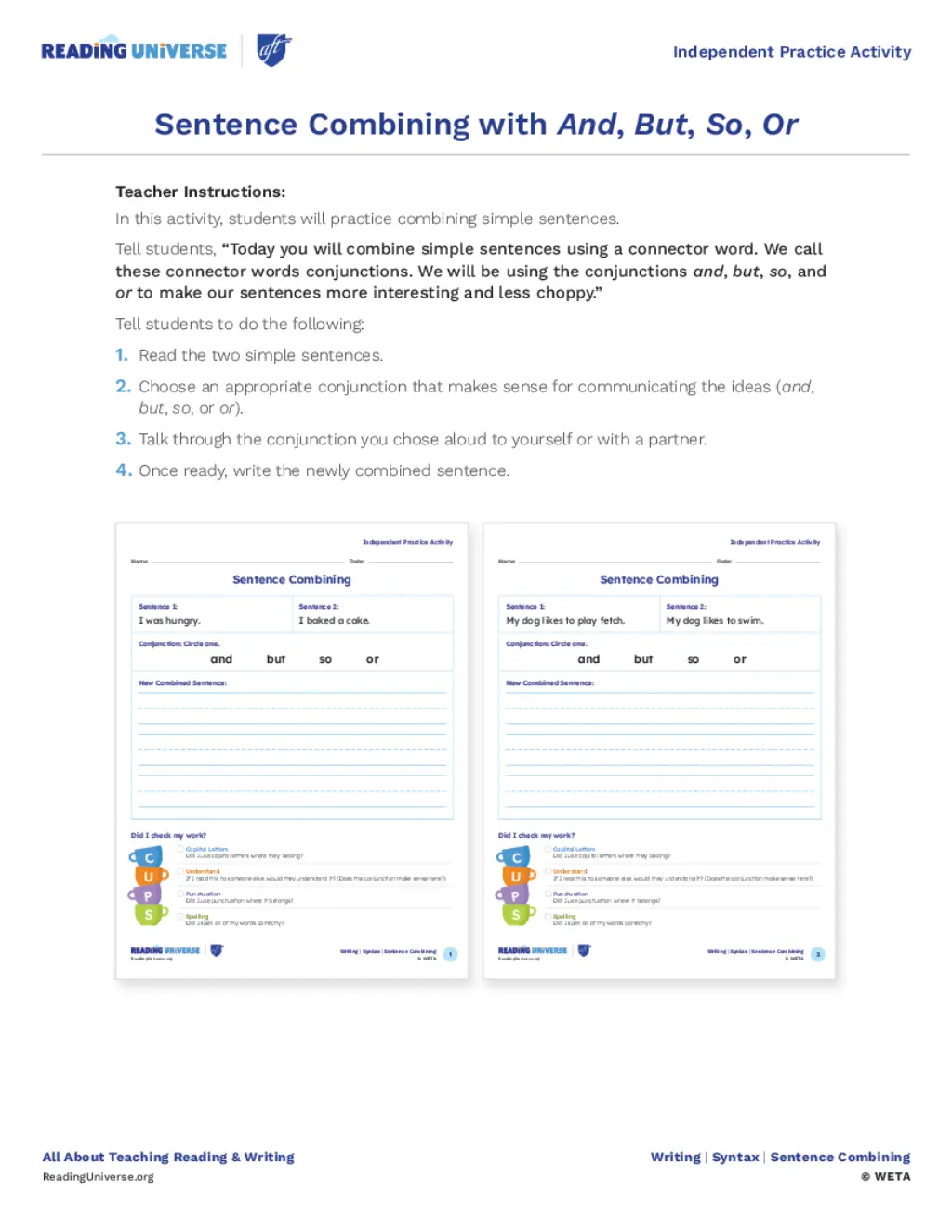
Independent Practice Activity: Sentence Combining with "And," "But," "So," "Or"
How to Teach More Advanced Sentence Combining
Hide Video Transcript
Show Video Transcript
Heather Adams: All right, so welcome back from lunch. I hope you had a good time.
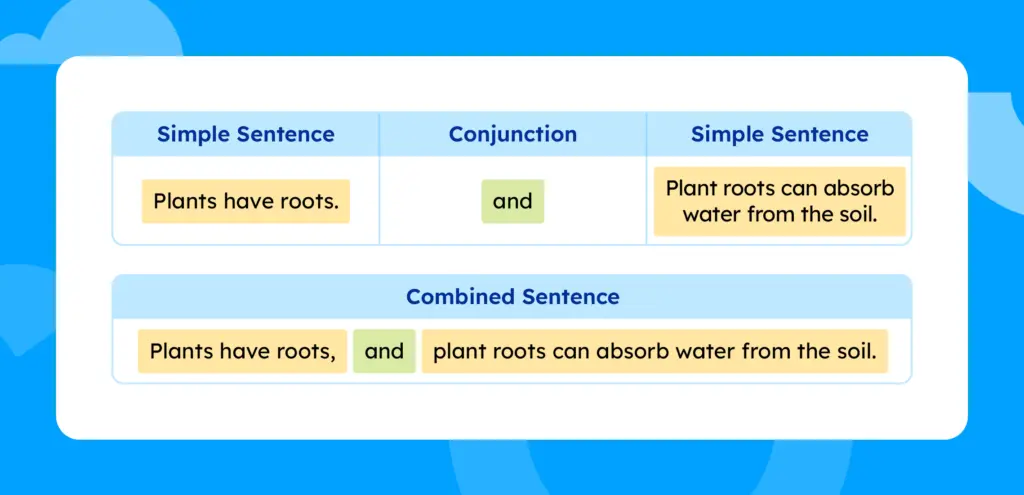
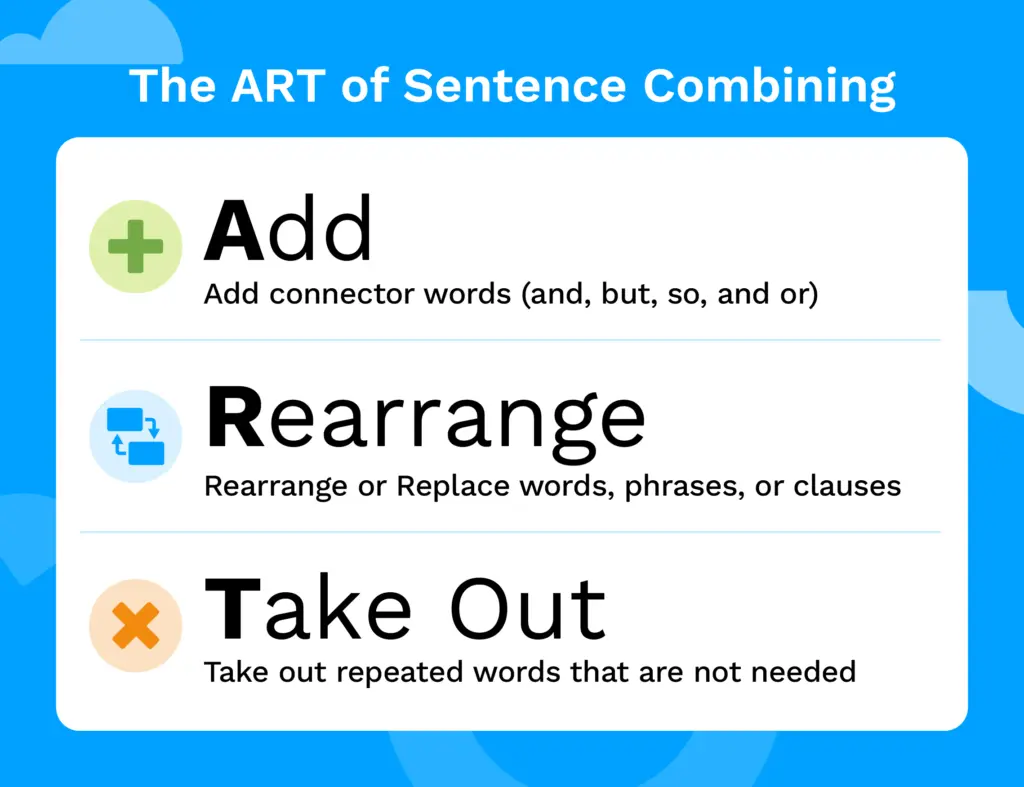
VO: Today, teacher Heather Adams at Oak Street Elementary is introducing her third graders to a powerful writing strategy. It's called the Art of Sentence Combining. When students combine two simple sentences, they have lots of choices to make and the "ART" mnemonic device can help keep them organized. "ART" stands for adding words using conjunctions or connector words, replacing or rearranging words for flow, and taking out repeated or unnecessary words.
Heather Adams: We talked about how we can turn our simple sentences into more interesting, complex sentences. And what did we learn about? What kind of words did we add into our sentences? We did some adding. What were those kinds of words? Say it if you remember.
Students: [overlapping] Conjuntions. Connecting words.
Heather Adams: I heard two answers. I heard "conjunctions." If you said conjunctions, pat on the back. And I heard "connecting words." If you said connecting words, also pat on the back. Conjunctions are connecting words, right? They allow us to combine our simple sentence ideas into a more sophisticated sounding sentence. Right? We also learned some other strategies. Sometimes we realize we should take out some words. We don't want to be super repetitive. And sometimes we even move them around or replace them. We used "they" or "it."
VO: Here's what this looks like in action. To combine the sentences, "The dog barked" and "The dog ran to the door," you can add the conjunction "and," rearrange the order so the action flows naturally, and take out the repeated use of "the dog" to create the complex sentence. "The dog ran to the door and barked."
Heather Adams: So we're going to be using all of these strategies that we talked about and these are just some different ways of sentence combining and there's not just one right way to do it. Remember last time some of us added different conjunctions or replaced different words. So we're going to get to have some fun and really just kind of show that artistic side of writing today. Here's a sentence that I have up here and I was looking at the important body parts part of my notes. So I wrote, "Tigers have sharp teeth. Tigers have sharp claws. Tigers have a tail." What's something you notice about the way those sentences are written?
Student: They're very short.
Heather Adams: Exactly. These sentences are really, really short. I noticed that too. What word do you notice that I used over and over? What word?
Students: [overlapping] "Have." "Tigers."
Heather Adams: "Tigers." Exactly. And "tigers" is repeated and every sentence starts with "tigers have," "tigers have," "tigers have." It almost makes my writing sound like another list. And we don't want our writing to sound like a list. A lot of you suggested that maybe I should use this powerful strategy. Adding conjunctions helps me to make simple sentences into combined, complex sentences. So let's try to see if maybe we can do better. Are there any details here that are related? Remember our "and" conjunction puts related ideas together. If you had to pick two related ideas here, what are kind of related? What are sort of related ideas in my simple sentences? Molly.
Molly: Sharp claws and teeth.
Heather Adams: Yeah. I noticed Molly, when she just said that, she said "sharp claws and teeth." Wow. Molly, first of all, deserves an air high five because I want to show you what Molly just did. "Tigers have sharp claws and teeth." So Molly not only added a conjunction, she took out a repeated word that wasn't really needed. It makes more sense and I think it sounds better. When I heard Molly's sentence, I was like, "That's it. It sounds right." So what we just did here was we used a few of these different strategies. We added conjunctions. We took out repetitive words that just didn't make our sentences sound polished. They didn't make our sentences sound sophisticated. We don't need to say "tigers" 800 times, right? We don't need to say, "tigers have this, tigers have this, tigers have this." We're going to use the power of conjunctions, the power of taking out unnecessary words, maybe even rearranging words or replacing them with words that sound better. And that's how we're going to start writing our first paragraph, our first part for each one of our animals.
VO: Reading Universe is made possible by generous support from Jim and Donna Barksdale; the Hastings/Quillin Fund, an advised fund of the Silicon Valley Community Foundation; the Emily Hall Tremaine Foundation; the AFT; and several anonymous donors. Special thanks to Keys to Literacy, Franklin Public Schools, and Oak Street Elementary located in Franklin, Massachusetts. If you enjoyed this video, please subscribe to our YouTube channel @RUTeaching. Reading Universe is a service of WETA, Washington D.C. and was developed in collaboration with the Barksdale Reading Institute and First Book.
