1. Overview of Teaching the Types of Sentences
Types of Sentences

Imagine saying these four sentences to your students:
You are lining up so quietly.
Can you line up quietly?
Please line up quietly.
What a quiet line!
While many of the same words appear in each sentence, each sentence has a different purpose. This is because English has four types of sentences: declarative (statements), interrogative (questions), imperative (commands), and exclamatory (exclamations).
Here's four more sentences. This time we've labeled each type:
The car drove up the hill. (declarative/statement)
Did the car drive up the hill? (interrogative/question)
Do not drive up the hill. (imperative/command)
That hill is too steep! (exclamatory/exclamation)
Helping your students recognize and use these sentence types supports their comprehension and their ability to share ideas clearly in writing.
You'll want to teach your students how to write these types of sentences, when to use them, and how to use the right ending punctuation.
In early writing instruction, you'll teach students the types of sentences using their informal labels. These are the ones your students will most commonly use: statements, questions, commands, and exclamations.

Teacher Tip
In early writing instruction, you'll teach students the types of sentences using their informal labels. These are the ones your students will most commonly use: statements, questions, commands, and exclamations.
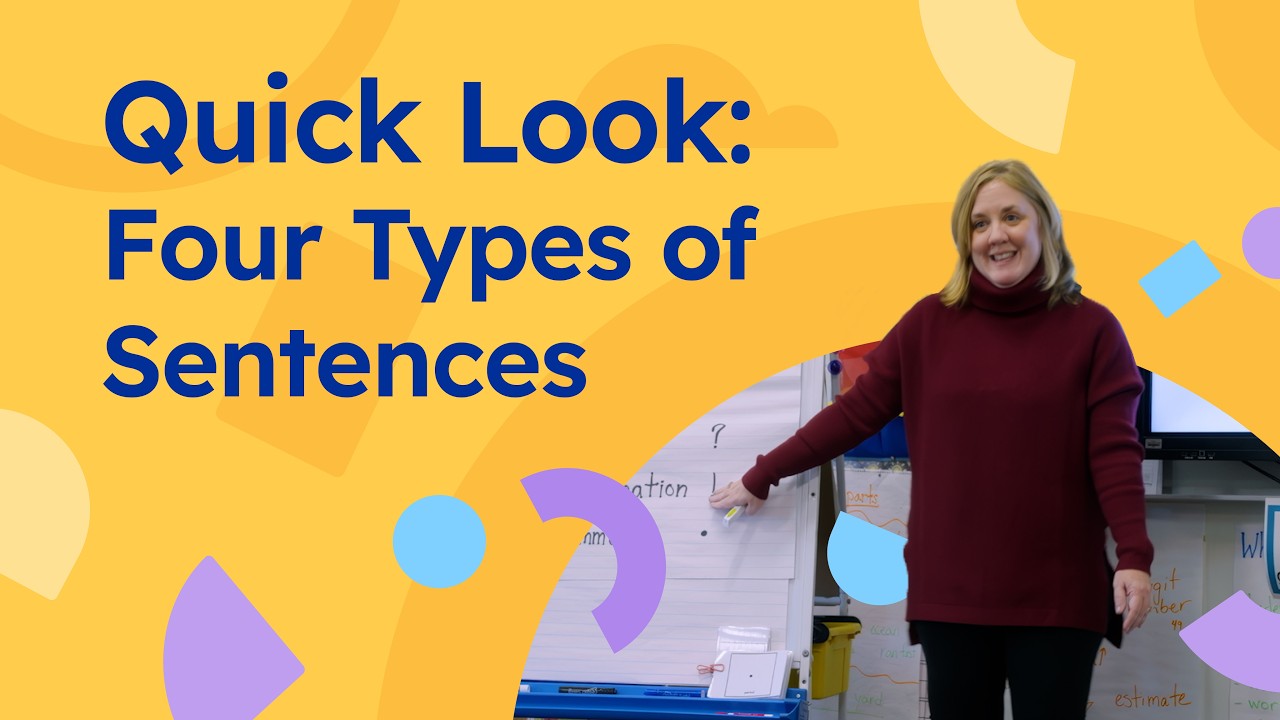
Hide Video Transcript
Show Video Transcript
Jenna Perro: Today we're going to talk about four types of sentences and maybe some of these sentence types you already know about. The first type is a statement. This, I feel really confident we've been writing a lot of statements. A statement gives some facts and it ends in a, what is this? What is it? End in a ... everybody tell me.
Students: Period.
Jenna Perro: It ends in a period. Say statement.
Students: Statement.
Jenna Perro: Okay. There's a second type. Boys and girls, what does this one say?
Students: Question.
Jenna Perro: Question. Ends in a ...
Students: Question mark.
Jenna Perro: We ask questions to get more information and to learn something new. Maybe we're trying to figure something out. You would ask a question. So we have a statement, we have a question. This is the fun one. Do you know what this one says? Say, exclamation!
Students: Exclamation.
Jenna Perro: What does an exclamation end in? Look at it, it looks different. What does it end in, Tristan?
Tristan: Like, a line and a dot.
Jenna Perro: Yeah, a line and a dot. A line in a dot is ... say, exclamation mark.
Students: Exclamation mark.
Jenna Perro: So a statement ends in a period. A question ends in a ...
Students: Question mark.
Jenna Perro: And an exclamation ends in a ...
Students: Exclamation point.
Jenna Perro: There's a fourth type of a sentence. I'm going to tell you about it, but we're not going to talk about it today. Are you ready to hear it? This word says, "command." Can you say command?
Students: Command.
Jenna Perro: Also ends in a period. Do you see how it's the same?
Connecting Sentence Types Across Languages

Most languages have an equivalent of the four sentence types used in English, but the punctuation may differ. For example, in Spanish, question marks and exclamation points are used both at the beginning and the end of a sentence, like this: ¿Cómo estás? and ¡Qué bueno!
In addition to differing punctuation, you can teach your students to recognize different sentence types by how they sound — through a reader's tone, expression, and volume. Start by asking your English learners (ELs) to say a few different sentences in their primary language. Then, ask your students who don't speak that language to guess the sentence type based on the speaker's tone, expression, and volume!
For example, a student might say, "¿Dónde está mi mochila?" and classmates might guess it's a question because of the speaker's rising intonation. In the same way, native English speakers can say a few sentences and ELs can guess the sentence type. This helps all students recognize that sentence types exist across languages.
