4. Videos: See It in the Classroom
Types of Sentences
Hide Video Transcript
Show Video Transcript
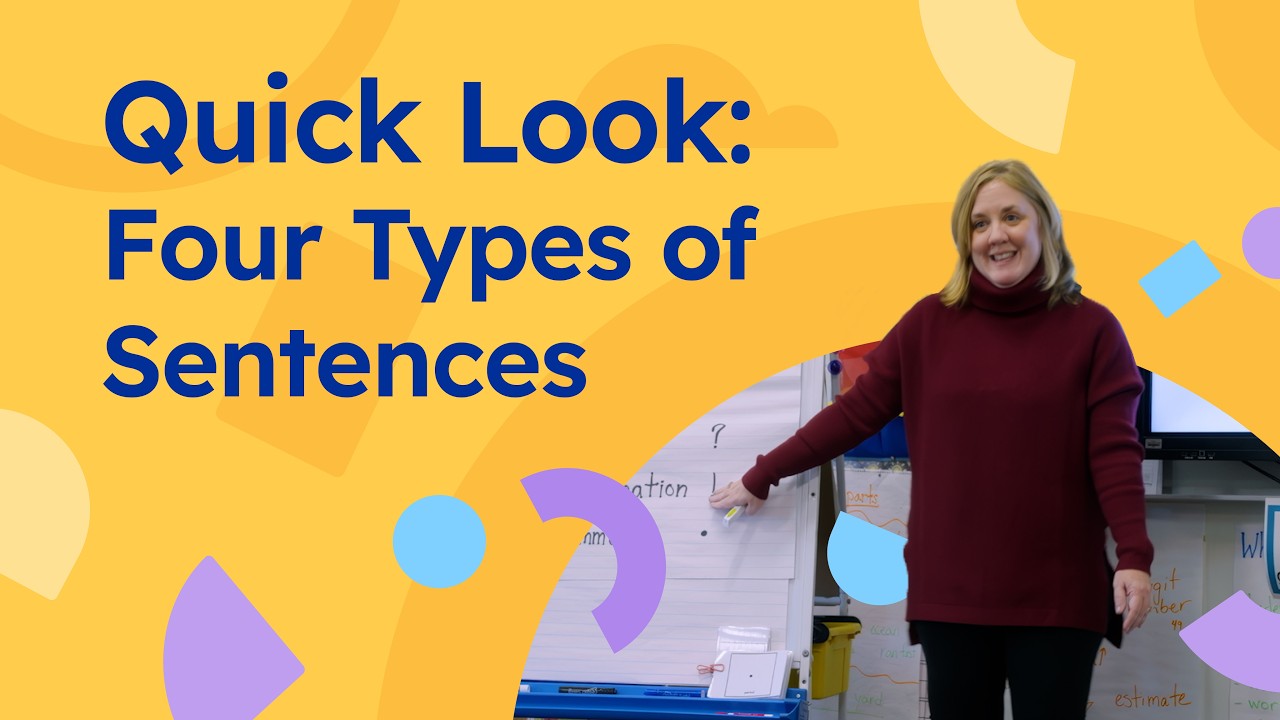
Jenna Perro: Today we're going to talk about four types of sentences and maybe some of these sentence types you already know about. The first type is a statement. This, I feel really confident we've been writing a lot of statements. A statement gives some facts and it ends in a, what is this? What is it? End in a ... everybody tell me.
Students: Period.
Jenna Perro: It ends in a period. Say statement.
Students: Statement.
Jenna Perro: Okay. There's a second type. Boys and girls, what does this one say?
Students: Question.
Jenna Perro: Question. Ends in a ...
Students: Question mark.
Jenna Perro: We ask questions to get more information and to learn something new. Maybe we're trying to figure something out. You would ask a question. So we have a statement, we have a question. This is the fun one. Do you know what this one says? Say, exclamation!
Students: Exclamation.
Jenna Perro: What does an exclamation end in? Look at it, it looks different. What does it end in, Tristan?
Tristan: Like, a line and a dot.
Jenna Perro: Yeah, a line and a dot. A line in a dot is ... say, exclamation mark.
Students: Exclamation mark.
Jenna Perro: So a statement ends in a period. A question ends in a ...
Students: Question mark.
Jenna Perro: And an exclamation ends in a ...
Students: Exclamation point.
Jenna Perro: There's a fourth type of a sentence. I'm going to tell you about it, but we're not going to talk about it today. Are you ready to hear it? This word says, "command." Can you say command?
Students: Command.
Jenna Perro: Also ends in a period. Do you see how it's the same?
Hide Video Transcript
Show Video Transcript
Jenna Perro: Maya, what question did you have about the elephants?
Maya: Why are you here?
Student: What do elephants eat?
Student: How old they are.
Student: Why do elephants use their trunks to eat?
Student: Who are you?
Jenna Perro: Who are you?
VO: First graders are full of questions, so teaching them how to write one is important work. Today at Oak Street Elementary in Franklin, Massachusetts, teacher Jenna Perro is on the job. She's starting with a review of ending punctuation, which will be a key player in this lesson about writing questions.
Jenna Perro: Here's our activity for the day. I'm going to give each partnership three cards. The first card looks like this. What's on the first card? Everybody tell me.
Students: Period.
Jenna Perro: Ready for the second card? The second card looks like this. What's on this one? Everybody tell me.
Students: Question mark.
Jenna Perro: Ready for the last one? What do you think is on the third card?
Students: Exclamation mark.
Jenna Perro: I'm going to read a statement on the board. You and your partner, you're going to turn and talk and you're going to decide which one of these cards you would use at the end of the sentence that's on the board. Ready? Let's read this one together. Ready?
Students: How do dolphins talk to each other?
Jenna Perro: How do dolphins talk to each other?
VO: With a turn and talk, every student gets to think and share at the same time, giving everyone a chance to practice their answer in a low stakes setting.
Jenna Perro: Everybody tell me what end mark should we use?
Students: Question mark.
Jenna Perro: A question mark. Why is it a question mark? Why did we choose a question mark for this sentence? Wyatt, why do we think we chose a question mark?
Wyatt: Because you don't know how they do.
Jenna Perro: You don't know how the dolphins talk to each other? So you're trying to learn more? You're trying to gain some information? So you would ask a question and you'd use a question mark at the end.
VO: After this review, Ms. Perro now begins explicit instruction on how to write a question.
Jenna Perro: The first thing a question should have is a question word, and here I've listed all of our question words. Let's try to read them together.
Students: Who, what, when, where, why, how.
Jenna Perro: Okay, so a question has to have one of these words in them.
VO: As Ms. Perro mentioned, questions help us learn something new and the ingredients for building one are simple. A question word plus what you want to know, plus one last detail to signal it is a question.
Jenna Perro: So there's a couple of new things here that weren't in our statements. What's different about a question than a statement? Tristan, what do they have?
Tristan: Question marks.
Jenna Perro: Statements have a period. Questions have a question mark.
VO: Now that they've reviewed the ingredients, it's time to cook up a question of their own as a class.
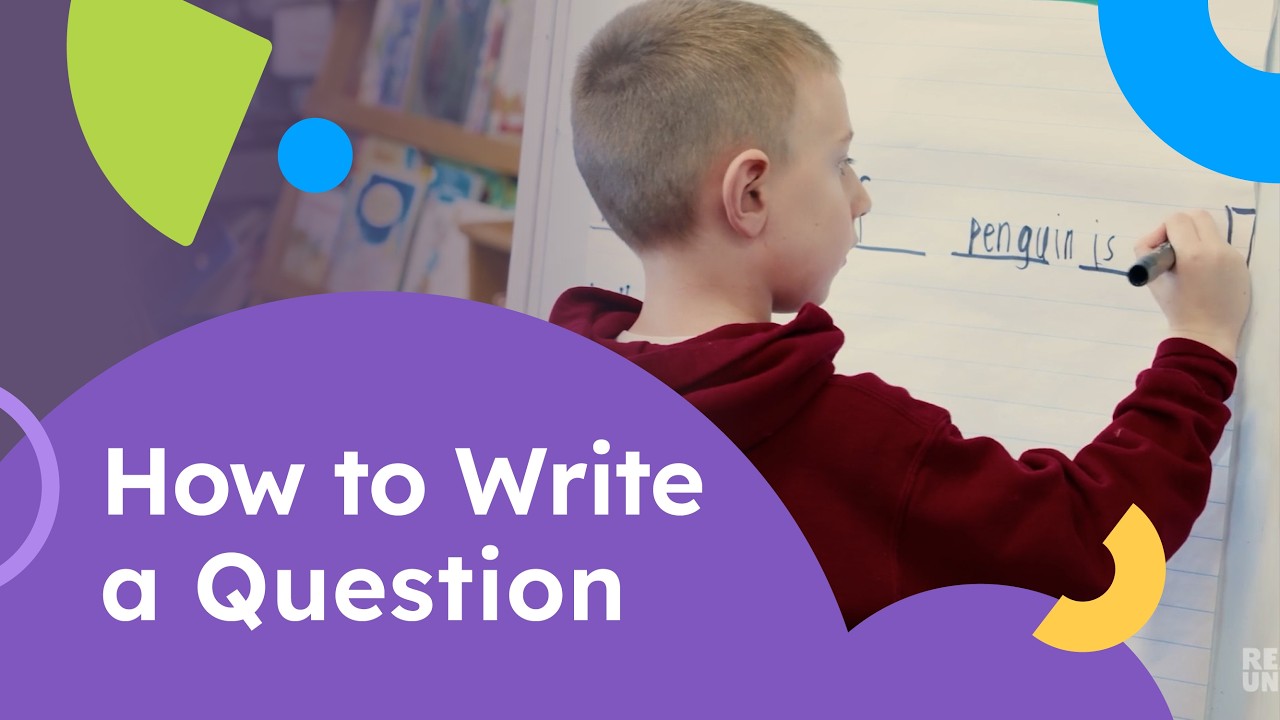
Jenna Perro: So here's what we're going to try. I'm going to put another picture on the wall, a different animal. We've been working so hard learning about animal superpowers, and that's what these pictures are all about. And we're going to try to write a question about that. Last time we wrote a statement, this time we're writing a question. Are you ready? What questions do you think you could ask about this penguin? Take a minute to think about a question you might ask about this penguin. Can you turn and whisper to your partner a question you have about this penguin?
[students chatter]
I heard some very good penguin questions. We did a lot of work learning about penguins. Does somebody have a question that starts with the word what? Was anybody able to come up with a question that starts with what? Leighton were you? Would you do one, Maya?
Maya: Kind of penguin is this?
Jenna Perro: What kind of penguin is it? What kind of penguin is it? Graham, come on up. Try "what," I already have "what" for you.
VO: Now that they've built one question together as a group, students will get the chance to try writing a question of their own.
Jenna Perro: You can chat with the people at your table and then you can use one of the question words. They're here and they're also at the top of your paper and you're going to come up with another question about the animal that I'm going to show you next. Are you ready? Here we go. What questions can you ask about these elephants? Talk to the people at your table and then see if you can write.
VO: As students practice, Ms. Perro walks the room, giving support as it's needed.
Jenna Perro: Do you have a question about the elephants?
Student: What kind of water do they drink?
Jenna Perro: Can you try to write those words on your paper? What's your question?
Student: How much weight do they have?
Jenna Perro: What do you have at the end of your sentence?
Student: A question word.
Jenna Perro: What's your question word? What's the one word that's a question word? Which one of these did you use in your sentence?
Student: How.
Jenna Perro: How? Nice job. Nice job. All right, boys and girls, you can just bring just your papers, leave your pencils. You just need to bring your papers. All right boys and girls, I'm just going to choose two friends to share so we can wrap up. Prajith, can you share your question with us please?
Prajith: What do elephants eat?
Jenna Perro: What do elephants eat? Boys and girls, what is the question word Prajith used in his sentence? Everybody tell me.
Students: What.
Jenna Perro: What. Aiden, what's your question about the elephants?
Aiden: Why do elephants use their trunks to eat?
Jenna Perro: Why do elephants use their trunks to eat? That's a great question. Aiden, do you have a question mark at the end of your question? Very nice. Looks great.
VO: Writing a question may seem like a small step, but it's one that helps these first graders grow in every direction as readers, as writers, and as thinkers.
Jenna Perro: Boys and girls, Mrs. Flemm and I are so proud of you. You worked super hard today on your sentence writing. I think that you wrote some great questions and I can't wait to talk about the other sentence type soon. You should give yourself a pat on the back. Great job. Yay me!
VO: Reading Universe is made possible by generous support from Jim and Donna Barksdale; the Hastings/Quillin Fund, an advised fund of the Silicon Valley Community Foundation; the Emily Hall Tremaine Foundation; the AFT; and several anonymous donors. Special thanks to Keys to Literacy, Franklin Public Schools, and Oak Street Elementary located in Franklin, Massachusetts. If you enjoyed this video, please subscribe to our YouTube channel @RUteaching. Reading Universe is a service of WETA Washington D.C. and was developed in collaboration with the Barksdale Reading Institute and First Book.
