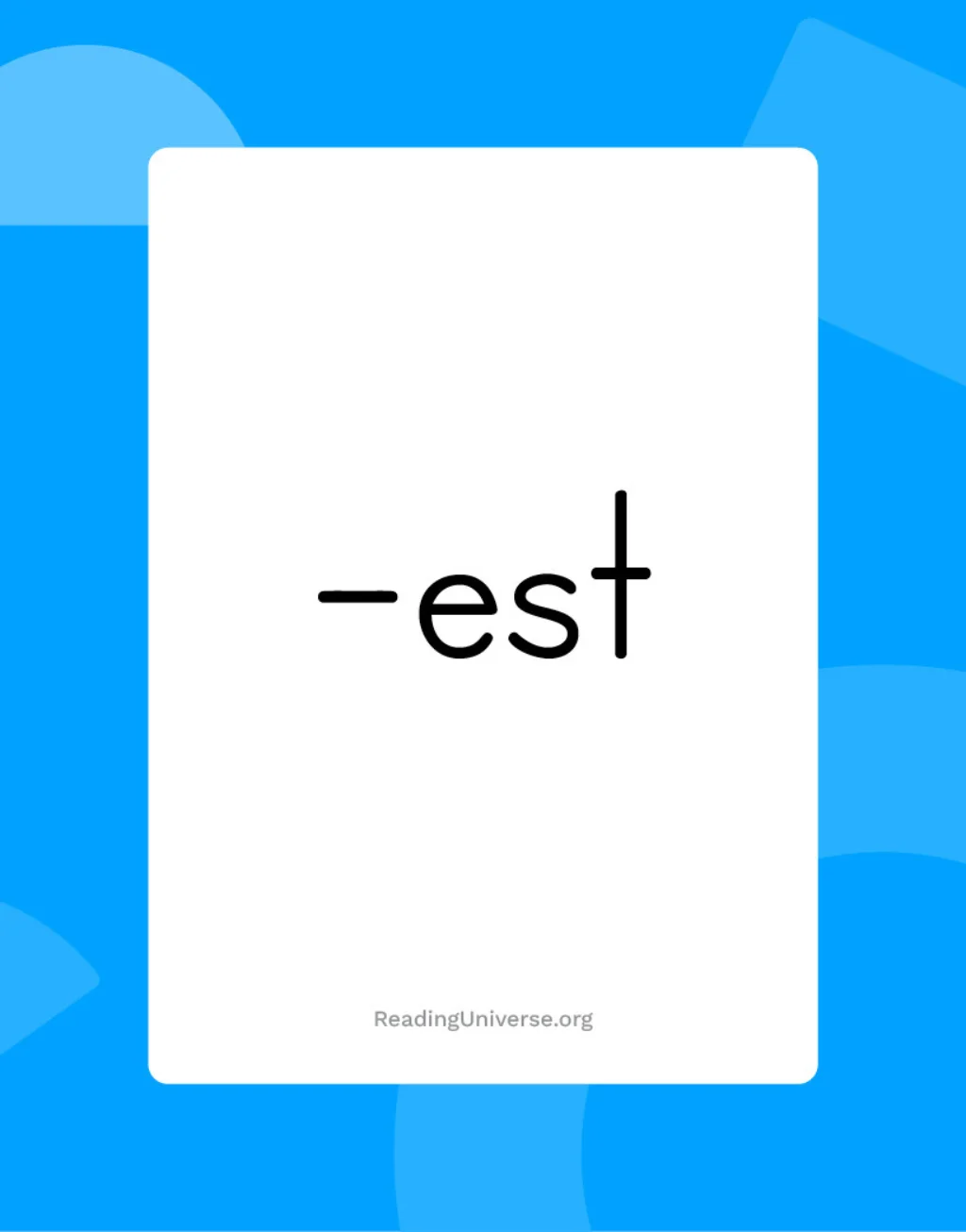
The suffix '-est' is a morpheme that can be added to adjectives and adverbs to show the greatest amount or degree of something. With younger students, we teach that '-est' means the best or the most. For example, the word fastest means "the most fast."
When we add the suffix '-est to a word, it does not change the part of speech. For example, the word easy is an adjective; and when we add -est to make easiest, it remains an adjective. Therefore, suffix '-est' is an inflectional suffix.
At the end of a word, the suffix '-est' is pronounced /ĭst/.
Since both '-er' and '-est' are used to show comparison, they're a good pair to introduce together.
Choosing Words for Your Lesson
When you first introduce the suffix '-est', it's helpful to use base words that remain unchanged when you add a suffix. This means using words that do not require doubling of the final consonant, as in biggest, or dropping of a magic 'e', as in nicest. Using base words with two consonants after a short vowel helps ensure the suffix can simply be added without changes. Here are some examples of these words:
Words with ending blends, like soft and cold
Words that end with digraphs, like rich and fresh
Words that end with glued sounds, like strong and grand
Words that follow the FLoSS(Z) rule, like dull and tall
Words that end with '-ck', like quick and thick
Words with r-controlled vowels, like smart and hard
Today we are going to learn about a new suffix. Remember that we learned that a suffix is something that we add to the end of a base word, and it has its own meaning.
Show the students the suffix '-est' flash card.
Say,
Listen to what we will say when we see this card.
The suffix 'e-s-t' says /ĭst/.
It means the most or the best.
Repeat.
<p>The suffix 'e-s-t' says /ĭst/. It means the most or the best.</p>
Students repeat,
The suffix 'e-s-t' says /ĭst/. It means the most or the best.
Write the word tall on the board.
Say,
If I add the suffix '-est' to the word, what is the new word?
Students respond,
tallest
Say,
Yes, as in, "Nick is the tallest boy in his class." The word tallest has the suffix '-est', and the suffix tells us that Nick is the most tall.
Let's say the word again.
Everyone repeats,
tallest
Say,
What sound is the suffix '-est' making in this word?
Students respond,
/ĭst/
Say,
Yes, in this word, the suffix '-est' sounds like /ĭst/. Even though we hear the /ĭst/ sound, when I wrote the word tallest, I did not just add 'ist' to the word. The letters 'ist' do not mean anything. I have to add the suffix '-est' because that means "the most."
Now, grab your suffix '-est' flash card.
Say,
Watch and listen to what we'll say when we see this card.
The suffix '-est' says /ĭst/.
It means the most or the best.
Say and have students repeat,
The suffix '-est' says /ĭst/.
It means the most or the best.
Write the word rest on the board. Say,
Here, 'e' 's' 't' is part of the base word. If I take away the 'e' 's' 't', I am left with 'r', and 'r' is not a word. This word rest does not have the suffix '-est'.
Write the word soft on the board. Have students read the word.
soft
Now add the suffix '-est' to the word. Ask students to read the new word.
softest
Write on the board: That rug is the softest one here.
Have students read the sentence aloud together.
That rug is the softest one here.
Say,
The suffix '-est' that is added to soft tells me that the rug is the "most soft."
Write the following words on the board one at a time and have students read them aloud chorally: smart, quick, and long.
Then add the suffix '-est' to each word and have students read the new words. Discuss how the meaning of the word changed when you added the suffix.