1. An Overview of Suffixes
Suffixes Skill Explainer
What is a suffix?

Hide Video Transcript
Show Video Transcript
Taurra Dorsey: Let's do this one.
Students: Suffix 'ing'.
Taurra Dorsey: What does suffix '-ing' ... what does that do? What does that mean when we add that? Go. Sophia?
Sophia: Makes it ... makes it happening now.
Taurra Dorsey: Happening now. Okay. Do we agree?
Students: Yes.
Taurra Dorsey: Yes. Let's go back to suffix 's'. So let me tell you about suffix 's'. Suffix 's' makes the noun more than one. Is suffix 's' a part of the base word?
Students: No.
Taurra Dorsey: We add it on just like we add on suffix '-ing'. Suffix '-s'..
Students: Suffix '-s' ...
Taurra Dorsey: makes the noun ...
Students: makes the noun ...
Taurra Dorsey: more than one.
Students: more than one.
Taurra Dorsey: Suffix 'ing' ...
Students: Suffix '-ing' ...
Taurra Dorsey: means happening now.
Students: means happening now.
Taurra Dorsey: Awesome job. Awesome job. Everybody. Kiss your brain.
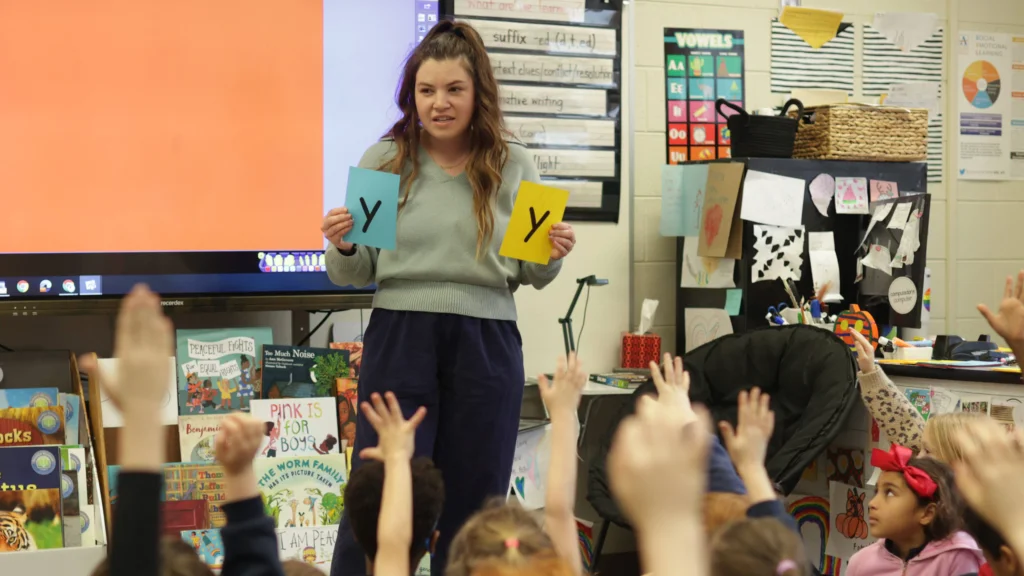
The benefit of this instruction is a stronger understanding of the meanings of words. An understanding of each suffix and the meaning it carries supports these skills:
Word recognition and decoding
Vocabulary growth
Improved spelling
Increased understanding of grammar
Improved reading comprehension
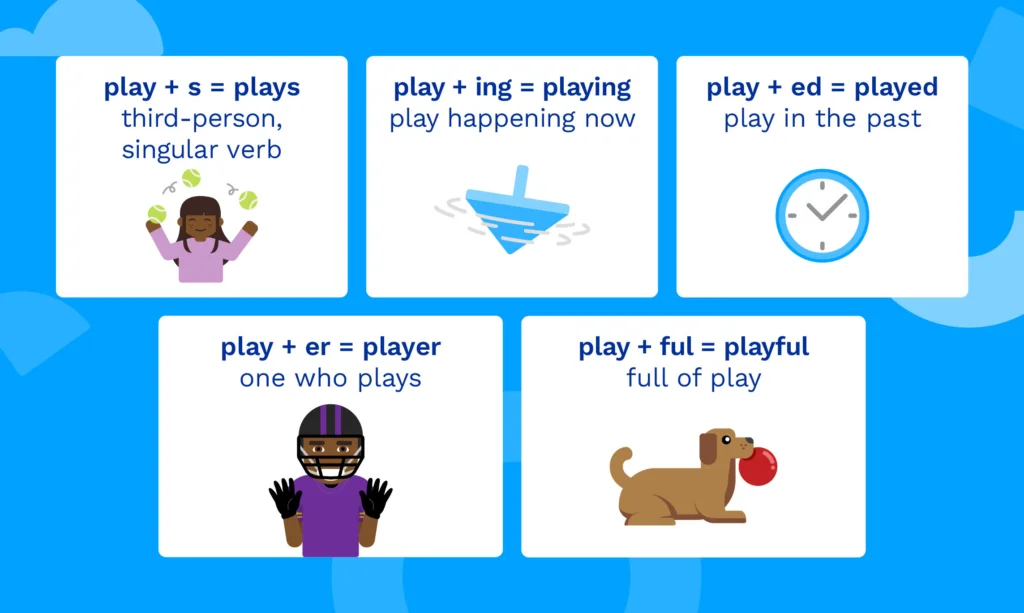
Use words that students are very familiar with (part of their oral language or easily decodable) to develop this understanding. Take the word play for example:

Teacher Tip
Inflectional and Derivational Suffixes
There are two types of suffixes, inflectional and derivational:
An inflectional suffix does not change the part of speech of the base word. For example, the word car is a noun. When I add the suffix '-s' to show more than one car I have the word cars, which is still a noun.
A derivational suffix does change the part of speech of the base word. This can be seen if I take the word help, which is a verb, and add the suffix '-ful' to make the word helpful. Now I have changed the verb into an adjective.
Inflectional and Derivational Suffixes
There are two types of suffixes, inflectional and derivational:
An inflectional suffix does not change the part of speech of the base word. For example, the word car is a noun. When I add the suffix '-s' to show more than one car I have the word cars, which is still a noun.
A derivational suffix does change the part of speech of the base word. This can be seen if I take the word help, which is a verb, and add the suffix '-ful' to make the word helpful. Now I have changed the verb into an adjective.
Teaching Suffixes to Your Students Who Speak African American English
Here's Dr. Washington on teaching suffixes to students who speak AAE:

Common Suffixes
Teacher Tip
Connection to Oral Language
Have you ever heard a young child say, "Look! I breaked the ice!" or "Mom, you are such a good cooker"? These are both examples of students attempting to apply what they've learned about suffixes through their exposure to oral language. This is the opportunity for explicit instruction that builds students morphemic awareness!
Connection to Oral Language
Have you ever heard a young child say, "Look! I breaked the ice!" or "Mom, you are such a good cooker"? These are both examples of students attempting to apply what they've learned about suffixes through their exposure to oral language. This is the opportunity for explicit instruction that builds students morphemic awareness!
