With your help, we can improve literacy instruction in every classroom. Support Reading Universe!

Skill Explainer

3.6 Explicitly Teach the Suffix '-ed'

Suffixes Skill Explainer

The Three Sounds of Suffix '-ed'
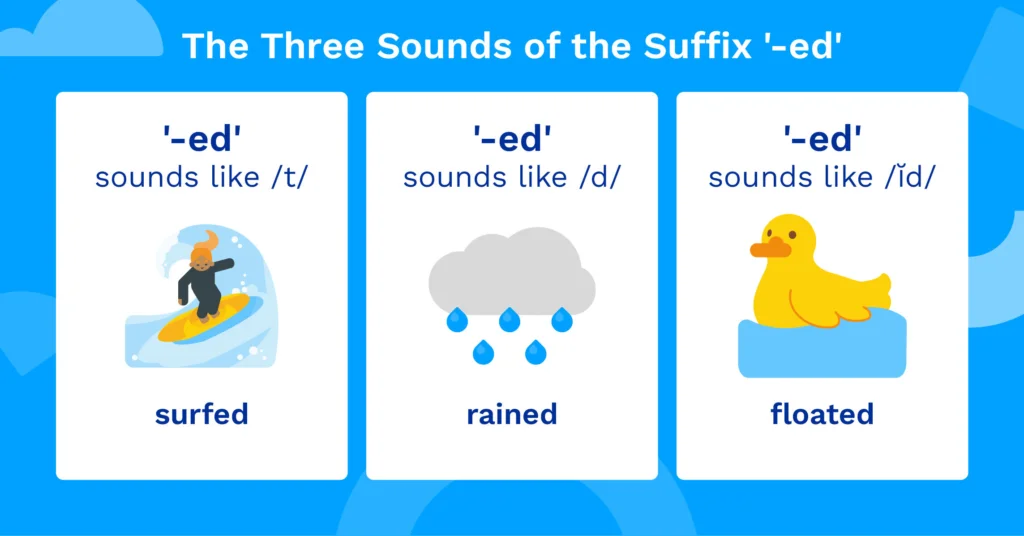
Illustrations for the three sounds of suffix '-ed': /t/, /d/, and /ĭd/.

1. When the base word ends in an unvoiced sound, like /f/ in surf, the suffix '-ed' will be pronounced /t/. Listen to the audio file below; then repeat what you hear. 

2. When the base word ends in a voiced sound, like /n/ in rain, the suffix '-ed' will be pronounced /d/. Listen to the audio file below; then repeat what you hear.

3. When the base word ends in a /t/ like float, the suffix '-ed' is pronounced /ĭd/. 

Teacher Tip

Pronunciations of '-ed'
Understanding how the final sounds of base words affect the pronunciation of '-ed' is teacher knowledge. Students should learn the three sounds of '-ed,' but you don't need to explicitly teach how ending sounds affect pronunciation.

Choosing Words for Your Lesson

Teacher Tip

Went and Did: Two Examples of Irregular Past-Tense Verbs
Some verbs are called irregular because they don't form the past tense by simply adding the suffix '-ed.' Instead, the entire word changes. For instance, go becomes went in the past tense, or do becomes did.

You might hear students say, "I goed to the store." 

We can support their oral language development by modeling the sentence, "I went to the store." 

You'll teach these exceptions at another time. For now, you want to just work on words that follow the patterns being explicitly taught so student can learn how to read and spell words with the suffix '-ed'. 

Now it's time to teach!
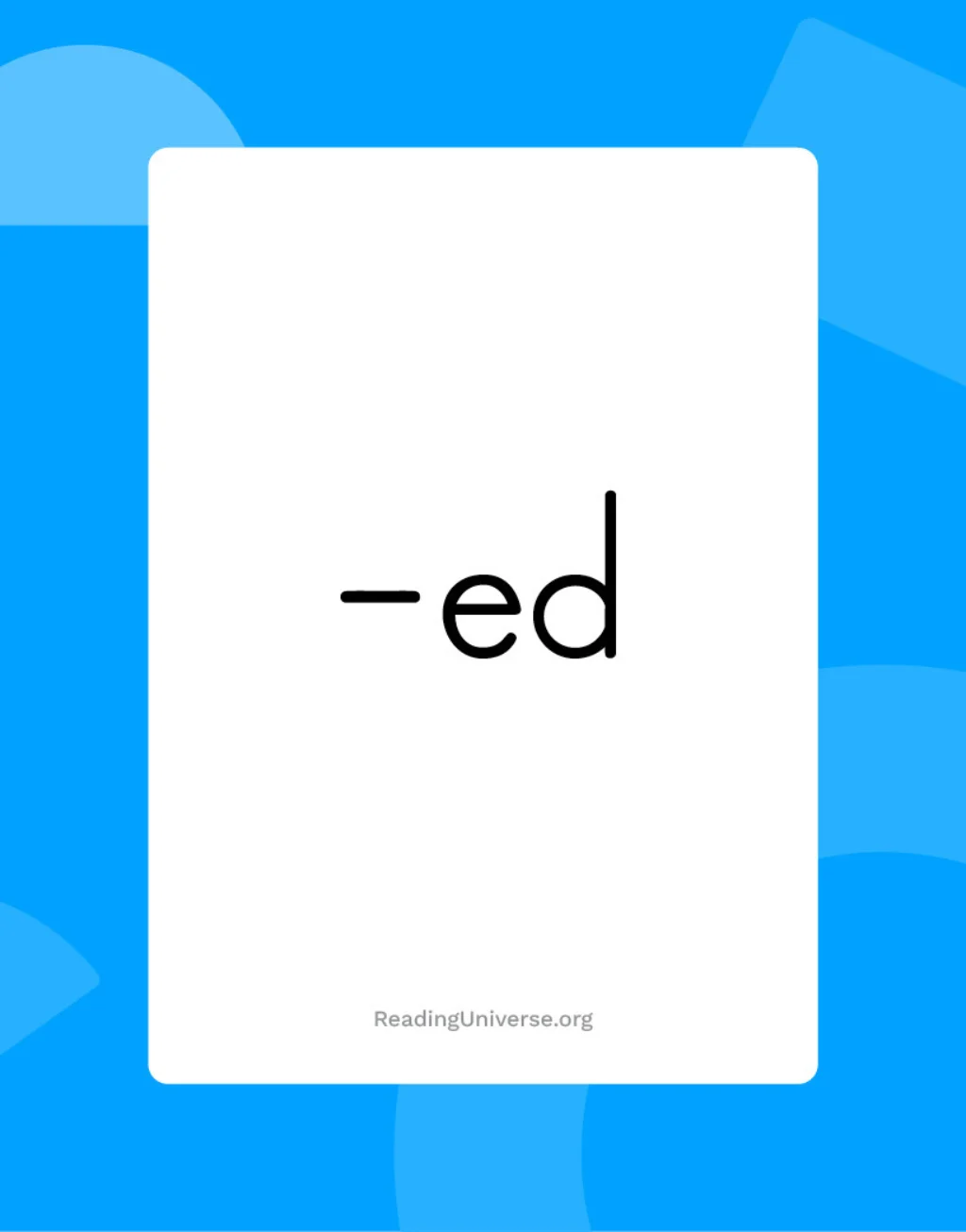
Today we are going to learn about a new suffix. Remember: a suffix is something you add after a base word, and it has meaning.

Suffix '-ed' flash card

This is the suffix 'e-d'. The suffix 'e-d' is special because it can make three different sounds! 

Listen to what we will say when we see this card:

"The suffix 'e-d', can say /d/, /t/, and /ĭd/. It makes a word past tense. This means that it has happened already."

Repeat.

The suffix 'e-d', can say /d/, /t/, and /ĭd/. It makes a word past tense. This means that it has happened already.

If I add the suffix 'e-d' to this word, what new word do I get?

Filled

Yes, filled, like in this sentence: "Mom filled the tub with warm water." The word filled has the suffix 'e-d'. This suffix tells us that the action already happened. Mom already filled, or added, warm water to the bathtub.

Let's say the word again together.

Filled

What sound is the suffix 'e-d' making in this word?

/d/

Yes, in this word, the suffix 'e-d' makes the /d/ sound.

Even though we hear /d/, I don't just add 'd' to spell the word. 'D' by itself is not a suffix. I have to add the suffix 'e-d', because the suffix 'e-d' is what shows that the action already happened.

If I add the suffix 'e-d' to this word, what is the new word?

Jumped

Yes, jumped, like in this sentence: "Bill jumped into the pool." The word jumped has the suffix 'e-d', and the suffix 'e-d' tells us that it already happened. Bill already jumped into the pool.

Let's say the word again. 

Jumped

What sound is the suffix 'e-d' making in this word?

/t/

Yes, in this word, the suffix 'e-d' is making the /t/ sound. After the word jump, I can't just write 't' because 't' is not a suffix — it does not have any meaning. I need to add the suffix 'e-d' to show that the action already happened.

If I add the suffix 'e-d' to this word, what is the new word?

Landed

Yes, landed, like in this sentence:

The plane landed at 10 o'clock. The word landed has the suffix 'e-d', which tells us that the action already happened. The plane already landed, or arrived, at 10 o'clock.

Let's say the word again together.

Landed

What sound is the suffix 'e-d' making in this word?

/ĭd/

Yes, in this word, the suffix 'e-d' makes the /ĭd/ sound.

After the word land, I added the suffix 'e-d' to show that the action took place in the past.

In this word, 'e' 'd' is part of the base. If I take away the 'e' 'd', I am left with 'b' and 'b' is not a word. This word bed does not have the suffix 'e-d'.

Reading Universe is made possible by generous support from Jim & Donna Barksdale; the Hastings/Quillin Fund, an advised fund of the Silicon Valley Community Foundation (opens in new window); the AFT (opens in new window); the Emily Hall Tremaine Foundation (opens in new window); and three anonymous donors.