Subscribe to our YouTube channel for free access to over 250 classroom videos.
Skill Explainer
3.4 Explicitly Teach the Suffix '-ing'
Suffixes Skill Explainer
3.4 Explicitly Teach the Suffix '-ing'
The suffix '-ing' is a morpheme added to the end of a base word to form the present participle of a verb, like in the word jumping. It shows that an action is happening right now. Depending on students' age or grade level, we might teach that '-ing' means "happening now" or explain that it shows an action in progress.
If you have already taught glued sounds, including /ing/, reading this suffix should be familiar to your students.
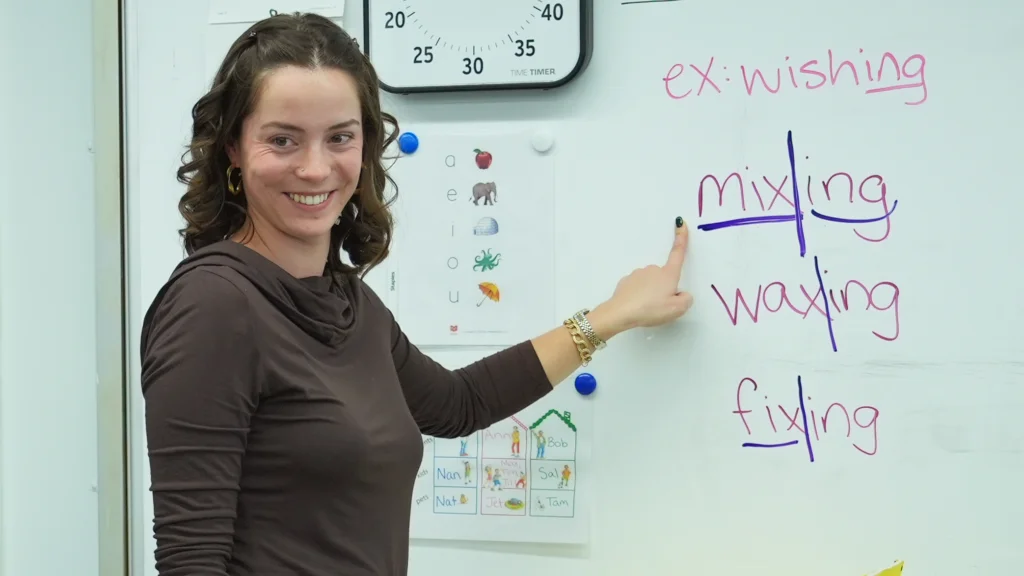
Photo by Fanny Texier
The suffix '-ing' is an inflectional suffix, which means it does not change the part of speech. For example, crush is a verb, and when you add '-ing', the word crushing is still a verb.
Teacher Tip
What is a Gerund? A gerund is formed when a verb with the suffix '-ing' functions as a noun. For example: "Splashing is my favorite thing to do in the pool!" or "Jumping is a frog's way of avoiding predators.
Choosing Words for Your Lesson
When you first introduce '-ing', it's helpful to choose words that have unchanging base words: fish becomes fishing; sail becomes sailing. Fish and sail don't change. Just put '-ing' on the end of each. It's simple, so it's easier for your students to learn.
We do NOT want to use words that have doubling of final consonants (grab becomes grabbing) or magic 'e' to drop (bake becomes baking). We'll save those challenges for a later lesson.
Here are some good word choices, where the base stays the same even when you add the suffix:
Words with ending blends, like bend
Words that end with digraphs, like wish
Words that end with glued sounds, like hang and think
Words that follow the FLoSS(Z) rule, like spell, miss, buzz, and stuff
Words that end with '-ck', like snack
Words that end with r-controlled vowels, like bark
We have already learned that 'i', 'n', 'g' says /ing/ like in the word ring. We know that the glued sound /ing/ is in the words sing, bring, and sting.
Say,
Today I am going to show you a new card that has '-ing' on it; but instead of /ing/ being a part of the base word, this '-ing' is a suffix and gets added after a base word. Remember, a suffix is something we add to a word that has its own meaning. When we add the suffix 'i-n-g', it tells us the action is happening now.
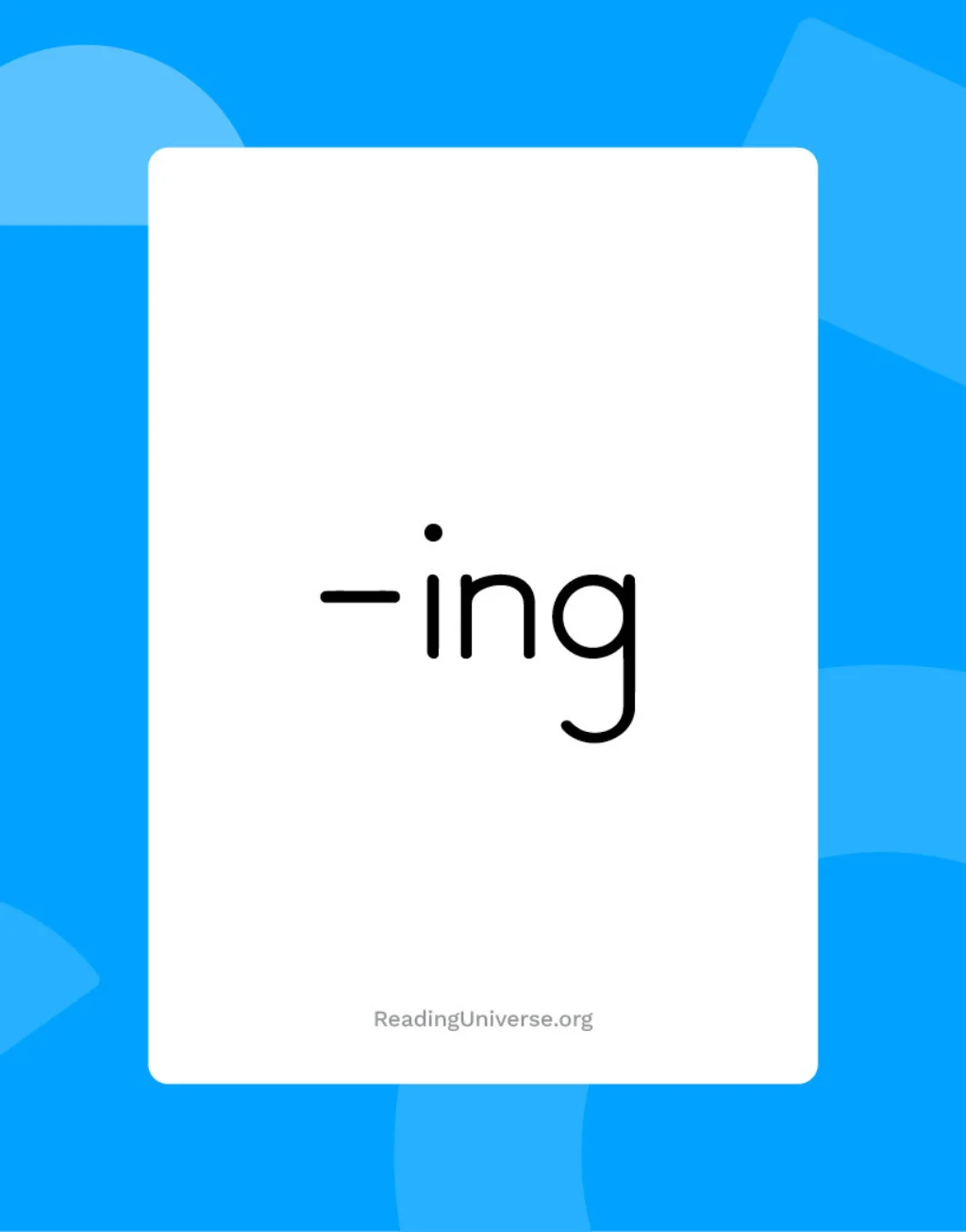
Holding your flash card for suffix '-ing', say,
Listen to what we will say when we see this card.
The suffix 'i-n-g' says /ing/. It means happening now.
Repeat.
<p>The suffix 'i-n-g' says /ing/. It means happening now.</p>
Students repeat,
The suffix 'i-n-g' says /ing/. It means happening now.
Write the word jump on the board. Have students read the word.
Jump.
Now add the suffix '-ing' to the word. Ask students to read the new word.
Jumping.
Write on the board: The kid is jumping off the dock.
Have students read the sentence aloud together.
The kid is jumping off the dock.
Say,
The suffix '-ing' that we added to jump tells me that the kid is doing it now.
Write the following words on the board one at a time and have students read them aloud chorally: flash, honk, send, miss and sing.
Then add the suffix '-ing' to each word and have students read the new words. Discuss how the meaning of the word changed when you added the suffix.
When you get to the last word, write the word sing on the board. Say,
In this word, 'i-n-g' is part of the base. If I take away the 'i', 'n', 'g', I am left with 's', and 's' is not a word. This word sing does not have the suffix '-ing'. But we can add the suffix to make the word singing. For example, I am singing out loud.