With your help, we can improve literacy instruction in every classroom. Support Reading Universe!

Skill Explainer

3.5 Explicitly Teach the Suffix '-es'

Suffixes Skill Explainer
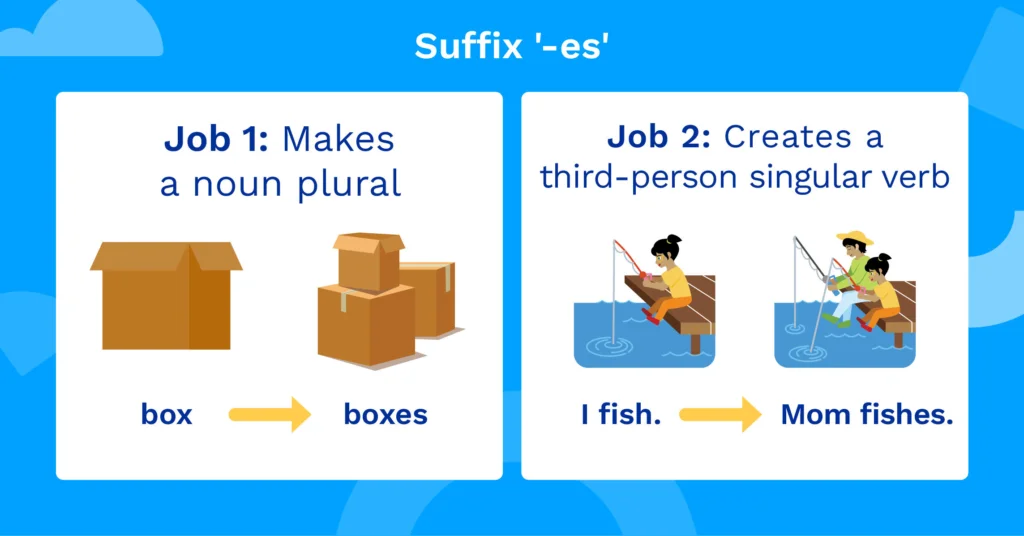
Illustration of suffix '-es' making a noun a plural and creating a third person singular verb.

The Suffix ‘-es’ Spelling Rule

On Reading Universe we have a chant that we teach students to help them remember when to use the suffix '-es'. It sounds like this:
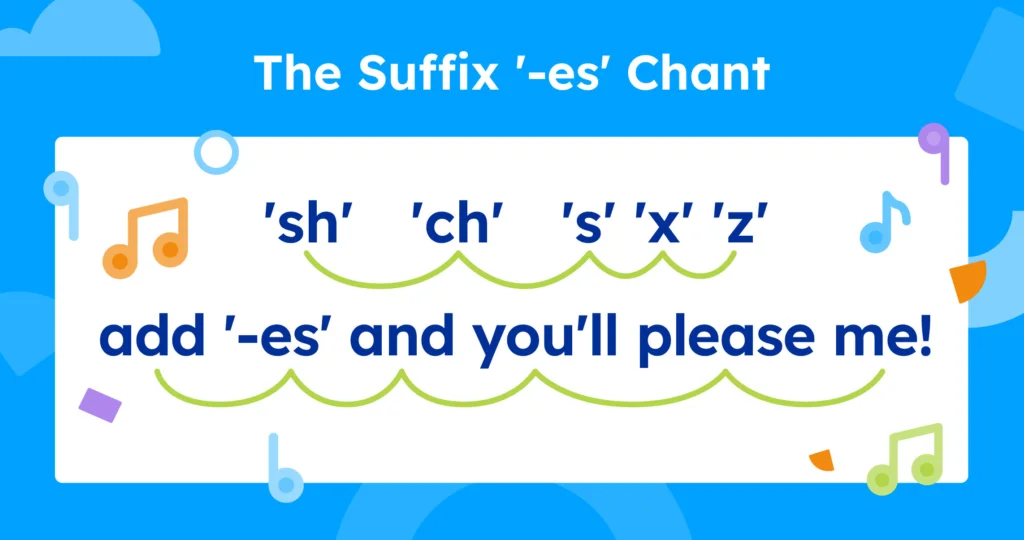
Illustration for singing the suffix '-es' chant.

Watch first grade teacher Carla Miller as she shares this special chant.

Video thumbnail for Quick Look: A Chant for the Suffix '-es' Rule
Produced by Reading Universe, a partnership of WETA, Barksdale Reading Institute, and First Book
Hide Video Transcript Show Video Transcript

Carla Miller: And I have a little cheer for us. You ready for a little cheer?

Students: Yes!

Carla Miller: Okay. Here we go. Okay, so the cheer goes like this, 'sh', 'ch', 'x', 's', 'z', add '-es' and you'll please me! We're going to do the first part first and then the second part. Let me hear you say ...

Together: 'sh', 'ch', 'x', 's', 'z', add '-es' and you'll please me!

In this video, Dr. Carla Miller of Burgess-Peterson Academy in Atlanta teaches her first graders when to use the suffixes ‘-s’ or ‘-es’ to make a word plural. Watch as she teaches students a chant to remember when to use ‘-es’ and includes dictation practice to allow students to practice this new skill.

Video thumbnail for Teaching Suffix '-s' and Suffix '-es'
Produced by Reading Universe, a partnership of WETA, Barksdale Reading Institute, and First Book

Now it's time to teach!

Today we are going to learn about a new suffix. Remember: a suffix is something that we add to the end of a base word and it has its own meaning. To learn about our new suffix, we need to think back to the first suffix we learned about, the suffix '-s'. We learned that the suffix '-s' can show more than one (makes a noun plural).

Our new suffix, the suffix 'e-s', is also used to make nouns plural. So if both the suffix '-s' and the suffix 'e-s' do the same job, how will we know which one to use?

Here is a chant to help you know when to use the suffix '-es':

'sh', 'ch', 's', 'x', 'z' … add '-es' and you'll please me!

That means that if a base word ends with 'sh', 'ch', 's', 'x', or 'z', I can't add the suffix '-s'. I have to add the suffix '-es'.

'sh', 'ch', 's', 'x', 'z' … add '-es' and you'll please me!

When I look at the word lunch, I notice it ends with the digraph ch. Is ch part of our chant for when to use the suffix '-es'? [yes]

That's right! So if I want to make lunch plural, I need to add '-es'.

The suffix 'e-s' says /ǐz/.  It makes a noun plural.

lunches

Yes, when we add the suffix '-es' to words, it typically sounds like /ĭz/. But we have to remember that even though we hear /ĭz/, we don't write is — because is is a word, not a suffix, and it doesn't do the job we need. The suffix '-es' is what makes a word plural.

Suffix '-es' flash card

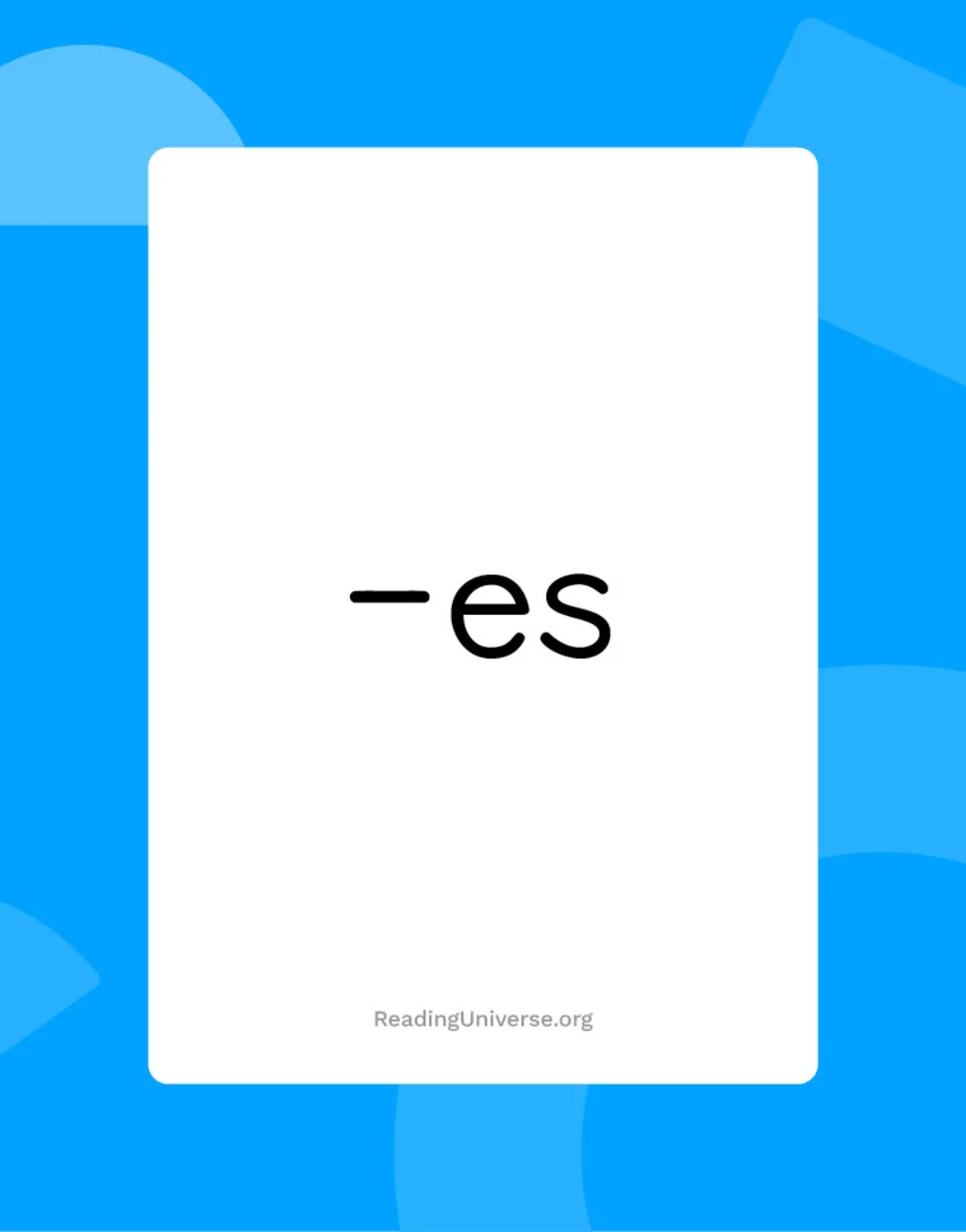
This card will help us learn about the suffix '-es'. When we see this card, we will say,

The suffix '-es' says /ĭz/.

It makes a word plural.

Repeat. 

The suffix '-es' says /ĭz/. It makes a word plural.

'sh', 'ch', 's', 'x', 'z' … add '-es' and you'll please me!

Repeat.

'sh', 'ch', 's', 'x', 'z' … add '-es' and you'll please me!

box

boxes

Can you get the boxes?

The suffix '-es' that is added to box tells me that there is more than one box.

The suffix '-es' has another job. When we add it to a verb, it helps tell what's happening now.

Watch and listen to what we'll say when we see this card.

The suffix '-es' says /ĭz/.

It helps a verb tell what's happening now.

The suffix '-es' says /ĭz/.

It helps a verb tell what's happening now

miss

misses

The kid misses his mom.

The suffix '-es' that is added to miss helps this verb agree with the subject to tell what is happening right now.

Reading Universe is made possible by generous support from Jim & Donna Barksdale; the Hastings/Quillin Fund, an advised fund of the Silicon Valley Community Foundation (opens in new window); the AFT (opens in new window); the Emily Hall Tremaine Foundation (opens in new window); and three anonymous donors.