4. Videos: See Suffix Instruction in the Classroom
Suffixes Skill Explainer
Hide Video Transcript
Show Video Transcript
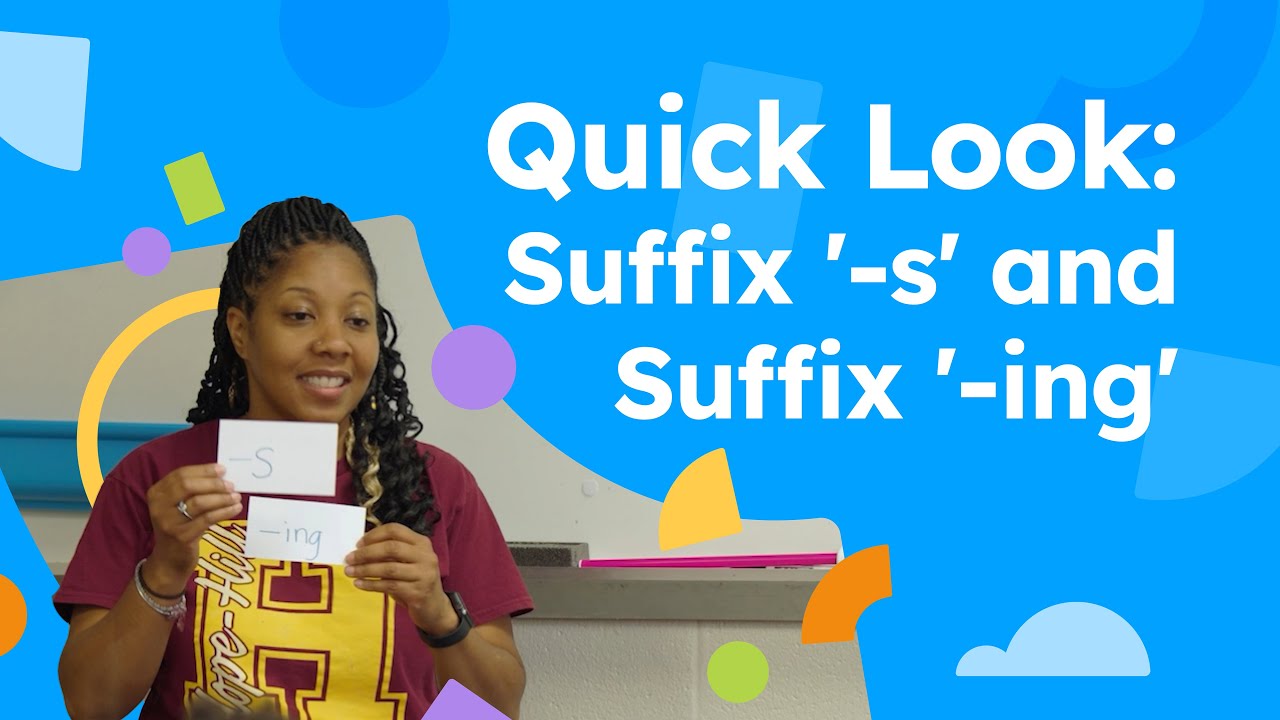
Taurra Dorsey: Let's do this one.
Students: Suffix 'ing'.
Taurra Dorsey: What does suffix '-ing' ... what does that do? What does that mean when we add that? Go. Sophia?
Sophia: Makes it ... makes it happening now.
Taurra Dorsey: Happening now. Okay. Do we agree?
Students: Yes.
Taurra Dorsey: Yes. Let's go back to suffix 's'. So let me tell you about suffix 's'. Suffix 's' makes the noun more than one. Is suffix 's' a part of the base word?
Students: No.
Taurra Dorsey: We add it on just like we add on suffix '-ing'. Suffix '-s'..
Students: Suffix '-s' ...
Taurra Dorsey: makes the noun ...
Students: makes the noun ...
Taurra Dorsey: more than one.
Students: more than one.
Taurra Dorsey: Suffix 'ing' ...
Students: Suffix '-ing' ...
Taurra Dorsey: means happening now.
Students: means happening now.
Taurra Dorsey: Awesome job. Awesome job. Everybody. Kiss your brain.
Quick Look: A Chant for the Suffix '-es' Rule
First grade teacher Carla Miller shares a special chant to help her students remember when to use the suffix ‘-es’.

Hide Video Transcript
Show Video Transcript
Carla Miller: And I have a little cheer for us. You ready for a little cheer?
Students: Yes!
Carla Miller: Okay. Here we go. Okay, so the cheer goes like this, 'sh', 'ch', 'x', 's', 'z', add '-es' and you'll please me! We're going to do the first part first and then the second part. Let me hear you say ...
Together: 'sh', 'ch', 'x', 's', 'z', add '-es' and you'll please me!
Teaching Suffix '-s' and Suffix '-es'
In this video, Dr. Carla Miller of Burgess-Peterson Academy in Atlanta teaches her first graders when to use the suffixes ‘-s’ or ‘-es’ to make a word plural. Watch as she teaches students a chant to remember when to use ‘-es’ and includes dictation practice to allow students to practice this new skill.

Hide Video Transcript
Show Video Transcript
Carla Miller: So we have talked about suffixes before, right?
Students: Yes.
Carla Miller: Who can tell me what a suffix is? Raise your hand. Lorelai, what's a suffix?
Lorelai: A suffix is a letter or letters that you add to a word to make it plural.
Carla Miller: A suffix is a letter or a group of letters that we add to what part of the word? Who can raise their hand and tell me what part of the word? Caroline.
Caroline: The end.
Carla Miller: You add it to the end of the word and it changes the word just a little bit. Today we're going to talk about two different suffixes. We're going to talk about suffix '-s' and suffix '-es'.
Voiceover: Knowing which suffix to use to make a word plural can be tricky for young writers. Is it '-s' or '-es'? In this lesson at Burgess-Peterson Academy in Atlanta, instructional coach Dr. Carla Miller teaches her first graders when to use each one.
Carla Miller: We're going to start with suffix '-s'. So we know when we add suffix '-s' to the end of the word, it makes a word plural, but I don't know what that word plural means. Who can help me out? Let's see. Some new hands. Clementine. What's it mean to make a word plural?
Clementine: More than one.
Carla Miller: More than one. Good. So when we could have the word cat, but when we add the suffix '-s', what does that do?
Students: Cats.
Carla Miller: Now we have more than one cat. Okay, so let's do some more.
Voiceover: After Dr. Miller models how adding '-s' makes a word plural, her students jump in to practice together.
Carla Miller: Who can read the next word for me? Charlie.
Charlie: Sock.
Carla Miller: Sock. Good. So we're going to go ahead and add suffix '-s'. Charlie, what word do we have now?
Charlie: Socks.
Carla Miller: We now have two socks. Good. Let's do the last one. Who can read the word for me? Gianna, what's the base word? What word do we have here?
Gianna: Clam.
Carla Miller: "Clam." Very good. Can you read the word now that we've added suffix '-s'?
Gianna: Clams.
Carla Miller: That's good
Voiceover: Now that they've practiced with the suffix '-s'. It's time for the next challenge — learning when to add '-es' instead.
Carla Miller: So we add suffix '-es' to a word to make a word plural. If the word ends in 'sh', 'ch', 'x', 's', or 'z'. Okay, and I have a little cheer for us. You ready for a little cheer?
Students: Yes!
Carla Miller: Okay, there we go. Okay, so the cheer goes like this, 'sh', 'ch', 'x', 's', 'z' ... add '-es' and you'll please me! We're going to do the first part first and then the second part. Let me hear you say 'sh', 'ch', 'x', 's', 'z' ... add '-es' and you'll please me! So we have a word who can raise her hand and read the word for me. I would like Lao to read the word.
Lao: Box.
Carla Miller: Box. I'm going to add suffix '-es' to that word. Lao, what did I do to that word?
Lao: Make it plural.
Carla Miller: I made it plural. What word do we have now?
Lao: Boxes.
Carla Miller: Boxes. We have more than one.
Voiceover: After a couple more examples as a group, dictation is up next. Here students will practice what they just learned, choosing the correct suffix to make a word plural. '-s' or '-es'.
Carla Miller: I'm going to remind you while we're writing these words, we're going to make a lot of these words plural. Remind me one more time. Bennett, what does it mean to make a word plural? What does it do to the word?
Bennett: Makes it more than one.
Carla Miller: It makes it more than one. So we're really going to listen for the ending sounds of words when we make them plural. Okay? So the first word I want you to write is ship. What word?
Students: Ship.
Carla Miller: Tap it.
Students: /s/, /ĭ/, /p/. Ship.
Carla Miller: Excellent. Make the word plural. Elliot, what did I need to do to make that word plural?
Elliot: Put an 's' at the end of the word.
Carla Miller: Excellent. Can you tell me why you decided to use an '-s' and not an '-es'?
Elliot: Because ship doesn't end with an 'sh', 'ch', 'x', 's', or 'z'.
Carla Miller: Excellent. Good work. Make sure yours looks like mine. Pencils down, tappers up. The word is rash. What word?
Students: Rash.
Carla Miller: Tap it.
Students: /r/, /ă/, /sh/. Rash.
Voiceover: Dr. Miller picked the word "rash" for a reason. It not only lets students decide which suffix to use, but it also opens a window to talk about word meaning, an essential component of comprehension.
Carla Miller: Before we go on, who can tell me what's a rash? Bennett?
Bennett: Rash is like a red spot on your leg and hurts a lot.
Carla Miller: Does it have to be on your leg?
Bennett: No. It can be anywhere on you, like on your arms. Anywhere.
Carla Miller: So a rash is, it's a group of red dots that you can find on your body, but rash can also mean if you do something quickly without thinking about it. Like if you make a rash decision. A rash decision. If I was at the top of that slide right there and I decided to jump off the top of the slide without thinking that it could hurt me. That would be making a rash decision. I want you to make that word plural. Ashton, what did you write? What did you add?
Ashton: '-es'.
Carla Miller: '-es'. So our choices ... we could have either added suffix '-s' or suffix '-es'. Let's think about our cheer. 'sh', 'ch', 'x', 's', 'z' When do you add '-es'?
Ashton: Because I see 'sh'.
Carla Miller: Yes. Very good. So since the word ended with that digraph, 'sh' we had to add '-es'. If your paper does not look like mine, make sure you fix it now. Next word.
Voiceover: And after the heavy lift of dictation is done, it's time for the final step of the lesson for these first graders — celebrating their work by reading what they wrote.
Carla Miller: Okay, friends, we're going to go ahead and read back. First word?
Students: Ships.
Carla Miller: Good. Next word.
Students: Rashes.
Carla Miller: Go ahead and read this one for me.
Students: Wishes. Girls ...
Carla Miller: Let's try this again. Grills. Everyone.
Students: Grills.
Carla Miller: Good.
Students: Blocks. Brushes.
Carla Miller: Very good.
Voiceover: Reading Universe is made possible by generous support from Jim and Donna Barksdale, the Hastings/Quillin Fund, an advised fund of the Silicon Valley Community Foundation, the AFT, the Emily Hall Tremaine Foundation, and anonymous donors. Special thanks to Burgess-Peterson Academy and Atlanta Public Schools. If you enjoyed this video, please subscribe to our YouTube channel @RUTeaching. Reading Universe is a service of WETA, Washington D.C., the Barksdale Reading Institute and First Book.
Carla Miller: I'm Dr. Carla Miller and this is Reading Universe.
Warming Up with Suffixes
Watch second-grade teacher Khadija Williams lead students in a flash card routine for suffixes. For each suffix, Ms. Williams spells it, says it, defines it, and gives examples. And her students echo her. Once her students have routines like this down pat, they can focus on learning new content — suffixes like ‘-ing’ (happening now) and ‘-ed’ (in the past) — instead of trying to follow along with a different process every day.

Hide Video Transcript
Show Video Transcript
Khadija Williams: All right, now we have our suffixes. Okay.
Narrator: Warming up with flashcards is a fast, easy way for students to review their letter-sound correspondences. It helps them develop automaticity and gets their brains ready for new content. Watch as Khadija Williams leads her second graders through a deck on suffixes.
Khadija Williams: '-er', /er/.
Students: '-er', /er/.
Khadija Williams: Someone.
Students: Someone, something, or more.
Khadija Williams: Very good. Teacher.
Students: Teacher. Marker.
Khadija Williams: Bigger.
Students: Bigger.
Khadija Williams: Very good.
Narrator: Notice how Ms. Williams uses the same routine for each suffix. She spells it, says it, defines it, and gives examples.
Khadija Williams: Suffix '-ing'.
Students: Suffix '-ing'.
Khadija Williams: /ing/. Happening now.
Students: Happening now.
Khadija Williams: Running.
Students: Running.
Khadija Williams: Jumping.
Students: Jumping.
Khadija Williams: Very good. Suffix '-ed'.
Students: Suffix '-ed'.
Khadija Williams: /d/, /t/, /ĭd/.
Students: /d/, /t/, /ĭd/.
Khadija Williams: In the past.
Students: In the past.
Khadija Williams: Very good. Cleaned.
Students: Cleaned.
Khadija Williams: Danced.
Students: Danced.
Khadija Williams: Very good. Suffix '-ful', /ful/.
Students: Suffix '-ful', /ful/.
Khadija Williams: Full of.
Students: Full of.
Khadija Williams: Very good. Helpful.
Students: Helpful.
Khadija Williams: Thoughtful.
Students: Thoughtful.
Khadija Williams: Wishful.
Students: Wishful.
Khadija Williams: Very good. Suffix '-s'.
Students: Suffix 's'.
Khadija Williams: /s/ or /z/.
Students: /s/ or /z/.
Khadija Williams: Plural, more than one.
Students: Plural, more than one.
Khadija Williams: Teachers.
Students: Teachers.
Khadija Williams: Girls.
Students: Girls.
Khadija Williams: Chairs.
Students: Chairs.
Khadija Williams: Very good. Suffix '-less'.
Students: Suffix '-less'.
Khadija Williams: /lĭs/.
Students: /lĭs/.
Khadija Williams: Without.
Students: Without.
Khadija Williams: Thoughtless.
Students: Thoughtless.
Khadija Williams: Harmless.
Students: Harmless.
Khadija Williams: Hopeless.
Students: Hopeless.
Narrator: Building a consistent flashcard routine like this one helps students focus less on the process and more on mastering their suffixes.
Khadija Williams: Very good. Awesome.
Narrator: Reading Universe is made possible by generous support from Jim and Donna Barksdale, the Hastings/Quillin Fund, an advised fund of the Silicon Valley Community Foundation, the AFT, the Emily Hall Tremaine Foundation, and anonymous donors. Special thanks to Hope Hill Elementary, Reading Is Essential For All People, and Atlanta Public Schools. If you enjoyed this video, please subscribe to our YouTube channel @RUteaching. Reading Universe is a service of WETA, Washington D.C., the Barksdale Reading Institute, and First Book.
Khadija Williams: My name is Khadija Williams, and this is Reading Universe.
Quick Look: Unlocking Meaning with Prefixes and Suffixes
In this quick demonstration, third grade teacher Lidra West models how to break a word into its parts — prefix, base word, and suffix — to make a connection to meaning.

Hide Video Transcript
Show Video Transcript
Lidra West: My first word is unprepared. Unprepared. I have a prefix 'u-n' here. My base word is here and then I have a suffix 'e-d'. I can take my word and I can break it apart to help me as the reader know what that word really means. So Orion, I have prefix 'u-n'. I have my base word prepare and then I have suffix 'e-d'. I know prefix 'u-n' means not. I know prepare, Hudson. That means that I have to get ready for something, right? And then I know suffix 'e-d' means that it happened in the past. So unprepared tells me that this word is, it means not ready in the past. I wasn't ready for something. I was unprepared for school because I didn't pack my backpack last night. I was unprepared for dance class because I left my tap shoes at my friend's house. So unprepared means I wasn't ready in the past.
Let's look at another ...
