3.1 Prepare to Teach Grammatical Building Blocks
Grammatical Building Blocks Skill Explainer
Nancy Chapel Eberhardt
Before you teach, you'll need to do a few things to get ready. If you haven't taught language comprehension skills with a function-first approach before, it may take a little longer than usual to prepare for your first lesson.
You'll be teaching each of the eight building blocks separately and then intentionally connecting them to show their relationship with one another — for example, a pronoun replaces a noun! The preparation we guide you through here can apply to all eight building blocks. We'll provide specific resources you'll need for each one later on in each block's own section.
Fitting Grammar Into Your Daily Classroom Schedule
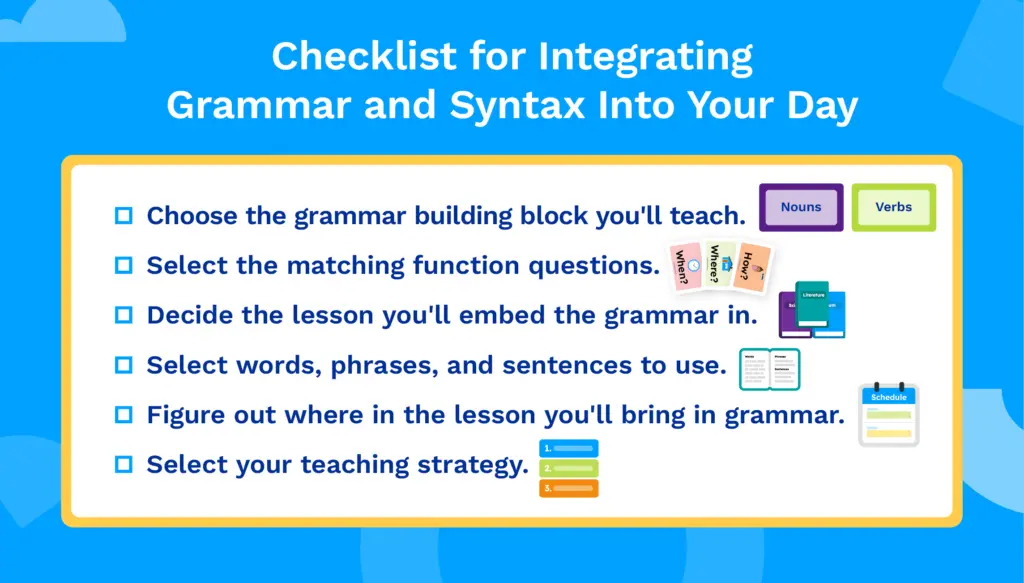
Prepare Your Grammar Lesson with Our Checklist
Let's walk through how to use this checklist with an example lesson:
1. Choose the grammatical building block you'll teach.
Let's say you're a first grade teacher towards the beginning of the school year, so you decide you want to teach your children about nouns. With our function-first approach, you'll call this the who or the what.

Grammatical building block: who or what
2. Select the matching function questions.
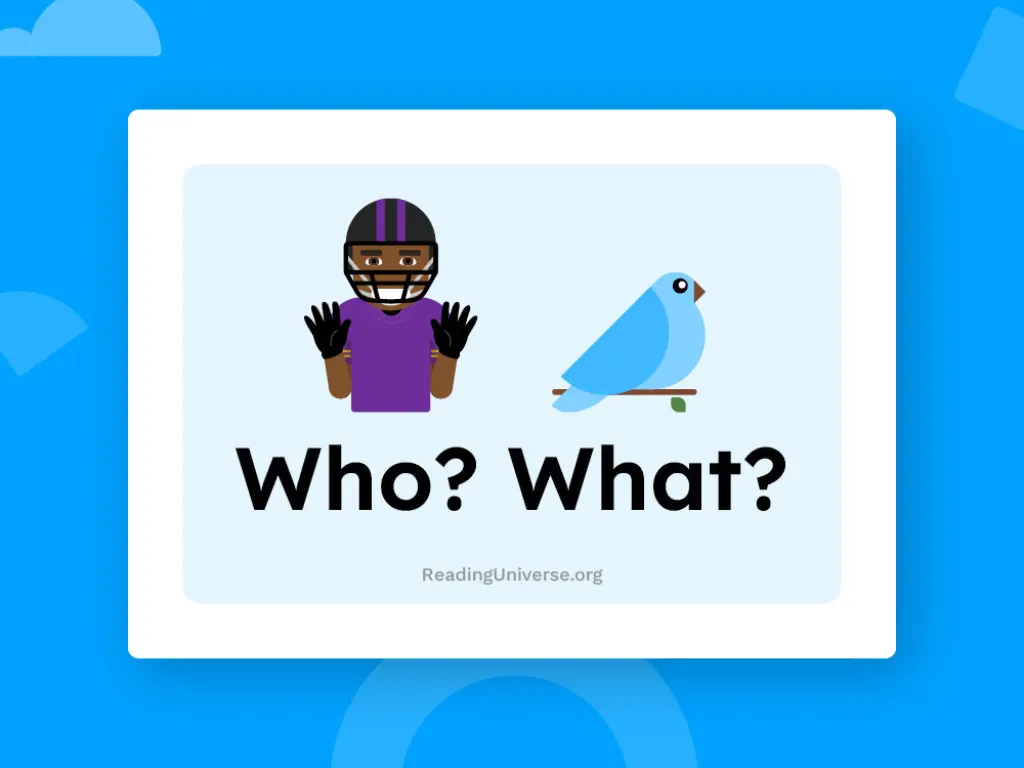
The function questions that go with the who or the what are — surprise! — "Who?" and "What?" Print your "Who? What?" function question card to use in the lesson.
Function questions: "Who?" and "What?"
3. Decide the lesson you'll embed the grammar in.
The who or the what (nouns) can go in almost any kind of lesson … because every school content area has nouns. You could teach it during science, during a read-aloud for social studies, or even in math. A phonics lesson can often be a good choice. For our example, let's say you'll teach it during your phonics lesson on beginning blends.
Lesson to embed in: Phonics – Beginning blends
4. Select words, phrases, and sentences to use.
You're in luck! Reading Universe provides a list of words, phrases, and sometimes sentences for each phonics skill, and here's one for beginning blends (opens in new window). Look at the sentences and choose two or three that will work well for your who or what instruction. There are a few that could work.
Sentences to use:
Dan sped in the van.
I slid on the wet path.
The milk can spill from the glass.
5. Figure out where in the lesson you'll bring in grammar.
You'll want to keep your explicit instruction on beginning blends tight and focused, so you won't want to mix in grammar throughout your phonics lesson. Instead, it makes sense to teach grammar after you've just finished dictation using the sentences you selected above.
When to teach grammar: After dictation
6. Select your teaching strategy.
You'll ask yourself, "What's the best way to introduce this concept to my kids?" Take a look at the teaching strategies we've included in this skill explainer. You could read through the later sections on how to teach nouns. You could look at our free lesson plans. If you do any of that, you'll see that the Sentence Unpacking strategy is a great way to introduce students to this building block.
Teaching strategy: Sentence Unpacking
Let's Watch!

Hide Video Transcript
Show Video Transcript
Marlene Gannaway: The word is lodge. What's the word?
Students: Lodge.
Marlene Gannaway: Stop. Think. Tap. /l/, /ŏ/, /j/.
Carla Stanford: Write it.
Narrator: Exploring words with multiple meanings helps students build a deeper vocabulary and teaches them the flexibility to understand language in many contexts. At Burgess-Peterson Academy in Atlanta, this exploration can happen at any time, even during a phonics lesson. Today, second grade teacher Marlene Gannaway and reading coach Carla Stanford, are focused on the '-dge' spelling pattern. So they'll take time during dictation to introduce words like judge and lodge.
Carla Stanford: Everyone say lodge.
Students: Lodge.
Carla Stanford: Say it again. Say lodge.
Students: Lodge.
Carla Stanford: Okay, I'm going to give you a sentence and you repeat. "The beaver built a lodge on the river." Repeat
Students: The beaver built a lodge on the river.
Carla Stanford: Thumbs up if you've ever heard of that meaning of lodge. Do you guys know about beavers?
Students: Yes.
Carla Stanford: Do you know they build little homes?
Students: Yes.
Carla Stanford: We call them a lodge. Say, "A beaver builds a lodge."
Students: A beaver builds lodge.
Carla Stanford: My goodness. Wait a minute. Have you ever been, like, to the mountains and there's a little cabin. And we don't stay there all the time. We might just visit on a vacation or something and we might call it a mountain ...
Students: Lodge.
Carla Stanford: Say it again. Mountain...
Students: ... lodge.
Carla Stanford: Oh my goodness. So we might think about the word lodge when we think about a mountain ...
Students: ... lodge.
Carla Stanford: Okay, I have another one. What if I was in a hurry and I jammed all of my things inside of my desk and I was like, oh my goodness. Ms. Gannaway asked me to get out my binder and I can't. It is lodged ...
Students: ... lodged in there.
Carla Stanford: Oh my goodness. What does that lodge mean?
Students: It means stuck.
Carla Stanford: What does it mean?
Students: Stuck!
Carla Stanford: Stuck. You guys, that is amazing. You were word detectives. You took this one word and now we know three meanings. Everyone say, "A beaver's lodge."
Students: A beaver's lodge.
Carla Stanford: Say, "my notebook is lodged."
Students: My notebook is lodged.
Carla Stanford: Say "a mountain lodge."
Students: A mountain lodge.
Carla Stanford: A beaver lodge. A place.
Students: Yeah.
Carla Stanford: Right? A mountain lodge.
Students: A place.
Carla Stanford: But if I lodge something ...
Student: Stuck.
Carla Stanford: It's something that I do. Oh my goodness.
Student: A verb.
Carla Stanford: It's a verb! Lodge can be like a noun — a person, place, thing, or idea. But lodge can also be a verb. "I lodged the notebook in." So now we are going to be word detectives. You already know how to read these words, but now we have to make sure we can think about what they mean and how we use them. I'm going to show you the word. We're going to read it. We're going to talk about is it a namer or is it an action, or could it be both? Are y'all ready? What's our word? Everyone read it?
Students: Judge.
Carla Stanford: Turn and talk with your seat partners. Talk about the meaning and talk about is it a namer or an action or both?
Student: Somebody is judging someone off what they do, I guess.
Carla Stanford: I'm hearing all these amazing things. I heard some amazing work all around. I'm going to have Amy share her thinking. What do you think about the word judge? Can it be a namer? Can it be an actioner? Can it be both? And explain your thinking.
Amy: It can be both because it can be a person that's a judge.
Carla Stanford: Wait a minute. Wait. Do you guys agree? Can it be a person that's a judge?
Students: Yes.
Carla Stanford: Oh my goodness. Okay. All right. We're all on the same page. Keep going.
Amy: Or it could be someone is judging another person.
Carla Stanford: Wait, if you're judging someone, is it something you're doing?
Students: Yes.
Carla Stanford: Do you guys agree it's something you're doing?
Students: Yes.
Carla Stanford: Say, "I'm judging the food on how good it is." Say that.
Students: I'm judging the food on good it is.
Carla Stanford: So if I was like the judge, the person, in a cooking contest, then I would actually do the action, right? Of judging. Can you guys give her a high five?
Carla Stanford: And pat yourselves on the back. So what is this?
Students: A bridge.
Carla Stanford: What is it?
Students: A bridge!
Carla Stanford: Yeah. So this thing right here?
Students: Barge!
Carla Stanford: A barge! And how would you describe the barge? Is it large or small?
Students: Large.
Carla Stanford: Okay. So it is a large ...
Students: ... barge.
Carla Stanford: Say that again.
Students: Large barge.
Carla Stanford: So the large barge. Oh my goodness. So it is — to me — it looks like the large barge is trying to get under the ...
Students: ... bridge.
Carla Stanford: Oh my goodness. But it looks to me like ...
Student: It is stuck.
Carla Stanford: It got stuck. Oh, what is that word?
Student: Lodge.
Carla Stanford: It got what? It got ...
Student: ... lodged! But why did it get lodged? I think that maybe the captain of the barge misjudged. Everyone say ...
Everyone: Misjudged.
Carla Stanford: So do you guys know mis? What does mis mean?
Students: Not.
Carla Stanford: Bad or wrong, right?
Student: Mispelled.
Carla Stanford: Like mispelled means I spelled it ...
Students: ... wrong!
Carla Stanford: So if I misjudged it, I judged it ...
Students: ... wrong!
Carla Stanford: So the large barge, right? He's trying to go under the bridge, but the captain must have misjudged. And so now the barge is ...
Students: ... lodged!
Narrator: Notice how many times the students have repeated the words and used them in context. This helps them store these words in their long-term memory and prepares them for the next step in their lesson — sentence dictation.
Carla Stanford: I'm going to give you a sentence for dictation. You are ready for it.
Narrator: Reading Universe is made possible by generous support from Jim and Donna Barksdale, the Hastings/Quillin Fund, an advised fund of the Silicon Valley Community Foundation, the AFT, the Emily Hall Tremaine Foundation, and anonymous donors. Special thanks to Burgess Peterson Academy and Atlanta Public Schools. If you enjoyed this video, please subscribe to our YouTube channel @RUteaching. Reading Universe is a service of WETA, Washington D.C., the Barksdale Reading Institute, and First Book.
