4. Videos: See Grammatical Building Blocks in the Classroom
Grammatical Building Blocks Skill Explainer
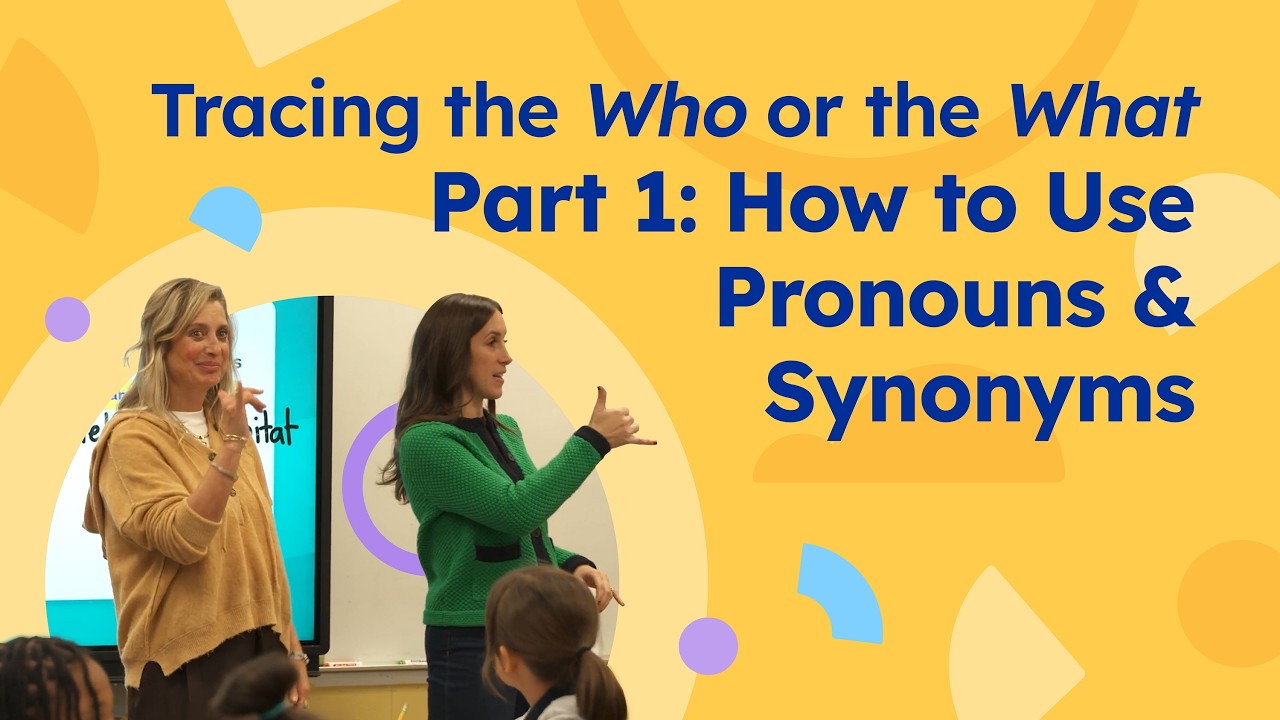
Nancy Chapel EberhardtTracing the Who or the What
Hide Video Transcript
Show Video Transcript
Julie Turner: Boys and girls, remember how we read the story "The Cactus Hotel" earlier today?
Narrator: As your students start to read more complex text, they'll need to be able to track the subject, the "who" or the "what," across a passage. It's what turns a group of disconnected sentences into a story. Students already know that every sentence has a "who" or a "what." What they'll be learning today is how authors use pronouns and synonyms to point back to the subject and keep those ideas connected. Watch as third grade teacher Julie Turner and reading specialist Carla Stanford guide students at Burgess-Peterson Academy in Atlanta through their first step in tracing the subject ... learning how pronouns and synonyms work.
Carla Stanford: Today we're going to become experts on the "who or what."
Narrator: They start by reviewing pronouns.
Carla Stanford: There's a group of words that can take the place of the "who or what." What are those words, Ms. Turner?
Julie Turner: Those words are called pronouns. Let's read through the list of words together. I, you, she, he, it, we, you, they.
Carla Stanford: Thumbs up if you've heard of a pronoun before. Thumbs up if you've used a pronoun when you were talking. Yes. You're already experts on pronouns when you're talking. You might say, "My mom is working hard. She is a hard worker." Right? And you would take mom and you would replace it with what pronoun? She. Excellent. So we know about pronouns when we are speaking, but now we want to think about the way an author uses pronouns to replace. Everyone say "replace."
Students: "Replace."
Carla Stanford: Say "pronouns replace."
Students: "Pronouns replace."
Narrator: The label pronoun doesn't tell us exactly what pronouns do. By teaching students that pronouns replace, Ms. Stanford is helping them understand the job of a pronoun.
Carla Stanford: So they replace the "who" or "what." And when they replace, they refer back. And what we have to start doing is thinking about, what are they referring back to? So we're going to do some practice. We're going to read some sentences, and we are going to make some decisions. We're going to pretend to be the author, and we're going to make some decisions about what pronouns should replace. You ready?
Students: Yes.
Carla Stanford: Let's do it.
Julie Turner: Let's take a look at our first sentence.
Everybody: "The giant cactus grows."
Narrator: Ms. Turner asks her students to think about what pronoun would replace the giant cactus in a second sentence: "The giant cactus grows for years."
Carla Stanford: "The giant cactus" is a noun that we can replace with one of those words from the list. Which word would replace "the giant cactus"? Give me a thumbs up when you know which word could replace "the giant cactus." Hadley, which word do you think would replace "the giant cactus"?
Hadley: It.
Julie Turner: Exactly: "It grows for years." "The giant cactus" is "it."
Carla Stanford: Do you see how that would have been repetitive to say "the giant cactus" and "the giant cactus"? And the job of the pronoun was to do what?
Students: Replace it.
Carla Stanford: Replace it.
Students: So it's shorter.
Carla Stanford: So it's shorter, and it's not so repetitive. So now let's read, all together, both of the sentences; and let's replace "the giant cactus" with it. Are y'all ready?
Students: Yeah.
Carla Stanford: All right. Let's read together.
Everybody: "The giant cactus grows. It grows for years."
Carla Stanford: Doesn't that sound so much better?
Students: Yes.
Narrator: The cactus hotel story has a lot of subjects to keep track of. The hotel itself, birds, bats, and snakes. Knowing which pronoun can stand in for a subject will help students keep track of, or trace, who or what each sentence is referring to, boosting their comprehension.
Julie Turner: So I think it's worth doing one more example where we're not replacing it with it, because it is one singular thing. But I noticed on this sentence ... "The ants and mice want to live in the cactus hotel." ... I don't think I can replace it with "it" this time.
Carla Stanford: Why not? Why can't we replace it with it?
Students: Because there's two of them.
Carla Stanford: There's two, and it only refers to ...
Students: One.
Carla Stanford: Yeah. They know so much already. I love it.
Julie Turner: Let's take a look at our next sentence: "The ants and mice find space to nest." So what do we think we can replace it with?
Students: They! They!
Julie Turner: Let's see ... the word they. Aha! You got it. All right. Let's read those two sentences together now. Ready?
Everybody: "The ants and mice want to live in the cactus hotel. They find space to nest."
Carla Stanford: Okay. As a reader, do you see how this is flowing?
Students: Yes.
Carla Stanford: When you get to they, your brain should be thinking, "Oh, what does 'they' stand in for? What is it replacing?"
Students: The ants and mice.
Carla Stanford: So you constantly, as a reader, have to track that. And as a writer, if we do the opposite, right? We're the ones creating the content. We don't want to have our stories have the same words repeated over and over and over. And so now we know we can use a pronoun to replace.
Narrator: Next, Ms. Stanford explains how synonyms work.
Carla Stanford: Everyone say synonym.
Students: Synonym.
Carla Stanford: A synonym is a word that means "the same." Say synonym.
Students: Synonym.
Carla Stanford: Same.
Students: Same.
Carla Stanford: Use your hand. Synonym.
Students: Synonym.
Carla Stanford: Same.
Students: Same.
Carla Stanford: If happy is a word, what is a word that means the same as happy.
Student: Joy.
Carla Stanford: Joy.
Student: Excited.
Carla Stanford: Excited.
Student: Happiest.
Carla Stanford: Happiest. Glad. Those are all very similar. What'd you say, sweet friend?
Student: Happiness.
Carla Stanford: Happiness, right? So words that mean, that are similar. They might not be exactly the same, but they give the same sentiment, the same meaning. So as readers, as we are reading, and we're thinking about who or what is the sentence about, who or what is the passage about? We know that the "who" or "what" will be named. We know the "who" or "what" can be replaced with a pronoun, but a "who" or "what" can also be reworded. Everyone say reworded.
Students: Reworded.
Carla Stanford: With a synonym!
Narrator: Synonyms and pronouns aren't interchangeable tools. So assigning each one a consistent function ... pronouns replace, synonyms reword ... helps students stay anchored as they're reading and processing sentences.
Carla Stanford: So we're going to practice this together. This happened a lot in "The Cactus Hotel" where the author intentionally took a "who" or "what" and did some rewording. So we're going to put our heads together; and our "who" or "what" we're going to think about is the Cactus Hotel. So I want you to think about that. If you were going to come up with another word to reword so that your passage didn't say, "The Cactus Hotel was big. The Cactus Hotel had lots of creatures. The Cactus Hotel had blooms on top" ... so that you didn't repeat "the Cactus Hotel" over and over and over ... what is another word or group of words that you could use in place of it? I'm going to have you turn and talk. Turn and talk with the people at your table, and let's see if you can come up with an idea before I share the ideas that Ms. Turner and I came up with.
Student 1: For insects, you could do bugs.
Student 2: But we're talking about both of them.
Student 1: Oh yeah.
Carla Stanford: I love your ideas. You're doing great work. Okay. We're going to pull some together. All right, friends. Eyes this way. I heard some amazing ideas. We have the Cactus Hotel. What did you say, friend?
Student: A house for animals.
Carla Stanford: A house for animals. That's really cool. These guys also were saying ...
Student: A word for house.
Carla Stanford: Another word for house. They were really brainstorming. What is another word for a house? I heard some people over ...
Student: Home.
Carla Stanford: A home. A home. What else?
Student: A nest?
Student: Maybe ...
Carla Stanford: A nest.
Student: Shelter.
Student: A shelter.
Student: Shelter.
Carla Stanford: A shelter. Do you like that? A shelter?
Students: Yes.
Carla Stanford: A shelter for animals? That could work.
Student: A safe place.
Carla Stanford: A safe place. There's this scientific word that I'm thinking of that means a home for animals. Do you guys know? What is that, Hadley?
Hadley: Habitat.
Carla Stanford: A habitat. Everyone say habitat.
Students: Habitat.
Carla Stanford: So now we have come up with a whole plethora of synonyms to reword "the Cactus Hotel." So let's think about this. As a reader, if I'm reading "The Cactus Hotel" and I know the "who" or "what" this book is about is what? It's about the Cactus Hotel. Now I can anticipate all the ways the author may reword "the Cactus Hotel" so they don't repeat it over and over and over and over again. Does that make sense? Now shift your brain. Say, shift!
Students: Shift!
Carla Stanford: Now think about it as a writer. As a writer, if Ms. Turner said, I would like for you to write a paragraph about the Cactus Hotel and all the residents of the Cactus Hotel, now you have a strategy. You can use the Cactus Hotel. You can use a replace word called a ...
Students: Pronoun.
Carla Stanford: Pronoun. And now you can use a reword, which is a ...
Everybody: Synonym.
Carla Stanford: You have a strategy. You ready to try some more?
Students: Yes.
Carla Stanford: So now we're going to look at birds, rats, and snakes. That's our "who" or "what." Now you are going to work with the people at your table, and I want you to come up with the rewords or the synonyms. It can be one word, or it can be a group of words. Turn and talk.
Student 1: Synonym is creatures, animals ...
Student 2: And um ...
Carla Stanford: What do you think?
Student: Visitors.
Carla Stanford: Oh, visitors. Do you like that one? Okay, Kingston and Kailei. Okay. We had some brilliance over here. We're going to check in with them. These two friends had a way that they want to reword birds, rats, and snakes. They said ...
Kingston and Kailei: Visitors.
Carla Stanford: Visitors. You guys agree? I also heard some other ones. Did you hear some over here, Ms. Turner?
Julie Turner: I heard desert animals.
Carla Stanford: I like that one, too. I heard another one over here.
Student: It was creatures.
Carla Stanford: Do you like that one? So we have desert animals. We have creatures. We have visitors. And we have birds, rats, and snakes. Do you think we have a bank of words that would help us anticipate what's coming?
Student: Yes.
Carla Stanford: I think so, too. You want to see what we came up with?
Everybody: The animals.
Carla Stanford: Would that work?
Students: Yeah.
Carla Stanford: Not as fun as yours, but yeah.
Students: Creatures.
Students: Residents of the hotel.
Carla Stanford: Excellent. Now, trick question. If I wanted to replace, not reword, but if I wanted to replace all of these "who" are "whats", what pronoun would I use?
Students: They.
Carla Stanford: They. You're really getting the hang of it. You guys are doing excellent work.
Julie Turner: Okay. So boys and girls, you said that the replacement pronoun for cactus is ...
Students: It.
Julie Turner: Now I want to hear some of the synonyms that you had for cactus. Raise your hand. Joseph.
Joseph: Hotel.
Julie Turner: Hotel. All right. So I'll write hotel on my list. Let's see if we've got another idea. Kingston?
Kingston: Plant.
Julie Turner: Plant. Absolutely. Cactus is a plant. We'll add the word "plant" to the list. And I saw some of those people had the same idea as Kingston.
Carla Stanford: I think you guys have gotten really good at this. Are you ready? Drum roll.
Everybody: [hands patting to make a drumroll sound]
Carla Stanford: Can you do it with your partners?
Student: Yeah.
Carla Stanford: Can you turn and talk and work to fill out the next one all by yourselves?
Students: [unintelligible]
Julie Turner: Okay, boys and girls, I think we're ready to have some discussion here. I heard a really good conversation between Ava and Joseph. They were deciding which pronoun to use. And, Ava, I heard you say something about the word it. Can you tell us what you said about the word it?
Ava: So what I said about it was ... bats and insects are two, and "it" means one, so we decided to put they.
Julie Turner: That was such a smart idea. And I see some people are giving you this. They had the same conversation with their partners. And I know I saw some really eager hands ready to answer replacement synonyms for bats and insects. Sadie.
Sadie: Creatures.
Julie Turner: Creatures. That's a great word that will replace both bats and insects. Let's record that on our chart. I think we haven't heard from Amy in a while.
Amy: Animals.
Julie Turner: Animals. That makes sense. Let's record the word animals.
Carla Stanford: Thumbs up if you had animals on your paper; and if you didn't, you can add it. This is all about creating a word bank for you to really think about this. So we're going to stop right here. Put your hands down and put your eyes right here. You guys, thank you so much for this hard work you did today. You already knew what a pronoun was, and you already knew what a synonym was; but what you started learning today is that they have a job when they're in a sentence or when they're in a passage. And as readers, if we know their job, we know their intention, we can track them and we can be thinking about the "who" or "what."
Narrator: Now that students understand the role that pronouns and synonyms play at the word level, their next lesson will be focused on applying what they've learned at the next level: sentences and passages.
Carla Stanford: Pat yourselves on the back. Give yourselves a round of applause. Give yourselves a woot woot!
Students: Woot woot!
Carla Stanford: Good job.
Narrator: Reading Universe is made possible by generous support from Jim and Donna Barksdale; the Hastings/Quillin Fund, an advised fund of the Silicon Valley Community Foundation; the AFT; the Emily Hall Tremaine Foundation; and anonymous donors. Special thanks to Burgess-Peterson Academy, Reading is Essential for All People, and Atlanta Public Schools. If you enjoyed this video, please subscribe to our YouTube channel @RUTeaching. Reading Universe is a service of WETA Washington, D.C., the Barksdale Reading Institute, and First Book.
Weaving in Grammar

Hide Video Transcript
Show Video Transcript
Lisa Glickman: Okay. The first thing we're going to do is practice writing the letters that spell the /oi/ sound.
Narrator: These second graders at Burgess-Peterson Academy in Atlanta have been learning about vowel teams 'oy' and 'oi' in their daily phonics lesson.
Lisa Glickman: So we have two ways to spell the /oi/ sound, right?
Narrator: Now, reading specialist Lisa Glickman will guide them through dictation, starting with writing words.
Lisa Glickman: When we do our word dictation, you're going to have to listen for where in the word that /oi/ comes so that you know which way you're going to spell /oi/.
Narrator: And she's going to weave in language instruction. She's going to teach her students how to identify the jobs these words can do in a sentence.
Lisa Glickman: The other thing we're going to think about today is after we do the words, we're going to think about ... is the word a who or a what. Right? Is it a noun? Does it tell us who or what? Or is it something that you can do? Is it a did what? Is it a verb? An action? Okay. Are you ready?
Students: Yes.
Lisa Glickman: The word is hoist. What's the word?
Students: Hoist.
Lisa Glickman: Hoist. I hear /h/, /oi/, /s/, /t/. Everybody write the word hoist. /h/... Hoist. Nice job. Everybody say, "To hoist is to lift."
Together: "To hoist is to lift."
Lisa Glickman: So if I was saying I need to lift this heavy box, I could also say I need to hoist this heavy box. Hoist is to lift.
Narrator: By pairing a simple motion with the definition of hoist, Ms. Glickman gives students a physical connection that reinforces its meaning.
Lisa Glickman: So is that a who or a what? Or is hoist something that you could do, a did what? What do you think?
Students: Did what?
Lisa Glickman: It's a did what. Good job. Are you ready? Next word. Look at me. The word is point. What's the word?
Students: Point.
Lisa Glickman: Point. Can we tap that together? Make sure we get all those sounds.
Together: /p/, /oi/, /n/, /t/. Point.
Narrator: Ms. Glickman carefully chose each of the words in this lesson. The word point provides an opportunity to explore multiple meanings.
Lisa Glickman: Make sure you have it like I have it. Okay. Now I want everybody to think for a minute. Guess what? You can't answer until I go like this. You ready? Point. Is point a who or a what? Or a did what? Everybody think. What do you think?
Students: Did what.
Lisa Glickman: Okay. Can I point at something? Is that something I can do?
Students: Yes.
Lisa Glickman: It is a did what. But guess what? May I borrow this? What is this?
Students: A point.
Lisa Glickman: It's a point of a pencil. So guess what? The word point can be a what. And it can be ... and it can be a did what. You're right. Okay. Now we're going to read these words back together. Are you ready? Go.
Students: Toy. Hoist. Boy. Point.
Lisa Glickman: Now, show me with your hands, not your mouth. Just quiet hands. What does hoist mean? Yes. Hoist means to lift. Great job. Okay. Now I'm going to show you a sentence. Everybody look here. Let's read this together.
Students: "The boy pointed."
Lisa Glickman: Oh, "the boy pointed." Who can tell me ... what is the who or what in this sentence? What is the who or what in this sentence?
Student: The boy. The boy pointed. It's a who?
Lisa Glickman: Good job. All right. And did what? What did that boy do? Yes, friend.
Student: He pointed.
Lisa Glickman: He pointed. Excellent. Okay. So we have, "the boy pointed." And this is just a little kernel sentence. It tells us who and did what. But we can expand the sentence by answering another question. We can answer "Where?" When we answer "Where?", if a writer answers "Where?" or you're reading about where, it helps you in your head to paint a picture of what's happening in the story. So instead of just, "the boy pointed," I could add a where. And this where is, "to his mom." Let's all read this sentence together in big loud voices.
Students: "The boy pointed to his mom."
Lisa Glickman: Good. Hmm. Where else could the boy point? If we needed to think of another where, everybody think for a minute. Where else could the boy point? Where else could the boy point?
Student: To his toy.
Lisa Glickman: To his toy. The boy pointed to his toy. Now I'm going to give you a job. Everybody is going to turn to a shoulder partner and I want you to come up with another thing and I want you to say "the boy pointed ..." and each of you think of another place the boy could point.
Narrator: By asking the question "Where?" about the action in her kernel sentence. Ms. Glickman helps her students practice their sentence expansion skills.
Lisa Glickman: Excellent. Okay, friends. One, two, three. Eyes on me.
Students: One, two. Eyes on you.
Lisa Glickman: Okay. I heard some great answers. I heard the boy pointed to his dad. The boy pointed to his home. So there are lots of wheres that could answer this "Where?" question that we could do. The next thing we're going to do in dictation, we're going to do phrases. And guess what? Those phrases could answer the "Where?" for this. Are you ready?
Students: Yes.
Lisa Glickman: So your first phrase — "At first base." Say it.
Students: At first base.
Lisa Glickman: Write it. "At first base." "At first base." And if you need any help or you want to check your work, look up here. This says "at first base." That was all you had to write. So now, can we read this whole sentence together? Let's read it.
Students: The boy pointed at first base.
Lisa Glickman: Good job. What does that where paint a picture of in your head? Everybody think. If a boy is pointing at first base, what might be happening in that story? What do you think might be happening in that story? Yes?
Student: Playing baseball. They might be playing baseball.
Lisa Glickman: Maybe they're playing baseball. What else? What else does it make you think of if someone is pointing at first base?
Student: They could be playing tag and there could be a base. They're pointing at it.
Lisa Glickman: Oh, there could be a base that you have to get to so you don't get tagged. That's amazing. So answering the "Where?" question really helps us think about what's happening in our sentence and in our story.
Narrator: The last step in this lesson is sentence dictation.
Lisa Glickman: What we're going to do now is I'm going to say a sentence to you. We're going to repeat it and you're going to write it. Okay? The sentence is, "The box was hoisted into the van." Say it.
Students: "The box was hoisted into the van."
Lisa Glickman: Good job. Write it. "The box was hoisted into the van." "The box was hoisted into the van." Okay. Let's read this whole thing together. Are you ready? Go.
Students: "The box was hoisted into the van."
Lisa Glickman: Okay. Now we have to be detectives. All right. Park your pencils. Everybody think in your head. What is the who or the what of this sentence? Everybody think for a minute. What is the who or the what in this sentence? Everybody?
Students: The box.
Lisa Glickman: The box.
Student: In the van.
Lisa Glickman: The box is the who or what that it's about. Yes. A van is also a what. That is so smart. Okay. The box is the who or the what that the sentence is talking about. Did what? What did we do with the box, everybody?
Students: We hoisted.
Lisa Glickman: We hoisted. Everybody show me hoisted with your hands. Hoisted. Everybody say, "Hoisted means lift."
Students: Hoisted means lift.
Lisa Glickman: Yes. So hoist means to lift. The box was hoisted. Oh my gosh. We still had one more question. Where? Where was the box hoisted, everybody?
Students: Into the van.
Lisa Glickman: Into the van is what answers the "Where?" question. So in this sentence, we expanded it. We have a what — was the box? We have a did what — it was hoisted. And where — into the van. So when you are reading and you're reading sentences and you think about the who or the what, did what, where, it helps you to understand what's happening in the story. And when you're writing, when you become writers and you're writing your stories, you want to think about putting all these things into your sentences so that it paints a really interesting picture for your readers.
Narrator: Reading Universe is made possible by generous support from Jim and Donna Barksdale, the Hastings/Quillin Fund, an advised fund of the Silicon Valley Community Foundation, the AFT, the Emily Hall Tremaine Foundation, and anonymous donors. Special thanks to Burgess-Peterson Academy, Reading is Essential for All People and Atlanta Public Schools. If you enjoyed this video, please subscribe to our YouTube channel @RUteaching. Reading Universe is a service of WETA Washington D.C., the Barksdale Reading Institute, and First Book.
Unpacking Meaning

Hide Video Transcript
Show Video Transcript
Ashlea Edwards: Hey guys, good morning. My name is Ms. Edwards and I'm excited to work with y'all today.
Narrator: Reading comprehension can feel abstract at first, but it's a process, not a mystery. At Burgess-Peterson Academy in Atlanta, Georgia, reading specialist Ashlea Edwards is teaching third graders how to unlock the meaning of a text by asking questions.
Ashlea Edwards: You all have already worked on "who" or "what," identifying the noun or the pronoun. And today we're going to work on answering other questions like did what? What is the action that's happening? And you can even use other function words like when, where, how, to keep unpacking that sentence to look for meaning.
Narrator: She begins by reviewing a question students have already learned to ask when reading. Who or what is this sentence about?
Ashlea Edwards: We're going to read this sentence. I want you to repeat after me. "The cactus grows."
Students: "The cactus grows."
Ashlea Edwards: "In the desert."
Students: "In the desert."
Ashlea Edwards: All right, let's read it all together.
Together: "The cactus grows in the desert."
Ashlea Edwards: Very good. So the first question we are going to ask is who or what is this sentence about? "The cactus grows in the desert."
Students: The cactus.
Ashlea Edwards: The cactus! Very good.
Narrator: Next, Ms. Edwards layers in additional questions students can ask themselves while reading, guiding them through the work of finding meaning, or as she calls it, unpacking the sentence.
Ashlea Edwards: We're going to practice unpacking some sentences from the chapter you're going to read. And the reason we're going to unpack these sentences is to understand the meaning of the sentences because really good readers, when they read, they're able to think and understand what they're reading about. So unpacking these sentences beforehand might help us be able to understand what we're going to read.
Narrator: Who or what? Did what? When? Where? Why? And how? These are simple, familiar questions, but they are powerful. Asking students to read a sentence and then answer those questions turns them into sentence detectives. All of the answers live in the text itself. The questions are the clues that guide students to understanding what they're reading.
Ashlea Edwards: So here's our first sentence. I want you to repeat after me again. "Butterflies shed scales."
Students: "Butterflies shed scales."
Ashlea Edwards: "On their wings."
Students: "On their wings."
Ashlea Edwards: "Regularly."
Students: "Regularly."
Ashlea Edwards: And regularly means like it happens often, like maybe every day that happens or every other day. Okay. Repeat after me. And let's read it all together. Ready? Go.
Together: "Butterflies shed scales on their wings regularly."
Ashlea Edwards: So our first question is going to be who or what is this sentence about?
Students: Butterflies.
Ashlea Edwards: Butterflies. Very good. And what are the butterflies doing? The butterflies did what?
Students: Shed scales.
Ashlea Edwards: Shed scales. Very good. Where did they shed those scales?
Students: On their wings.
Ashlea Edwards: On their wings. And then I'm even going to ask another question this time. When did they do this?
Students: Regularly.
Ashlea Edwards: Regularly. And everyone say, "Regularly means often."
Students: "Regularly means often."
Ashlea Edwards: Good.
Narrator: They may not realize it yet, but these students just unpacked a sentence for meaning. This strategy is effective because it takes the spotlight off of reading individual words and puts it on comprehension.
Ashlea Edwards: Okay. So now we're going to read one more sentence. And remember, as we are reading this sentence, we are thinking about those function questions so that we can understand the meaning of the sentence. So let's read this. Repeat after me. "A butterfly's wings."
Students: "A butterfly's wings."
Ashlea Edwards: "Are injured."
Students: "Are injured."
Ashlea Edwards: "If they get torn."
Students: "If they get torn."
Ashlea Edwards: All right. Let's read it all together. Ready?
Together: "A butterfly's wings are injured if they get torn."
Ashlea Edwards: Very good. Okay. So the first question that we will ask is who or what is this sentence about?
Students: A butterfly.
Ashlea Edwards: Okay. Let's see. Do you think that the sentence is about a butterfly or can we be more specific? Who or what is this sentence about? A butterfly's ...
Students: Wings.
Ashlea Edwards: Very good. A butterfly's wings. What is the butterfly's wings doing? What's happening to the butterfly's wings?
Students: They're injured.
Ashlea Edwards: They're getting injured and that means they're being hurt. They are injured or hurt. Why? What makes that happen?
Students: If they get torn.
Ashlea Edwards: If they get torn. Very good.
Narrator: While it may seem simple, practicing unpacking the sentence in isolation now gives these students a strategy they can reach for when they're tackling longer, more complex texts on their own later.
Ashlea Edwards: So you guys are so good at unpacking these sentences. Now that you understand the meaning in these sentences, when you read about the butterfly's wings in your storybook later, hopefully that will help you understand the sentence as you're reading it.
Narrator: Reading Universe is made possible by generous support from Jim and Donna Barksdale; the Hastings/Quillin Fund, an advised fund of the Silicon Valley Community Foundation; the AFT; the Emily Hall Tremaine Foundation; and anonymous donors. Special thanks to Burgess-Peterson Academy, Reading Is Essential for All People, and Atlanta Public Schools. If you enjoyed this video, please subscribe to our YouTube channel @RUTeaching. Reading Universe is a service of WETA Washington D.C., the Barksdale Reading Institute, and First Book.
Meet the Conjunctions

Hide Video Transcript
Show Video Transcript
Heather Adams: All right, welcome back. Did you have a good lunch?
Students: Yes.
Heather Adams: Awesome. Alright, well, Jeff's here to start writing with us. Say hi.
Students: Hi, Jeff.
Heather Adams: Hi. Jeff is ready. Our class pet is ready and today what we're going to be talking about is sentence combining and we're going to try to answer two questions. Why should I combine sentences and how do I do it?
Narrator: Today, Heather Adams is teaching her third graders at Oak Street Elementary how to transform simple sentences into more complex and interesting ones. They will be combining sentences using conjunctions or connector words.
Heather Adams: So what we're going to talk about is some connector words. And these connector words are called conjunctions. What are they called?
Students: Conjunctions.
Heather Adams: And I know when I talk about conjunctions, I like to think about them as connectors.
Narrator: Knowing when and how to use conjunctions isn't always obvious to students. That's why Ms. Adams is breaking down the role of four key connector words today: and, but, or, and so.
Heather Adams: They all have slightly different jobs to do. So we're going to go through and just understand what job does each one of these conjunctions do, and how can I use them when I'm combining ideas or simple sentences. So we're going to start with this first one. And I know you've used this word lots of times when you've been speaking, when you've been writing, you've seen it in your reading. It's the word and it's used for putting related ideas together. And is for combining two ideas that are the same. So Jeff ... If you are going to share that, Jeff likes tacos and Jeff likes ice cream. These are two related ideas. There are two things that Jeff ...
Students: Likes ...
Heather Adams: Likes, exactly! So we can use that connector word, that conjunction and to make a compound sentence. I think this sounds better. Jeff likes tacos and ice cream. Do you see what and is doing in that sentence? Connecting two similar ideas.
Narrator: Ms. Adams is diving deep into how each conjunction works with explicit and direct instruction. Focusing on these details now will make choosing the right conjunction more automatic for students later on.
Heather Adams: Sometimes though you have two ideas that are different, two things that are not the same. And we want to show that they are contrasting, different ideas and we would use the conjunction but. See this picture, it kind of helps me remember these ideas are not the same. So here's what these simple sentences might sound like. Jeff enjoys sledding. Me too. Jeff doesn't enjoy shoveling. Actually, me neither. So if we wanted to kind of combine these two simple sentences, but they're not the same thing, we might combine them with but. Jeff enjoys sledding, but he doesn't enjoy shoveling. Does that make sense?
Students: Yeah.
Heather Adams: Awesome. Our next one is or, and this is when we might put two options together. We just had lunch. Can you think of a situation where you might use "or" when you're talking about two different choices or two different options? Molly?
Molly: Would you like a chicken patty or a salad?
Heather Adams: Yeah, Molly. Exactly. So we would probably have a choice between a chicken patty or a salad. We weren't eating both of them. They were two options. Exactly. So let's check out Jeff's example of two options. Jeff can read at his desk, or Jeff can read at the library. We know these are two options for Jeff, but combining it with this conjunction or just makes it sound more interesting and sophisticated. Jeff can read at his desk or in the library. And we have one final conjunction left. This one's my favorite. It's so sophisticated because if you notice this last conjunction, what is it?
Students: So.
Heather Adams: So is such an interesting conjunction because it shows how one thing might lead to another thing. How one thing might cause something else to happen. And that's a relationship that we might use a lot in our writing. So let's look at Jeff's example. Jeff listens to directions. Good job. So Jeff understands what to do. Because he listens to directions, he understands what to do. And we might see the conjunction so in lots of places, because we know a lot about cause and effect.
Narrator: Now that they know the role, each conjunction plays, students are ready for the next step. They'll practice picking the right one to create more complex sentences.
Heather Adams: So what we're going to do is we're going to try to put our conjunction knowledge to the test. We're going to try to choose a conjunction connector word that connects some simple sentences.
Introducing Sentence Expansion

Hide Video Transcript
Show Video Transcript
Maria Bailey: Alright, one, two, and three. Eyes on me. We've got some fabulous, fabulous ideas here.
Narrator: Today. Literacy support teacher Maria Bailey is helping second graders in Toledo, Ohio add more detail to their sentences. A skill often called sentence expansion.
Maria Bailey: So, boys and girls, we have been working on writing sentences and making them better and more interesting, right? So, some of the sentences that we thought we need to have some help with were sentences like, "I like mom," "I like dad," "It is fun." "Let's play." What is wrong with sentences like that?
Student: They don't share enough detail.
Maria Bailey: There's no details ... Who is fun? What is fun? Tell me more.
Narrator: By learning how to add more detail, students aren't just making their sentences more interesting, they're also building their understanding of sentence structure. Ms. Bailey models how to use simple question words like "when," "where," and "why" to add more detail to their sentences.
Maria Bailey: So these are question words that we use when we are writing a sentence and how we might answer or add more details using one of those question words.
Narrator: In this lesson, students will work on expanding sentences by answering the question "why?" with some help from the word "because."
Maria Bailey: "Because" ... our word "because" is going to answer our "why" ... why is something happening? Why ... why is that happening? The dog was barking because why? Okay, that's our why. So let's start with "the dog was barking because ..." So, let's start.
Narrator: "Turn and talks" are a key part of Ms. Bailey's lesson, giving students the opportunity to safely share ideas while practicing their new sentence elaboration skills.
Students: The dog was barking because he was hungry ...
Maria Bailey: All right, so let's chat. I like a quick share out. Quick share out and then we'll pick one. We'll start right here. Go ahead. Josiah, your group. What'd you say?
Josiah: The dog was barking because it saw another dog.
Maria Bailey: ... because he saw another dog. I like that. That would make a dog bark. Absolutely. Ian.
Ian: The dog was barking because it seen a squirrel.
Maria Bailey: Oh-oh-oh, it saw a squirrel. Okay. I kind of like that because that would make my dogs bark. Thumbs up if that would make a dog bark. Does that make sense to us? Yeah, I think so, too.
Narrator: After Ms. Bailey models a few more examples, it's time for the students to write their sentences down.
Maria Bailey: Okay, so what I want to do right now, guys, I want us to do a little practice with this in partners. So on your paper, let's take a look at your paper today, all right? And let's put our finger at the first sentence. Here we go. "Winter is a fun season because ..." Okay, I want you now, this is on you guys. This is your "We Do." So we, you and your partner, you're going to talk, you're going to come up with an answer, and I'd like you to write it on the lines, okay? If you need any assistance, I'm right here, but let's go. So turn and talk to your partner. Why winter is the fun season. Why? Okay, talk to her partner and then write your answers.
Narrator: As students put their ideas down on paper, Ms. Bailey listens carefully and steps in to help when needed.
Maria Bailey: So, I should see, it should say, because we make something, don't just put one word. We're expanding a sentence here. Okay. Alright. So I have heard a lot of different, some really good ideas, and a lot of them were quite the same. So, I know what you guys like to do in the winter time. So, why don't you share out, what did you come up with? What'd you come up with? What is your sentence?
Students: Winter ... winter is a fun season because we make a snowman.
Maria Bailey: A snowman. And does that make sense, everybody? Thumbs up. If you think that makes sense ... in the winter, we can make a snowman. Now, thumbs up if you also said we can make a snowman ... because half of you did.
Narrator: Now that they've had a chance to practice as a group and with a partner, the next step for Ms. Bailey students will be stretching out their sentences independently.
Maria Bailey: Pat on the back for working so hard today. Oh my gosh, you just kissed that brain. You're amazing.
Narrator: Reading Universe is made possible by generous support from Jim & Donna Barksdale, the Hastings/Quillen Fund, an advised fund of the Silicon Valley Community Foundation, the AFT, The Emily Hall Tremaine Foundation, and anonymous donors. Special thanks to the Toledo Federation of Teachers, Riverside Elementary School, and Toledo Public Schools in Toledo, Ohio. If you enjoyed this video, please subscribe to our YouTube channel @RUTeaching. Reading Universe is a service of WETA, Washington, D.C., the Barksdale Reading Institute, and First Book.
Teaching Suffix 'ing'
Hide Video Transcript
Show Video Transcript
Carla Miller: Okay friends, we're going to start with some listening games. Are you ready?
Students: Yes.
Carla Miller: Okay. Did everybody bring their listening ears? Put 'em both on. One, two. Okay.
Narrator: First grade teacher Carla Miller has been teaching her students all about suffixes. Today she's getting ready to review the suffix '-ing'. She begins with a listening game.
Carla Miller: For listening games today, I'm going to give you a word and this word has a suffix at the end. Okay. I want you to give me the base word. What are you going to give me?
Students: The base word.
Carla Miller: Okay. Now I want you to listen and think about these words and see if you can think of something that all of these words have in common. Okay? The word is swimming. What word?
Students: Swimming.
Carla Miller: Base word?
Students: Swim.
Carla Miller: Good. The next word is flying. What word?
Students: Flying.
Carla Miller: Base word?
Students: Fly.
Carla Miller: Good job. The last word is flocking. What word?
Students: Flocking.
Carla Miller: Base word?
Students: Flock.
Narrator: Next, they warm up with flashcards including letter sounds and the suffixes they've been working on.
Students: /ch/.
Carla Miller: Good.
Students: /o͞o/
Carla Miller: Good job.
Students: /ē/.
Carla Miller: Sound.
Students: /ō/.
Carla Miller: Good.
Together: Suffix '-s'. /s/. /z/.
Students: Plural. More than one.
Carla Miller: Excellent.
Together: Suffix '-es' is ...
Students: Plural. More than one.
Carla Miller: Next one.
Together: Suffix '-ing'. /ing/. Happening now.
Carla Miller: Very good. Very good. Okay. Are you guys ready to read some words?
Students: Yes.
Carla Miller: Okay. During our listening games today, all of our words had suffix '-ing'. Right? So we're going to read some words that have suffix '-ing'. What word?
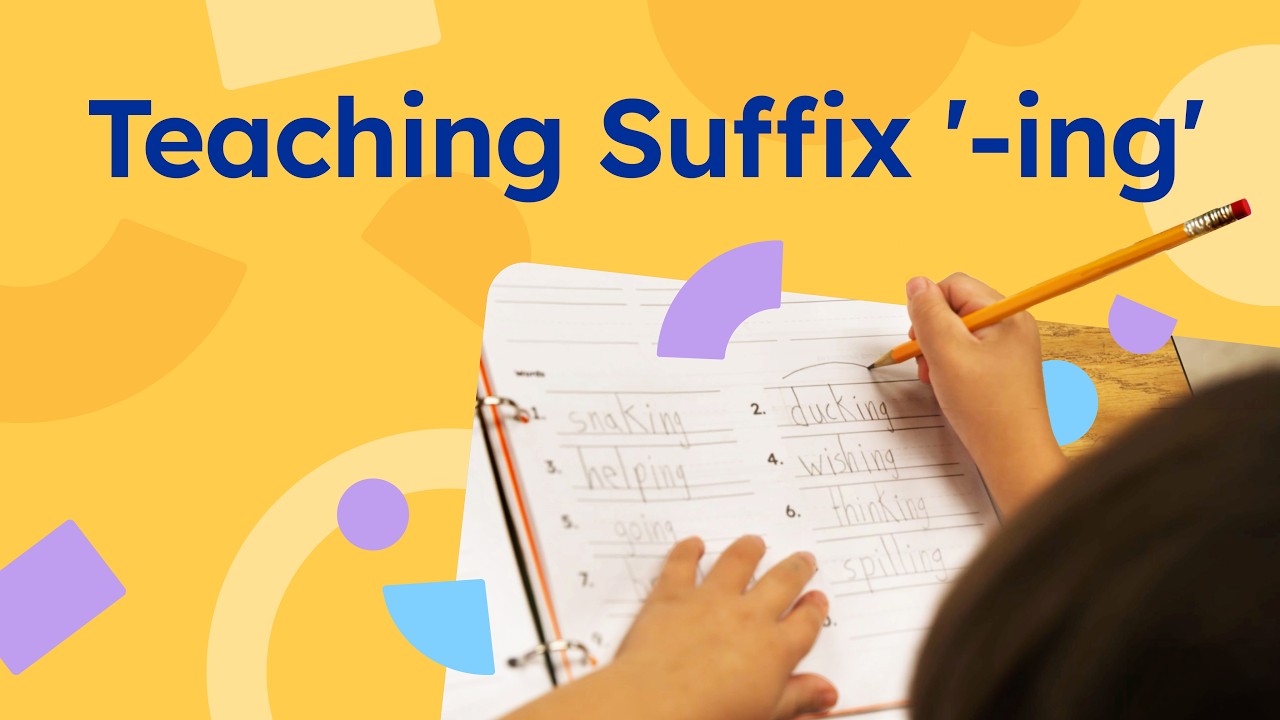
Students: Duck. Ducking.
Carla Miller: Good.
Students: Snack. Snacking.
Carla Miller: Good job.
Students: Splash. Splashing.
Narrator: Next up is word dictation, where they'll be spelling and writing their suffix '-ing' words.
Carla Miller: First word. The word is snacking. What word?
Students: Snacking.
Carla Miller: Base word?
Students: Snack.
Carla Miller: I want you to write snacking.
Narrator: Notice how Dr. Miller follows each '-ing' word with its base word. This helps students to spell the base word correctly before adding the suffix.
Carla Miller: Jude, can you spell snacking for me?
Jude: S-N-A-C-K-I-N-G. Snacking.
Carla Miller: Jude, when is this happening?
Jude: Now.
Carla Miller: It's happening right now. Good. If I'm snacking, I'm doing it right now. Okay. Next word. The word is wishing. What word?
Students: Wishing.
Carla Miller: Base word?
Students: Wish.
Carla Miller: Write "wishing." Can everybody spell wishing for me?
Students: W-I-S-H-I-N-G. Wishing.
Carla Miller: Excellent. Excellent. When is this happening? When am I wishing?
Students: Right now.
Carla Miller: Right now I'm wishing. Good job. Good job. Make sure your paper looks like my board.
Narrator: After students have worked through the full list of words, Dr. Miller asked them to read what they wrote.
Carla Miller: Okay, let's go ahead and read back our words.
Narrator: This gives students a chance to check their work against the board, and reinforces the sound spelling connection.
Carla Miller: First word.
Students: Snacking.
Carla Miller: Good.
Students: Ducking.
Carla Miller: Good.
Students: Helping.
Carla Miller: Excellent.
Students: Wishing.
Narrator: Now it's time to discuss meaning.
Carla Miller: I want you to look at these words. I want you to circle the word that means to cover for safety. You're going to cover your head for safety. Circle that word. What am I doing? Arla, what word did you circle?
Arla: Ducking.
Carla Miller: Ducking. Good. Can you say that one more time for me?
Students: Ducking.
Carla Miller: Ducking. Can you say ducking?
Arla: Ducking.
Carla Miller: If I'm ducking for cover, I'm going to cover my head for safety, right? If there was a ball coming at my head, I might have to duck. So if I'm doing it right now, the word is what?
Students: Ducking!
Carla Miller: Ducking. Ducking. I should have circled ducking.
Student: Not this duck. Quack, quack, quack.
Carla Miller: And not that duck. Good, good, good. Okay. One more word that I want you to think about. Okay. I want you to underline the word that means you're doing something to make a job easier. You're doing something ... you might do it for someone to make their job easier. Think about that for a second. Think about that for a second. Azaya, what word did you underline?
Azaya: Helping.
Carla Miller: Helping.
Narrator: All of these words were chosen intentionally. Dr. Miller chose "helping" to show that some words can have multiple meanings.
Carla Miller: Friends, can I tell you something about the word helping? There is another definition for helping. So as I underline that word, because we know that if I'm helping somebody, I might be making their job easier, right?
Student: Yeah.
Carla Miller: But I could also use the word helping in a different way. Last week during Thanksgiving, last week, I asked for an extra helping of turkey. I wanted an extra helping of turkey. Who can tell me what do you think helping means if I wanted an extra helping of turkey? Aurora?
Aurora: You wanted another piece?
Carla Miller: I wanted another piece. Exactly. I wanted another serving. So helping could mean making something easier for somebody or helping could mean I want another serving. When I like something and it's super yummy, I want another helping.
Narrator: Next, during the fluency section of the lesson, Dr. Miller takes the opportunity to weave in some elements of grammar. They'll be talking about who or what each sentence is about. This helps students build the skills they'll need to understand more complex sentences later.
Carla Miller: We're going to look at some sentences that have suffix '-ing' in them. Eyes on the board. Let's go ahead and read.
Together: "The kid is snacking."
Carla Miller: Very good. Next sentence.
Students: "I am snacking."
Carla Miller: Good job. Eyes on the board, please. Next sentence.
Together: "The kids are snacking."
Carla Miller: Okay, so we have learned that every single sentence has a who or what, and it has a does what, right? All of my sentences have two parts. I have a who or what and a does what. What do all of these sentences have in common? I'm going to call on my friend over here, Monroe. What do they all have in common?
Monroe: They all have the word snacking.
Carla Miller: They all have the word snacking. Thumbs up if you see that. Thumbs up if you see that they all have snacking. Very good.
Narrator: By keeping the action, the did what, consistent for each sentence, Dr. Miller is able to focus students' attention on the subject. The who or the what each sentence is about.
Carla Miller: We know snacking is our does what? That's what's happening in the sentence. I want everybody to tell me, who is this sentence about?
Students: The kid.
Carla Miller: The kid. Good. The next sentence. I am snacking. Who is this sentence about? I. Very good. Thank you to all my friends that I can hear. I want to hear everybody. The last one, let's see who can get this one. The last sentence is the kids are snacking. Who is this sentence about? So good. The kids, you got it.
Narrator: Now Dr. Miller points out something special in sentences that have a suffix '-ing' action. The helping verb.
Carla Miller: I want everybody to notice there's a little, small little word in each sentence right before snacking. Does everybody ... Touch your nose if you see that word. Touch your nose. It's a little word here right before snacking. That word is helping out the verb, which the does what is our verb, right? Snacking is our verb. That word is helping out our verb. That little word is called a helping verb. Everybody say helping verb.
Students: "Helping verb."
Carla Miller: These ... snacking needs a little help to show that it is an action. Okay? So in this sentence, the word is is our helping verb. So when we see "is snacking," that is our does what. That's what's happening in the sentence. That's what we're doing in the sentence.
Narrator: On top of the steps that anchor every phonics lesson — the listening game, warming up with flashcards, word dictation and fluency — Dr. Miller also worked in word meaning, words with multiple meanings, sentence structure, and the helping verb.
Carla Miller: You guys did such a great job. I think we deserve an "oh yeah!" What do you think?
Students: Yeah!
Carla Miller: One, two, three.
Students: Oh yeah!
Carla Miller: Oh yeah! Good job guys.
Narrator: Reading Universe is made possible by generous support from Jim and Donna Barksdale; the Hastings/Quillin Fund, an advised fund of the Silicon Valley Community Foundation; the AFT; the Emily Hall Tremaine Foundation; and anonymous donors. Special thanks to Burgess-Peterson Academy, Reading Is Essential for All People, and Atlanta Public Schools. If you enjoyed this video, please subscribe to our YouTube channel @RUTeaching. Reading Universe is a service of WETA Washington D.C., the Barksdale Reading Institute, and First Book.
Carla Miller: I'm Dr. Carla Miller and this is Reading Universe.
The Suffix '-ing' and Helping Verbs

Hide Video Transcript
Show Video Transcript
Carla Miller: So I want to talk to you about our suffix '-ing'. We've learned that suffix '-ing' means what?
Student: Happening right now.
Carla Miller: Happening right now. Happening now. Good. We're going to look at some sentences that have suffix '-ing' in them.
Narrator: At Burgess-Peterson Academy in Atlanta, Georgia, teacher Carla Miller is leading her first graders through a lesson on the suffix '-ing'.
Together: "The kid is snacking."
Narrator: This little suffix often gets tacked onto action verbs to show that something is happening right now. But the action verbs usually need a partner, a helping verb, like the words is, am, and are.
Together: "The kids are snacking."
Narrator: Dr. Miller begins by reviewing simple sentence structure.
Carla Miller: Okay. So we have learned that every single sentence has a who or what and a does what, right? All of my sentences have two parts. I have a who or what and a does what. So look at the sentence, "The kid is snacking." We know snacking is our does what? That's what's happening in the sentence. I want everybody to tell me, who is this sentence about?
Students: The kid.
Carla Miller: The kid. Good. The next sentence, "I am snacking." Who is this sentence about?
Students: I.
Carla Miller: I. Very good. Thank you to all my friends that I can hear. I want to hear everybody. The last one. Let's see, you can get this one. The last sentence is, "The kids are snacking." Who is this sentence about?
Students: The kids!
Carla Miller: So good. The kids. You got it. We know the who in the sentence is the kid. We know what they're doing is snacking. I want everybody to notice there's a little, small little word in each sentence right before snacking. Does everybody ... Touch your nose if you see that word. Touch your nose. That word is helping out the verb, which the does what is our verb, right? Snacking is our verb. That word is helping out our verb. That little word is called a "helping verb." Everybody say "helping verb."
Students: "Helping verb."
Carla Miller: Snacking needs a little help to show that it is an action. Okay. In this sentence the word is our helping verb. So when we see "is snacking," that is our does what? That's what's happening in the sentence. That's what we're doing in the sentence. What's our base word everybody?
Students: Sing!
Carla Miller: Sing. What word do we have now?
Students: Singing!
Carla Miller: Singing. Okay. We are going to build a simple sentence. Our simple sentence needs a who and a does what, right? So we have singing. Now it needs a who. What's our who?
Students: Steve.
Carla Miller: Steve. What I need to do is I need that helping verb. Let's see. Let's read it together.
Together: "Steve is singing."
Carla Miller: What is our who in the sentence?
Students: Steve.
Carla Miller: And what is he doing?
Students: Singing!
Carla Miller: He is singing. Good. Is my sentence complete?
Students: No.
Carla Miller: Who can raise your hand and tell me what does my sentence need? Leo, what does it need?
Leo: It needs a period.
Carla Miller: It sure does. It needs a period. Now let's read this sentence together, everybody.
Together: "Steve is singing."
Carla Miller: I've got my who. I've got my ... does what. And then I have my what? Helping verb. Let's try another one. Okay. Base word. What is it everybody?
Students: Wish.
Carla Miller: Wish. What word do we have now?
Students: Wishing.
Carla Miller: What is it?
Students: Wishing!
Carla Miller: Wishing. This is my does what. This is what we're doing in the sentence. It's happening now. This is my action. This is who the sentence is about. Who is the sentence about? Who is the sentence about?
Students: I. I have to have a helping verb to help out this sentence. So now let's read together.
Together: "I am wishing."
Carla Miller: Good. Who can tell me who is the sentence about? Carson, say it.
Carson: I.
Carla Miller: Good. What am I doing everybody?
Students: Wishing.
Carla Miller: I am wishing. Good job. Good job. And we need a ...
Students: Period.
Carla Miller: Period. Today you guys did such an amazing job today. We learned how to take our words with suffix '-ing' and add a helping verb with them to make the do what of our sentence. You guys did such a great job. I think we deserve an "oh yeah!" What do you think? One, two, three.
Students: "Oh yeah!"
Carla Miller: Oh yeah! Good job guys.
Narrator: Reading Universe is made possible by generous support from Jim and Donna Barksdale; the Hastings/Quillin Fund, an advised fund of the Silicon Valley Community Foundation; the AFT; the Emily Hall Tremaine Foundation; and anonymous donors. Special thanks to Burgess-Peterson Academy, Reading Is Essential for All People, and Atlanta Public Schools. If you enjoyed this video, please subscribe to our YouTube channel @RUTeaching. Reading Universe is a service of WETA Washington D.C., the Barksdale Reading Institute, and First Book.
Carla Miller: I'm Dr. Carla Miller and this is Reading Universe.
Quick Look: Teaching Grammar Inside a Phonics Lesson
Hide Video Transcript
Show Video Transcript
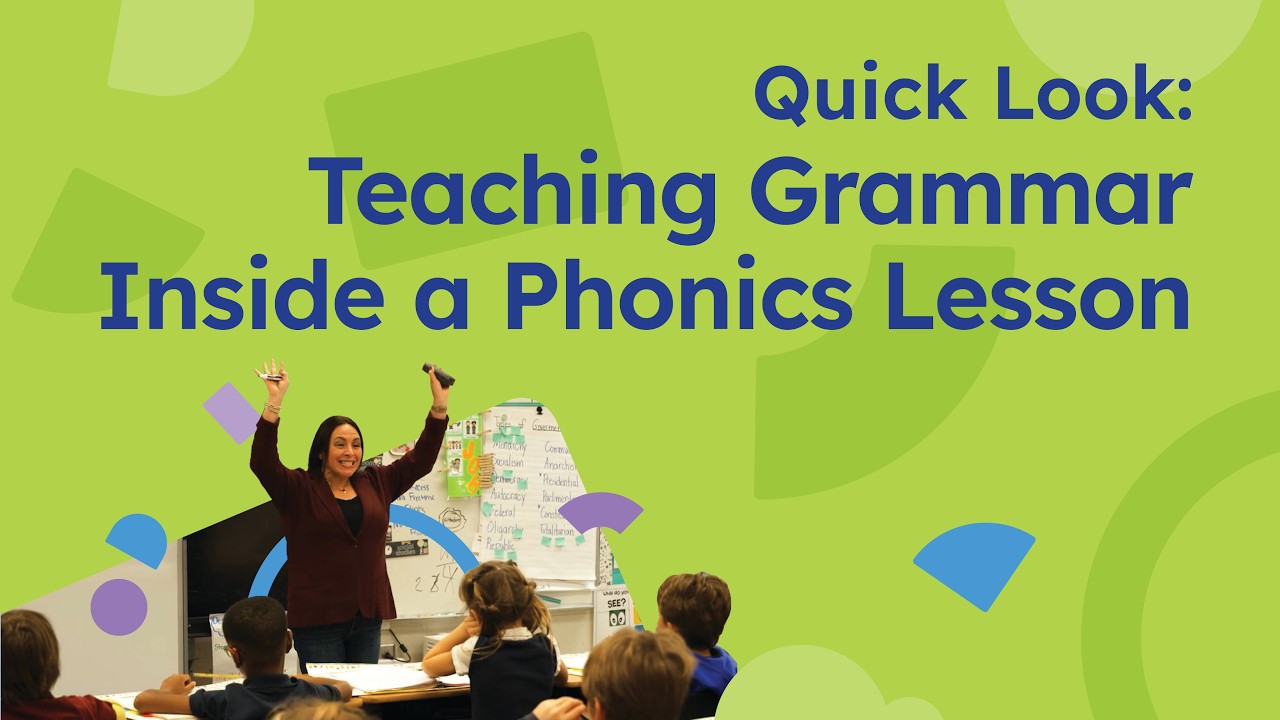
Lisa Glickman: After we do the words, we're going to think about is the word a who or a what? Right. Is it a noun? Does it tell us who or what? Or is it something that you can do? Is it a did what? Is it a verb? An action? Okay. Are you ready? The word is hoist. What's the word?
Students: Hoist.
Lisa Glickman: Hoist. Everybody say, "To hoist is to lift."
Students: "To hoist is to lift."
Lisa Glickman: So if I was saying, "I need to lift this heavy box," I could also say, "I need to hoist this heavy box." Hoist is to lift. So is that a who or a what? Or is hoist something that you could do, a did what? What do you think?
Students: [overlapping voices] Did what.
Lisa Glickman: Did what? Good job. Your next word is boy. What's the word?
Students: Boy.
Lisa Glickman: Is boy a who or a what? Or a did what? Everybody on three. Let's see. Who or what or did what? [counts silently by holding up her fingers]
Students: Who.
Lisa Glickman: It's a who. It's telling us who. Good. Are you ready for your last word?
Students: Yes.
Lisa Glickman: The word is point. What's the word?
Students: Point.
Lisa Glickman: Is point a who or a what? Or a did what? Everybody think. What do you think?
Students: Did what.
Lisa Glickman: Okay. Can I point at something? Is that something I can do?
Students: Yes.
Lisa Glickman: It is a did what, but guess what? May I borrow this? What is this?
Students: A point!
Lisa Glickman: It's a point of a pencil. So guess what? The word point can be a what. And it can be ... and it could be a did what. You're right.
Multiple Meaning Words in a '-dge' Lesson

Hide Video Transcript
Show Video Transcript
Marlene Gannaway: The word is lodge. What's the word?
Students: Lodge.
Marlene Gannaway: Stop. Think. Tap. /l/, /ŏ/, /j/.
Carla Stanford: Write it.
Narrator: Exploring words with multiple meanings helps students build a deeper vocabulary and teaches them the flexibility to understand language in many contexts. At Burgess-Peterson Academy in Atlanta, this exploration can happen at any time, even during a phonics lesson. Today, second grade teacher Marlene Gannaway and reading coach Carla Stanford, are focused on the '-dge' spelling pattern. So they'll take time during dictation to introduce words like judge and lodge.
Carla Stanford: Everyone say lodge.
Students: Lodge.
Carla Stanford: Say it again. Say lodge.
Students: Lodge.
Carla Stanford: Okay, I'm going to give you a sentence and you repeat. "The beaver built a lodge on the river." Repeat
Students: The beaver built a lodge on the river.
Carla Stanford: Thumbs up if you've ever heard of that meaning of lodge. Do you guys know about beavers?
Students: Yes.
Carla Stanford: Do you know they build little homes?
Students: Yes.
Carla Stanford: We call them a lodge. Say, "A beaver builds a lodge."
Students: A beaver builds lodge.
Carla Stanford: My goodness. Wait a minute. Have you ever been, like, to the mountains and there's a little cabin. And we don't stay there all the time. We might just visit on a vacation or something and we might call it a mountain ...
Students: Lodge.
Carla Stanford: Say it again. Mountain...
Students: ... lodge.
Carla Stanford: Oh my goodness. So we might think about the word lodge when we think about a mountain ...
Students: ... lodge.
Carla Stanford: Okay, I have another one. What if I was in a hurry and I jammed all of my things inside of my desk and I was like, oh my goodness. Ms. Gannaway asked me to get out my binder and I can't. It is lodged ...
Students: ... lodged in there.
Carla Stanford: Oh my goodness. What does that lodge mean?
Students: It means stuck.
Carla Stanford: What does it mean?
Students: Stuck!
Carla Stanford: Stuck. You guys, that is amazing. You were word detectives. You took this one word and now we know three meanings. Everyone say, "A beaver's lodge."
Students: A beaver's lodge.
Carla Stanford: Say, "my notebook is lodged."
Students: My notebook is lodged.
Carla Stanford: Say "a mountain lodge."
Students: A mountain lodge.
Carla Stanford: A beaver lodge. A place.
Students: Yeah.
Carla Stanford: Right? A mountain lodge.
Students: A place.
Carla Stanford: But if I lodge something ...
Student: Stuck.
Carla Stanford: It's something that I do. Oh my goodness.
Student: A verb.
Carla Stanford: It's a verb! Lodge can be like a noun — a person, place, thing, or idea. But lodge can also be a verb. "I lodged the notebook in." So now we are going to be word detectives. You already know how to read these words, but now we have to make sure we can think about what they mean and how we use them. I'm going to show you the word. We're going to read it. We're going to talk about is it a namer or is it an action, or could it be both? Are y'all ready? What's our word? Everyone read it?
Students: Judge.
Carla Stanford: Turn and talk with your seat partners. Talk about the meaning and talk about is it a namer or an action or both?
Student: Somebody is judging someone off what they do, I guess.
Carla Stanford: I'm hearing all these amazing things. I heard some amazing work all around. I'm going to have Amy share her thinking. What do you think about the word judge? Can it be a namer? Can it be an actioner? Can it be both? And explain your thinking.
Amy: It can be both because it can be a person that's a judge.
Carla Stanford: Wait a minute. Wait. Do you guys agree? Can it be a person that's a judge?
Students: Yes.
Carla Stanford: Oh my goodness. Okay. All right. We're all on the same page. Keep going.
Amy: Or it could be someone is judging another person.
Carla Stanford: Wait, if you're judging someone, is it something you're doing?
Students: Yes.
Carla Stanford: Do you guys agree it's something you're doing?
Students: Yes.
Carla Stanford: Say, "I'm judging the food on how good it is." Say that.
Students: I'm judging the food on good it is.
Carla Stanford: So if I was like the judge, the person, in a cooking contest, then I would actually do the action, right? Of judging. Can you guys give her a high five?
Carla Stanford: And pat yourselves on the back. So what is this?
Students: A bridge.
Carla Stanford: What is it?
Students: A bridge!
Carla Stanford: Yeah. So this thing right here?
Students: Barge!
Carla Stanford: A barge! And how would you describe the barge? Is it large or small?
Students: Large.
Carla Stanford: Okay. So it is a large ...
Students: ... barge.
Carla Stanford: Say that again.
Students: Large barge.
Carla Stanford: So the large barge. Oh my goodness. So it is — to me — it looks like the large barge is trying to get under the ...
Students: ... bridge.
Carla Stanford: Oh my goodness. But it looks to me like ...
Student: It is stuck.
Carla Stanford: It got stuck. Oh, what is that word?
Student: Lodge.
Carla Stanford: It got what? It got ...
Student: ... lodged! But why did it get lodged? I think that maybe the captain of the barge misjudged. Everyone say ...
Everyone: Misjudged.
Carla Stanford: So do you guys know mis? What does mis mean?
Students: Not.
Carla Stanford: Bad or wrong, right?
Student: Mispelled.
Carla Stanford: Like mispelled means I spelled it ...
Students: ... wrong!
Carla Stanford: So if I misjudged it, I judged it ...
Students: ... wrong!
Carla Stanford: So the large barge, right? He's trying to go under the bridge, but the captain must have misjudged. And so now the barge is ...
Students: ... lodged!
Narrator: Notice how many times the students have repeated the words and used them in context. This helps them store these words in their long-term memory and prepares them for the next step in their lesson — sentence dictation.
Carla Stanford: I'm going to give you a sentence for dictation. You are ready for it.
Narrator: Reading Universe is made possible by generous support from Jim and Donna Barksdale, the Hastings/Quillin Fund, an advised fund of the Silicon Valley Community Foundation, the AFT, the Emily Hall Tremaine Foundation, and anonymous donors. Special thanks to Burgess Peterson Academy and Atlanta Public Schools. If you enjoyed this video, please subscribe to our YouTube channel @RUteaching. Reading Universe is a service of WETA, Washington D.C., the Barksdale Reading Institute, and First Book.
Quick Look: Unpacking a Sentence with Function Questions
Hide Video Transcript
Show Video Transcript
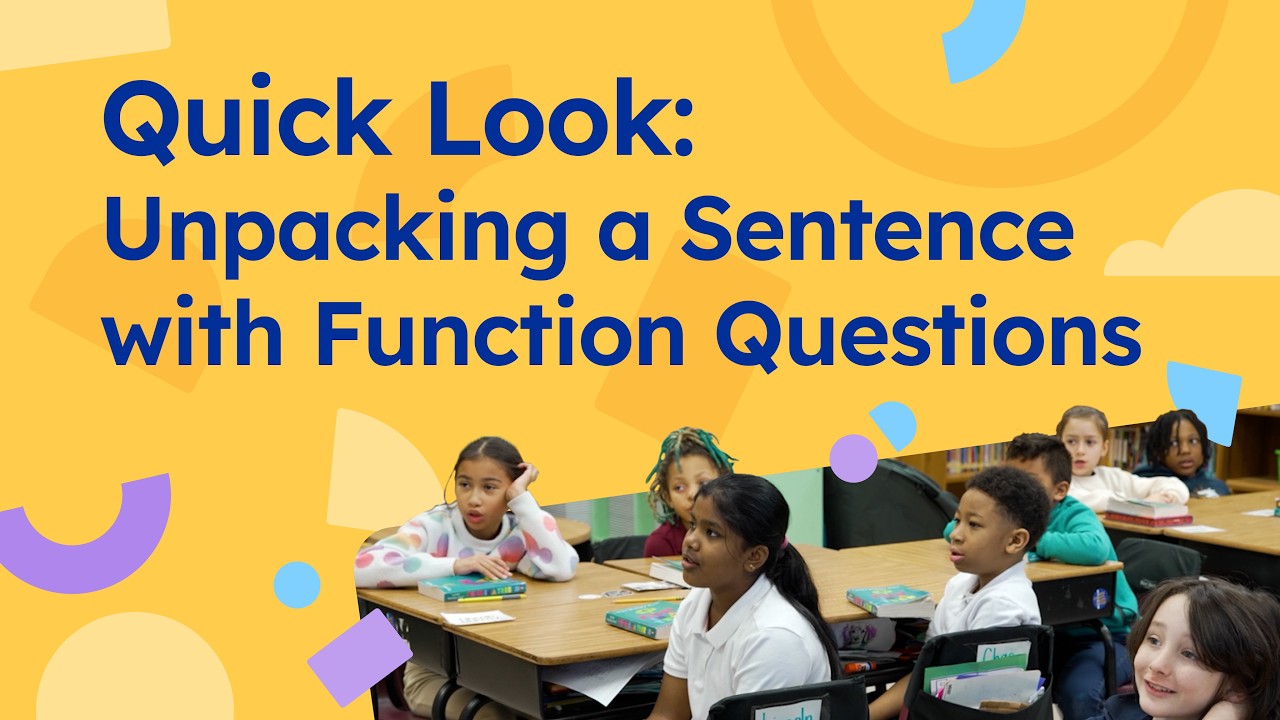
Together: "Butterflies shed scales on their wings regularly."
Ashlea Edwards: So our first question is going to be who or what is this sentence about?
Students: Butterflies.
Ashlea Edwards: Butterflies. Very good. And what are the butterflies doing? The butterflies did what?
Students: Shed scales.
Ashlea Edwards: Shed scales. Very good. Where did they shed those scales?
Students: On their wings.
Ashlea Edwards: On their wings. And then I'm even going to ask another question this time. When did they do this?
Students: Regularly.
Ashlea Edwards: Regularly! And everyone say, "regularly means often."
Students: "Regularly means often."
Ashlea Edwards: Good.
Using Function Questions to Write Expanded Sentences

Hide Video Transcript
Show Video Transcript
Ashlea Edwards: Hey guys, how are you?
Students: Good.
Narrator: Today, reading specialist Ashlea Edwards is leading third graders at Burgess-Peterson Academy in Atlanta through a lesson on sentence expansion. This is the process of taking a simple sentence and adding details to make it richer and more complex.
Ashlea Edwards: What we're going to do next is we're going to be writers ourselves. And writers have to ask themselves these function questions in order to add details to their sentences.
Narrator: To prepare to write, they read. The students have been reading the book "Fish in a Tree" as a class, so it's a great source for writing material. All students are familiar with the content, and they'll get to experience how writing can help them better understand a passage.
Ashlea Edwards: Read these sentences together. Are you ready? Go.
All: "'You say purple is the color of royals,' he says. 'They only wore purple because it was the most difficult and expensive color to make.'"
Ashlea Edwards: Let's keep going.
All: "'In medieval times, they needed to collect three thousand Murex brandaris snails to have enough slime to make one cloak.'"
Narrator: Ms. Edwards uses this text to create a simple sentence — a sentence with just a subject and an action — from the passage they're reading.
Ashlea Edwards: So our simple sentence is going to be, "Cloaks were worn."
Narrator: To expand on the simple sentence "Cloaks were worn," Ms. Edwards asks what she calls function questions. These are simple questions like "When?", "Where?", "Why?", or "How?" that function as tools to dig up more detail to build the simple sentence up.
Ashlea Edwards: So thinking about that text and the cloaks that were worn, what kind of cloaks were worn?
Students: Purple.
Ashlea Edwards: Purple coats, yes. Okay. So who wore purple coats?
Students: Royals.
Ashlea Edwards: Royals. Or royalty, we could say.
Narrator: Working from a passage the students have in front of them is important. All the answers to the function questions are right there in the text, waiting to be found.
Ashlea Edwards: Okay. Purple cloaks were worn by royalty when?
Students: In medieval times.
Ashlea Edwards: Yeah. What was it?
Student: Medieval times.
Ashlea Edwards: In medieval times, very good.
Narrator: Once the function questions are answered, the next step is to take those details and build a new, more complex sentence.
Ashlea Edwards: Okay. So now we have answered all of these questions about the cloaks being worn, but can I just say: "Cloaks were worn purple royalty, medieval times, so expensive snail snot 3000 snails?" I can't just say it like that. So now we have to figure out how to put this sentence together. So our simple sentence is "Cloaks were worn." And the first thing that I think we should start our sentence with is "When?" So when were purple cloaks worn?
Students: In medieval times.
Ashlea Edwards: In medieval times. And then we need to take our simple sentence and include it. So should we say "cloaks were worn" or can we be more specific?
Students: Purple cloaks.
Ashlea Edwards: Purple cloaks. And now we're going to have to decide ... how are we going to describe these purple cloaks? As being so expensive? As it taking 3000 snails?
Narrator: The goal isn't to stuff every detail into one sentence. It's to build a sentence that's more complex and still makes sense.
Ashlea Edwards: By who?
Students: Royalty. Royals.
Ashlea Edwards: Because ...?
Student: Because they're so expensive to make.
Ashlea Edwards: Okay. Let's see if this makes sense. Y'all want to read it with me? All eyes up here and let's read it.
All: "In medieval times, purple cloaks were worn by royalty, because they are hard to make."
Ashlea Edwards: Or I heard some of you say they're expensive to make. I like that.
Narrator: Now students get to practice their new skills and expand sentences using function questions on their own. They'll start by reading a new passage from the book.
Ashlea Edwards: "'So, good for you. I'd prefer beige.' He turns to me. 'What about you, Ally? Slime or beige?'"
Okay, so the sentence that you're going to work on, and I'm going to give you a piece of paper, is "Albert smiles." I want you to take the sentence "Albert smiles" and I want you to expand it to show why he's smiling, how he's feeling. And there's not one right answer. You might have a different idea than Lincoln has, or Chase has, and that's okay. All of our sentences can be different because we're going to choose different words and we're going to choose different ways to describe it.
Narrator: Because sentence expansion lives at the intersection of writing and comprehension, this practice strengthens both skills at once.
Ashlea Edwards: Okay. I heard so many great ideas as I was walking around. So when he asked her, "slime or beige," that made him smile. Why did that make him smile? Think about it. Why did that make him smile? Kingston had a really good answer that I'm going to ask him to share.
Kingston: He thought he was clever.
Ashlea Edwards: Yes, Kingston, very good.
Narrator: For the last step in today's lesson, Ms. Edwards models how to take the details students found and shape them into a complete complex sentence.
Ashlea Edwards: Okay, so let's try to put this together in an expanded sentence and we'll just say it. Everyone say, "Albert smiles."
Students: "Albert smiles ..."
Ashlea Edwards: when he asks Shay the questions ..."
Students: "when he asks Shay the questions ..."
Ashlea Edwards: "because he was clever. .."
Students: "because he was clever ..."
Ashlea Edwards: "and outsmarted her."
Students: "and outsmarted her."
Ashlea Edwards: Very good friends.
Narrator: Each time these third graders ask themselves "When?", "Where?", "Why?", and "How?" about a text, they're deepening their comprehension, and now they have the tools to turn that understanding into more complex writing.
Ashlea Edwards: Y'all have done such amazing work. Thank you so, so much. Kiss your brains, pat your friend on the back.
Narrator: Reading Universe is made possible by generous support from Jim and Donna Barksdale; the Hastings/Quillin Fund, an advised fund of the Silicon Valley Community Foundation; the AFT; the Emily Hall Tremaine Foundation; and anonymous donors. Special thanks to Burgess-Peterson Academy, Reading is Essential for All People, and Atlanta Public Schools. If you enjoyed this video, please subscribe to our YouTube channel, @RUTeaching. Reading Universe is a service of WETA, Washington, D.C., the Barksdale Reading Institute, and First Book.
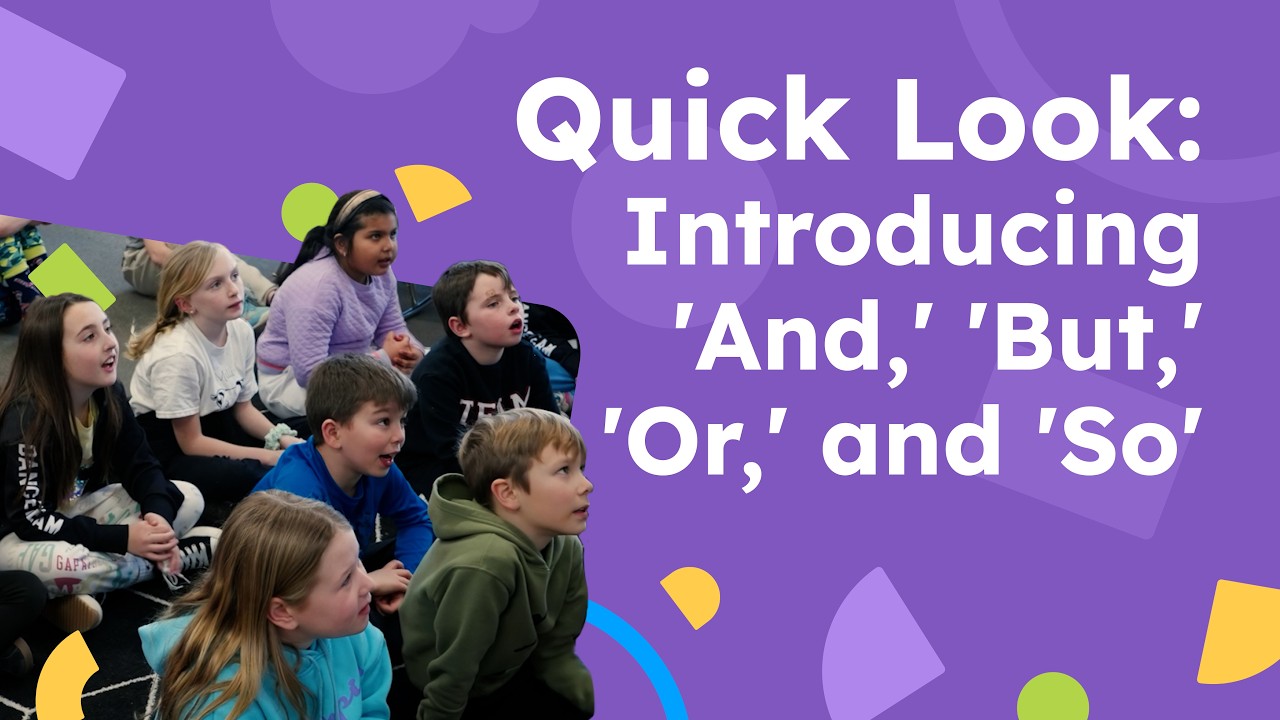
Quick Look: Introducing And, But, Or, and So
Hide Video Transcript
Show Video Transcript
Heather Adams: Are you ready? All right, we're going to start by just going over these four important words. Let's read them out loud together. What's our first conjunction?
Together: And.
Heather Adams: We put related ideas together. What's our second conjunction?
Students: But.
Heather Adams: But. This is when we have two contrasting ideas, things that are different than each other. What about this third one?
Students: Or.
Heather Adams: Or. I remember last time Molly said, "chicken patty or salad." We use this for choices or options. And then finally, what's this last one?
Students: So.
Heather Adams: So. I think so might be my favorite because so shows cause and ...
Together: effect.
Heather Adams: This happens, so this happens. Exactly.
