2. When to Teach Grammatical Building Blocks
Grammatical Building Blocks Skill Explainer
Nancy Chapel EberhardtWhen should I introduce grammatical building blocks to my students?

This skill explainer will focus on how to explicitly introduce your students to each of the eight grammatical building blocks: nouns, verbs, adverbs, adjectives, prepositions, pronouns, conjunctions, and interjections. Depending on the building block, your explicit introduction will happen some time during the early elementary grades (more detail to come below), as you help students understand the role words play in sentences.
Of course, even with kindergartners you'll be using these word forms regularly in oral language and in print, and you'll start to draw their attention to them as you teach read-alouds and other content. That kind of daily embedded grammar exposure is all leading up to explicit instruction in each building block.
Prerequisite Skills
Grade Level: A Systematic and Cumulative Approach
What if my school's grammar scope and sequence is different?
Your scope and sequence may differ from what we've provided here, and many curricula introduce or emphasize certain grammatical elements at different grade levels. The guidance we've provided is intended as a suggested progression for introducing grammatical concepts, not a rigid sequence. Regardless of when you first introduce a concept, effective grammar instruction builds upon itself: students revisit, apply, and deepen their understanding of each grammatical element year after year.
Nouns and Verbs: Introduce in kindergarten and refresh with every new grammatical building block
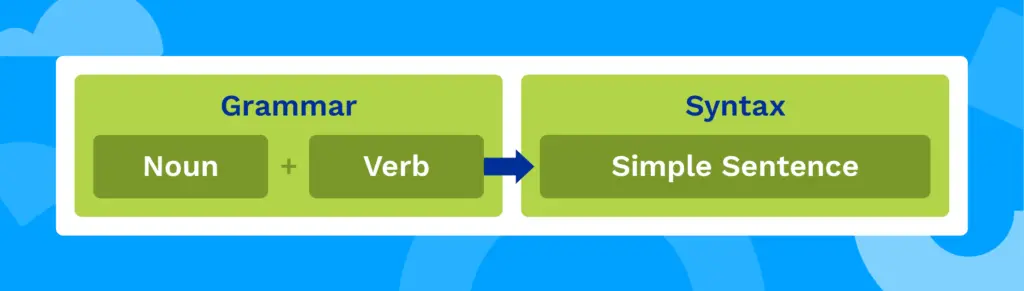
You'll typically begin your grammar instruction in kindergarten with nouns and verbs, because they form the foundation of every complete sentence. Regardless of what grade you teach, before you teach any other grammatical building block, you'll want to be sure your students are comfortable with nouns and verbs.
Adverbs: Introduce in first grade and add complexity in second and third
Adverbs are a building block we teach beginning in first grade after your students master basic verbs (since adverbs add information about verbs). You'll most likely only teach adverbs that end in suffix '-ly' … like quickly or softly, adverbs that tell how an action is done. In later grades, you'll bring in the other functions of adverbs, describing when (late), where (on the floor), or why (to win a prize) an action occurs.
Adjectives: Introduce in first grade
In first grade, students are ready to learn adjectives, which add information about nouns. Adjectives help students create more precise and descriptive sentences by answering questions such as "Which one?" (the first one), "What kind?" (striped), and "How many?" (fourteen).
Grammar, Comprehension, and Writing
Watch It in Action

Hide Video Transcript
Show Video Transcript
Marlene Gannaway: The word is lodge. What's the word?
Students: Lodge.
Marlene Gannaway: Stop. Think. Tap. /l/, /ŏ/, /j/.
Carla Stanford: Write it.
Narrator: Exploring words with multiple meanings helps students build a deeper vocabulary and teaches them the flexibility to understand language in many contexts. At Burgess-Peterson Academy in Atlanta, this exploration can happen at any time, even during a phonics lesson. Today, second grade teacher Marlene Gannaway and reading coach Carla Stanford, are focused on the '-dge' spelling pattern. So they'll take time during dictation to introduce words like judge and lodge.
Carla Stanford: Everyone say lodge.
Students: Lodge.
Carla Stanford: Say it again. Say lodge.
Students: Lodge.
Carla Stanford: Okay, I'm going to give you a sentence and you repeat. "The beaver built a lodge on the river." Repeat
Students: The beaver built a lodge on the river.
Carla Stanford: Thumbs up if you've ever heard of that meaning of lodge. Do you guys know about beavers?
Students: Yes.
Carla Stanford: Do you know they build little homes?
Students: Yes.
Carla Stanford: We call them a lodge. Say, "A beaver builds a lodge."
Students: A beaver builds lodge.
Carla Stanford: My goodness. Wait a minute. Have you ever been, like, to the mountains and there's a little cabin. And we don't stay there all the time. We might just visit on a vacation or something and we might call it a mountain ...
Students: Lodge.
Carla Stanford: Say it again. Mountain...
Students: ... lodge.
Carla Stanford: Oh my goodness. So we might think about the word lodge when we think about a mountain ...
Students: ... lodge.
Carla Stanford: Okay, I have another one. What if I was in a hurry and I jammed all of my things inside of my desk and I was like, oh my goodness. Ms. Gannaway asked me to get out my binder and I can't. It is lodged ...
Students: ... lodged in there.
Carla Stanford: Oh my goodness. What does that lodge mean?
Students: It means stuck.
Carla Stanford: What does it mean?
Students: Stuck!
Carla Stanford: Stuck. You guys, that is amazing. You were word detectives. You took this one word and now we know three meanings. Everyone say, "A beaver's lodge."
Students: A beaver's lodge.
Carla Stanford: Say, "my notebook is lodged."
Students: My notebook is lodged.
Carla Stanford: Say "a mountain lodge."
Students: A mountain lodge.
Carla Stanford: A beaver lodge. A place.
Students: Yeah.
Carla Stanford: Right? A mountain lodge.
Students: A place.
Carla Stanford: But if I lodge something ...
Student: Stuck.
Carla Stanford: It's something that I do. Oh my goodness.
Student: A verb.
Carla Stanford: It's a verb! Lodge can be like a noun — a person, place, thing, or idea. But lodge can also be a verb. "I lodged the notebook in." So now we are going to be word detectives. You already know how to read these words, but now we have to make sure we can think about what they mean and how we use them. I'm going to show you the word. We're going to read it. We're going to talk about is it a namer or is it an action, or could it be both? Are y'all ready? What's our word? Everyone read it?
Students: Judge.
Carla Stanford: Turn and talk with your seat partners. Talk about the meaning and talk about is it a namer or an action or both?
Student: Somebody is judging someone off what they do, I guess.
Carla Stanford: I'm hearing all these amazing things. I heard some amazing work all around. I'm going to have Amy share her thinking. What do you think about the word judge? Can it be a namer? Can it be an actioner? Can it be both? And explain your thinking.
Amy: It can be both because it can be a person that's a judge.
Carla Stanford: Wait a minute. Wait. Do you guys agree? Can it be a person that's a judge?
Students: Yes.
Carla Stanford: Oh my goodness. Okay. All right. We're all on the same page. Keep going.
Amy: Or it could be someone is judging another person.
Carla Stanford: Wait, if you're judging someone, is it something you're doing?
Students: Yes.
Carla Stanford: Do you guys agree it's something you're doing?
Students: Yes.
Carla Stanford: Say, "I'm judging the food on how good it is." Say that.
Students: I'm judging the food on good it is.
Carla Stanford: So if I was like the judge, the person, in a cooking contest, then I would actually do the action, right? Of judging. Can you guys give her a high five?
Carla Stanford: And pat yourselves on the back. So what is this?
Students: A bridge.
Carla Stanford: What is it?
Students: A bridge!
Carla Stanford: Yeah. So this thing right here?
Students: Barge!
Carla Stanford: A barge! And how would you describe the barge? Is it large or small?
Students: Large.
Carla Stanford: Okay. So it is a large ...
Students: ... barge.
Carla Stanford: Say that again.
Students: Large barge.
Carla Stanford: So the large barge. Oh my goodness. So it is — to me — it looks like the large barge is trying to get under the ...
Students: ... bridge.
Carla Stanford: Oh my goodness. But it looks to me like ...
Student: It is stuck.
Carla Stanford: It got stuck. Oh, what is that word?
Student: Lodge.
Carla Stanford: It got what? It got ...
Student: ... lodged! But why did it get lodged? I think that maybe the captain of the barge misjudged. Everyone say ...
Everyone: Misjudged.
Carla Stanford: So do you guys know mis? What does mis mean?
Students: Not.
Carla Stanford: Bad or wrong, right?
Student: Mispelled.
Carla Stanford: Like mispelled means I spelled it ...
Students: ... wrong!
Carla Stanford: So if I misjudged it, I judged it ...
Students: ... wrong!
Carla Stanford: So the large barge, right? He's trying to go under the bridge, but the captain must have misjudged. And so now the barge is ...
Students: ... lodged!
Narrator: Notice how many times the students have repeated the words and used them in context. This helps them store these words in their long-term memory and prepares them for the next step in their lesson — sentence dictation.
Carla Stanford: I'm going to give you a sentence for dictation. You are ready for it.
Narrator: Reading Universe is made possible by generous support from Jim and Donna Barksdale, the Hastings/Quillin Fund, an advised fund of the Silicon Valley Community Foundation, the AFT, the Emily Hall Tremaine Foundation, and anonymous donors. Special thanks to Burgess Peterson Academy and Atlanta Public Schools. If you enjoyed this video, please subscribe to our YouTube channel @RUteaching. Reading Universe is a service of WETA, Washington D.C., the Barksdale Reading Institute, and First Book.
